The Golden Trap Why One Womans Routine X Ray Left Medical Experts In Total Disbelief
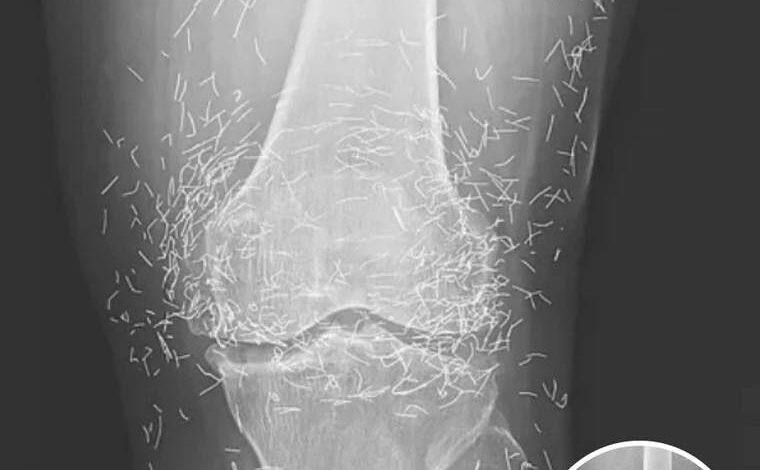
The medical field is no stranger to anomalies, but even the most seasoned radiologists occasionally encounter a case that defies conventional logic. For one sixty-five-year-old woman in South Korea, a standard diagnostic procedure for chronic joint pain turned into a global medical sensation. What appeared on the digital imaging screen was not just the expected wear and tear of a life lived well, but a shimmering, metallic constellation that left her surgical team speechless. Embedded deep within the soft tissue and surrounding the bone of her knees were hundreds of tiny gold needles, a permanent and unintended map of her desperate search for relief.
The patient’s journey into this medical mystery began years earlier with a diagnosis of osteoarthritis. This degenerative condition is a relentless adversary, characterized by the progressive breakdown of the protective cartilage that cushions the ends of the bones. As the cartilage vanishes, bone begins to rub against bone, creating a cycle of inflammation, swelling, and agonizing stiffness that can make even the simplest movements feel like a monumental task. For this woman, the pain had become a constant companion, a dull ache that eventually sharpened into a debilitating barrier to her daily life.
Like many patients suffering from chronic inflammation, she initially turned to the staples of Western medicine. She was prescribed a regimen of high-strength painkillers and non-steroidal anti-inflammatory drugs. However, the relief was fleeting and came at a steep cost. Long-term use of these medications began to erode her digestive health, causing severe stomach complications that forced her to abandon traditional pharmaceutical intervention. Left with few options and a quality of life that was rapidly deteriorating, she turned to the deep-rooted traditions of her culture, seeking solace in the ancient art of acupuncture.
Acupuncture is a cornerstone of traditional Asian medicine, premised on the insertion of hair-thin needles into specific meridian points to balance the body’s energy and trigger natural pain-relieving chemicals. In most modern practices, these needles are inserted and removed within a single session. However, in certain intensive variations of the practice still found in parts of East Asia, the treatment goes a step further. Known as gold thread or permanent needle implantation, the process involves intentionally leaving small fragments of gold within the tissue. The theory behind this extreme method is that the presence of the precious metal provides a localized, continuous stimulation to the nerves and blood vessels, supposedly offering a permanent solution to chronic ailments like arthritis.
While the patient may have felt she was taking a proactive step toward healing, the X-ray told a much more complicated story. To the doctors at the hospital, the image looked less like a medical treatment and more like a localized shrapnel field. The gold needles, numbering in the hundreds, had migrated over time, weaving themselves into the very fabric of her joints. While gold is often considered a biocompatible metal, the sheer volume of foreign material presented a biological minefield that modern medical experts find deeply concerning.
Radiology experts, including professors from leading Western institutions, have pointed out that the human body is not a passive host for foreign objects. The immune system is designed to identify and isolate anything that does not belong. When hundreds of metal slivers are introduced into the tissue, the body’s defense mechanisms kick into high gear. This often results in chronic inflammation, the formation of thick fibrous scar tissue, and in the worst cases, the development of deep-seated infections or abscesses that can be incredibly difficult to treat. Instead of soothing the joint, the “treatment” may have been creating a permanent state of low-level immune provocation.
Beyond the biological risks, the presence of these needles creates a significant barrier to modern diagnostic technology. In an irony not lost on her medical team, the very tools needed to monitor her arthritis were compromised by the needles. Metal fragments can cause “artifacts” or shadows on X-rays, obscuring the fine details of the bone and making it impossible for doctors to see the true extent of the joint damage. More dangerously, the presence of these gold slivers effectively barred her from ever receiving an MRI. The powerful magnetic fields used in MRI machines can cause metallic objects to vibrate or migrate through the body. If those hundreds of needles were to shift, they could act like microscopic scalpels, puncturing blood vessels or severing nerves, turning a routine scan into a life-threatening emergency.
This case, which was eventually documented in the prestigious New England Journal of Medicine, serves as a stark reminder of the cultural divide that still exists in global healthcare. In South Korea and several neighboring nations, these gold implants are often viewed as a legitimate and even prestigious form of therapy for the elderly. For those who feel failed by the side effects of modern drugs, the promise of a “permanent” cure is a powerful lure. However, the scientific evidence supporting the efficacy of leaving metal in the body is almost non-existent. Most Western practitioners view the practice as an unnecessary gamble that complicates the long-term management of the patient’s health.
The story of the South Korean woman is not an isolated one. In the United States, acupuncture has seen a massive surge in popularity, with millions of adults and children seeking out the therapy every year for everything from migraines to back pain. While the overwhelming majority of American acupuncturists follow strict safety protocols and never leave needles behind, the rise of “alternative” medical tourism means that more patients are returning from abroad with these permanent implants. It creates a growing challenge for emergency room doctors and radiologists who may not be familiar with the practice and could inadvertently put a patient at risk by ordering an incompatible scan.
As the patient continues to manage her osteoarthritis, she does so with a body that is now a permanent record of her desperation. The hundreds of gold needles remain, too numerous and too deeply embedded to safely remove without causing catastrophic damage to the surrounding tissue. Her case stands as a cautionary tale for anyone standing at the crossroads of traditional and alternative medicine. It highlights the vital importance of informed consent and the need for patients to understand that “natural” or “traditional” does not always mean “harmless.”
In the end, the woman’s X-ray is a hauntingly beautiful but tragic image. It represents the lengths to which a human being will go to escape the prison of chronic pain. It also underscores the responsibility of the global medical community to bridge the gap between ancient beliefs and modern safety standards. While the gold in her knees may have been intended to buy her a future free of pain, it instead served to highlight the delicate balance between the desire for a miracle cure and the uncompromising reality of human biology. The lesson is clear: in the search for healing, sometimes the most shimmering solutions carry the heaviest price.