I Bought A Rusty 98 Dollar Harley And Found A Hidden List Of Names That Brought A Biker Gang To My Door
At twenty-nine years old, the world doesn’t usually feel like a place of deep, interconnected mysteries. It feels like a series of logistical hurdles. I was living in a state of constant, low-level panic because my car had finally given up the ghost, leaving me stranded in a precarious financial situation. I didn’t need a legacy or a story; I just needed a way to get to my shift on time without spending half my paycheck on ride-shares. That was the headspace I was in when I scrolled past a listing for a ninety-eight dollar Harley-Davidson.
The price was absurd. Even a rusted frame stripped of its engine usually goes for more than that. I assumed it was a scam or a typo, but desperation has a way of making you believe in miracles. I contacted the seller and found myself at a weathered, nameless repair shop on the outskirts of town. The air inside smelled of old grease, cold iron, and tobacco. The man behind the counter was as worn down as the machines he surrounded himself with, his eyes clouded with the kind of fatigue that sleep can’t fix.
He didn’t try to sell me on the bike. He didn’t boast about its horsepower or its history. He looked at me with a piercing intensity, asking only if I had people nearby, if I had family. When I told him I was mostly on my own, trying to make ends meet, he grunted and accepted my ninety-eight dollars. Along with the keys, he handed me a small, yellowed piece of paper folded into a tight square. He told me to keep it with the bike. I was so preoccupied with the logistics of pushing a dead motorcycle two miles to my apartment that I shoved the paper into my pocket without a second glance.
The bike was a mess. It was a skeletal remain of its former glory, covered in a fine layer of orange rust that looked like dried blood in the sunset. It took me hours to get it home, my muscles screaming and my hands stained black. But there was something about the weight of it that felt different from any machine I had ever handled. It didn’t feel like a heap of junk; it felt like a heavy secret.
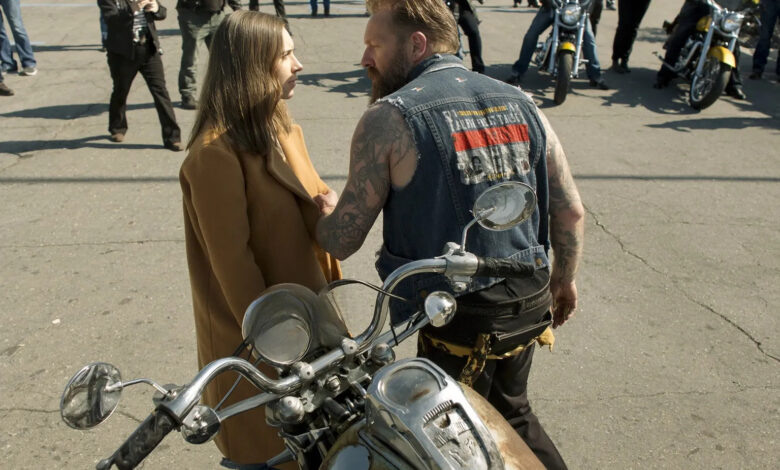
The next morning, I took it to an empty parking lot in Riverside, armed with a basic toolkit and a jug of fresh gasoline, hoping to coax a spark of life out of the engine. I was deep in the mechanical guts of the machine when the atmosphere changed. It started as a vibration in the soles of my boots—a low, rhythmic thrum that grew into a roar. One by one, motorcycles began to pull into the lot. These weren’t weekend warriors on shiny new cruisers; these were grizzled riders on bikes that had seen thousands of miles of asphalt. They didn’t scream or threaten; they simply formed a wide, silent circle around me and my ninety-eight dollar Harley.
A man stepped forward from the pack. His leather vest was covered in patches, but his face was surprisingly gentle. He didn’t ask me where I stole the bike. He didn’t demand I hand it over. He simply pointed at my pocket and asked to see the paper.
I pulled out the folded square and handed it to him. As he unfolded it, the other riders leaned in. The silence was absolute. On that paper, in a cramped, steady hand, were nine names and nine dates. Below them was a hand-drawn symbol—a gear intertwined with a willow branch. I watched as the man’s eyes tracked the list, his jaw tightening as he reached the end.
He didn’t explain right away. Instead, he reached into his own pocket and produced a photograph. It was taken decades ago, featuring a younger version of the man who had sold me the bike. He was standing next to this very motorcycle, looking vibrant and invincible. Surrounding him were nine other men, all laughing, all leaning on their machines. The man in the parking lot pointed to the faces in the photo, then to the names on my list.
“This bike shouldn’t be running,” he told me quietly. “But it’s the only one that survived.”
Years ago, the group in the photo had been on a cross-country run—a brotherhood bound by the road. They had encountered a freak patch of black ice and a failing bridge during a mountain storm. It was a tragedy that made local headlines and broke the heart of the community. Nine riders went down that night. Only one man and one motorcycle made it through the wreckage. The survivor was the man who had sold me the bike for ninety-eight dollars.
He had kept the machine in his shop for years, unable to scrap it but unable to ride it. It was a monument to his fallen brothers, a heavy reminder of the night his life changed forever. But as he grew older, he realized that a monument shouldn’t sit in the dark gathering dust. He wanted it to go to someone who needed it for the right reasons—not someone looking for a vintage project to flip for profit, but someone who truly needed a way forward. By selling it to me for a price I could afford, he was turning a symbol of death into a tool for life.
The riders in the parking lot weren’t there to reclaim the past. They were the remnants of that brotherhood, the ones who had stayed in touch with the old man over the decades. They had seen the listing, and they had come to see who was carrying the torch.
Without a word of instruction, the men dismounted. They didn’t treat me like an outsider; they treated me like a temporary custodian. They spent the next three hours working on the bike with me. They replaced the fouled plugs, cleaned the carburetor with professional precision, and adjusted the chain. They taught me the quirks of the engine, the way it liked to be throttled, and the sounds I should listen for. They were passing on the oral history of the machine, ensuring that the vessel carrying those nine names would stay upright on the road.
When the engine finally turned over, it didn’t just rattle; it roared with a deep, healthy growl that seemed to vibrate through my very bones. The lead rider nodded once, a gesture of silent approval. There were no grand speeches about brotherhood or the sanctity of the road. They didn’t ask for a dime or a favor. They simply told me to keep the rubber side down and to keep moving forward.
As they rode out of the lot, leaving me alone with the idling Harley, the weight of the situation finally hit me. I had bought a motorcycle because I was broke and needed a ride to work. But I had inherited something far more significant. I was riding a piece of history that had been forged in tragedy and preserved by love.
The rust on the fenders didn’t look like an eyesore anymore; it looked like a patina of survival. Every time I kick-start that engine now, I think of those nine names. I’m not a biker in the traditional sense, and I don’t belong to their club, but I understand the responsibility of the path I’m on. We often think we own the things we buy, but some objects are too heavy with the past to ever truly belong to one person. I am just the current driver, carrying a legacy of nine men across the miles, making sure that their story keeps moving, even when the road gets dark.