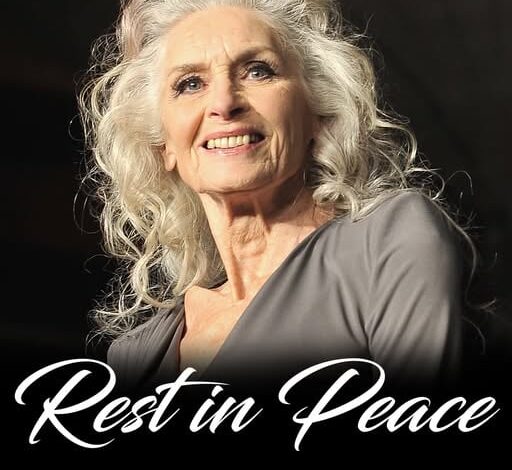
The World Mourns A Legendary Fashion Icon Who Shattered Every Ageist Barrier In The Industry
The fashion industry, a world notoriously obsessed with the fleeting promise of perpetual youth, is mourning the loss of a woman who spent her final decades proving that brilliance has absolutely no expiration date. Daphne Selfe, a name that eventually became synonymous with grace, resilience, and an unwavering commitment to authenticity, has passed away, leaving behind a legacy that fundamentally altered our cultural understanding of aging. She did not merely participate in the fashion world; she dismantled it, piece by piece, simply by refusing to apologize for the passage of time. While many of her contemporaries spent their golden years retreating into the shadows of obscurity, Selfe stepped into the blinding spotlight of the global stage, silver hair flowing, spine perfectly straight, and an expression of serene confidence that silenced every critic who dared to suggest that she had somehow stayed too long at the party.
Daphne Selfe’s journey was far from a traditional ascent to fame. She was first discovered as a young woman of twenty-one in the post-war era, a time when the industry had a very narrow, rigid definition of what a model should be. She worked steadily, finding her footing in an era of classic elegance, but eventually, she made a choice that was, for her time, entirely standard: she stepped away from the cameras to prioritize love, marriage, and the raising of her family. For many, that exit would have been permanent—a closing chapter in a life of glamour that was meant to be stored away in a scrapbook. Yet, life has a way of surprising those who are willing to remain curious, and decades later, the industry that had once sidelined her found itself desperate for something it had forgotten how to cultivate: genuine, lived-in character.
Her return to the limelight in her seventies was not a desperate bid for attention, nor was it an attempt to masquerade as the woman she had been in her youth. It was an evolution. When she walked back onto the scene, she did not arrive with a head full of artificial color or a face pulled tight by surgical intervention. She arrived with the silver hair that nature had granted her and a posture that commanded respect without ever needing to demand it. The world of high fashion, suddenly tired of the hollow, repetitive aesthetic of youth, looked at Daphne and saw something it had been starving for: a story. She possessed a calm, meditative interiority that only comes with surviving the many trials of a long life. She wasn’t just wearing clothes; she was embodying the idea that elegance is not a function of one’s birthday, but a conscious, daily decision.
Her presence on the runways of London Fashion Week and at the prestigious gatherings of Royal Ascot became a powerful, silent protest against an industry built on the fear of becoming invisible. Every stride she took was a rebuke to the pervasive narrative that women must diminish in stature or importance as they get older. She walked with the easy, unhurried rhythm of someone who had long ago stopped trying to impress people who did not understand her value. She navigated the chaotic, often superficial world of high-end modeling with an internal compass that was perfectly calibrated, remaining unfazed by the frantic demands of designers and the endless chatter of the press. She taught us that beauty is not a resource that runs out; it is a quality that deepens, matures, and becomes more textured with every year.
Beyond the glitz of the campaign shoots and the prestigious covers, Daphne Selfe was deeply invested in the smaller, more radical acts of living well. She was an outspoken proponent of the idea that a late-blooming life is just as dazzling—if not more so—than the frantic ambition of one’s twenties. She often spoke about the importance of simple, human joys: a perfectly brewed cup of coffee enjoyed in the company of friends, the necessity of laughter, and the value of maintaining an active, engaged mind. She did not treat her fame as a shield or a trophy; she treated it as a platform to remind people that the most important work of our lives is not done in a studio, but in the way we choose to treat ourselves and our neighbors on a daily basis.
Her legacy is as simple as it is radical. She redefined what it meant to be a professional, what it meant to be beautiful, and what it meant to be a woman of substance in the public eye. She stood as a living argument against the concept of retirement as a state of inactivity or irrelevance. She showed us that you are never finished until you decide that you are. In an industry that thrives on the constant manufacturing of newness, she offered the profound, stable value of maturity. She invited the younger generation of models, designers, and consumers to stop viewing the elderly as a problem to be solved or a demographic to be ignored, and instead to see them as the keepers of the stories and the wisdom that hold our culture together.
As the industry reflects on her life, there is a palpable sense of gratitude for the barriers she shattered. She didn’t just open doors; she took them off their hinges, ensuring that the designers of the future would have to contend with the reality that beauty is expansive, not exclusionary. The women who follow in her footsteps—those who embrace their grey, those who value their wrinkles as a map of their experiences, and those who refuse to let the calendar dictate their ambition—owe a debt to the poise with which she carried herself. She proved that there is power in being exactly who you are, without filters or apologies.
Ultimately, Daphne Selfe was a pioneer of the most essential kind: she changed the way we look at ourselves. She challenged every person who has ever looked in the mirror and wished away a wrinkle or a shadow of age to reconsider the value of their own history. She left behind a world that is slightly more open, slightly more appreciative of the passage of time, and significantly more respectful of the idea that we can be at our most vibrant when we have the least left to prove. She lived a life that was wide, deep, and beautifully honest, and she taught us that the final act can be the most brilliant of all. Her life was not about the race to the finish; it was about the richness of the journey, and the dignity of refusing to turn back the clock. We are all, in some way, beneficiaries of her refusal to be anything other than herself.