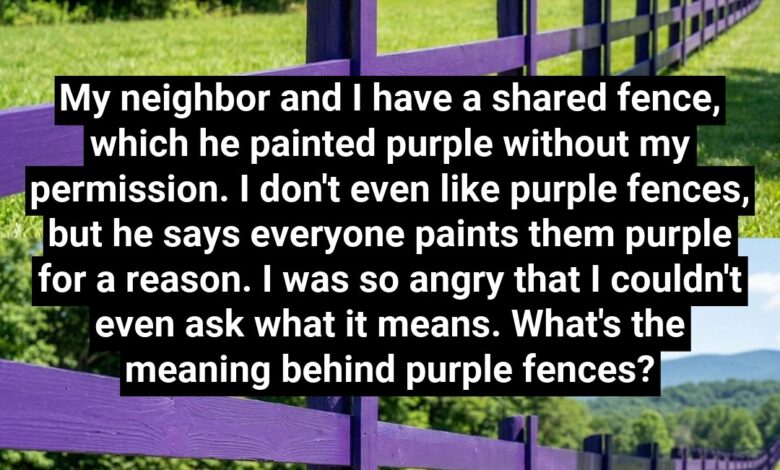
HIDDEN WARNING BEHIND THE PURPLE FENCE REVEALED AS EXPERTS URGE HIKERS AND HOMEOWNERS TO LEARN THE CHILLING LEGAL TRUTH BEFORE IT IS TOO LATE
The great outdoors often feels like a vast frontier of freedom where the only boundaries are the ones set by nature itself. Whether you are an avid hiker seeking the solace of a hidden trail a seasoned hunter tracking game through the dense brush or a weekend wanderer looking for a quiet escape from the digital noise of the city the landscape seems to belong to everyone. However as you traverse the rolling hills and deep forests of the American countryside you may encounter a sight that seems strikingly out of place a splash of vibrant purple paint on a fence post or a vertical stripe of violet on a sturdy oak tree. To the untrained eye this might look like a whimsical choice by an artistic landowner or perhaps a strange forest service marking intended for environmental research. But the reality is far more serious and ignoring these colorful signals could lead to a swift and unpleasant confrontation with the law.
The phenomenon known as the Purple Paint Law is rapidly spreading across various states turning what was once a localized tradition into a powerful legal standard. For decades property owners relied on traditional metal or plastic No Trespassing signs to protect their boundaries. These signs while effective in theory were often plagued by practical issues. They were frequently stolen by vandals shot at for target practice or simply worn down by the unrelenting forces of wind rain and sun. A landowner might spend hundreds of dollars posting their property only to find that within a few months the signs had vanished or become unreadable leaving their land vulnerable to unwanted intruders. The purple fence was born out of a need for a permanent weather resistant and cost effective solution to the age old problem of property protection.
When you spot a painted purple fence you are not just looking at a choice of aesthetic decor you are looking at a legal line in the sand. According to the specific statutes adopted by over a dozen states including Missouri Texas Arkansas and Illinois vertical purple stripes serve as the official legal equivalent of a physical sign. The requirements are often very specific to ensure there is no confusion in the eyes of the court. Typically these markings must be vertical stripes approximately one inch wide and at least eight inches long. They must be placed between three and five feet off the ground and repeated every hundred feet or so along the property line. In some regions the paint must also be applied to trees or posts at every point of entry. To the state these markings are loud and clear messages that say in no uncertain terms that you are not welcome to cross without explicit permission.
The logic behind using the color purple is rooted in practical necessity and historical precedent. Purple is a color that does not occur frequently in the natural forest environment making it stand out even to those who may be colorblind. It remains visible in the dim light of dawn and the fading glow of dusk which are the prime times for hunters and explorers to be active. Furthermore by codifying the use of purple paint into law state governments have provided landowners with a tool that cannot be easily removed or ignored. While a trespasser might claim they never saw a small plastic sign nailed to a tree it is much harder to argue against a series of bright purple stripes that follow the perimeter of a forest.
For hunters hikers and wanderers the implications of the purple fence are profound. In the eyes of the law crossing a purple line is no different than hopping a locked gate or ignoring a neon orange warning sign. You are no longer just exploring or taking a shortcut you are committing a criminal act of trespassing. Depending on the jurisdiction and the circumstances of the entry the penalties can range from a simple fine to a misdemeanor charge that stays on your permanent record. In more extreme cases where the intruder is armed or refuses to leave the consequences can escalate into felony territory. The purple paint serves as a fair warning that the owner intends to prosecute anyone who disregards the boundary.
The shift toward paint based marking also reflects a broader change in how we perceive private property rights in the modern era. As rural areas become more developed and the demand for outdoor recreation grows the tension between public access and private ownership has reached a boiling point. Landowners who may have once been lenient about a neighbor walking through their back woods are now facing increased liability concerns and property damage. By using the Purple Paint Law these individuals are asserting their rights with a permanence that traditional signage could never provide. It is a visual manifestation of the desire for privacy and safety in an increasingly crowded world.
However the burden of knowledge rests squarely on the shoulders of the public. Not every state has adopted these laws and the specific requirements can vary slightly from one border to the next. This creates a patchwork of regulations that can be confusing for those who travel across state lines for outdoor activities. This is why experts and legal professionals are urging the public to educate themselves before heading out into the wilderness. Ignorance of the law is rarely a valid defense in court and assuming that a lack of physical signs means the land is open for public use is a dangerous gamble. If you see purple you should stop and turn back unless you have written consent from the owner to be there.
Beyond the legal ramifications the purple fence also carries a cultural weight. In many rural communities the use of purple paint is a sign of a landowner who is savvy and serious about their property. It commands a level of respect among those who understand its meaning. It is a silent sentinel that stands guard during the harshest winters and the hottest summers never fading and never backing down. For the landowner it offers peace of mind; for the trespasser it offers a final chance to avoid a legal nightmare.
As we move further into 2026 it is likely that more states will join the movement as the benefits of paint based marking become even more apparent. The simplicity of the system is its greatest strength. A single bucket of specialized high durability paint can protect thousands of acres for a fraction of the cost of traditional methods. It is a rare example of a low tech solution effectively solving a high stakes problem in the modern world. So the next time you are out in the woods and you see that unmistakable violet glow on a distant fence post do not mistake it for a random act of graffiti. Recognize it for what it truly is a legal barricade as strong as stone and as binding as any written contract. Respect the purple and you respect the law; cross it and you may find that your simple walk in the woods has just become a very expensive and very public mistake.