THEY MOCKED ME FOR BEING A PASTORS DAUGHTER, UNTIL MY GRADUATION SPEECH LEFT THE ENTIRE ROOM IN SILENCE
For years, I learned how to smile and keep walking.
That was my strategy. Not fighting back. Not explaining myself. Just moving forward like the words didn’t stick. But the truth is, they always did—just quietly, just enough to carry with me.
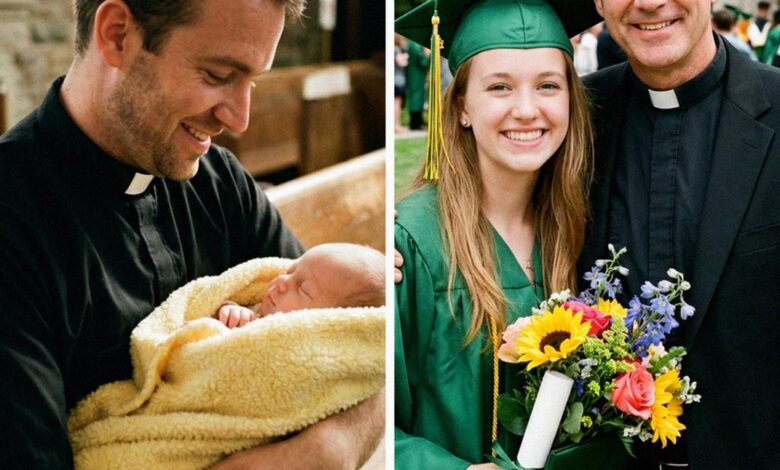
I wasn’t born into the life everyone assumed I had. I didn’t grow up in a perfect home or a picture-perfect family. I was left on the front steps of a church as a baby, wrapped in a yellow blanket, alone before I ever understood what alone meant.
That church became my beginning.
And the man who found me—Pastor Josh—became my father in every way that mattered.
He never told my story like it was something broken. He never made it sound like I had been abandoned. Instead, he would say, “You were placed where love would find you first.” And somehow, he made that feel real. Not like a comforting lie, but like a truth I could build my life on.
He raised me with a kind of steady care that doesn’t demand attention but changes everything. He packed my lunches. Signed every school paper. Sat through every performance, no matter how small. He even taught himself how to braid my hair by reading library books because there was no one else to teach him.
That was my reality.
But at school, it looked different.
By the time I reached middle school, the labels had already found me. “Miss Perfect.” “Goody Claire.” “The church girl.” It wasn’t said with admiration. It was said like a joke—something easy to laugh at.
People asked if I ever had fun, as if my life was something limited, something smaller than theirs. I learned to shrug it off, to act like it didn’t matter. That’s what my dad always encouraged.
“People speak from what they know,” he would say. “You respond from what you’ve been given.”
It sounded simple at home.
It felt different in crowded hallways.
Some days, I carried those comments back with me, like small weights I couldn’t quite drop. My dad always noticed. He didn’t rush me, didn’t brush it off. He listened—really listened—and then reminded me not to let someone else’s misunderstanding shape who I became.
One night, I asked him something I hadn’t said out loud before.
“What if I get tired of always being the strong one?”
He didn’t answer right away. Then he smiled, gently.
“That just means your heart’s been working hard. And that’s nothing to be ashamed of.”
I didn’t fully understand it then.
But I would.
Years later.
On a stage.
In front of everyone.
When graduation came around, I was asked to give the speech. I said yes before I had time to think about it, then spent the next two weeks wondering why I had agreed. I rewrote that speech over and over, trying to get every word right.
My dad listened to every version like it was already perfect.
He made small things feel big.
And I wanted that day to matter—not for me, but for him.
The morning of graduation, he gave me a bracelet. Simple, silver, with a small engraving hidden on the inside.
“Still chosen.”
That one detail said everything.
We arrived at the ceremony together. He was still wearing his pastor’s robe, standing exactly as he always did—steady, proud, completely himself. I was proud to stand next to him.
But not everyone saw it that way.
The comments started before I even reached my seat.
“Miss Perfect finally showed up.”
“Don’t make it boring.”
Laughter followed.
The same kind of laughter I had heard for years.
I told myself I could ignore it.
But something felt different that day.
When I walked toward the stage, I heard one last comment behind me.
“She’s going to sound like a sermon.”
That was it.
Not louder than before. Not worse than before.
Just enough.
I reached the podium, looked at the speech I had prepared—and set it aside.
Because for the first time, I didn’t want to say what was expected.
I wanted to say what was true.
“It’s interesting,” I began, “how people decide who you are without ever asking.”
The room went quiet.
I repeated the names I had heard for years. The labels. The assumptions. Then I told them what they didn’t know.
That I went home every day to a man who chose me.
That I wasn’t raised by circumstance—I was raised by love.
That while they were defining me from the outside, I was living something they had never taken the time to understand.
I told them about my father.
About how he showed up for everything.
About how he gave me a life filled with care, not obligation.
About how he never made me feel like I had less—only that I had something rare.
And then I said the part I had never said out loud before.
“I was never the one with less.”
That moment changed everything.
Not dramatically.
Not with applause.
Just silence.
The kind of silence that means people are finally listening.
I finished, walked off the stage, and didn’t look back.
No one laughed.
No one made another comment.
For the first time, the room felt different.
When I found my dad, his eyes were red, his expression caught somewhere between pride and something deeper.
“I’m sorry if I embarrassed you,” I said.
He looked at me like that was the last thing on his mind.
“You honored me,” he said.
That was it.
That was all that mattered.
Later, someone from my class approached me, trying to explain, trying to say they didn’t realize.
I looked at them and said something simple.
“That’s the point.”
Because it was.
They didn’t know.
And they never asked.
But I didn’t need them to anymore.
Because for the first time, I didn’t feel like I had to explain myself.
I had already said everything that mattered.
On the drive home, I looked at my bracelet again.
“Still chosen.”
And I realized something.
Some people spend their whole lives trying to figure out where they belong.
I never had to.
Because love found me first.