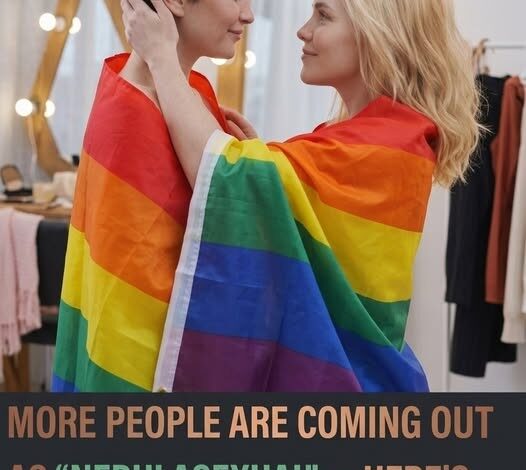
The Shocking Truth About The Strange New Label People Are Using To Define Their Sexuality
As our collective understanding of human identity continues to evolve and deepen in profound ways, new terms and concepts frequently emerge to describe complex personal experiences that traditional labels simply cannot capture. In today’s rapidly changing world, the way we define ourselves and our connections to others is constantly being rewritten to match the richness of human diversity. One fascinating term that is rapidly gaining immense traction and sparking intense debate across the internet is nebulasexual. This unique identity is closely connected to neurodivergence and the frequently confusing and unclear experience of human attraction. As conversations surrounding sexuality, romantic orientation, and gender become significantly more nuanced in modern society, a growing number of individuals—particularly those who identify as neurodivergent—have found that existing, conventional categories do not accurately or adequately reflect how they experience deep personal connection or romantic desire. This disconnect has driven an unprecedented search for new language that validates the complex ways different brains process attraction. It marks a significant shift in how we approach human psychology and emotional availability.
The Meaning Behind The Nebula
The concept of nebulasexuality has been widely discussed within specialized online communities and dedicated advocacy spaces such as Autism Nottingham. Within these groups, it has been systematically described as falling under the broader, more inclusive quoisexual umbrella. The fascinating term draws its primary inspiration from the word nebula, which refers to a massive, cloudy, or unclear expanse of gas and dust in space. This cosmic metaphor perfectly reflects the deep difficulty some neurodivergent individuals face when attempting to distinguish between different types of attraction.
For people living with neurodivergent conditions such as attention deficit hyperactivity disorder (ADHD), autism spectrum disorder (ASD), or obsessive-compulsive disorder (OCD), neurological differences can profoundly blur the distinct lines between sexual, romantic, aesthetic, and even intrusive thoughts. These neurological variations make attraction much harder to define and categorize using conventional, black-and-white terminology. Instead of fitting neatly into the boxes of homosexual, heterosexual, or asexual, these individuals experience attraction as a misty, ill-defined nebula that defies easy categorization.
Understanding The Spectrum Of Attraction
To fully grasp what it means to be nebulasexual, one must look beyond the standard frameworks of desire that have governed society for decades. It is vitally important to note that nebulasexuality is not framed as simple confusion or a temporary questioning phase. Rather, it describes an ongoing, deeply felt psychological state in which a person may strongly desire deep emotional intimacy or committed relationships but cannot clearly identify whether they experience sexual attraction itself.
Some individuals sharing their stories on online forums explain that they experience intense emotions or noticeable physical responses without being able to neatly categorize or label them. Others describe feeling neither a strong, overwhelming desire nor a complete aversion to physical intimacy. Instead, they report feeling a profound sense of neutrality while still deeply valuing emotional connection, shared experiences, and companionship. This experience highlights the vast difference between sexual attraction and the desire for emotional intimacy, showing that the two do not always align in the way that societal norms dictate.
The Neurodivergent Intersection
Neurodivergent individuals from all walks of life have come forward to share that having a specific label for their experience offers them immense psychological validation. For many people living with ADHD, the phenomenon of intense hyperfixation can significantly complicate the way attraction is processed. It can make it difficult to determine whether a strong interest is a temporary fixation or genuine romantic attraction.
Meanwhile, those who experience OCD may struggle daily to separate intrusive thoughts from their true, authentic feelings, leading to severe anxiety about what their desires actually mean. In these highly specific contexts, the term nebulasexual provides much-needed language that dramatically reduces feelings of isolation. It counteracts the damaging notion that these individuals are somehow broken or abnormal, instead affirming that neurological differences shape human experience in unique, beautiful, and valid ways. This linguistic tool empowers people to communicate their boundaries and their feelings more effectively to their partners.
The Debate And Skepticism
However, like many newly emerging identity terms and concepts, the nebulasexual label has faced significant skepticism and criticism from both inside and outside the neurodivergent community. Some critics question whether such an extensive number of additional labels are truly necessary for everyday communication, arguing that it complicates a landscape already filled with nuanced terminology.
They suggest that the experience may simply reflect a natural, universal uncertainty that many young people experience during the process of self-discovery and personal growth. Broader debates concerning the definitions of gender and sexuality—often fiercely discussed on platforms like Quora—continue to highlight the ongoing, fundamental shifts in how society distinguishes between biological sex and socially constructed gender roles. Despite this pushback, advocates argue that giving names to these experiences helps people find their place in the world, fostering a sense of belonging and community that was previously inaccessible to them.
Looking To The Future
As global visibility and acceptance grow, the concept of nebulasexuality contributes to a much broader and more comprehensive conversation about how attraction can vary drastically across different neurological experiences. For many individuals who adopt this label, the ultimate goal is not to unnecessarily complicate the discussion of identity, but rather to find the perfect, accurate language that reflects their personal reality.
By understanding and embracing these nuanced expressions of attraction, society can move closer to a world where every individual feels seen, heard, and respected, regardless of how their brain processes the world around them. The ongoing dialogue surrounding these alternative frameworks of attraction proves that human emotion is incredibly diverse and defies any single definition.