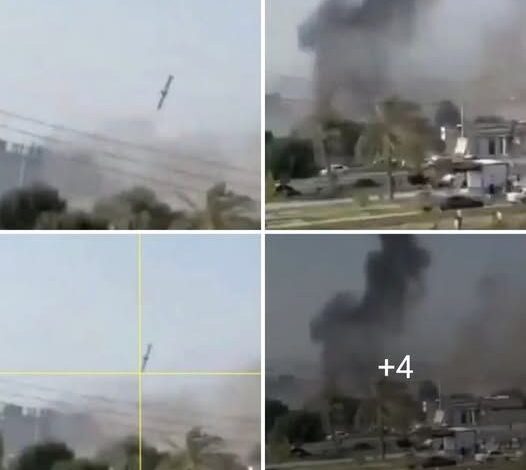
TERRIFYING SKY STRIKE NEAR GIRLS SCHOOL LEAVES NATION IN SHOCK AND WORLD LEADERS DEMANDING IMMEDIATE ANSWERS
The quiet morning in Minab was shattered by a sound that no community should ever have to hear. In an instant, the peaceful atmosphere of this southern Iranian city in Hormozgan Province was replaced by a deafening roar and the terrifying sight of smoke billowing into the sky. The target of this sudden and violent disruption was not a military outpost or a government installation but the immediate vicinity of a girls school. As the dust settled and the screams of panicked students filled the air, it became clear that the world was witnessing a catastrophic event that would have far reaching consequences for regional stability and international human rights. This was not just an explosion; it was a direct assault on the sanctity of an educational institution, leaving a trail of shattered glass, broken walls, and a community scarred by trauma.
Initial reports from the scene painted a harrowing picture of the immediate aftermath. The blast was powerful enough to shake buildings several blocks away, sending residents running into the streets in a desperate attempt to find safety or search for their loved ones. Emergency responders, including firefighters and medical teams, raced through the narrow streets of Minab to reach the impact zone. Their priority was the school building, where students had been in the middle of their lessons when the strike occurred. While official numbers are still being verified, local medical sources have confirmed that several individuals suffered injuries, including young students who were struck by flying debris and shattered glass. The school, which should have been a sanctuary for learning, was transformed into a site of chaos and medical emergencies within seconds.
In the digital age, news of such a magnitude travels faster than the emergency services can arrive. Almost immediately, the internet was flooded with grainy footage and frantic social media posts. Among the wave of digital speculation, one particular theory gained significant traction: the claim that the weapon responsible for the carnage was a Raduga Kh 55. This long range cruise missile, a relic of the Cold War era designed by the Soviet Union, is a weapon of immense destructive power. Capable of flying at low altitudes to evade radar and carrying a significant payload, its alleged presence in a civilian area like Minab raised the stakes of the incident exponentially. However, military analysts and defense experts have issued stern warnings against jumping to conclusions. The identification of such a complex piece of military hardware requires more than a smartphone video; it requires a meticulous forensic investigation of the impact site and the recovery of specific missile fragments.
The Raduga Kh 55 is not a common tool of local conflict. It is a strategic air launched cruise missile traditionally associated with major military powers and high level strategic operations. If such a weapon was indeed involved, it would suggest a level of escalation that the region has not seen in recent years. This type of missile is designed for precision strikes over vast distances, making its impact near a schoolhouse either a terrifyingly precise act of aggression or a catastrophic failure of guidance systems. Because of these stakes, international investigators are looking for physical evidence like turbine engine components, specific alloy fragments, or guidance system boards that could definitively link the blast to a specific weapon system. Until that evidence is laid bare, the world remains in a state of anxious uncertainty.
The process of uncovering the truth in Minab will be long and arduous. Investigating a missile strike is a multidisciplinary effort that involves ballistics experts, structural engineers, and intelligence analysts. They must document the exact crater dimensions, analyze the blast pattern to determine the direction of the strike, and scour the area for every scrap of metal that survived the heat of the explosion. This forensic trail is the only way to bypass the propaganda and misinformation that inevitably follows such a tragedy. Furthermore, satellite data and radar logs from the moments leading up to the explosion will be crucial in determining where the object originated and what path it took through the sky. Without this transparency, the incident in Minab risks becoming another unsolved mystery in a region already plagued by hidden agendas.
Beyond the technical questions of ballistics and missile types lies a much deeper and more painful reality: the violation of civilian safety. Under international humanitarian law, schools are recognized as protected spaces that must be kept far from the reach of military conflict. The fact that an explosion of this magnitude occurred during school hours, while children were at their desks, has ignited a firestorm of international condemnation. Human rights organizations and global observers are emphasizing that the protection of children is a non negotiable priority. When a school building is damaged and its students are hospitalized, the fundamental social contract between a government and its people is tested. The psychological impact on the survivors in Minab cannot be overstated; for many of these girls, the school will no longer feel like a place of growth, but a place of vulnerability.
International reactions were swift and multifaceted. Governments from around the globe issued diplomatic statements expressing grave concern and calling for a transparent, impartial investigation. There is a collective demand for clarity, as the world recognizes that an unaddressed strike on a school can set a dangerous precedent for future conflicts. Humanitarian groups are already mobilizing to provide support, not just in terms of physical reconstruction of the damaged buildings, but also in providing mental health services for a generation of students now dealing with the symptoms of post traumatic stress. The international community is watching Minab closely, knowing that the way this investigation is handled will signal whether the world still values the lives of innocent civilians in the face of geopolitical maneuvering.
For the local community in Minab, the recovery process is just beginning. Community leaders have been working tirelessly to comfort grieving and terrified families, while local authorities assess whether the structural integrity of the school allows for eventual reopening. The physical damage to the neighborhood, characterized by shattered storefronts and debris strewn streets, serves as a constant reminder of the morning the sky fell. There is a palpable sense of unease as parents wonder if it is safe to send their children back to any classroom. This erosion of trust is perhaps the most lasting damage of all. While the buildings can be repaired and the glass replaced, the sense of security that once defined this city has been fundamentally altered.
The spread of unverified information continues to be a major challenge in the wake of the blast. Social media platforms have become a digital battlefield where various factions attempt to control the narrative by blaming different actors or claiming knowledge of secret motives. Experts warn that this “fog of war” is often used to obscure the truth and radicalize public opinion. They urge the public to remain patient and rely on verified reports from established investigative bodies. In an era of deepfakes and rapid fire misinformation, the truth is often the first casualty of an explosion. Responsible reporting and a commitment to evidence based conclusions are the only tools available to combat the wave of rumors currently sweeping through the digital world.
As we look ahead, the findings of the investigators in Minab will likely shape the geopolitical landscape of the Middle East for months to come. If the blast is found to be a military strike, the questions of intent and origin will dominate international summits. If it is found to be a tragic accident or a technical failure, it will raise serious questions about military safety and the proximity of weapons testing to civilian centers. Regardless of the final report, the incident in southern Iran remains a stark reminder of the fragility of peace. The world stands with the students of Minab, hoping for their swift recovery and demanding a future where schools remain places of light, learning, and absolute safety.