Internal Affairs Captain Becomes The Target Of The Most Dangerous Cop In The City
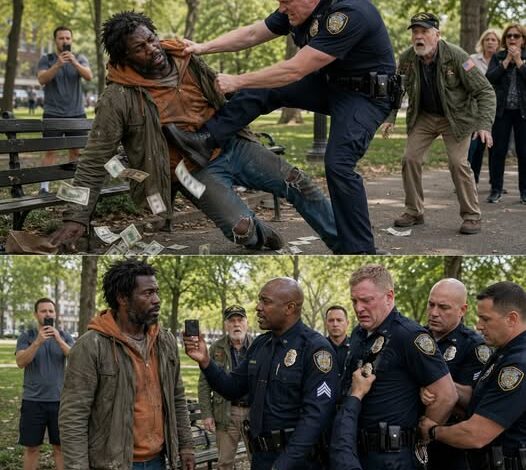
The air in Morrison Park was thick with the smell of damp earth and diesel exhaust, but for six days, I had known only the scent of the grime on my own skin. To the world, I was just another shadow on a bench, a nameless man wrapped in a threadbare blanket that smelled of woodsmoke and neglect. I was invisible. That was the point of the assignment. To most, I was a nuisance to be ignored; to Officer Walsh, I was a target.
Walsh didn’t move at first when I spoke. The words seemed to hover in the cold morning air, refusing to settle. His grip on my collar tightened, his knuckles white against the dark leather of his gloves. He leaned in so close I could see the broken capillaries in his eyes and the flickers of a man who believed his badge was a shield against any consequence. He asked what I had said, his voice dropping to a dangerous, controlled low. It wasn’t the sound of a man seeking clarity; it was the sound of a predator wondering if the prey had finally grown teeth.
I coughed, a calculated move to buy a second of composure. Hidden within the coarse weave of my blanket, a pinhole camera remained steady, tracking every micro-expression on his face. I repeated the words, forcing my voice to remain level and devoid of the fear he expected. I told him that Internal Affairs had been watching him. The shift in the atmosphere was instantaneous. Behind him, Officer Carter finally looked up from the pavement, his face pale. Officer Lopez froze mid-step. The certainty that usually radiated from Walsh like a physical heat began to crack.
He tried to reclaim the narrative, shoving me backward with enough force to send me sprawling. He barked the word resisting at the top of his lungs, a practiced reflex designed to justify the violence that was supposed to follow. He was already rewriting the scene for a police report that would never be filed. He turned to the few bystanders, including a jogger who had slowed to a crawl, and ordered them to back up, claiming this was official police business. I stayed on the ground, playing the part of the broken man I had been for nearly a week. I watched him reach for his handcuffs, his movements jerky and fueled by a rising, panicked instinct.
When he ordered me to put my hands behind my back, I didn’t move. I simply reached into the inner lining of my coat. Walsh tensed, his hand hovering over his holster, but I moved with a slow, deliberate calmness that stopped him in his tracks. I pulled out the gold shield. It caught the morning sun, casting a sharp glint across the dirt where my meager belongings lay scattered. I introduced myself as Captain Jonathan Rivers of the Internal Affairs Division.
The silence that followed was heavy. It was the kind of silence that made the distant hum of city traffic sound like a roar. Walsh stared at the badge, then at my face, then back at the badge. The reality of the situation began to bleed through his bravado. He claimed it was a joke, a desperate hope that this was some elaborate prank, but I pointed to the seam in the blanket. I told him about the cameras. Three angles. High definition. Direct stream to a secure server.
For six days, I had documented a reign of terror that would make a seasoned veteran sick. On Monday, I watched him threaten a homeless man with an existential erasure. On Tuesday, he destroyed a woman’s only possessions because her presence offended his sense of aesthetics. On Wednesday, he shoved an elderly man into the dirt for the crime of wasting oxygen. And today, he had kicked me in the ribs and ordered me to crawl for his amusement. As I listed his crimes, Walsh’s shoulders slumped. The fear in his eyes was palpable now. He tried to argue that I didn’t understand how things worked on the street, that these people lied and complained. I told him they existed, and that was enough.
I pulled out my phone and called for a supervisor unit. I didn’t do things halfway. I had given him every opportunity to show a shred of humanity, to act like a peace officer instead of a tyrant. He had failed every single test. The sirens began as a faint wail in the distance, growing louder until they dominated the park. Lopez, the officer who had spent the week looking away, stepped forward to perform the arrest. He moved with a sudden, sharp clarity, as if the weight of his own silence had finally become too much to bear. The sound of the handcuffs clicking shut was the most honest thing I had heard in six days.
When the supervisor arrived, the scene was already settled. There were no shouts, no struggle. Walsh was led away in a daze, looking back at the bench one last time. For the first time in his career, he looked at that piece of wood and iron as something that mattered, rather than just a place to exert his will. It was too late for reflection. The evidence was already being cataloged and timestamped.
Carter and Lopez approached me afterward, their voices small and thick with a mix of shame and relief. They tried to explain their silence, their complicity. I didn’t offer them an easy out. I told them that their inaction was a fundamental part of the investigation. It wasn’t just about the one man who pulled the trigger or swung the boot; it was about the culture that allowed him to believe he was untouchable. They promised to give full statements, and I believed them. They knew the cameras had seen them, too.
As I stood there brushing the park grime from my coat, I looked at the jogger who had stayed to film the encounter. He admitted he had almost kept walking. I told him that his decision to stay mattered more than he knew. Power reveals its true face in the dark, in the corners of society where people think no one is watching. It thrives on the belief that some lives are worth less than others. Walsh believed he was the master of a kingdom of shadows, but he forgot that shadows only exist when there is a light nearby.
The case wouldn’t be decided by long-winded legal arguments or complex character witnesses. It was decided the moment he swung his foot into the ribs of a man he thought was a nobody. The footage was raw, undeniable, and permanent. In the quiet of the Internal Affairs office later that evening, as I watched the playback of the week, I realized that the badge didn’t give me the power to stop him. The power came from the willingness to sit in the dirt and see the world through the eyes of the people he had spent years trying to erase. Walsh thought he was invisible because of his authority, but I was the one who truly disappeared, and that was why he never saw the end coming.