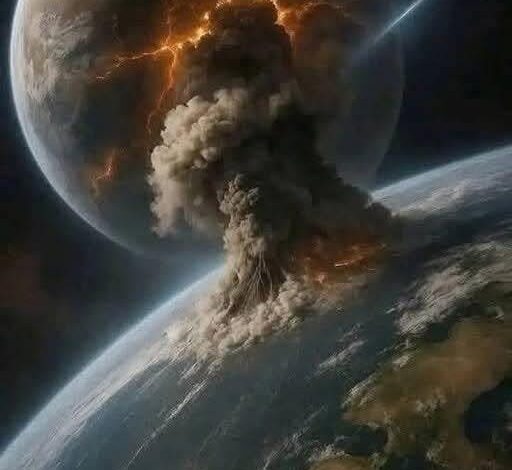
Giant Space Rock 52768 Just Brushed Past Earth and Scientists Say We Are Not Ready for What is Coming Next
In the vast, silent theater of the cosmos, the most terrifying actors are often the ones that move without sound or light. They do not announce their presence with a roar; they simply exist, drifting through the vacuum with the cold, indifferent precision of a clockwork mechanism. One such actor bears a name that sounds more like a dusty catalog entry in a government basement than a global catastrophe: 52768 (1998 OR2). It is a titan of stone and ice, stretching between 1.5 and 4 kilometers in width—a mountain of dead matter hurtling through the dark. On Earth, teams of astrophysicists and planetary defense specialists track its every wobble, calculating its trajectory down to fractions of a second. This time, the verdict is a sigh of relief that echoes across the scientific community: this one will miss. The math has been checked, the orbits recalculated, and the data verified. There will be no blinding flash of light, no atmospheric shockwave to level forests, and no global winter. We are safe for now.
Yet, as 52768 glides harmlessly past our orbit, its proximity slices open a deep and unsettling realization that we often choose to ignore. Our entire species, with all its art, history, technology, and ambition, lives at the absolute mercy of what we can detect in time to stop. We exist on a small, fragile blue marble in a shooting gallery of celestial debris. While we congratulate ourselves on the “no danger” press releases that accompany these flybys, the reality beneath the surface is much more precarious. Our protection is not a physical shield; it is a thin web of detection networks, fluctuating funding cycles, and the inconsistent political will of a species prone to short-term thinking. We are defended by telescopes that can only see so much and by budgets that are often the first to be cut in times of earthly crisis.
The passage of an object as large as 52768 serves as a chilling reminder of the scale of the universe versus the scale of our defenses. If an object of this size were to strike, it would not just be a local disaster; it would be a planetary reset button. The energy released would be equivalent to billions of tons of TNT, throwing enough soot and debris into the stratosphere to blot out the sun for years, collapsing agriculture and plunging civilization into a desperate struggle for survival. The fact that this particular asteroid is missing us is not a victory of human defense, but a stroke of mathematical luck. The indifferent physics of the universe simply dictated that our paths would not cross this Tuesday. But physics is never static, and the gravitational dance of the solar system is constantly shifting.
Today, the data appearing on the monitors at NASA’s Jet Propulsion Laboratory is comforting. The green lines indicating orbital paths remain clear of our little blue dot. But tomorrow, or a decade from now, a different blip may appear. It might be smaller—perhaps only the size of a city block—but traveling at such extreme velocities that it evades our current infrared surveys until it is weeks, or even days, away. It might come from the direction of the sun, hidden in the glare where our telescopes struggle to peek. The question that hangs over every reassuring news cycle, the one that scientists whisper in the hallways but rarely state during a televised interview, is the one that keeps planetary defense officers awake at night: what happens when the answer quietly changes?
The infrastructure of our survival is surprisingly thin. We rely on the Near-Earth Object (NEO) Observations Program, a network of ground-based telescopes and a few aging space-based sensors to act as our eyes in the dark. While these systems are marvels of human ingenuity, they are far from exhaustive. There are hundreds of thousands of objects out there that we have yet to categorize, “dark” asteroids that reflect very little light and move against the black backdrop of deep space like charcoal in a dark room. Each time a known entity like 52768 makes its approach, it highlights the gaps in our knowledge. We celebrate the miss, but we rarely discuss the “near-misses” we didn’t see coming until they were already retreating into the distance.
Furthermore, the gap between detection and deflection is a chasm we have only just begun to explore. Missions like DART have shown that we can, in theory, nudge a small moonlet out of its path, but scaling that technology to handle a multi-kilometer behemoth like 1998 OR2 is a different challenge entirely. It would require decades of lead time, massive international cooperation, and a level of technical precision that currently exists only on the drawing boards of aerospace engineers. We are currently in a race between our technological evolution and the statistical inevitability of an impact. The math is on our side for the moment, but the clock is ticking.
There is a psychological comfort in the “catalog entry” names given to these threats. By labeling a world-ender as 52768, we strip it of its mythic power and turn it into a manageable data point. It becomes a problem for the experts, a headline for the morning news, and a curiosity for amateur astronomers with backyard telescopes. This clinical approach allows us to go about our daily lives—going to work, paying bills, arguing over politics—without the paralyzing fear that the sky could fall at any moment. But this comfort is a double-edged sword. It breeds a sense of complacency that makes the funding for next-generation space telescopes seem like a luxury rather than a necessity. We treat planetary defense like an insurance policy we hope we never have to use, forgetting that in this case, if we don’t have the policy, there is no one left to pay out the claim.
As 52768 (1998 OR2) recedes back into the cold depths of the outer solar system, it leaves behind a world that is unchanged but for a slightly higher degree of awareness. We have been reminded that we are part of a much larger, much more indifferent system. The “all clear” has been sounded, and the telescopes are already turning their lenses toward the next potential visitor. We live in the interval between impacts, a period of grace that has allowed humanity to flourish. However, the history of our planet is written in craters and extinction events. The Earth bears the scars of previous encounters that were not “misses.” Those scars are silent witnesses to the fact that the math eventually changes.
The next object to appear on our screens might not be a catalog entry we have tracked for decades. It might be a new arrival, a nameless visitor from the Oort Cloud or a fragmented comet. When that day comes, the press releases will be shorter, and the tone will be different. Our survival as a species may one day depend on whether we spent our time of grace wisely—whether we built the eyes to see the dark and the hands to move the mountains of the sky. Until then, we watch the monitors, we check the math, and we hope that the indifferent precision of the universe continues to look the other way. For now, the night remains clear, the sun rises as expected, and the great stone mountain passes us by in the dark, a silent reminder of how much we have to lose and how little it would take to lose it all.