The Viral Image That Proves We Have Lost The Ability To Distinguish Fact From Our Own Political Fantasies
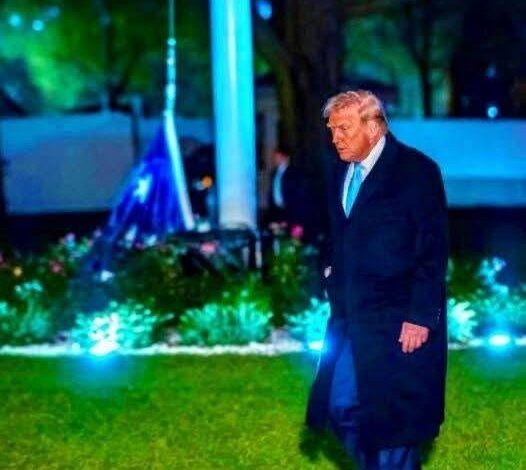
In the fractured ecosystem of modern political discourse, the truth has become a secondary concern, easily discarded in favor of whatever narrative best confirms our pre-existing biases. A recent, grainy image of Donald Trump, captured in the dim light of late-night uncertainty, provided a stark demonstration of this phenomenon. The photograph, which showed him clutching an unidentified, mysterious object, served as the primary spark for a wildfire of speculation that engulfed the internet within minutes of its release. By the time the sun had fully risen, the actual reality of what he was holding had become entirely irrelevant. The true story was not the object itself, but the speed, ferocity, and utter lack of restraint with which millions of people rushed to complete the narrative, projecting their own anxieties and desires onto an ambiguous series of pixels.
This event was a perfect microcosm of our current reality. Within the digital echo chambers of social media, the image became a psychological Rorschach test. Those who view the former president as a looming threat saw evidence of a sinister plot or a coded signal to his followers. Those who view him as a misunderstood crusader saw a symbol of secret strength or a token of a private battle being waged on behalf of the people. Even those who looked at the photo and saw absolutely nothing of significance were drawn into the fray; their indifference was quickly weaponized by both sides to accuse them of either being blind to the danger or dismissive of his importance. In this environment, neutrality is an impossibility, and every reaction—even the absence of one—became ammunition in a narrative war that was unfolding in real time.
The photo functioned as a mirror, but it did not reflect the objective reality of that night. Instead, it reflected the private fears, the deep-seated grudges, and the wildest fantasies that the American public currently carries in its collective subconscious. Comment threads across various platforms transformed into digital confessionals, where users did not offer analysis, but rather revealed their own political pathologies. One might find a thread debating the precise dimensions of the object, only for that conversation to devolve into a sprawling, vitriolic debate about the future of the republic. The medium was the message, and the message was that we are no longer interested in investigating reality; we are only interested in finding pieces of evidence that can be fashioned into the weapons we use against our ideological opponents.
Cable news panels, ever hungry for content that stimulates emotional engagement, treated this speculation as if it were forensic evidence. Experts were brought on to analyze the lighting, the grip, and the historical context of similar gestures, all while ignoring the most basic principle of journalism: verification. By treating conjecture as fact, these platforms validated the public’s impulse to jump to conclusions, turning a moment of ambiguity into a centerpiece of a twenty-four-hour news cycle. Every zoomed-in, heavily pixelated detail was heralded as definitive proof of a larger, darker agenda, even when it proved absolutely nothing at all. The more blurred the image became through successive cropping and filtering, the more “truth” people claimed to see in it.
In the midst of this chaotic, digital storm, a darker and more unsettling realization began to settle in: the real danger was not whatever he was holding in his hand. The true threat was how incredibly eager we have become to believe our own invented versions of reality, and how quickly we have mastered the art of mistaking the loudest, most sensationalized story for the truest one. We have reached a point where the shared baseline of objective reality has eroded, replaced by a hyper-personalized version of the world where facts are optional and feelings are sovereign. This is not just a problem for political junkies or internet trolls; it is a fundamental challenge to the stability of a democratic society that relies on a common understanding of events to function.
When we prioritize the speed of our reactions over the accuracy of our observations, we forfeit our capacity for critical thought. The urgency to be the first to “crack the code” of a viral image often overrides the patience required to wait for context. This desperation to be right—or at least to be on the winning side of a trending topic—is a symptom of a society that is fundamentally exhausted by the complexity of truth. It is easier to believe in a clear-cut villain or a flawless hero than it is to accept that most events are mundane, messy, and lacking in dramatic significance. The mysterious object in the photo was likely something entirely ordinary, perhaps a phone, a document, or even just a trick of light and shadow, but that mundane explanation could never compete with the vibrant, horrifying, or heroic stories that the public had already committed to memory.
This cycle of reactionary behavior has profound consequences. When we are conditioned to view every image, every gesture, and every word through a lens of hyper-partisan interpretation, we lose the ability to speak to one another across the divide. We begin to exist in different universes, governed by different rules and supported by different sets of “facts.” The tragedy of this moment is that we are collectively training ourselves to see the world not as it is, but as we fear it to be. The viral image of the former president was just one instance in an endless stream of digital triggers, but it provides a necessary pause for reflection.
As we move forward, we must ask ourselves what we are losing in this pursuit of narrative dominance. We are losing the ability to wait. We are losing the ability to say, “I do not know.” We are losing the ability to be wrong without feeling that our entire worldview is under attack. The next time a mysterious image begins to circulate, the most radical act one could perform is to simply look away, to refrain from sharing, and to acknowledge that we do not have enough information to form a judgment. Yet, given the architecture of our current digital landscape, that feels like an increasingly impossible task. We are caught in a feedback loop of our own design, fueled by an insatiable hunger for drama and a dwindling capacity for the quiet, difficult work of verifying the truth. The story of the night, and the object held in the hand, will eventually be forgotten, but the precedent we are setting—where our own invented versions of reality are more valuable than the truth itself—is a legacy that will continue to haunt us long after the pixels have faded from our screens.