The Unexplained Hospital Visitor Who Left Doctors Baffled and Patients questioning Reality
In the sterile, fluorescent-lit corridors of modern hospitals, logic and science are the reigning monarchs. Every heartbeat is tracked by a digital pulse, every breath is measured by a sensor, and every person who enters or exits a room is caught by the unblinking eye of a security camera. Yet, amidst the cold efficiency of medical charts and antibiotic drips, there are moments that defy the boundaries of the known world. For one woman, a routine stay in a recovery ward turned into a profound confrontation with the impossible, leaving behind a mystery that would haunt her long after her physical wounds had healed. It began as a battle with a crushing sense of isolation, but it ended with a revelation that kindness might sometimes originate from a place beyond our physical reach.
Loneliness in a hospital is a visceral, heavy thing. It is a weight that clings to the skin like a second blanket, cold and suffocating. For days, her world was reduced to the rhythmic, mechanical beeping of monitors and the predictable rotation of the nursing staff. The daylight hours were a blur of check-ups and bland cafeteria trays, but the nights were different. At night, the hospital changed. The bustle of the day faded into a hollow, echoing quiet, and the sterile lights seemed to cast longer, sharper shadows. It was during these hours that fear would settle in—a creeping anxiety about the future, the fragility of the body, and the realization of how small one person feels in the vast machinery of a medical institution. She felt like a ghost drifting through her own life, waiting for a signal that she still mattered to the world outside those white walls.
Then, during the deepest part of the night, when the silence felt most oppressive, the door to her room creaked open. There was no rush, no urgency of a medical emergency. Instead, a gentle stranger stepped into the soft glow of the nightlight. His presence was immediately calming, radiating a sense of stability that seemed to anchor the room. He didn’t wear the traditional scrubs of the surgical team or the lab coat of a specialist. Instead, he moved with a quiet, unassuming grace that felt almost like a rescue from the depths of her despair. He sat by her bed, and for the first time in days, the air in the room felt breathable.
He spoke with a voice that was calm and melodic, a stark contrast to the clipped, professional tones of the daytime staff. He didn’t ask for her insurance information or her pain levels on a scale of one to ten. Instead, he simply talked to her. He spoke of the world outside—of the way the wind moved through the trees and the simple beauty of a morning sun. He listened as she poured out the fears she hadn’t dared to voice to her family or her doctors. He heard her without judgment, his steady gaze providing a sanctuary for her vulnerability. In those moments, the weight pressing on her chest began to lift. She wasn’t just a patient in bed 402 anymore; she was a human being seen and heard.
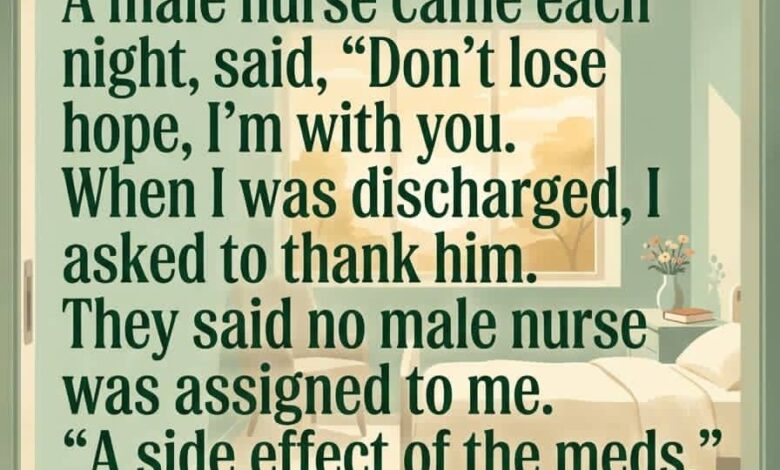
As her health improved and the day of her discharge approached, she mentioned the kind visitor to her primary nurse. She wanted to ensure that he was thanked for his extraordinary bedside manner, for the way he had sustained her spirit when it was at its lowest. However, the nurse’s reaction was not what she expected. The nurse paused, her brow furrowed in confusion as she checked the night-shift logs. There had been no male nurses on that floor during the week. There were no volunteers scheduled for late-night visits, and security protocols strictly prohibited unauthorized guests after visiting hours. The staff insisted that no such person had been in the wing.
The medical team offered the usual clinical explanations. They spoke of the side effects of pain medication, the psychological impact of prolonged sleep deprivation, and the mind’s tendency to create vivid hallucinations under extreme stress. Their logic was neat, orderly, and entirely unsatisfying. They treated the event as a symptom to be noted rather than an experience to be honored. To them, it was a glitch in the brain; to her, it was the most real thing she had experienced in years. She left the hospital clutching her discharge papers and her prescriptions, but her mind remained anchored in that darkened room, trying to reconcile the vivid memory of the man’s face with the clinical insistence that he never existed.
The skepticism of the world has a way of eroding our own certainty. In the weeks that followed her return home, she began to wonder if the doctors were right. Perhaps the brain, in its desperate need for comfort, had simply hallucinated a savior. She started to classify the memory as a beautiful but ultimately imaginary dream—a trick of the light and the chemistry of recovery. She began to move on, re-entering the rhythm of her daily life and letting the mystery of the hospital visitor fade into the background of her consciousness.
That was until she began the process of unpacking her hospital bag, a task she had delayed as she adjusted to her new routine. Tucked deep inside the pocket of her overnight robe—a garment that had remained folded in her suitcase since the night she returned—she found a small piece of paper. It was a simple, hand-folded note, the edges slightly worn. Her breath hitched as she unfolded it. Written in a steady, elegant hand were eight words: “Don’t lose hope. You’re stronger than you think.”
There was no signature, no date, and no hospital letterhead. There was no logical way for that note to be there. She lived alone, and no one had touched her belongings since she had packed them in the hospital room. The message reached exactly where her fear still lingered, addressing the quiet doubts she still harbored about her own resilience. It was the physical proof she had been searching for, yet it only deepened the mystery. If he hadn’t been real, how was the note in her pocket? If he had been a regular person, why did the cameras and the staff miss him?
Eventually, she realized that the “how” and the “who” were far less important than the “why.” She stopped trying to prove the event to others. She stopped searching for names in old yearbooks or asking about former employees of the hospital. Instead, she chose to accept the experience as a gift. She chose to believe that in her loneliest, most vulnerable moment, a profound kindness had sought her out. Whether he was a guardian, a glitch in the fabric of time, or a manifestation of a collective compassion we don’t yet understand, the result was the same. He had given her the strength to continue when she felt she had none left.
This story serves as a powerful reminder that there are still wonders in the world that science cannot measure and that cameras cannot capture. It suggests that when we are at our lowest, we are never truly as alone as we feel. Sometimes, the universe provides exactly what we need in the form of a gentle stranger, a quiet word, or a note tucked into a pocket. For this woman, the mystery of the nurse who never existed became a source of permanent strength. She no longer fears the silence or the long nights, because she knows that even in the dark, kindness is looking for a way in. And for her, and perhaps for all of us, that belief is more than enough to change a life forever.