The Stranger in the Grocery Aisle: How a Split-Second Choice Changed Two Lives Forever
You walk past hundreds of strangers every single day, never knowing the private battles they are fighting behind their eyes. You see a tired mother, a frantic student, or an elderly man alone, but you keep moving because your own life feels too heavy to carry someone else’s burden. But what if you stopped? What if one simple, seemingly insignificant gesture was the exact spark someone needed to pull themselves back from the very edge of hopelessness? A chance encounter in a sterile supermarket aisle revealed a truth that will shake your soul: you have the power to save a life, right now.
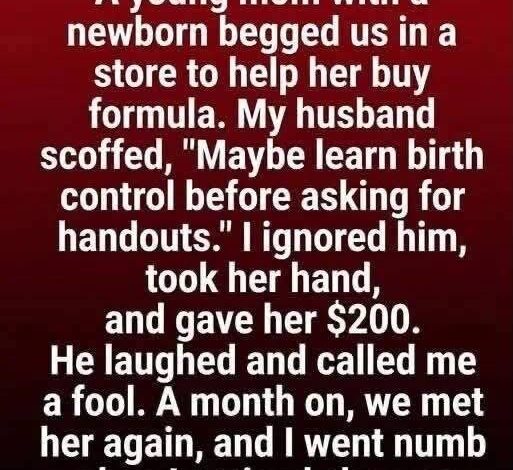
I remember that day with haunting clarity. It was a typical afternoon at the supermarket, the kind where the harsh fluorescent lights hum with a dull, clinical drone and the air is thick with the scent of sterile plastic. I was aimlessly wandering through the baby department, just killing time, when a woman caught my eye. She was clutching her infant so tightly it looked like she was shielding him from an invisible threat. She wasn’t shopping; she was staring at the shoppers around her with a look of profound, hollow detachment. There were no tears, no dramatic outbursts—just the heavy, silent weight of someone who had reached the end of her rope.
My common sense told me to mind my own business, to keep my head down and finish my errands. But something deep in my gut, that instinct we are all taught to ignore in favor of logic, refused to let me turn away. She began walking toward us, moving with a hesitant, rhythmic shuffle, as if she were second-guessing every single movement. When she finally stopped in front of me and my husband, her hands were trembling violently as she adjusted the baby’s blanket. She looked desperate, searching for words she clearly didn’t have. My husband, ever the pragmatist, responded with polite, guarded brevity, eager to be on our way.
But I saw the truth in her eyes—a terror that defied language. I interrupted before my rational mind could talk me out of it. “It’s alright,” I whispered, my voice barely audible over the hum of the freezers. “Take your time.” In that fleeting second, the carefully constructed mask she wore shattered. She didn’t have to say a word for me to understand the sheer volume of trauma she was carrying. People often assume that those in need are looking for a miracle or a grand solution, but often, the most revolutionary thing you can offer someone is the simple, profound acknowledgment that they are not invisible to the world.
Without overthinking the logistics or performing a psychological assessment, I reached into my bag and pulled out two hundred dollars. I handed the cash to her, meeting her gaze, and told her to use it for whatever the baby needed. It wasn’t a calculated charitable donation; it was an impulsive, human reaction to a suffering I couldn’t ignore. There were no grand declarations, no exchanges of contact information, and no applause. Just a quiet “thank you” that seemed to echo through the aisle like the sudden release of a long-held breath. My husband questioned me later, rightfully pointing out that we didn’t know her, that the world is full of people ready to take advantage of kindness. He wasn’t wrong, but he was operating on logic, and I was operating on a feeling I couldn’t explain.
Weeks turned into months, and the encounter became a lingering memory—a ghost in the back of my mind. It made me more observant. I started noticing the glimmers of despair in the eyes of strangers, the way people pull back from conversation, and the hidden stories written in the lines of a face. I realized that the world is a tapestry of quiet, unseen struggles, and that we walk past these stories a thousand times a day without ever truly seeing them. Kindness, I learned, isn’t about the grand, televised gestures; it’s about the micro-moments of connection that remind someone that they still matter.
Then, fate intervened. I was in a completely different part of the city, in a massive, chaotic store, when I looked up at the checkout counter and froze. It was her. She was wearing a uniform, her hair tied back, and she was moving with a confidence and purpose that was utterly unrecognizable from the broken woman I had met months prior. When she finally looked up and our eyes locked, the entire store seemed to go silent. Her eyes widened, and she smiled with a brightness that felt like it had been held back for years.
“You,” she breathed, as if she couldn’t believe I was real. We stepped aside from the line, and she refused to let me walk away without speaking. “I had hoped I might see you again,” she said, her voice steady and assured. “There were things I didn’t get to say that first day. That moment was more important to me than you could possibly imagine. I was in a place so dark I wasn’t sure I could see the light of the next morning. I almost didn’t ask for your help, but you didn’t turn away. You didn’t make me feel like a burden, and that changed everything.”
I asked her what that moment had given her, and she whispered one word: “Hope.”
She explained that my small, impulsive gesture had been the catalyst. It was the proof she needed that the world hadn’t completely abandoned her. It gave her the strength to seek resources, to apply for that job, and to begin the grueling work of rebuilding her life. It wasn’t easy, she admitted, but that one moment of kindness had provided the foundation for everything that followed.
I left that store feeling lighter, deeply humbled by the realization that we chronically underestimate the impact of our small actions. We hold out for the big, impressive moments to make a difference, forgetting that the true architecture of change is built from the small, unnoticed gestures. I don’t look at the world the same way anymore. I take those extra few seconds to look at the person in front of me—really look at them—because we all carry burdens that are invisible until someone cares enough to ask. The world is full of people waiting for a sign that they aren’t alone; sometimes, you have to be that sign. Kindness is a quiet power, and it ripples far further than we will ever know.