My Daughter Saved 1 900 to Buy Her First Heifer but Her Own Father Bid Against Her So I Took Her to Another Auction
Then she took the pen from the clerk. She pulled the ticket for lot 302 across the table. She drew a line through thirteen hundred dollars, and above it she wrote eleven hundred, and she initialed it. D.L.
“Mrs. Lund,” the clerk said. “You can’t…”
“I can do whatever I want, Earl,” Dorcas said. “It’s my sale.” She handed the pen back. “Two hundred off. That’s what she has left. Ivo doesn’t need to stand good for anything.”
Kinley stared at her. “Ma’am, I can’t…”
“Yes, you can,” Dorcas said. Then she asked Kinley what she would name them.
Kinley thought about it. She looked at the old woman’s face for a long time. Then she asked a question back.
“What were your daughters’ names?”
Dorcas had to sit down before she could answer. She was already sitting, but she sat back in her chair, slowly, like the air had gone out of her. Her hand went to the silk scarf at her throat. Her eyes filled.
“Ellen and June,” she said finally. “Ellie and Junie. They were twins. They’d have been fifty-six this spring.” She swallowed. “They were fourteen. Your age. There was a school bus on Highway 2 in the winter of 1983. Black ice.”
Nobody at that clerk’s table said anything. The clerk set down his pen. Ivo took off his hat.
“Those two heifers,” Dorcas said, “are out of the last two cows the girls ever showed. Ellie’s cow was called Blossom and Junie’s was called Pearl. I kept their lines going forty-two years. Harold said I was crazy. Every year, I’d keep back a heifer from each line.” She looked out the tent flap at the corrals. “I couldn’t sell those two to just anybody. I wanted them to go to a girl who’d love them.”
Kinley stood there at the table. Then she reached into her hoodie pocket and took out her envelope, and counted out eleven hundred dollars for the second heifer, and laid it on the table in front of Dorcas Lund.
“Ellie and Junie,” she said. “That’s what I’ll name them.”
Chapter Nine: Home
We loaded them that bright, cold afternoon, with the sun almost down and the sky over the Sandhills going pink and gold. Ivo helped. He stood at the gate of the loading chute and talked the two little heifers up into my silver gooseneck, quiet and slow, and they went in side by side without a fuss, like they knew they were going together.
Before we could leave, there was paperwork. You can’t just haul cattle from Nebraska to Colorado. There’s a brand inspection, and a certificate of veterinary inspection from a vet saying they’re healthy. The Nebraska brand inspector was there at the sale, a tired young man named Cody with a clipboard, and he checked the Lund brand on each heifer’s hip and wrote out the papers. The vet at the sale had already checked them, and their health papers were ready at the clerk’s table.
“First cattle?” Cody asked Kinley, writing her name on the inspection certificate.
“You going to register a brand?”
Kinley looked at me. I nodded. “When we get home,” I said. “With the Colorado Brand Board. She’s been drawing it for a year.”
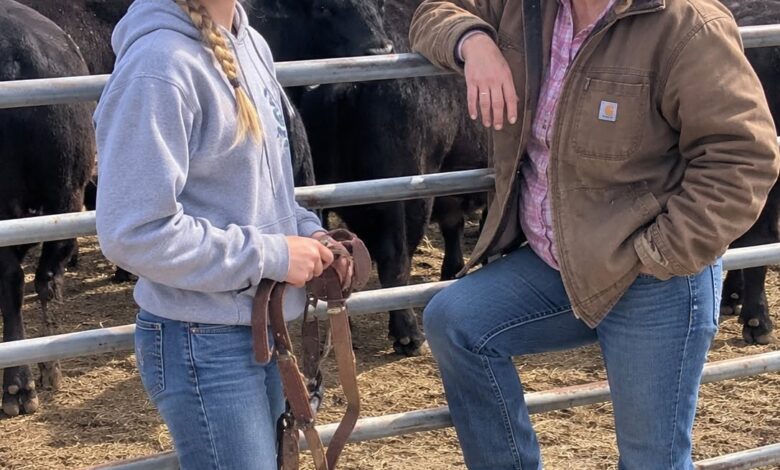
Kinley stood at the pipe pen with a halter in her hand, grinning like I hadn’t seen in a year. The new halter Ivo had given her right there at the sale, a red rope halter he’d bought from the vendor booth and handed to her without a word. She was standing at the rail looking through the slats of my trailer at the two red heifers inside, and her face was lit up like a Christmas tree.
Dorcas came out to the trailer before we left. Her grandnephew walked her, holding her arm. She stood at the side of my gooseneck and looked in through the slats at the two heifers for a long time.
“You’ll send me pictures,” she said to Kinley. “Every spring. When they calve.”
“Yes, ma’am.”
“And you’ll show them at your county fair.”
Dorcas reached out with one thin hand and put it on Kinley’s cheek. “Ellie and Junie would have liked you,” she said. “They were stubborn too.”
We drove home in the dark. Two hundred miles. Kinley fell asleep against the window somewhere south of Arthur, with the red halter in her lap and her empty envelope folded in her hoodie pocket. I drove the whole way with the radio off, listening to the trailer behind us and the heifers shifting in the straw.
The next morning we turned them out in my pasture along the county road. Forty acres of brome and native grass behind the house, with a stock tank and a windbreak of cedars, fenced with four strands of barbed wire. It’s the pasture right along the county road that runs past our place, County Road 37, a gravel road that goes from the highway to the feedlot east of town.
The road Troy drives every single day. Twice a day, back and forth to the feedlot, in his white Ford pickup. He’d see them. He couldn’t help it.
Kinley knew it too. She didn’t say anything about it. But I noticed she’d put a little hand-painted sign on the fence post by the gate that morning, on a piece of scrap board. ELLIE AND JUNIE. KO RANCH.
Chapter Ten: Sunday
He drove past three times that week. I saw his pickup go by twice, slow, and Kinley told me she saw it once on her way home from school, stopped at the end of the pasture with the engine running. She said she couldn’t see his face through the windshield. She said she didn’t wave.
Sunday after church, his pickup came down that road.
We’d been to the Lutheran church in Haxtun, the same one where Troy and I got married, and gotten home around noon. I was in the kitchen making sandwiches. Kinley had changed out of her church clothes into her jeans and her barn boots and her gray hoodie and gone straight out to the pasture with a bucket of range cake, the way she’d done every morning and evening since we brought them home. Ellie and Junie had learned the sound of the bucket by the third day. They’d come trotting across the pasture to the gate as soon as they heard it rattle.
I saw it through the kitchen window. The white Ford coming from the direction of town, slow. It slowed down more as it came alongside the pasture.
It stopped by my fence.
Right at the gate, where Kinley was standing in the grass with the bucket, with Ellie and Junie crowded around her eating the cake out of her hand. She was laughing at something one of them did. She looked up when she heard the truck stop, and I saw her face change.
I put down the knife and the bread and went to the back door. I didn’t go out. I stood in the doorway with my hand on the frame where I could see.
Troy got out and started walking toward her.
He was wearing jeans and a clean flannel shirt and his good boots, and he wasn’t wearing his cap. His hair was combed. He walked slowly through the ditch and up to the fence, and he stopped there with his hands on the top wire. Kinley stood on the other side with her bucket. Neither of them said anything for a long time.
Then he said something I couldn’t hear. Kinley didn’t answer. He said something else, and she shook her head. Then he climbed through the fence, carefully, holding the wires apart, and stood in the pasture with her, about six feet away.
I opened the back door and walked out across the yard. I didn’t hurry. I didn’t want to break whatever was happening. But I wanted to be close enough to hear, and close enough to step in if I had to.
When I got to the edge of the yard, I heard Troy say, “Are those Lund heifers?”
“Yes,” Kinley said. “Their names are Ellie and Junie.”
He looked at them for a long time. Then he looked at her.
“How’d you afford two Lund heifers?” he asked. “Those went for three thousand a head up there. I read the sale report.”
“Not these two,” Kinley said. “These were for kids only.” She held out a piece of cake to Junie, who took it gently out of her hand. “And Mrs. Lund took two hundred dollars off the second ticket. Because I told her what you did.”
Troy flinched like she’d hit him.
Chapter Eleven: The Black Heifer
“You told her,” he said.
“She asked me why I came two hundred miles,” Kinley said. “So I told her.”
Troy looked down at the grass. He stood there in my pasture with his hands at his sides, and I watched his shoulders go down, and I realized I’d never seen him look small before. Not in fifteen years. Troy Odegaard was always big, always loud, always the one who knew best.
“I bought that heifer,” he said finally. “At Sterling.”
“I know,” Kinley said. “I was there.”
“I mean I still have her.” He looked up. “I’ve got her out at Darrell Schultz’s place. I’m paying him to keep her. Four dollars a day.” He laughed, a short, unhappy sound. “I don’t have any grass. I don’t have anywhere to put her. I paid two thousand dollars for a heifer I can’t keep, and I’ve been paying four dollars a day for two weeks to keep a heifer I didn’t want.”
Kinley didn’t say anything.
“I don’t know why I did it,” Troy said. “That’s a lie. I know exactly why I did it. I was sitting up there in the top row, and I saw you come in with your mom, and you were so happy. And I thought, she’s going to buy her first heifer and she didn’t even tell me. She didn’t call me. She didn’t ask me to come look at it with her.” His voice cracked. “And I wanted you to need me. Just once. I wanted you to have to ask me for something.”
He stopped. He rubbed his face with both hands.
“So I bid,” he said. “And I watched your face. And you looked at me like I was a stranger. And I kept bidding because I couldn’t stop.” He looked at the ground. “And then you put your card down, and I won, and I sat up there and felt like the lowest man in Colorado.”
Kinley stood very still. The heifers had finished the cake and wandered off a little way to graze. The wind moved through the brome.
“I needed you, Dad,” she said finally. Her voice was very quiet. “I didn’t need you to buy me a heifer. I needed you to not bid against me.”
Troy’s face crumpled. He stood there in the pasture with tears running down into his beard, and he didn’t wipe them.
“I know,” he said. “I know, honey. I’m sorry. I’m so sorry.”
Then he reached into the pocket of his flannel shirt and took out a folded piece of paper. He held it out to her.
“It’s the bill of sale,” he said. “And the brand inspection. For the black heifer. I signed it over to you this morning. At the brand office. She’s yours. I’ll haul her out here tomorrow.”
Kinley looked at the paper in his hand. She didn’t take it.
“I don’t want her,” she said.
Troy stared at her.
“I don’t want her, Dad,” Kinley said again. “I’m sorry. I don’t. Every time I looked at her, I’d see you up in the top row.” She looked over at Ellie and Junie, grazing side by side in the grass. “I’ve got my heifers. I paid for them myself. Mrs. Lund gave them to me because she wanted them to go to a girl who’d love them.”
She was quiet for a moment, looking at the two red heifers. Then she looked back at her father, and something in her face had changed.
“But I know somebody who’d want her,” she said.
“Who?”
“There’s a girl in my 4-H club,” Kinley said. “Hannah Ruiz. Her dad got hurt at the feedlot last year. You probably know him. Marco Ruiz.” Troy nodded slowly; Marco had worked the same shift. “Hannah’s wanted a heifer for three years. She’s been saving too. She has three hundred and forty dollars.” Kinley looked at the paper in her father’s hand. “She’ll never have two thousand.”
Troy looked at his daughter for a long time.
“There’s a heifer program,” Kinley said. “Through the Logan County 4-H. Pass It Forward. Somebody donates a heifer to a kid who can’t afford one. The kid raises her and shows her, and then gives the first heifer calf back to the program to go to the next kid.” She paused. “Mrs. Lund kind of did it for me. With the two hundred dollars. You could do it for Hannah.”
Chapter Twelve: County Fair
Troy took the black heifer to Hannah Ruiz the next Saturday.
He didn’t tell anybody he was going to do it. He just called the 4-H extension office in Sterling on Monday morning and asked how the Pass It Forward program worked, and the extension agent, a young woman named Amanda, walked him through it on the phone. There was paperwork. A donation agreement, a brand transfer, a health certificate. He filled it all out himself.
On Saturday, he hauled the black heifer out to the Ruiz place in a borrowed trailer, with Kinley riding along in his passenger seat. She told me about it that night at supper. She said Hannah came out of the house in her pajamas and stood in the yard and didn’t say anything at all, just put both hands over her mouth. She said Hannah’s dad came out on his crutches and shook Troy’s hand for a long time without letting go.
“She named her Domino,” Kinley said. “Because she’s black with one white spot on her forehead.” She stirred her mashed potatoes. “Dad helped her put the halter on. He showed her how to tie a quick-release knot. The way Grandpa Arnie taught him.”
I didn’t say anything. I just reached across the table and took her hand.
Troy started coming by on Sundays after that. Not every Sunday at first. Every other one, when it wasn’t his weekend. He’d pull up by the pasture gate after church and get out and stand at the fence while Kinley fed Ellie and Junie. Sometimes he’d climb through and help. Sometimes they’d just stand there together at the fence and not say anything at all.
In May, he helped her build a new set of pipe panels for a little sorting pen behind my barn. He brought the welder from his buddy’s shop. They worked on it for three Sundays. I watched them from the kitchen window, my ex-husband and my daughter, bent over the welder together in the spring sun, arguing about where the gate should go.
Kinley registered her brand with the Colorado Brand Board in April. It cost a hundred and sixty dollars for five years, out of the money she had left after the sale. She’d drawn it a hundred times on the back of her school notebooks. A K and an O, with a little heart underneath them. The Brand Board approved it in June. She has the certificate framed on her bedroom wall, next to a photograph Dorcas Lund mailed her, an old black-and-white picture of two fourteen-year-old girls in a show ring in 1982, each holding the halter of a red-and-white Hereford heifer.
The Logan County Fair was the first week of August. Kinley showed Ellie and Junie in the breeding heifer class, two red-and-white Herefords with white faces walking side by side into the ring, and the whole arena stopped to watch them. She’d washed them and clipped them and blown out their hair that morning, the way Ivo taught her on the phone, and they looked like sisters out of a painting.
Ellie took a blue ribbon. Junie took a red. Kinley stood in the middle of the ring with both halters in her hands, grinning so hard her face must have hurt.
Hannah Ruiz showed Domino in the same class. She took a purple. Grand champion breeding heifer.
I sat in the bleachers on the third row. On one side of me was Ivo Kucera, who drove a hundred and seventy miles from Ogallala that morning in his best felt hat. On the other side was Dorcas Lund, eighty-one, who rode down from Thedford with her grandnephew because she said she wasn’t going to miss it, not after forty-two years. She held Ivo’s arm and cried through the whole class.
And in the top row, on the far side of the arena, where the light from the big doors is so bright you can barely see, sat a man in a clean flannel shirt and a black feed cap.
He didn’t raise his hand. He didn’t bid on anything. He just sat there with his arms crossed and watched his daughter walk two red heifers around the ring, and every time she passed below him, he stood up and clapped so loud you could hear it over the announcer.
After the class, Kinley came up into the bleachers with both ribbons pinned to her shirt. She hugged me. She hugged Ivo, who patted her back and said good girl. She hugged Dorcas for a long time, the old woman holding her face in both hands and saying something to her I couldn’t hear.
Then Kinley turned and looked across the arena, at the top row on the far side.
She raised her hand. Not a bid card. Just her hand, the way you’d wave to somebody across a crowded room. Like she was saying, I see you. I’m glad you’re here.
Across the arena, in the bright light from the doors, Troy raised his hand back.
Then he came down out of the top row, slow, through the crowd, all the way around the arena to our side. Kinley met him at the bottom of the bleachers. And he reached out and touched the blue ribbon on her shirt, very gently, with one finger, the way you’d touch something you were afraid you might break.
“Your grandpa would be so proud,” he said. “Of both of you. You and your heifers.”
“Ellie and Junie,” Kinley said.
“Ellie and Junie,” he said. He looked over at Dorcas in the bleachers, and something passed between them, an old woman who’d lost her daughters and a man who’d almost lost his. He took off his cap and nodded to her. She nodded back.
Then he turned to Kinley.
“Would you show me?” he asked. “Your heifers? In the barn? I want to see how you fit them.”
Kinley looked at him for a long moment. Then she took his hand, the way she used to when she was little, and led him down the bleachers and across the arena toward the cattle barn, where two red heifers stood side by side in the straw under a hand-painted sign that said ELLIE AND JUNIE, KO RANCH. I watched them go, my daughter and her father, walking slowly together through the crowd. Neither one of them was in any hurry. Neither one of them was trying to win.