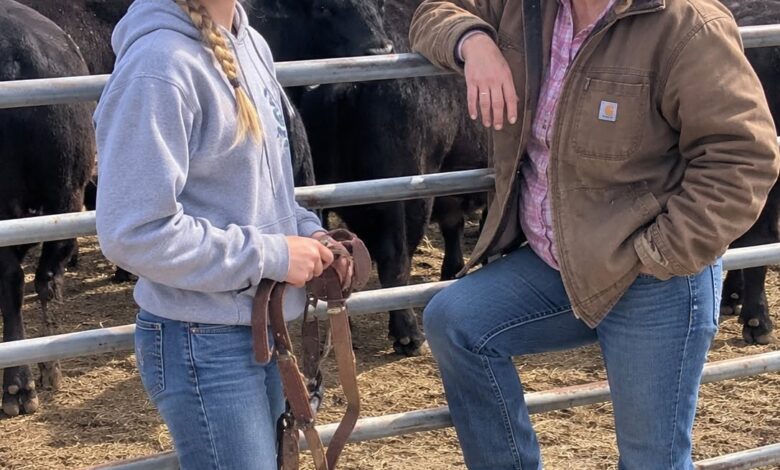
My Daughter Saved 1 900 to Buy Her First Heifer but Her Own Father Bid Against Her So I Took Her to Another Auction
Chapter One: Wednesday in Sterling
It was the Wednesday calf sale at the livestock commission in Sterling, Colorado, the second week of March, and the sale barn was packed the way it always is in spring. Ranchers had come in from three states with their bred heifers and their bawling calves, and the parking lot was full of gooseneck trailers and muddy pickups clear out to the highway. Inside, the bleachers smelled like coffee and diesel and cattle, and the auctioneer’s chant rolled over everything like a hailstorm on a tin roof.
My daughter Kinley sat beside me on the third row of the bleachers, holding her bid card in both hands. It was a square of white cardboard with the number 214 printed on it in black, and she’d registered for it herself at the office window an hour before, standing on her tiptoes to see over the counter while the lady behind it explained the rules. Because she was fourteen, the card had to be in my name, but she’d filled out every line of the form herself in her careful handwriting and signed it at the bottom.
She had saved for two years. She started the summer she turned twelve, after she showed a borrowed heifer at the Logan County Fair and took a blue ribbon and came home saying she wanted a cow of her own more than anything in the world. Not a show calf to sell at the end of the summer. A cow. Something to keep, and build on, and call hers.
She babysat for every family on our road. She cleaned out stalls at the vet clinic on Saturday mornings. She saved every 4-H premium check and every birthday dollar and every five-dollar bill her grandmother slipped into her Christmas cards. She kept it all in a manila envelope in the bottom drawer of her dresser, and every few months she’d bring it out to the kitchen table and count it, and then count it again, and write the total on the front of the envelope in pencil and erase the old one.
The night before the sale, she counted it twice on my kitchen table. One thousand, nine hundred dollars. Mostly twenties and tens, with a few fifties she’d traded for at the bank so the stack wouldn’t be so thick. She put a rubber band around it and zipped it into the front pocket of her gray hoodie, and she wore that hoodie to bed.
A little black heifer came into the ring a little after one o’clock. She was a straight-backed Angus calf about four hundred pounds, with a white tag in her ear and a calm way of standing that made the old ranchers around us lean forward on their elbows. The auctioneer read her out: a heifer calf from a reputation herd east of Akron, out of a good cow, open and ready to grow.
Kinley sat up straight. She’d looked at that heifer in the pens that morning, walking up and down the alley with me for an hour until she found her. She’d stood at the gate and looked at her for ten minutes without saying a word, and then she’d turned to me with her whole face lit up.
“That one, Mom,” she said. “That’s her.”
Chapter Two: Two Years of Dollars
I should tell you about Kinley’s father.
Troy Odegaard and I were married for twelve years. We met at the county fair when I was nineteen and he was twenty-two, and we got married the next summer in a little Lutheran church in Haxtun, and for a long time we were happy. He ran a few hundred cows on rented grass southeast of town and worked at the elevator in the winter, and I started hauling cattle for other ranchers to make a little extra money. Kinley came along three years after the wedding, a tiny, fierce, red-faced baby who screamed for six months straight and then never stopped smiling.
The marriage came apart slowly, the way a fence comes apart. A post here, a wire there, until one day you look up and realize there’s nothing holding anything in. Troy started drinking more after his dad died. He lost his grass lease when the landlord’s kids sold the place, and he sold his cows rather than find more, and after that he didn’t seem to know what to do with himself. He got short with me, and then he got short with Kinley, and then one night he said something to her at the supper table that I won’t repeat, and she cried herself to sleep, and the next morning I called a lawyer in Sterling.
The divorce was final two years ago, when Kinley was twelve. The judge gave us joint custody, but at her age, she got a say in where she lived most of the time. She chose me. She told the judge herself, in his chambers, with only the court reporter there. I wasn’t allowed in. I don’t know exactly what she said. I only know that when she came out of that room, her face was very white, and she wouldn’t look at her father.
Troy never forgave her for it. He never said so outright. He still had her every other weekend, and he paid his child support through the state, six hundred and twelve dollars a month, on time. But when she was at his place, he was cold to her. He’d make her supper and then sit in front of the television and not talk. He’d drive her back to my house on Sunday evenings and not get out of the truck.
He’d make little cracks about me, about how I’d turned her against him, about how she was going to grow up just like her mother. Kinley never told me about them. I found out from his sister.
Troy hadn’t run a cow since the divorce. He had no grass and no corrals and no use for a heifer. He worked full time at the feedlot east of Sterling now, running a feed truck, and he rented a little house in town with a yard about the size of a horse trailer.
So when the auctioneer started the bidding on that little black heifer, I didn’t even think to look for him. I didn’t know he was in the sale barn at all.
Chapter Three: Troy’s Hand
“Who’ll give me eight hundred?” the auctioneer called. “Eight hundred dollars for this good heifer calf, eight hundred, eight hundred.”
Kinley raised her card. Her hand was shaking a little, but she held it high, the way I’d shown her the night before at the kitchen table, so the ringman could see it.
“Eight hundred, thank you, young lady,” the auctioneer said. “Now nine, nine hundred, who’ll give nine?”
A man down on the front row raised his hand. Kinley raised her card again at a thousand. The man on the front row went to eleven hundred, and Kinley went to twelve, and the man shook his head and dropped out. For about two seconds, I thought she had it.
“Twelve hundred dollars to the young lady in the third row,” the auctioneer said. “Twelve hundred, do I hear thirteen?”
Then a hand went up across the ring. On the far side, up in the top row of the bleachers, where the light from the big doors was so bright you could barely see. A man in a brown Carhartt jacket and a black feed cap.
“Thirteen hundred,” the auctioneer said. “Thank you, sir.”
Her father’s.
I knew him the second I saw him. I’d know the shape of that man anywhere. Troy was sitting up there in the top row with his arms crossed, and when Kinley raised her card at fourteen hundred, he raised his hand at fifteen, without moving anything but his wrist.
Kinley looked across the ring and saw him. Her face went white. She looked at me.
“Mom,” she whispered. “That’s Dad.”
“I know, baby.”
She raised her card at sixteen hundred. Troy went to seventeen. She went to eighteen. He went to nineteen.
She raised her card at nineteen hundred and fifty, which was fifty dollars more than she had, because she didn’t know what else to do. And Troy raised his hand at two thousand without even blinking.
He kept bidding anyway, right past her limit. He never looked at the calf. Not once, the whole time. I watched him. His eyes were fixed across the ring on the third row of the bleachers, on his daughter in her gray hoodie with the money zipped in the pocket.
He was looking at her.
I knew why. He was still sore that she chose to live with me. Two years later, he still hadn’t gotten over standing in that hallway at the courthouse while a twelve-year-old girl told a judge she didn’t want to live with her father. I guess he wanted her to know he still had the last word.
The auctioneer glanced at Kinley. He’s done this forty years. He knew a girl’s bid card when he saw one, and he knew a man bidding to beat somebody when he saw that too. He paused, longer than he needed to, and looked straight at her.
“Two thousand to the gentleman up top,” he said gently. “Young lady? Twenty-one hundred?”
She shook her head and laid the card in her lap.
“Sold,” the auctioneer said, and banged his gavel, and didn’t say the price again. “To number 98, up top.” And then he moved on to the next lot as fast as he could, the way you’d move past a wreck on the highway.
Chapter Four: The Pickup
People asked me later why I didn’t stand up and say something. Troy’s sister asked me. My mother asked me. A woman from church who’d been sitting two rows behind us asked me in the grocery store the next week, with her hand on my arm and her eyes full of pity.
The answer is simple. Because a scene in that ring would have shamed my daughter, not him. Every rancher in four counties was sitting in those bleachers. If I’d stood up and yelled across the ring at my ex-husband, they’d have talked about it for ten years, and every time they saw Kinley at a sale barn or a fair, they’d remember. She’d be the girl whose parents had a fight at the Sterling sale. Not the girl who saved two years for a heifer.
So I sat still and hurt.
I sat on that hard wooden bleacher with my hand on my daughter’s back and watched the next three lots go through the ring without seeing any of them. Kinley sat beside me with the bid card in her lap and her eyes on the floor of the ring. She didn’t move. She didn’t look across the ring at her father again. When the sale broke for lunch twenty minutes later, she stood up and walked out of the sale barn without a word, and I followed her.
She didn’t cry until we got to the pickup.
She held it together walking across the parking lot, past the trailers and the mud and the men smoking by their trucks. She climbed up into the passenger seat of my Dodge and shut the door and buckled her seatbelt. Then she put both hands over her face, and her shoulders started to shake, and she cried the way she hadn’t cried since that night two years ago at the supper table.
I sat there behind the wheel with my hand on her knee and let her. There wasn’t anything else to do. Out the windshield, I could see the sale barn and the big open doors and the cattle moving through the alleys, and somewhere in there, my ex-husband was writing a check for a heifer he didn’t want and had nowhere to keep.
After a long time, Kinley wiped her face on the sleeve of her hoodie. She took a big, shaky breath. She unzipped the front pocket and took out the envelope and looked at it, and then she zipped it back in.
“It’s okay, Mom,” she said. “I’ll just save more.”
That was the worst part. Not the bidding. Not Troy’s face across the ring. It was my fourteen-year-old daughter sitting in my pickup with her eyes swollen, saying it’s okay, I’ll just save more, like she’d already decided it was her own fault for not having enough.
Chapter Five: Ivo
I haul cattle for a living. I’ve done it for nine years now, ever since the divorce, with a silver Featherlite gooseneck trailer and a three-quarter-ton Dodge that has three hundred and forty thousand miles on it. I haul calves to sale barns and pairs to summer grass and bulls to new owners, mostly in northeast Colorado and western Nebraska and Kansas, anywhere there’s a cow that needs to go somewhere. It doesn’t pay much, but it pays steady, and I like it. I like the long empty highways and the quiet and the ranchers.
I know ranchers from here to the Dakota line. That’s the thing about hauling. You get to know every outfit on every road, every old man and every widow and every young couple trying to make a go of it. You stand in their corrals at five in the morning helping them load, and you drink their coffee, and they tell you things.
That evening, after Kinley went to bed, I sat at the kitchen table and called one of them.
Ivo Kucera is seventy-eight years old. He runs eight hundred cows on a ranch along the Platte River outside of Ogallala, Nebraska, that his grandfather homesteaded in 1888. He’s a small, wiry old man with a white mustache and hands like tree roots, and he’s the best cattleman I ever hauled for. He knows every bloodline in the Sandhills, and he can look at a calf in a sale ring for three seconds and tell you what she’ll weigh as a cow.
I’ve hauled for him for seven years. The first time, I was so nervous I almost backed my trailer into his loading chute, and he stood there laughing with his hands in his pockets and then walked over and talked me in. After that, he called me every time he needed something moved.
He answered on the second ring, the way old men answer the phone, loud. “Kucera.”
“Ivo,” I said. “It’s Lacey. I’m sorry to call so late.”
“It’s not late,” he said. “I’m reading the sale reports. What’s wrong?”
I told him. All of it. The two years of saving. The envelope. The black heifer. Troy across the ring, bidding against his own daughter while he looked her in the eye. Kinley in the pickup saying she’d just save more.
Ivo didn’t say anything until I was done. Then he was quiet for a long time, and I could hear his kitchen clock ticking through the phone.
“That boy’s daddy was a good man,” he said finally. “I knew Arnie Odegaard forty years. He’d turn over in his grave.”
“I know.”
“How much does she have?”
“Nineteen hundred.”
He was quiet again. I heard him shuffling papers.
“There’s a dispersal up in the Sandhills on Saturday,” he said. “North of Thedford, out toward Brownlee. Dorcas Lund is selling out.”
I knew the name. The Lund outfit was famous, one of the oldest registered Hereford herds in Nebraska, and the Lunds had been breeding cattle on that ground since the 1920s. Harold Lund died last fall, Ivo said. Dorcas was eighty-one and she couldn’t run it alone, and her family was all gone, and she’d decided to sell everything. Cows, bulls, machinery, and the land too, to a neighbor.
“She’s selling three hundred head,” Ivo said. “Some of the best Herefords in the state. People are coming from Montana and Texas.” He paused. “And she asked the auctioneer for something unusual. She’s got two heifer calves she’s held back. She wants them sold last, at the end of the day, after everything else. And she wants them sold to kids only. Nobody over eighteen can bid.”
I sat at my kitchen table and didn’t say anything.
“It’s two hundred miles,” Ivo said. “But if you bring that girl up there, I’ll meet you at the pens. And Lacey?”
“Yes?”
“Don’t tell her about the kids-only part,” he said. “Let her think she’s got to fight for it. She’ll value it more.”
Chapter Six: Two Hundred Miles
Saturday we pulled out with the silver gooseneck at first light.
I’d told Kinley on Thursday night. Not everything. Just that there was a big sale in Nebraska on Saturday, a dispersal, and there might be a heifer or two she could afford, and Ivo Kucera would be there to help her. She looked at me across the supper table for a long time without saying anything. Then she got up and went to her room, and I heard her open her dresser drawer, and I knew she was counting the envelope again.
It was cold that morning. Fourteen degrees, with frost on the windshield and our breath steaming in the truck cab until the heater caught up. We hooked up the trailer in the dark, with the yard light buzzing, and Kinley checked the hitch twice and the chains and the lights, the way I taught her. Then we climbed in the cab with a thermos of coffee and a bag of breakfast burritos from the Cenex, and we pulled out onto the county road at six-twenty.
It’s about two hundred miles from our place near Sterling to Thedford, Nebraska. North through Julesburg and across the Platte, then up Highway 61 through Arthur and Hyannis into the heart of the Sandhills. There’s nothing out there but grass. Rolling grass-covered hills as far as you can see in every direction, like an ocean frozen in place, with a windmill every few miles and herds of black and red cattle scattered across the hillsides like pepper. Kinley had never been that far north. She sat with her nose almost against the window, watching it go by.
Kinley kept the envelope zipped in her hoodie pocket the whole way. Every so often I’d see her hand go to it and press it, the way you’d check that your wallet was still there. She didn’t take it out. She didn’t count it. She just kept her hand on it.
Somewhere north of Arthur, in the middle of nowhere, she finally spoke.
“Mom,” she said. “Why did Dad do that?”
I’d been waiting three days for her to ask. I’d thought about what I’d say. I’d thought about lying, about telling her he probably needed a heifer, or he didn’t know it was her, or he was just bidding for the fun of it.
“I think he’s still hurt,” I said. “About the judge. About you choosing to live with me.”
She looked out the window at the hills. “I didn’t choose against him,” she said. “I just couldn’t live with him. Not like that. He was so mad all the time.”
“I know, honey.”
“Does he hate me?”
I looked over at her. Fourteen years old. In her gray hoodie with two years of babysitting money zipped in the pocket.
“No,” I said. “He doesn’t hate you. I think he hates that you didn’t need him. And he doesn’t know what to do with it.”
She was quiet for a long time. Then she said something I’ll never forget.
“I did need him,” she said. “I just needed him to be different.”
Chapter Seven: The Rail
The Lund place sits back off a gravel road twelve miles north of Thedford, in a valley between two big grass hills, with a white house and a red barn and a set of pipe corrals that must have cost a fortune. When we pulled in at ten-thirty, there were already two hundred pickups and trailers parked in the hayfield, and a big white sale tent set up beside the corrals with bleachers inside and a sound system. People had come from everywhere. I saw plates from Montana and Wyoming and Texas and Kansas.
Ivo was waiting at the pens when we got there. He was leaning on the pipe rail of the first pen in his old canvas jacket and a gray felt hat, with a cup of coffee from the food truck in his hand. When he saw my rig come in, he raised the cup.
Kinley had only met him twice, both times when she rode along with me to haul his calves. She walked across the gravel toward him a little shyly, with her hands in her hoodie pocket.
“Mr. Kucera,” she said.
“Ivo,” he said. “Nobody calls me Mr. Kucera except the bank.” He looked at her for a long moment, up and down, the way he looks at a heifer. Then he nodded once. “Your mother tells me you saved two years.”
“Yes, sir.”
“How much?”
“Nineteen hundred dollars.”
He nodded again slowly. “That’s a lot of babysitting,” he said. “Come on. Let’s go look at some cattle.”
He stood at the rail beside Kinley like she was his own. For two hours before the sale started, he walked her through every pen on the place. He showed her how to look at a heifer’s feet and her legs and the depth of her body. He showed her how to tell a good mother from her shape. He told her the history of every bloodline in the Lund herd, and she listened to every word with her hands wrapped around the pipe rail.
At the last pen, at the far end of the corral by itself, two little Hereford heifer calves stood side by side in the straw. Red with white faces, both of them, with white stockings and white bellies. They were small, maybe four hundred and fifty pounds each, and they stood close together like sisters. A hand-lettered sign was wired to the gate. LOTS 301 AND 302. SELLING LAST.
Kinley stopped and looked at them. She didn’t say anything. She just stood there with her hands on the rail.
“Those two,” Ivo said quietly. “Those are the ones we came for.”
The sale started at noon. The cows went first, then the bulls, then the bred heifers. The bidding was fast and hard, with buyers from big outfits all over the country, and the good cows were bringing three and four thousand dollars apiece. Kinley sat between Ivo and me in the bleachers, with her bid card in her hands, watching every lot go through, and I could see her face getting tighter and tighter as the prices went up.
“Mom,” she whispered, around three o’clock. “I can’t afford anything here. Everything’s three thousand dollars.”
“Wait,” Ivo said, before I could answer. “Don’t watch the other bidders. Watch me.”
At five-thirty, with the sun going down orange behind the big grass hill to the west, the auctioneer finally got to the end. Three hundred lots, sold. He set down his gavel and took a long drink of water, and then he looked out at the crowd in the bleachers.
“Folks,” he said. “We’ve got two more lots. Mrs. Lund has asked that these two heifer calves be sold to young people only. Eighteen and under. If you’re over eighteen, I’m going to ask you to keep your hands in your laps.” He paused. “And she’s asked me to tell you that these two calves are out of the last two cows her daughters ever owned.”
Chapter Eight: Dorcas
The first heifer came into the ring, lot 301, the smaller of the two sisters. She stood in the straw and looked up at the bleachers with her white face, calm, and the crowd went quiet.
There were maybe twenty kids in that tent with bid cards. Ranch kids from all over the Sandhills, some of them with their parents sitting behind them. A tall boy in a Stetson. Two girls in FFA jackets. A little kid who couldn’t have been more than nine.
“Who’ll start this heifer at five hundred?” the auctioneer asked.
Kinley started to raise her card. Ivo put his hand on her arm.
“Wait,” he said quietly. “Let them go first.”
The bidding went to six hundred, seven, eight. The tall boy in the Stetson was bidding against one of the FFA girls. At nine hundred, the FFA girl dropped out. At nine hundred and fifty, the boy hesitated.
“Now,” Ivo said.
Kinley raised her card. “One thousand,” the auctioneer called. The boy went to ten-twenty-five. Ivo nodded, and Kinley went to ten-fifty, and the boy looked at his dad in the bleachers behind him, and his dad shook his head.
“Sold,” the auctioneer said. “Ten hundred and fifty dollars to number 47.”
The first heifer went to Kinley at one thousand and fifty. She sat there holding her bid card in both hands, staring at the ring, like she couldn’t believe it.
Then the second heifer came in, lot 302, her sister. And this time it was different. The tall boy in the Stetson wanted this one, and so did one of the FFA girls, and the bidding climbed fast. Eight hundred. Nine. A thousand. Eleven hundred.
The second one climbed past what Kinley had left. She had eight hundred and fifty dollars after the first heifer. The bidding was at nine hundred, and then a thousand, and she sat there with her card in her lap and her face going white.
She looked up at Ivo.
He looked back at her for a long moment. Then he nodded once.
“Go on,” he said. “I’ll stand good for it.”
She raised her card. Eleven hundred. The boy went to twelve. She went to thirteen. The FFA girl dropped out. The boy looked at his dad again, and his dad shook his head again, and the boy put his card down.
“Sold,” the auctioneer said. “Thirteen hundred dollars to number 47. And folks, I believe that young lady just bought herself a pair.”
She won it. The whole tent clapped. Kinley sat there between Ivo and me with tears running down her face and her bid card in her lap, and Ivo reached over and patted her knee with his big rough hand.
“Good girl,” he said. “You waited. Most people can’t.”
At the clerk’s table afterward, there was a line. Buyers settling up, writing checks, signing brand inspection papers for out-of-state cattle. Kinley stood in line with me, clutching her envelope, and Ivo stood behind her. When we got to the front, there was an old woman sitting at the end of the clerk’s table in a wool coat and a silk scarf, with white hair pinned up in a bun and a cane hooked over the back of her chair.
Dorcas Lund.
She looked at Kinley’s bid card. She looked at Kinley’s face.
“You came a long way,” she said. Her voice was thin but clear. “Ivo says you’re from Colorado.”
“Yes, ma’am,” Kinley said. “Sterling.”
Dorcas looked at her for a long moment. Then she asked why a girl her age came two hundred miles for two heifers.
Kinley told her. All of it. Standing at the clerk’s table in her gray hoodie with her envelope in her hand. The two years of saving. The babysitting and the stall cleaning and the birthday dollars. The little black heifer at the Sterling sale. Her father across the ring, bidding against her. Watching her the whole time. Not the calf.
She didn’t cry while she told it. She just told it, plain, the way you’d tell somebody the weather.
Dorcas didn’t say a word. She just listened, with her hands folded on top of the clerk’s table. When Kinley was done, she was quiet for a long time………….READ MORE NEXT PAGE