The Simple Register Riddle That Is Leaving Thousands On The Internet Utterly Confused And Frustrated
At first glance, this classic riddle looks incredibly simple to the point where most people are completely confident they know the correct answer within just a few seconds of reading it. But then something strange happens to the human brain when processing the specific sequence of events. The longer people think about the scenario, the more confused and uncertain they become, leading to massive, intense debates all over social media platforms. Some people passionately answer that the business lost 200 dollars, others insist the answer must be 170 dollars, while a few vocal groups argue it must be 130 dollars. It is astonishing how one tiny, straightforward math problem has managed to frustrate thousands of people online simply because the human mind naturally wants to count the exact same currency twice.
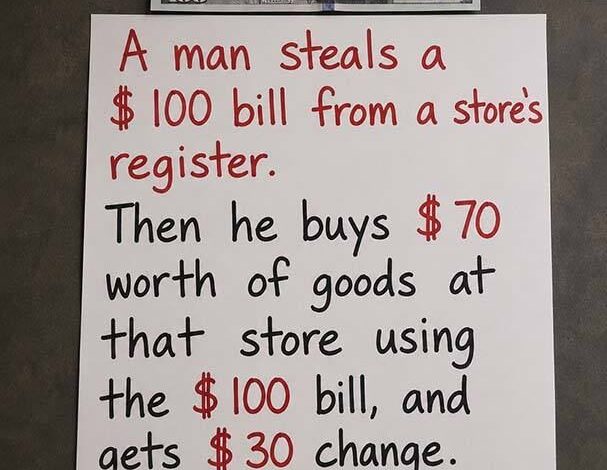
To test your own logical thinking, consider the challenge carefully before looking at how the math actually balances out in the end. The exact scenario goes like this: A man sneaks into a store and steals a crisp 100 dollar bill directly from the cash register. Later that same day, he returns to that exact store as a customer and decides to buy 70 dollars worth of products, paying for the merchandise using the stolen 100 dollar bill. The unsuspecting cashier takes the bill, places it back into the register, and hands the man 30 dollars in cash as his correct change.
The primary reason that online arguments about this specific riddle become so surprisingly intense is that people absolutely refuse to accept the real answer even after seeing the step by step breakdown. The clever wording of the puzzle tricks the human brain into overcomplicating something that is fundamentally basic, leading to wild mathematical theories and unnecessary accounting equations. To see past the linguistic trap, there is another incredibly easy way to visualize the entire transaction.
Imagine if the thief had never stolen the bill initially, but instead simply walked into the store and directly demanded 70 dollars worth of tangible items along with 30 dollars in cold, hard cash without giving the business anything in return. That clean scenario makes it immediately obvious that the business would suffer an exact 100 dollar loss. When you apply that same logic back to the riddle, you realize the physical 100 dollar bill itself ended up back exactly where it started inside the store register. Because that specific bill returned to the cash drawer, it cannot logically be counted as missing from the store’s final inventory or cash balance.
Once people finally realize that crucial detail, the entire illusion created by the riddle suddenly becomes crystal clear. Usually, that is the exact moment they either laugh out loud at the simplicity or get incredibly annoyed that they didn’t see the trick sooner. What makes puzzles like this so wildly addictive is that they actively challenge a person’s core logic rather than their actual mathematical ability. You do not need advanced mathematical equations, you do not need spreadsheets, and you certainly do not need a calculator to find the truth. You simply need to carefully follow the physical movement of what is actually lost in the final outcome of the day.
When you break down the movement of assets, the reality is undeniable. In the first step, the store is down a 100 dollar bill. In the second step, the thief hands that exact 100 dollar bill back to the store, bringing the register balance back to zero. In the third step, the store hands the thief 70 dollars worth of goods and 30 dollars of remaining change. When you add the value of the 70 dollars in items to the 30 dollars in cash, the final outcome remains entirely unchanged no matter how many times you recheck the math. The store lost exactly 100 dollars.