My Future Mother in Law Called My Mom Trailer Trash in Front of 500 Wedding Guests but That Was Only the Beginning
The first time my future mother-in-law called my mother trailer trash in front of five hundred wedding guests, I thought I’d hit the bottom of my life. Then my fiancé laughed, and I understood that the bottom was further down than I’d imagined. The man waiting to become my husband wasn’t simply allowing his family to humiliate us. He was enjoying it.
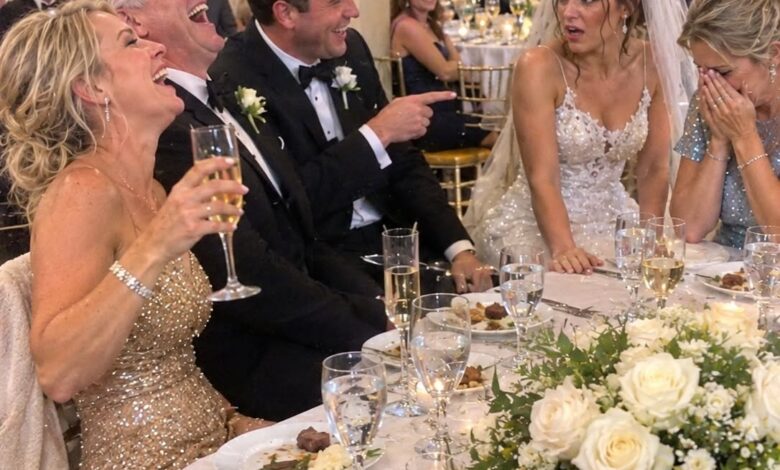
The ballroom of the Grand Windsor Hotel in downtown Columbus looked like a page torn from a bridal magazine. Crystal chandeliers glittered under a ceiling painted with gold leaf. Towers of white roses spilled out of silver urns on every table, and the linens were ivory silk. A twenty-piece orchestra played beneath carved arches at the far end of the room, and waiters in white jackets drifted between the tables with trays of champagne.
Five hundred people had come to watch me marry Preston Vale. Most of them believed I was the luckiest woman in Ohio.
I was thirty years old that night, in an ivory silk gown my mother had altered herself, taking in the waist by half an inch and re-stitching every one of the forty covered buttons down the back so they’d lie perfectly flat. My dark hair was pinned in a low knot at my neck. Beside me at the head table sat my mother, Elena Morales, fifty-eight, in a pale blue dress she’d spent three weeks sewing at her kitchen table after closing her shop each night.
Her dark hair, threaded with silver, was swept up the way she wore it to church. Her hands were rough from forty years of needles and steam irons and scrub brushes, but she’d painted her nails a soft shell pink, because she wanted everything to be perfect for me. Those hands had held cold washcloths to my forehead through childhood fevers. They’d checked my algebra at a folding table under a single bulb. They’d worked past midnight more nights than I could count.
Under the tablecloth, those hands were trembling.
Caroline Vale stood at the microphone near the orchestra. At sixty, my future mother-in-law was a woman who looked like money: a sleek auburn bob, a champagne-colored designer gown, diamond studs the size of peas, and a smile that never once made it up to her eyes.
She lifted her glass. “To family,” she said brightly. “And to the little miracles that bring people from completely different worlds together.”
Polite applause rippled across the room. Then Caroline turned and looked straight down the head table at my mother.
“Because honestly,” she said, “who would have imagined that a woman from a trailer park could raise a girl polished enough to marry a Vale?”
The ballroom erupted in laughter. Not everyone, but enough. Enough that it rolled across the room like a wave, from the tables near the front to the tables by the bar. I sat frozen in my chair. Beside me, my mother lowered her eyes to the folded napkin in her lap.
Caroline was delighted. She leaned into the microphone. “When Sophie first started seeing Preston, there was just so much to teach her,” she said. “The right restaurants. The right clothes. Which fork goes with which course.” She waited for the next round of laughter, and it came. “Although I’ll say this for her. She’s improved tremendously.”
I felt Preston shift in the chair beside me. My handsome fiancé, thirty-three years old, with his dark blond hair combed just so and a midnight-blue tuxedo tailored to the quarter inch, leaned over to his younger brother, Graham, and said, loudly enough for the nearest three tables to hear: “At least she finally stopped asking if caviar was a kind of jam.”
People howled. A man at table four slapped the linen with his palm.
I turned to look at him. “Preston,” I whispered. “You promised me they’d stop.”
He gave me the smile I’d come to know too well over two years, the patient, slightly pitying smile a man gives a child who’s overreacting. “Relax, babe,” he said. “Mom’s being funny.”
“She’s humiliating my mother.”
“You’re making it a bigger deal than it is.” He reached under the table and squeezed my knee. “Smile,” he murmured. “Everyone’s watching.”
I looked at him for a long moment, and two years went past behind my eyes like a slideshow.
When Caroline told me, the first time we met, that my dress was “sweet, in a department-store way,” I told myself she just had different taste. When Preston’s father, Richard, asked at our engagement party whether my mother would be “comfortable” attending such an expensive event, I told myself he was awkward and meant well. When Preston suggested, gently, that I not mention my mother’s alterations shop when we had dinner with his business associates, I told myself it was a misunderstanding about context.
I’d spent two years translating cruelty into sophistication and cowardice into patience. I’d done it so smoothly I’d almost fooled myself. Now, in a gold-leafed ballroom in front of five hundred people, there was nothing left to translate.
My mother leaned toward me. “It’s all right, mija,” she whispered. “It’s all right.”
But her eyes were wet, and that nearly broke me in half. Because nobody in that ballroom had any idea what that woman had given up to sit at that table in a dress she’d sewn herself.
When I was little, we really did live in a trailer. That part was true. A single-wide with a leaking roof in a park off Route 23 outside Columbus, with a gravel lot and a chain-link fence and a neighbor’s pit bull that barked all night. During thunderstorms, my mother set out mixing bowls and saucepans to catch the drips, and we’d lie on the floor and listen to the different notes the water made, like a xylophone.
She did alterations during the day out of a rented booth at the back of a dry cleaner’s on Morse Road. At night she cleaned offices downtown, vacuuming carpets in insurance companies and law firms until two in the morning, while Mrs. Delgado from the next trailer over sat with me. In the winters, she turned the heat down to fifty-eight so I could have new shoes for school. She wore the same brown coat for eleven years.
But she never once taught me to envy rich people. She taught me to respect honest work. There’s no shame in a needle, Sophie, she used to say, threading one under the lamp. The only shame is in a lie.
What the Vales didn’t know, because they had never once bothered to ask, was what my mother had done with the next twenty years.
When I was ten, she bought her first building: a boarded-up two-unit house in Linden with a caved-in porch that nobody else wanted. She paid eleven thousand dollars at a county tax auction, money she’d saved in a coffee can for six years. She fixed it herself on weekends with a borrowed drill and YouTube videos and a lot of stubbornness, rented both units, and used the rent to buy the next one. Then the next.
Over two decades, she bought neglected buildings all over Columbus, the ones with broken windows and code violations that the big developers turned up their noses at. She fixed them. She rented them fairly, to families and small shops. She reinvested nearly every dollar. Eventually, on the advice of an old lawyer named Mr. Feldman who’d been one of her cleaning clients, she placed all of it into a trust: the Northstar Property Trust.
She kept her alterations shop open because she loved to sew. Not because she needed the money.
And the four-story brick building on Gay Street downtown that housed three of Vale Retail Group’s flagship boutiques, the gift shop, the home décor store, and the women’s clothing boutique that Caroline liked to call “her baby”?
My mother owned it. Every brick. Every storefront. Every square foot.
She’d bought it nine years earlier, when it was half empty and the previous owner was about to lose it to the bank. She’d restored the original tin ceilings herself. And every month, the Vale family’s companies mailed their rent checks to a post office box for Northstar Property Trust without once wondering who stood behind the name.
Preston knew my mother’s trust had helped pay for our wedding. I’d told him. He simply let everyone believe the money came from the Vales. I had personally covered half of that reception through Northstar: the roses, the orchestra, the chandeliers. And I was the charity case at the head table.
Caroline sat down to applause. Then Richard Vale rose from his seat and tapped a silver knife against his champagne flute.
At sixty-three, Richard had the silver hair and broad shoulders of a man who’d spent forty years being the most important person in every room he entered. He ran Vale Retail Group, a chain of upscale boutiques, home goods stores, and gift shops across Ohio and Indiana, founded by his grandfather in 1958. He sat on the boards of two hospitals and the art museum. His photograph hung in the lobby of the Columbus Chamber of Commerce.
“Well,” he said, smiling down the head table, “I suppose I ought to welcome Elena into the family as well.”
My mother forced a smile and lifted her water glass an inch.
“Don’t worry, Elena,” Richard said warmly. “We won’t be sending you an invoice for tonight. I’m quite sure your little sewing business couldn’t cover the centerpieces.”
The ballroom exploded again. Richard waited for it to settle with the patience of a man used to timing his punch lines in front of shareholders. Then he turned to me.
“And Sophie,” he said, “remember that being a Vale comes with certain standards. We’re delighted to help you rise to them.”
I looked at my mother. One tear slid down her cheek, and she brushed it away with the side of her pink-painted finger so fast that I don’t think anyone else saw. She was hoping nobody noticed. She’d been hoping nobody noticed her for her whole life.
Something inside me went completely still.
Because there was one more thing the Vales didn’t know about me, and it was the reason my hands had been cold since eight o’clock that morning.
I’m a forensic accountant. I specialize in finding the places where money goes when people don’t want it to be found. Fourteen months earlier, before Preston and I were engaged, before my name meant anything to the Vale family, a regional bank called Meridian Capital had hired the firm I worked for to examine some irregularities in the financial statements of one of their largest borrowers.
The borrower was Vale Retail Group.
I’d disclosed my relationship with Preston to my firm the day he proposed, and I’d stepped off the engagement immediately, as the rules require. Another team took over the final independent review. I signed a confidentiality agreement, and I kept it. I never said a word to Preston or his family. I never said a word to anyone.
But before I stepped away, I’d seen enough to lose sleep over. I wasn’t allowed to discuss any of it, and I won’t here, except to say that the review team’s conclusions had arrived in my personal inbox at 8:13 that morning, as a courtesy, because some of my early work was cited in the final report. The bank had delivered formal notice to Vale Retail Group’s attorneys the day before.
I didn’t know the details of that notice. I didn’t need to. I knew what forty-eight hours meant in banking. And I knew one other thing, a thing that wasn’t confidential at all, because it’s sitting in the Franklin County Recorder’s Office for anyone with a computer to look up.
The deed to the building on Gay Street.
Preston leaned close to my ear. “Stop looking so miserable,” he said through his smile. “You’re embarrassing me.”
I turned and looked at him. “Did you know?” I asked quietly. “That they were going to say those things?”
He hesitated. Just for a fraction of a second. If I hadn’t spent two years learning his face, I’d never have caught it. Then he shrugged one shoulder.
“They wrote the toast last week,” he said.
My stomach dropped. “You knew.”
“Sophie, please don’t start.”
“You knew,” I said, “and you let me bring my mother here.”
His expression hardened, the patience draining out of it. “You’re marrying into a very important family,” he said, very low. “Sometimes you have to learn to take a joke.”
I looked down at the ring on my left hand. A three-carat oval diamond in a platinum setting, which he’d placed on my finger on a rooftop terrace with a string quartet playing. For two years, I’d thought it meant love. Now it looked like what it was: a small, glittering handcuff.
My mother touched my wrist under the table. “You don’t have to protect me, honey,” she whispered.
I covered her hand with mine and squeezed it. “No, Mom,” I said. “I don’t.”
I stood up. “But I do have to stop protecting them.”
Preston grabbed my arm. “Where are you going?”
I removed his hand from my arm, finger by finger, as gently as I’d unpick a crooked seam. “To say a few words,” I said.
The wedding coordinator, a nervous woman named Tiffany with a headset and a clipboard, hurried toward me as I crossed to the microphone. I smiled at her and held out my hand. After a moment’s hesitation, she gave it to me.
Behind me, Caroline clapped her hands with delight. “Oh, wonderful!” she called. “A speech from our new Cinderella!”
A few guests chuckled.
I turned to face the ballroom. Five hundred faces. Business partners and country club friends and politicians and the head of the hospital board. Five hundred conversations slowly dying out, table by table, until the only sound was the orchestra’s violinist lowering her bow.
At the head table, Preston was watching me with a warning in his eyes. Richard looked irritated, like a man whose meeting had run long. Caroline had her champagne raised, already smiling, waiting for the next opportunity to laugh.
My mother sat perfectly still, with her hands folded in her lap.
I lifted the microphone.
“Caroline,” I said, “you told everyone tonight that my mother is fortunate her daughter is marrying into such a wealthy family.”
A little ripple of amusement went through the room.
“And Richard,” I said, “you said my mother’s sewing business couldn’t cover the centerpieces.”
Richard smiled indulgently. “All in good fun, sweetheart.”
I nodded. “Of course,” I said. “So in that same spirit of fun, let me tell you a little about the centerpieces.”
I gestured at the nearest silver urn overflowing with white roses. “Those were paid for,” I said, “by the Northstar Property Trust. So was the orchestra. So were the chandeliers you’ve all been admiring. Half of this reception was paid for by Northstar.” I let it settle. “Preston knows that. He just didn’t think it was worth mentioning.”
Murmurs. A woman at table two turned to look at Preston. He’d gone very still.
“I’m a forensic accountant,” I said. “Some of you know that. What some of you may not know is that I’m bound by professional confidentiality on certain matters, and I will honor it tonight, whatever else happens.” I looked straight at Richard. “So I’m not going to discuss anybody’s finances or anybody’s bank. I’m only going to tell you about something that’s a matter of public record. Anyone in this room can look it up on their phone at the Franklin County Recorder’s website before dessert.”
Richard’s smile flickered.
“There’s a beautiful four-story brick building on Gay Street,” I said. “Built in 1911. Original tin ceilings. It houses three of Vale Retail’s flagship boutiques. Caroline, I believe the clothing store on the first floor is the one you call your baby.”
Caroline’s champagne glass had stopped halfway to her lips.
“That building,” I said, “has never belonged to the Vale family. Not one brick of it.”
I took a breath.
“It belongs to the woman you just spent ten minutes laughing at.”
For about three seconds, nobody moved. Then the room broke into a noise I’d never heard before. Not laughter this time. A low, rolling murmur, five hundred people turning to each other at once, chairs scraping, phones coming out of jacket pockets and evening bags.
At table six, a silver-haired man I recognized from the Chamber of Commerce was already scrolling, his reading glasses pushed down his nose. At table nine, two women in sequins were bent over a single phone screen. I watched one of them look up at the head table, at my mother, and put her hand over her mouth.
My mother hadn’t moved. She was sitting exactly where I’d left her, very straight, with her rough hands folded in her lap. But she’d lifted her eyes from the napkin. For the first time all evening, she was looking at the room.
Richard was on his feet. “This is absurd,” he said, loudly, without a microphone. “Our company has occupied that building for nine years. We…”
“You lease it,” I said. “From Northstar Property Trust. Your rent checks go to a post office box on Henderson Road. Northstar’s trustee and sole beneficiary is Elena Morales.” I looked at him steadily. “Nine years of rent, Richard. You’ve never once asked who you were paying.”
Caroline set down her champagne glass so hard it tipped over. A dark stain spread across the ivory tablecloth. She looked at my mother as though she’d never seen her before, at the pale blue handmade dress, the silver threads in her dark hair, the work-rough hands with their careful pink nails.
“That’s not possible,” Caroline said. Her voice had gone thin. “She runs a… a sewing shop.”
“She does,” I said. “She loves it. She’s the best seamstress in Columbus. She also owns thirty-one buildings in this city.” I paused. “She altered my wedding dress herself. She’s altered three of your gowns too, Caroline, through your personal shopper. The navy one with the beading. She let out the waist an inch and a half. You told your shopper it was the finest work you’d ever seen.”
Caroline’s hand went to her throat.
That was when I heard a phone buzz on the head table.
It was Preston’s. Face down beside his champagne glass, vibrating against the silk. He didn’t pick it up. It stopped. Then it started again.
Richard’s phone rang next, in his inside jacket pocket. He pulled it out, glanced at the screen, and his face changed. He silenced it. Then Graham’s phone. Then a phone at table three, where Vale Retail Group’s chief financial officer was sitting with his wife.
I’ll never know exactly who was calling. I’ll never ask. But I know what time it was: 9:47 on a Saturday night. And I know that when a company’s lender has delivered a formal notice of default and given forty-eight hours, its attorneys don’t wait for Monday to start calling.
Preston stood up slowly. He walked down the head table toward me with the fixed, pleasant smile of a man trying to look like nothing was wrong. When he reached me, he put his hand on the small of my back and leaned down to speak into my ear, low enough that the microphone wouldn’t catch it.
“Give me the microphone,” he said. “Right now. You have no idea what you’re doing.”
“I know exactly what I’m doing,” I said. “I’m telling the truth about my mother.”
“You’re destroying my family.”
I turned and looked up at him. “No, Preston. I’m just declining to keep holding it up.”
He stared at me. Then, for the first time in two years, I saw something underneath his smile that I’d never seen before. It wasn’t anger. It was fear. Plain, naked fear.
“Sophie,” he said, so quietly I barely heard him. “Your mother. The building. The papers she signed last month.”
I went cold. “What papers?”
He didn’t answer. He didn’t have to. I looked past him at my mother at the head table, and I saw her face change. Saw her realize the same thing I was realizing.
Five weeks before the wedding, Preston had taken my mother to lunch.
She’d told me about it at the time, pleased and a little flustered. He’d invited her to a nice restaurant in the Short North, just the two of them, which he’d never done before. He’d been charming. He’d asked about her shop and her sewing and her childhood in Michoacán. And over dessert, he’d brought up the Gay Street building.
He said Vale Retail wanted to buy it. He said that now that we were going to be family, it made sense to keep the building “in the family.” He said his father would be thrilled. He offered her a price, and he slid a letter of intent across the table, a simple non-binding agreement to begin negotiations, and asked her to sign it as a gesture of goodwill.
She signed it. She was going to be his mother-in-law. She wanted him to like her.
She’d mentioned it to me in passing two days later, and I’d been so swamped with wedding planning that I’d only half listened. Preston talked to me about the building, mija. He wants to buy it for the family. Isn’t that sweet? I’d said, That’s nice, Mom, and gone back to the seating chart.
I hadn’t asked what price. I hadn’t asked to see the letter.
I put the microphone down on the cocktail table beside me. I walked to the head table. I knelt down beside my mother’s chair in my wedding gown.
“Mom,” I said quietly. “The letter Preston had you sign. Do you have a copy?”
She nodded slowly. She opened the small beaded purse she’d made to match her dress and took out a folded piece of paper. My mother keeps copies of everything. Thirty years of property ownership will teach you that.
I unfolded it. I read it.
It wasn’t non-binding.
It was a purchase option. Drafted by Vale Retail’s own attorneys, three pages long, in dense legal language. It gave Vale Retail Group the exclusive right to purchase the Gay Street building from Northstar Property Trust, at any time within the next twelve months, for one point four million dollars.
The building was worth, at the last appraisal I’d seen, a little more than six million.
And in paragraph eleven, buried in the middle of the third page, was a clause permitting Vale Retail to assign the option to any lender as collateral.
I looked up from the paper. Preston was standing at the end of the head table, watching me read it. His face was white.
I didn’t need to know a single confidential fact to understand what I was holding. You don’t buy a six-million-dollar building for one point four million because you love the tin ceilings. You do it because you need a valuable asset on your books in a hurry, and you know someone who trusts you enough to sign without reading.
“You were going to marry me,” I said to him quietly, “and buy my mother’s building for a quarter of what it’s worth. As a family favor.”
Preston didn’t say anything.
“When were you going to tell her it was binding?” I asked. “After the honeymoon?”
The voice that broke the silence didn’t belong to Preston, or Richard, or Caroline.
It belonged to Graham, Preston’s younger brother. Twenty-nine years old, quieter than the rest of his family, the one who’d always seemed a little embarrassed at dinner parties. He’d stood up from his seat at the end of the head table. He was holding his phone in one hand, and his face was gray.
“Dad,” he said. “That was Marty Klein. From legal.”
Richard turned to him sharply. “Not now, Graham.”
“He says the bank won’t extend,” Graham said. “He says it’s done. He’s been trying to reach you and Preston since four o’clock.” He looked at his brother. “Preston, he says you knew. He says you were the one who told him the building deal would close before Monday.”
The ballroom went completely silent. No murmuring. No phones. Five hundred people holding their breath.
Graham looked at his older brother for a long moment, then at the paper in my hand, then at my mother in her handmade blue dress……………READ MORE NEXT PAGE 2