The Real Story Behind The Viral Claims That The Trump Assassination Attempt Was Staged
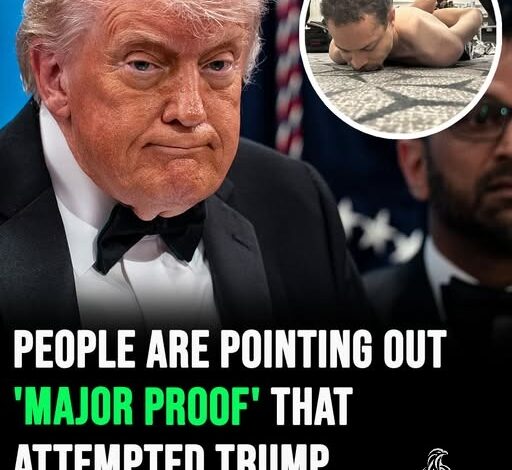
In an era dominated by hyper-connectivity and 24-hour news cycles, major political events are no longer just consumed; they are instantly dissected, debated, and reconstructed by millions of amateur analysts online. Recently, a sensational narrative began circulating across social media platforms and online forums, capturing the attention of a highly divided public. The viral claims suggest that a high-profile, live-fire incident involving President Donald Trump—specifically occurring during a crowded, glitzy media gala—was not a genuine, terrifying security breach, but rather a meticulously choreographed piece of political theater. According to these rumors, online theorists are pointing to what they call major proof that the entire harrowing event was preplanned and staged, designed specifically to manipulate public sentiment and shift the political landscape of a nation in turmoil.
At the absolute center of this viral storm is a single, offhand comment allegedly made by Trump’s own press secretary. Conspiracy theorists have seized upon this brief statement, replaying it, analyzing the syntax, and weaponizing it as definitive evidence of a coordinated setup. The narrative suggests that the press secretary’s choice of words somehow slipped up, hinting at prior knowledge of the chaotic scene before the first shots were ever fired. The articles circulating online paint a dramatic picture of a room freezing in anticipation, followed by a sudden outbreak of gunfire, suggesting that the timing, the security response, and the subsequent media coverage were all too perfect to be authentic.
As this dramatic theory continues to ripple across digital networks, it has fueled intense speculation, heated debates, and widespread confusion. In tense geopolitical moments, highly charged rumors of this nature act as digital wildfire, preying on existing public distrust of institutions, mainstream media, and political figures. The articles urge readers to continue reading to uncover the dark truth, promising a deeper look into a conspiracy that could redefine modern history.
However, a serious, objective evaluation of the facts, security protocols, and official investigative records reveals that these claims of a staged event are entirely baseless and fabricated.
First, there is absolutely no record, official confirmation, or credible journalistic reporting of an assassination attempt or live-fire incident occurring at a media gala involving Donald Trump in the spring of 2026. The scenario described in the viral posts is entirely fictional, relying on sensationalized storytelling to mimic the urgency of breaking news. Actual, verified security threats against high-ranking political figures and former presidents are subjected to immediate, highly rigorous investigations by the Secret Service, federal law enforcement agencies, and independent oversight committees. The findings of such investigations are thoroughly documented, publicly briefed, and covered extensively by reputable global news organizations, none of which have reported on this alleged media gala incident.
Furthermore, the claim that a press secretary’s offhand remark serves as major proof of a conspiracy is a classic example of selective interpretation, often referred to as confirmation bias. In the immediate, chaotic aftermath of any highly stressful public event, verbal slips, misspoken phrases, and confusing timelines are incredibly common. Legitimate communications professionals and security experts emphasize that analyzing a single sentence out of context to construct a massive, multi-agency conspiracy is a highly unreliable and unscientific approach to understanding complex security events.
To suggest that a live-fire incident could be safely and flawlessly staged in a room packed with high-profile guests, active media personnel, and multiple independent cameras is a logistical and physical impossibility. Modern political events involving protected individuals are secured using multi-layered defense perimeters, active surveillance, and strict access controls managed by professional security details. The coordination required to choreograph a fake shooting in such an environment without leaving a massive, undeniable trail of physical and digital evidence is completely unfeasible.
The viral spread of this fabricated conspiracy highlights a troubling trend in the modern digital media landscape: the monetization of outrage and skepticism. Sensationalist websites and independent content creators frequently design emotionally manipulative headlines and vague, dramatic stories to exploit political polarization. By using clickbait techniques, open-ended cliffhangers, and conspiratorial framing, these platforms successfully drive high volumes of traffic to their pages, generating substantial advertising revenue in the process. They cater directly to audiences already inclined to believe the worst about their political opponents, reinforcing echo chambers and further eroding public trust in verified facts.
This phenomenon underscores the critical necessity of digital media literacy and critical thinking. When encountering highly dramatic, world-shifting news on social media, consumers must look past emotional triggers and actively seek out verification from multiple, independent, and established journalistic sources. True investigative journalism relies on verifiable evidence, on-the-record sources, and rigorous fact-checking, whereas viral rumors rely on speculation, unnamed sources, and circular reasoning.
Ultimately, the definitive reality is that the sensationalized reports of a staged media gala attack on Donald Trump are entirely fictional. No such incident took place, no security breach was manufactured for the cameras, and the viral headlines circulating online are simply engineered to capture clicks, stir political division, and capitalize on public anxiety for digital profit. Verifying the source, demanding credible evidence, and maintaining a healthy skepticism toward unverified breaking news remains the most effective defense against the spread of harmful digital misinformation.