My Son Found a One-Eyed Teddy Bear in the Dirt – That Night, It Whispered His Name and Begged, Help Me
The Sunday walks between my son, Mark, and me had become our sacred ritual—a necessary anchor in the two years since my wife passed away. Mark is a gentle child, perhaps too attuned to the world’s sharpness, and our time together by the lake was the only hour each week where the silence between us felt peaceful rather than heavy with grief.
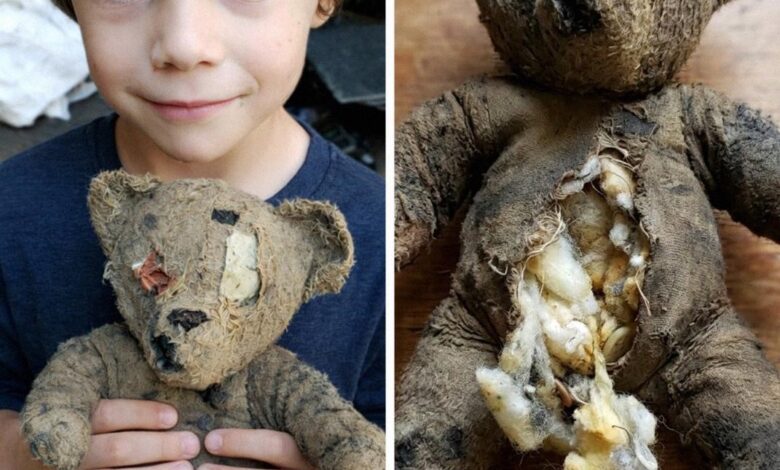
On one such afternoon, under a pale, washed-out sky, Mark stopped abruptly and reached into the tall weeds. He pulled out a filthy, one-eyed teddy bear, half-buried in the mud and matted with grime. It was a wretched object, leaking lumpy stuffing from a jagged tear in its back, but Mark clutched it to his chest with a desperate intensity. “We can’t leave him,” he whispered, that familiar, fragile look in his eyes telling me that, to him, this discarded toy was a mirror of his own sense of loss.
I spent that evening meticulously restoring the bear. I scrubbed the fur, vacuumed out the grit, and carefully stitched the seam in its back while Mark watched, silent and wide-eyed. When I finally tucked him into bed that night, he was already drifting off, the bear nestled under his chin. As I reached down to adjust his blanket, my hand brushed the toy’s belly.
Inside the bear, something clicked. A burst of static hissed through the fabric, followed by a tiny, trembling voice that turned my blood to ice. “Mark, I know it’s you. Help me.”
I froze. It wasn’t a prerecorded greeting or a digital malfunction; it was the raw, straining voice of a child. I eased the bear from Mark’s sleeping grip and retreated to the kitchen. Under the harsh overhead light, I ripped open the stitches I had just sewn and pulled out a small plastic box, crudely held together with duct tape. When I pressed the button, the voice returned, frantic. “Mark? Can you hear me?”
“This is Mark’s dad,” I replied, my heart hammering against my ribs. “Who is this?”
After a long silence and more static, the reply came through: “It’s Leo. Please help me.”
Leo. I remembered him immediately—the exuberant boy who used to play with Mark at the park every weekend until he vanished from our routine months ago. Through the makeshift walkie-talkie, Leo’s voice broke as he spoke of a “loud house” and grown-ups who didn’t listen. He had planted the bear where he knew Mark would find it, using his toy as a desperate message in a bottle.
The next morning, I gently questioned Mark, who remembered Leo’s “blue house” near the park. Following the lead, I drove there after school drop-off. When Leo’s mother, Mandy, answered the door, she looked exhausted, the tell-tale signs of a promotion-driven burnout etched into her face. I didn’t lead with accusations; I simply told her the truth about the bear and the voice inside it. The realization that her son had resorted to such a desperate measure to cry out for her attention shattered her composure. She hadn’t been abusive; she had simply been absent, her new career consuming the hours she once spent at the park, leaving Leo in a silent, lonely world of his own.
That Saturday, we met at the lake. When the two boys saw each other, they collided in a hug that was clumsy and perfect. While the kids played, Mandy and I sat nearby, discussing the dangerous ease with which life can become a series of unanswered emails and missed moments. We made a pact to slow down, to ensure that the silence in our homes was filled with presence rather than isolation.
Today, the bear sits quietly on a shelf in Mark’s room. It doesn’t speak anymore, which is exactly how it should be. But that Sunday taught me a vital lesson: sometimes, the things that look like trash in the dirt are actually the loudest voices, begging us to pay attention before it’s too late.