Two Boys Emptied My Daughters Savings Jar Until I Taught Their Mother A Lesson
I’m thirty-four years old, and I honestly never thought I’d have to argue with a grown woman about stealing from a six-year-old.
But there I was. Standing in my upstairs hallway on a Tuesday afternoon in May, holding an empty pink plastic jar, with my phone pressed against my ear. And my sister-in-law was laughing at me.
“Oh, relax, Caroline,” Piper said. “It’s just money!”
Let me back up.
My name is Caroline Ellis. My husband is Matt. We live in a split-level house in Lee’s Summit, Missouri, about thirty minutes outside Kansas City. Matt’s a pharmacist at the Hy-Vee on Rice Road. I’m a medical biller for an orthopedic practice. I work from home three days a week.
We have one daughter. Elsie. She’s six.
Elsie is the kind of kid who lines her stuffed animals up by height before bed. Who says “excuse me” when she burps, even when she’s alone. Who once cried for twenty minutes because she accidentally stepped on a worm on the sidewalk and then insisted we hold a funeral for it in the flower bed.
She’s careful. She’s thoughtful. She takes things very, very seriously.
Including money.
In January, Elsie decided she wanted a bike.
Not just any bike. A specific bike. She’d seen it at Target when we were buying laundry detergent. It was purple, with white tires and a white basket on the front with little plastic daisies on it. It had streamers coming out of the handlebars. Purple and silver.
She stood in front of it in the aisle for ten minutes.
“Mommy,” she said. “That’s my bike.”
I looked at the price tag. A hundred and fifty-nine dollars.
“That’s a lot of money, sweetheart.”
“How much is a lot?”
“More than you have.”
She thought about that for a long time. Then she looked up at me.
“How do I get more?”
Matt and I talked about it that night.
We could have just bought it for her. We’re not rich, but we could have. Her birthday was in April. We could have wrapped it up with a big bow.
But Matt had an idea.
“What if she saves for it?” he said. “Part of it. We’ll match whatever she saves. Dollar for dollar. But she has to put in the work.”
“She’s six, Matt.”
“I know,” he said. “That’s the perfect age. That’s when you learn this stuff. Money doesn’t grow on trees. You want something, you work for it. You save for it. And when you finally get it, it means something.”
He was quiet for a moment.
“I wish somebody had taught me that at six,” he said.
I didn’t know what he meant. Not then.
So we sat Elsie down at the kitchen table the next morning.
We explained the plan. Every dollar she saved, we’d match it. When she got to eighty dollars, we’d add eighty, and that would be enough for the bike. Plus tax.
“Eighty dollars,” Elsie repeated.
“Eighty dollars.”
“How long does that take?”
“It depends,” Matt said. “On how hard you work.”
She got a jar.
A pink plastic jar with a screw-top lid that used to have cheese puffs in it. She peeled the label off herself. She decorated it with stickers. Unicorns and rainbows and one sticker of a taco that she said was “for luck.”
On the front, she taped a piece of paper. She wrote on it herself, in purple marker, very carefully, with her tongue sticking out the side of her mouth the whole time.
BIKE MUNY.
She put it on her dresser. Right in the middle. Where she could see it from her bed.
And then she started saving.
Every dollar. Every quarter. Every penny.
She got a dollar a week for setting the table and feeding our cat, Biscuit. She put every single one in the jar.
She got five dollars from the tooth fairy when her front tooth fell out in February. She put it in the jar.
She got twenty dollars from Grandma Linda for her birthday in April. She put it in the jar.
She found a quarter in the couch cushions. She put it in the jar.
She sold lemonade on our front porch on the first warm Saturday in April. Fifty cents a cup. She made eleven dollars and fifty cents. Mostly from our neighbor Mr. Kowalski, who bought six cups and said it was the best lemonade he’d ever tasted, even though I’d forgotten to put enough sugar in it.
She put it all in the jar.
She counted it every night.
Every single night before bed. She’d take the jar down off her dresser and sit on the floor of her room with her legs crossed and dump it all out on the carpet. She’d sort it into piles. Dollars. Quarters. Dimes. Nickels. Pennies.
She’d count each pile. Out loud. Very slowly. Then she’d write the total on a little notepad she kept next to the jar.
Then she’d put it all back in the jar and put the jar back on the dresser and climb into bed.
“How much tonight, Els?” I’d ask from the doorway.
She’d tell me. Every night. The exact amount.
$12.75.
$23.50.
$41.25.
By the middle of May, she had eighty-seven dollars and forty cents.
She’d done it. More than she needed. She’d been saving for four months.
That night, she sat on the floor of her room and counted it three times. Then she wrote it on the notepad and drew a big star next to it.
“Mommy,” she said. “I did it.”
“You did it, baby.”
“Can we get the bike now?”
“This weekend,” I said. “Saturday. We’ll go to Target and get it. Daddy will match it, just like he promised.”
She looked at the jar for a long time.
“I want to count it one more time on Saturday morning,” she said. “Before we go. To make sure.”
“Okay.”
“And then I want to carry it into the store myself. And give it to the lady.”
“Okay, baby.”
She climbed into bed. She lay there looking at the jar on her dresser.
“Four more days,” she whispered.
Now I have to tell you about Piper.
Piper is Matt’s older sister. She’s thirty-eight. She lives about fifteen minutes away from us, in Blue Springs. She has two boys. Tucker is ten. Brody is eight.
I’m going to try to be fair here. I really am.
Piper’s not a monster. She’s funny. She’s loud. She’s the kind of person who walks into a room and everybody turns to look at her. She tells great stories. She does a perfect impression of every one of their relatives.
And she loves her boys. I’ve never once doubted that.
But those boys have never heard the word “no.”
Not once in their lives.
They take things.
Every time they come to our house, something goes missing. Or gets broken. Or gets taken home.
Elsie’s Barbie camper. Brody took it home in his backpack last summer. We found out three weeks later when Piper posted a picture on Facebook of Brody playing with it in her backyard.
Elsie’s tablet. Tucker grabbed it out of her hands at Thanksgiving because he wanted to play Minecraft. When she cried and asked for it back, he held it over his head where she couldn’t reach it.
Elsie’s Halloween candy. All of it. The whole pillowcase. Gone, the day after Halloween, when Piper brought the boys over “just to say hi.” Tucker had a mouth full of Reese’s when they left.
And every single time, Piper brushed it off.
“Oh, they’re just kids! Don’t be so uptight!”
I’d try to say something. Gently.
“Piper, Brody took Elsie’s camper home.”
“Did he? Huh. I’ll look for it.”
She never looked for it.
“Piper, Tucker won’t give Elsie her tablet back.”
“Tucker. Give it back.” Then, to me, laughing: “He’ll give it back. Boys, right? They just love electronics.”
He didn’t give it back. Not until Matt went over and took it out of his hands.
“Piper, the boys ate all of Elsie’s Halloween candy.”
“Oh, Caroline. It’s candy. She doesn’t need all that sugar anyway. Honestly, they did her a favor.”
Matt never said much.
That was the thing that drove me crazy. He’d sit there at Thanksgiving dinner while Tucker held Elsie’s tablet over his head, and his jaw would get tight, and a little muscle would jump in his cheek. But he wouldn’t say anything.
Later, in the car, I’d ask him.
“Why don’t you ever say anything to her?”
He’d look out the windshield.
“Because it doesn’t do any good,” he’d say. “It never has.”
Then came that Tuesday.
It was a work-from-home day. I was at the kitchen table with my laptop, going through a stack of insurance claims for a knee replacement that Blue Cross had denied three times.
Elsie was home from school. It was a teacher in-service day. She was upstairs in her room playing with her stuffed animals.
At two-fifteen, the doorbell rang.
I opened the door.
Piper. And Tucker. And Brody.
No phone call. No text. No heads-up.
Typical Piper.
“Surprise!” she said. “We were in the neighborhood!”
They were not in the neighborhood. Nobody is ever in our neighborhood. It’s a cul-de-sac.
“Hi, Piper,” I said. “I’m actually working today—”
“Oh, don’t mind us!” she said, already coming in the door. “The boys have the day off school too. In-service day. I thought they could play with Elsie. You just keep working. We’ll be quiet as mice.”
The boys ran straight past me and up the stairs.
They didn’t take off their shoes. They didn’t say hi. They just ran.
“Boys!” Piper called after them. Not very loud. “Be nice to your cousin!”
Then she walked into my living room and sat down on my couch. She kicked off her sandals. She put her feet up on my coffee table.
“Got any of that iced tea?” she said.
I made her iced tea.
I sat back down at my laptop.
Piper talked for an hour. About her neighbor’s new pool. About her husband, Craig, who was working too many hours at the car dealership. About a fight she had with a woman at the PTA meeting over the fall carnival.
I said “mm-hm” and “wow” and “that’s crazy” and tried to work.
Upstairs, I could hear the kids. Running. Thumping. Some yelling. Some laughing. At one point, something fell over and there was a loud crash.
“Boys!” Piper called. Without getting up. “Be careful!”
At three-thirty, Piper looked at her phone.
“Oh, shoot,” she said. “I’ve gotta pick up Craig’s dry cleaning before five. Boys! Let’s go!”
The boys came thundering down the stairs.
Tucker was first. He had his hands jammed in the front pocket of his hoodie.
Brody was right behind him. He was giggling.
“Bye, Aunt Caroline!” Brody said.
“Bye, Brody.”
They ran out the front door to Piper’s minivan.
Piper put her sandals back on. She put her empty iced tea glass on my coffee table. Not in the sink. On the coffee table. Next to a ring of water.
“Thanks, hon! See you Sunday at Mom’s!”
And they were gone.
I went back to my knee replacement claims.
About five minutes later, I heard Elsie on the stairs.
Slow. One step at a time.
She came into the kitchen.
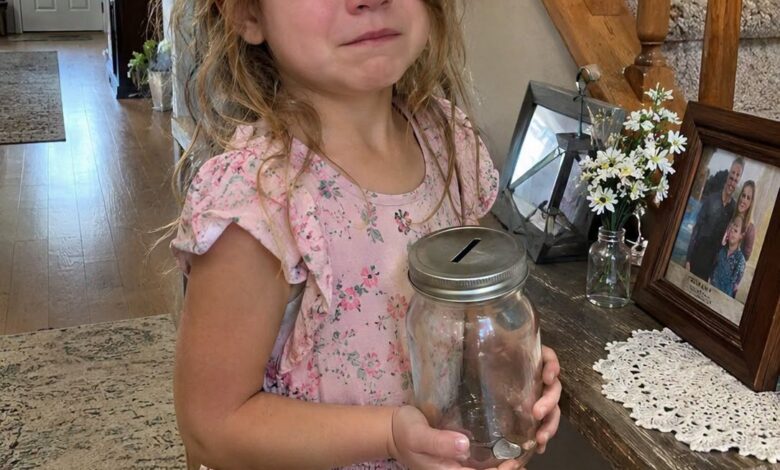
She was trying really hard not to cry. I could see it. Her lips were pressed together so tight they’d gone white. Her chin was shaking. Her eyes were huge and wet.
“Sweetheart,” I said. “What’s wrong?”
She didn’t answer.
“Elsie. Baby. What happened?”
“Mommy,” she said. Her voice cracked right down the middle. “They took my money.”
“What money, honey?”
“My bike money,” she said. “They took all of it.”
I stood up so fast my chair fell over.
I ran up the stairs.
Elsie’s room looked like a tornado had been through it. Her stuffed animals were all over the floor. Her bookshelf was knocked over on its side. Her bedspread was half off the bed.
And on her dresser, right in the middle, where it always was, was the pink jar.
The lid was off.
It was empty.
Completely empty.
Not a dollar. Not a quarter. Not a penny.
Eighty-seven dollars and forty cents. Four months. Every tooth fairy dollar. Every birthday dollar. Every cup of lemonade.
Gone.
The little notepad was still next to the jar. With all her totals written on it. In her careful purple handwriting.
$87.40. With a big star next to it.
I went back downstairs.
Elsie was sitting on the bottom step. She was holding her stuffed bunny, Mr. Buttons, very tight against her chest.
I sat down next to her.
“Elsie,” I said. “Did you see them take it?”
She nodded.
“Tell me what happened.”
She was quiet for a long time.
“Tucker took the jar off my dresser,” she said. “And he opened it. And he dumped it out on the bed. And I said, ‘That’s my bike money. Don’t touch it.’”
“And then what?”
“And then Brody grabbed some,” she said. “And Tucker grabbed the rest. And they put it in their pockets. And I said, ‘Give it back.’ And Tucker said no.”
Her chin was shaking.
“And I tried to take it back,” she said. “Out of Brody’s pocket. And Tucker pushed me. And I fell on my bookshelf. And it fell over.”
I looked at her.
At her arm. There was a red mark on her elbow. Where she’d hit the bookshelf.
“Did you tell Aunt Piper?”
“I tried,” Elsie said. “I went to the top of the stairs. But Tucker said if I told, he’d break my bunny.”
She held Mr. Buttons tighter.
“So I didn’t,” she said. “I waited till they left.”
I sat there on the stairs with my daughter.
I couldn’t think.
I couldn’t breathe.
I put my arm around her. She leaned against me. She didn’t cry. That was the worst part. She just sat there, holding Mr. Buttons, with her chin shaking, trying so hard not to cry.
“Mommy,” she said. “Can I still get my bike on Saturday?”
I called Piper.
She picked up on the third ring. I could hear the minivan radio in the background. Some pop song. The boys yelling.
“Caroline! Did I forget something?”
I tried to stay calm.
I really, really tried.
“Hey,” I said. “The boys took Elsie’s savings. Out of her jar. Can you please make sure they give it back?”
There was a little pause.
Then she laughed.
She actually laughed.
“Oh, relax,” Piper said. “It’s just money!”
“Piper,” I said. “She’s been saving for months. For a bike. She’s been saving since January. Every dollar she’s gotten.”
“Well,” Piper said. “Maybe it’s time she learned to share.”
“Share?” I said. “Share? They took it without asking! Tucker dumped her jar out on the bed and took every penny! She asked them to give it back and Tucker pushed her into her bookshelf!”
“Oh, he did not push her.”
“She has a mark on her arm, Piper.”
“Kids roughhouse,” Piper said. “God, Caroline. You’re making such a big deal out of nothing. My boys wanted some spending money too! We’re going to the mall tomorrow. They want to get those Pokémon cards everybody’s buying.”
I couldn’t believe what I was hearing.
“They’re going to spend Elsie’s bike money on Pokémon cards,” I said slowly.
“It’s not her money anymore,” Piper said. “It’s their money now. Finders keepers.”
“They didn’t find it. They stole it. Out of her room.”
“Stole,” Piper said. “Oh my God. Listen to yourself. Stole. They’re eight and ten. They’re her cousins. It’s family. Family shares.”
And then she said it.
“Honestly, Caroline,” Piper said, “you’re raising a selfish little girl. Making a six-year-old count her pennies every night like Scrooge McDuck. It’s creepy. Kids should be generous. She should be happy her cousins wanted it.”
That did it.
Something in me went very, very quiet.
I looked down at Elsie. She was sitting next to me on the bottom stair. Clutching her empty pink jar against her chest with both arms. With the BIKE MUNY sign. And the unicorn stickers. And the taco for luck.
She was trying so hard not to cry.
I could have screamed at Piper.
I wanted to. Believe me. I had about forty things I wanted to say. Some of them I won’t write down.
But I looked at my daughter.
And I said, very calmly:
“Okay, Piper. I’ll see you Sunday.”
And I hung up.
Matt came home at six-thirty.
He walked in the front door and saw me sitting on the couch with Elsie asleep in my lap. She’d cried herself to sleep around five. Finally. After holding it in for two hours.
She was still holding the empty jar.
Matt looked at the jar.
He looked at me.
“What happened?”
I told him.
Everything. Piper showing up without calling. The boys running upstairs in their shoes. The crash. Tucker with his hands jammed in his hoodie pocket. Brody giggling. The empty jar. The bookshelf. The red mark on Elsie’s elbow. “If you tell, I’ll break your bunny.”
The phone call.
“It’s just money.” “Maybe it’s time she learned to share.” “Finders keepers.” “Pokémon cards.” “You’re raising a selfish little girl.”
Matt didn’t say anything the whole time.
He stood in the middle of the living room in his white pharmacist coat with his car keys still in his hand.
When I got to “You’re raising a selfish little girl,” his keys fell out of his hand onto the carpet.
He didn’t pick them up.
He sat down on the coffee table across from me.
He looked at Elsie. Asleep in my lap. With the jar.
“She took it,” he said quietly. “She took it again.”
I looked at him.
“Again?”
Matt was quiet for a long time.
“I was seven,” he said.
“I wanted a bike,” Matt said. “A red Huffy. With a banana seat. I saw it at the Ben Franklin store in Independence. Thirty-nine dollars.”
He was looking at Elsie’s jar.
“Dad said if I saved half, he’d pay the other half,” he said. “So I saved. I mowed Mrs. Henley’s lawn next door. A dollar every Saturday. I collected cans and took them to the recycling place. I didn’t buy one piece of candy for a whole summer.”
He swallowed.
“I kept it in a coffee can,” he said. “Under my bed. A Folgers can. I had nineteen dollars and eighty cents. Twenty cents away.”
“Matt.”
“And one day I came home from swimming lessons,” Matt said, “and it was gone. The can was empty. On my bed.”
“Piper,” I said.
“Piper,” Matt said. “She was eleven. She took it to buy a Walkman. A yellow Sony Sports Walkman. She’d been begging Mom for it for months. Mom kept saying no. So Piper went in my room and took my coffee can.”
He laughed. It wasn’t a real laugh.
“I told Mom,” he said. “I was crying so hard I could barely talk. And Mom went to Piper’s room. And she came back out. And you know what she said?”
I knew. I already knew.
“She said, ‘Matthew, honey, your sister needed it more. Family shares.’”
The living room was very quiet.
“She let her keep it,” Matt said. “The Walkman. She said I was being selfish. She said I’d get over it.”
He looked down at his hands.
“I never got the bike,” he said. “Dad got laid off that fall. From the Ford plant in Claycomo. There wasn’t money for bikes after that. I never got it.”
He looked at Elsie.
“I was thirty-six years old,” he said, “before I finally bought myself a bike. Remember? Two years ago? At Dick’s Sporting Goods?”
I remembered. He’d come home with a gray mountain bike and stood in the driveway with it for twenty minutes, just looking at it. I thought it was funny at the time. I’d teased him about his midlife crisis.
“That’s why,” Matt said quietly.
He reached over and very gently touched Elsie’s hair.
“That’s why I wanted her to save for it,” he said. “That’s why I wanted her to learn. So that when she finally got it, it would be hers. Really hers. Something nobody could take away.”
His voice broke.
“And Piper took it,” he said. “Again. Thirty years later. Same thing. Same exact thing.”
I’d never seen Matt cry.
Not at our wedding. Not when Elsie was born. Not when his dad died.
He didn’t cry now, either. Not quite.
But he sat on the edge of our coffee table with his hand on our daughter’s hair. And his shoulders were shaking.
That night, after we put Elsie to bed, Matt and I sat at the kitchen table for a long time.
“I could just give her the money,” Matt said. “Eighty-seven dollars. It’s nothing. I’ll give it to her tomorrow. We’ll go get the bike Saturday like we said.”
“And then what?”
He looked at me.
“And then Piper comes over again next month,” I said. “And the boys take something else. And Piper laughs. And we pay for it again. And Elsie learns that if somebody takes something from you, Mommy and Daddy just replace it. And nobody ever has to say sorry.”
Matt didn’t say anything.
“And the boys learn,” I said, “that they can take whatever they want. From anybody. And their mom will call it sharing.”
“So what do you want to do?” Matt said.
I thought about it.
I’d been thinking about it since the phone call. Since “You’re raising a selfish little girl.”
“Sunday,” I said. “At your mom’s.”
Every Sunday, the whole family has dinner at Matt’s parents’ house in Independence. Grandma Linda and Grandpa Ron. They’ve lived in the same brick ranch on Delaware Street since 1979.
Grandma Linda makes pot roast. Every single Sunday. For forty years.
Everybody comes. Matt and me and Elsie. Piper and Craig and the boys. Matt’s younger brother, Danny, and his wife, Sabrina, and their twin girls. Sometimes Aunt Carol, Grandma Linda’s sister.
Fourteen people. Around a dining room table that’s really only big enough for ten.
“What are you going to do?” Matt asked.
I looked at him.
“I’m going to take Piper’s advice,” I said.
“What advice?”
“She says family shares,” I said. “So I’m going to share.”
I spent all day Wednesday and Thursday getting ready.
First, I went to Target.
Not for the bike. Not yet.
I went to the craft aisle. I bought a big glass jar. The biggest one they had. A gallon-size cookie jar with a cork lid. I bought a roll of pink ribbon and a sheet of glittery letter stickers.
At home, I cleaned the jar. I tied pink ribbon around the neck. I put the letter stickers on the front, very carefully, one at a time.
THE SHARING JAR.
Then I went through my closet. And Matt’s.
And I found some things.
I found the cashmere sweater Piper gave me for Christmas three years ago. Light blue. It still had the tags on. She’d told me at the time it cost two hundred dollars. She told me that several times.
I found the KitchenAid stand mixer Piper and Craig gave Matt and me for our wedding. Red. She’d mentioned that every Thanksgiving since. “Are you still using the mixer we gave you? That was a really nice gift. Those things are expensive.”
I found a framed photograph. Piper’s senior picture. She’d given one to every member of the family when she graduated high school in 2004. In a gold frame. Matt’s mom has one on her mantel. We had ours in a box in the basement.
I found a coffee mug. It said WORLD’S BEST AUNT. Piper bought it for herself, at a gift shop in Branson, and gave it to Elsie to give back to her. Then forgot it at our house. It had been sitting in our cabinet for a year.
I put everything in a big cardboard box.
The sweater. The mixer. The photograph. The mug.
And on top, I put Elsie’s empty pink jar. With the BIKE MUNY sign. And the unicorn stickers. And the taco for luck.
Then I did something else.
Something I’m not proud of. But I’d do it again.
I called Craig.
Craig is Piper’s husband. He’s forty-one. He sells cars at the Ford dealership on Highway 40 in Blue Springs. He’s a big, quiet guy with a goatee. He watches football. He doesn’t say much at Sunday dinners.
I didn’t have his number. I had to get it from Matt.
He picked up on the second ring.
“Caroline?” he said. Surprised. “Is everything okay?”
“Craig,” I said. “I need to tell you something. And I need you to just listen. Okay?”
I told him.
The jar. The bike. Eighty-seven dollars and forty cents. Four months. The red mark on Elsie’s elbow. The bookshelf. “If you tell, I’ll break your bunny.”
Then I told him what Piper said on the phone.
“It’s just money.” “Finders keepers.” “Pokémon cards.” “You’re raising a selfish little girl.”
Craig didn’t say anything for a long time.
“Craig?”
“I’m here,” he said. His voice was strange. Quiet.
“I’m not asking you to do anything,” I said. “I just thought you should know. Before Sunday.”
“Pokémon cards,” Craig said slowly.
“That’s what she said.”
“They came home from the mall on Wednesday,” Craig said, “with a whole bag of Pokémon cards. Like, a big bag. And a Nerf gun. One of the big ones. With the drum. Tucker said Piper bought them.”
He was quiet.
“I asked her where she got the money,” Craig said. “I’ve been working sixty-hour weeks, Caroline. We’re behind on the van payment. I told her no extras this month. Nothing. And she comes home with a bag of Pokémon cards and a forty-dollar Nerf gun.”
He let out a long breath.
“She told me she’d been saving,” Craig said. “She said it was from her own savings.”
“I’m sorry, Craig,” I said.
“Don’t be,” Craig said. “Don’t you be sorry.”
He was quiet for a moment.
“She did this to Matt,” he said. “Didn’t she? When they were kids. With the bike. She told me that story once. At a Christmas party. She thought it was funny. She called it ‘the Great Walkman Heist.’”
I closed my eyes.
“Yes,” I said. “She did.”
“Thirty years,” Craig said. “And she’s still laughing about it.”
Sunday came.
We got to Grandma Linda’s at five. Like always.
Matt carried in the cardboard box. He set it on the floor of the living room, in the corner, by the TV.
Elsie came in holding my hand. She was wearing her favorite yellow dress. She’d brushed her own hair. She was holding Mr. Buttons.
She was quiet. She’d been quiet all week.
Every night, she’d taken her empty jar down off her dresser. And sat on the floor of her room. And looked at it.
She didn’t count anything. There was nothing to count.
She just sat there.
Grandma Linda met us at the door. She was seventy. Short and round, with curly gray hair and reading glasses on a beaded chain and an apron that said KISS THE COOK, which nobody ever did.
“There’s my girl!” she said. And she bent down and hugged Elsie.
Elsie hugged her back. She didn’t say anything.
Grandma Linda pulled back and looked at her.
“What’s wrong, sweet pea?” she said. “You look sad.”
Elsie looked up at me.
I didn’t say anything. Not yet.
“Nothing, Grandma,” Elsie whispered.
Piper got there at five-twenty.
She came in loud. Like always. “We’re here! Sorry we’re late! Brody couldn’t find his other shoe!”
Craig came in behind her. He looked at me across the room. He nodded. Just once.
The boys came in last.
Tucker was carrying the Nerf gun. The big one, with the drum. It was bright orange and blue. It was almost as long as he was.
Brody had a deck box. A little plastic box with a Pikachu on it. Full of Pokémon cards.
They ran straight into the living room. Brody sat down on the floor by the TV and started spreading his Pokémon cards out on the carpet. Tucker started shooting foam darts at the dog.
“Tucker!” Grandpa Ron said from his recliner. “Not at Biscuit!”
Tucker shot one at the ceiling instead.
Elsie stood in the doorway of the living room.
She was looking at the Pokémon cards spread out on the carpet.
At the Nerf gun.
She didn’t say anything.
She just stood there holding Mr. Buttons. And her chin started shaking.
I put my hand on her shoulder.
“Come help me in the kitchen, baby,” I said.
Dinner was at six.
Pot roast. Mashed potatoes. Green beans with bacon. Grandma Linda’s yeast rolls. Sweet tea in the big glass pitcher with the lemons painted on it.
Fourteen people. Squeezed around the dining room table. Elbows touching. Kids at the card table pushed up against the end.
Everybody was talking at once.
Piper was telling a story about the woman at the PTA meeting. The fall carnival fight. She was doing an impression. Everybody was laughing.
I waited.
Then, halfway through dinner, Brody held up a Pokémon card.
“Grandpa! Look! I got a Charizard! A shiny one!”
Grandpa Ron squinted at it. “What’s a Charizard?”
“It’s the best one,” Brody said. “It’s worth like a hundred dollars. Tucker says.”
“A hundred dollars?” Grandma Linda said. “For a card?”
“Some of them,” Tucker said. With his mouth full of roll. “We got a whole bunch at the mall. Mom bought us like fifteen packs.”
“Fifteen packs!” Grandma Linda said. She looked at Piper. “Piper. Those things are expensive.”
Piper laughed.
“Oh, they’ve been so good lately,” she said. “I wanted to treat them.”
I put down my fork.
I looked at Matt.
He nodded.
I stood up.
“Actually,” I said. “I have something too.”
Everybody looked at me.
I walked into the living room. I picked up the cardboard box. I carried it back into the dining room.
I set it down on the sideboard. Next to Grandma Linda’s good china.
Then I reached into the box.
And I took out the big glass jar. With the pink ribbon. And the glittery letters.
THE SHARING JAR.
Piper looked at it.
“What’s that?” she said.
I smiled at her.
“Well,” I said. “Piper and I were talking on the phone this week. And she taught me something really important.”
Piper’s face changed. Just a little.
“She told me,” I said, “that family shares.”
The table went quiet.
Not all at once. In a wave. The grown-ups first. Then Danny’s twins. Then even Brody, with his Charizard still in his hand.
“So I thought,” I said, “since we’re all family, we should all share. Like Piper says.”
I reached into the box.
I took out the light blue cashmere sweater. With the tags still on.
“Piper gave me this sweater,” I said. “For Christmas. Three years ago. It cost two hundred dollars. She told me so.”
I folded it. I put it in the Sharing Jar. Well, I tried to. It didn’t fit. I set it next to the jar.
“I’m going to share it,” I said. “With whoever wants it. Since family shares.”
Piper’s face went pink.
“Caroline—”
I reached into the box again. I took out the red KitchenAid mixer. I set it on the sideboard with a thunk.
“Piper and Craig gave us this for our wedding,” I said. “It’s a really nice gift. Those things are expensive. Piper tells us every Thanksgiving.”
“Caroline, what are you—”
I reached into the box. I took out the senior picture. In its gold frame. Seventeen-year-old Piper, with big hair and a lot of lip gloss.
“And this,” I said. “Piper gave everybody one of these. In 2004.”
Grandpa Ron snorted into his sweet tea.
I set it next to the mixer.
“And this,” I said. I took out the mug. WORLD’S BEST AUNT. “Piper left this at our house last year.”
I set it down.
“All of it,” I said. “We’re sharing it. With whoever wants it. Because family shares.”
Then I reached into the box one more time.
And I took out Elsie’s pink jar.
I held it up so everybody could see.
The unicorn stickers. The rainbows. The taco for luck.
The BIKE MUNY sign. In purple marker. In a six-year-old’s careful, crooked handwriting.
And nothing inside.
“This is Elsie’s jar,” I said.
The table was dead quiet now.
“She’s been saving in it since January,” I said. “For a bike. A purple bike, at Target, with a basket on the front with daisies on it.”
I looked at Grandma Linda.
“She put your birthday twenty dollars in here, Linda,” I said. “Every single dollar of it.”
Grandma Linda put her hand over her mouth.
“She put her tooth fairy money in here,” I said. “And her lemonade money. And a dollar a week for feeding Biscuit. And a quarter she found in the couch. She counted it every night. On the floor of her room. Out loud. And wrote it down.”
I set the jar on the table. Right in the middle. Next to the pot roast.
“Eighty-seven dollars and forty cents,” I said. “That’s what was in it on Monday night. She’d done it. She was going to get her bike yesterday.”
I looked at the kids’ card table.
At Brody, with his shiny Charizard.
At Tucker, with the orange and blue Nerf gun leaning against his chair.
“On Tuesday afternoon,” I said, “Piper came over with the boys. Without calling. And the boys went upstairs to Elsie’s room.”
Tucker had stopped chewing.
“And they took it,” I said. “All of it. Every penny. They dumped it out on her bed and put it in their pockets. And when Elsie asked for it back, Tucker pushed her into her bookshelf.”
I looked at Elsie.
“Show Grandma your arm, baby,” I said.
Elsie held up her arm.
There was a bruise on her elbow. Purple and yellow now. Five days old.
Grandma Linda made a sound. A small one. Like something had hit her in the chest.
“I called Piper,” I said. “And I asked her to make the boys give it back.”
I looked at Piper.
“And she said, ‘It’s just money.’ She said, ‘Maybe it’s time she learned to share.’ She said, ‘Finders keepers.’”
Piper’s face had gone from pink to red.
“She said the boys wanted spending money too,” I said. “For Pokémon cards. At the mall.”
I looked at the shiny Charizard in Brody’s hand.
“And then she told me,” I said, “that I’m raising a selfish little girl.”
Nobody said anything.
The only sound in the whole dining room was the clock on Grandma Linda’s wall. The one shaped like a cat whose tail swings back and forth.
Tick. Tick. Tick.
“So I thought,” I said, “since Piper’s taught us all that family shares, we should all do it. Together.”
I picked up the Sharing Jar.
I walked over to the kids’ card table.
I held it out.
“Brody,” I said. “Would you like to share your Pokémon cards with Elsie? Since family shares?”
Brody looked at me.
He looked at the jar.
He looked at his mom.
He looked down at the cards spread out on the card table. The shiny Charizard.
His face crumpled.
“Mom?” he said. Very small.
“Absolutely not!” Piper said.
She was on her feet. Her chair scraped back against the wall.
“Those are his! I bought those for him! Those are his cards!”
“With what money, Piper?” Craig said.
Everybody turned and looked at Craig.
He was sitting at the far end of the table. Next to Grandpa Ron. He hadn’t said a word all through dinner.
He put down his fork.
“With what money?” he said again. Quiet. Very quiet. “I told you no extras this month. I told you we’re behind on the van. You told me you’d been saving.”
Piper stared at him.
“Craig—”
“Fifteen packs of Pokémon cards,” Craig said. “And a Nerf Ultra. Do you know what those cost, Piper? I looked it up. Fifteen packs at four-fifty. That’s sixty-seven dollars. And the Nerf gun’s forty-nine ninety-nine at Walmart.”
He looked at Elsie’s empty pink jar in the middle of the table.
“That’s a hundred and seventeen dollars,” Craig said. “I’m guessing eighty-seven of it came out of that jar.”
Piper opened her mouth.
She closed it.
She looked around the table………………CONTINUED ON NEXT PAGE