Two Boys Emptied My Daughters Savings Jar Until I Taught Their Mother A Lesson
At her mother. At her father. At her brother Danny and his wife Sabrina. At Aunt Carol.
Everybody was looking at her.
Nobody was laughing.
“Tucker,” Grandpa Ron said.
His voice was low. Gravelly. Grandpa Ron worked thirty-one years on the line at the Ford plant in Claycomo before they laid him off. He’s seventy-two. He doesn’t talk much. When he does, people listen.
Tucker looked up.
“Tucker,” Grandpa Ron said. “Did you take your cousin’s bike money?”
Tucker didn’t say anything.
He looked at his mom.
Piper was looking at the floor.
He looked at his dad.
Craig was looking right back at him. Steady. Waiting.
He looked at Elsie. At her bruised elbow. At Mr. Buttons in her lap.
And then Tucker’s face broke apart.
“Mom said it was okay,” he said.
Everybody froze.
“Mom said it was okay,” Tucker said again. He was crying now. Big, ugly ten-year-old crying. “She said Aunt Caroline and Uncle Matt have lots of money. She said they’d just buy Elsie another one. She said Elsie wouldn’t even care.”
He wiped his nose on his sleeve.
“She said it was sharing,” he said.
Nobody moved.
Piper had gone completely white.
“Tucker,” she said. “That’s not—I didn’t—”
“You did,” Tucker said. “In the car. On the way over. On Tuesday. You said, ‘If you see Elsie’s piggy bank, you can take some. She’s got plenty.’ You said that.”
He was sobbing now.
“And Elsie cried,” Tucker said. “When we took it. She cried really hard. And I pushed her. And I told her I’d break her bunny if she told.”
He put his face in his hands.
“I’m sorry,” he said. “I’m sorry, Elsie. I’m sorry.”
Brody was crying too now. Quietly. He picked up the shiny Charizard. He looked at it.
Then he got up from the card table.
He walked over to where Elsie was sitting. Next to me.
He held out the Charizard.
“You can have it,” Brody said. “It’s worth a hundred dollars. Tucker said.”
Elsie looked at the card.
She looked at Brody.
She didn’t take it.
“I don’t want a card,” she said. Very quietly. “I wanted my bike.”
I need to tell you what happened next.
Because it wasn’t what I expected.
Grandma Linda stood up.
She took off her reading glasses. She let them hang on the beaded chain.
She looked at her daughter across the table.
“Piper,” she said. “Is that true? What Tucker said?”
Piper didn’t answer.
“Piper Ann,” Grandma Linda said. “Look at me.”
Piper looked at her.
“Did you tell those boys to take Elsie’s money?”
Piper’s chin started shaking.
“Mom,” she said. “It’s not a big deal. It’s just money. It’s kid money. It’s like eighty dollars. Caroline makes a fortune at that billing job. Matt’s a pharmacist. They’re fine. They can afford it. And Craig’s been so stressed about money, and the boys never get anything anymore, and everybody at school has those cards, and I just—”
She stopped.
“It’s just sharing,” she said. “That’s all. You always said family shares.”
Grandma Linda didn’t say anything for a long time.
She looked at Piper.
Then she looked at Matt.
Then she looked at Elsie’s empty pink jar in the middle of her dining room table.
And I watched it happen. I watched her remember.
“The Walkman,” Grandma Linda said.
Matt went very still.
“The yellow Walkman,” Grandma Linda said slowly. “In 1996. You took Matthew’s bike money. Out of his coffee can. Under his bed.”
Piper didn’t say anything.
“And he came to me,” Grandma Linda said. Her voice was shaking now. “He came to me crying. He was seven years old. He could barely talk.”
She looked at Matt across the table.
“And I told him,” she said, “that his sister needed it more. That family shares.”
Matt didn’t say anything.
He sat there at his mother’s dining room table. Thirty-seven years old. In his pharmacist’s Sunday khakis.
And for the first time in thirty years, he looked seven.
“I never got the bike, Mom,” he said quietly.
Grandma Linda closed her eyes.
“Dad got laid off that fall,” Matt said. “There wasn’t any money after that. I never got it.”
“I know,” Grandma Linda whispered.
“I was thirty-six before I bought myself one,” Matt said. “Two years ago. At Dick’s. I stood in the driveway with it for twenty minutes. Caroline thought I was having a midlife crisis.”
He laughed. A little. Not really.
“I wasn’t,” he said. “I was seven.”
Grandma Linda sat back down in her chair.
Slowly. Like her legs weren’t working right.
She put her face in her hands.
“I taught her that,” she said. Through her fingers. “I taught her it was sharing. When it was stealing. I taught her that. Thirty years ago.”
She lifted her head and looked at Piper.
“And she taught it to her boys,” Grandma Linda said.
Nobody ate dessert.
Grandma Linda had made a peach cobbler. It sat on the kitchen counter all night under a dish towel. Nobody touched it.
Piper left first.
She stood up from the table without saying anything. She went and got her purse from the front hall. She got her keys.
At the front door, she stopped.
She looked back into the dining room. At everybody. At her mother with her face in her hands. At her father, staring at his plate. At her husband, who hadn’t moved.
At her boys. Crying. At the card table.
“Craig,” she said. “Let’s go.”
Craig didn’t get up.
“Craig.”
“You go,” Craig said. “I’ll bring the boys home later.”
Piper stared at him.
“Craig—”
“Go home, Piper,” Craig said. Very quietly. “I’ll be there later. We’ll talk then.”
Piper looked at him for a long, long moment.
Then she turned around and walked out the front door.
We heard the minivan start. We heard it back out of the driveway.
We heard it drive away down Delaware Street.
Craig stayed.
He sat at the dining room table with his boys. Grandma Linda brought them each a glass of milk. Nobody said anything for a long time.
Then Craig took out his wallet.
He counted out the bills. Out loud. One at a time. On the dining room table.
“Twenty. Forty. Sixty. Eighty.”
He reached into his pocket. He found some change. He counted it out.
“Eighty-five. Eighty-six. Eighty-seven. Eighty-seven forty.”
He pushed the little pile of money across the table.
To Elsie.
“This is yours,” he said. “I’m sorry, Elsie. I’m so sorry.”
Elsie looked at the money.
Then she looked at me.
I didn’t say anything. I wanted her to decide.
She looked at the money for a long time.
Then she pushed it back across the table.
To Craig.
Everybody stared at her.
“Elsie?” I said. “Baby. That’s your money. Uncle Craig’s giving it back.”
“It’s not my money,” Elsie said.
She looked at Tucker. At Brody.
“It’s Uncle Craig’s money,” she said. “My money is gone. Tucker and Brody spent it.”
She looked down at Mr. Buttons in her lap.
“If Uncle Craig gives it back, it’s still not mine,” she said. “It’s his.”
Nobody said anything.
Craig sat there with his mouth open.
Grandpa Ron put down his sweet tea.
Matt looked at our daughter like he’d never seen her before.
“Elsie,” Craig said slowly. “What do you want, sweetheart? What would make it right?”
Elsie thought about it.
She thought about it for a long time. She’s like that. She takes things very seriously.
Then she looked across the table at her cousins.
“I want them to earn it,” she said. “Like I did.”
Craig drove the boys to our house the next Saturday at nine in the morning.
He didn’t come in. He just dropped them off at the curb. He rolled down the window.
“They’re yours till five,” he said to me. “Work ’em hard.”
Tucker and Brody stood on our front walk. Tucker in old jeans. Brody in a T-shirt that was too big for him.
They looked terrified.
I’d made a list.
On a sheet of notebook paper. Taped to the refrigerator. Every chore in our house. And how much it was worth.
Pull weeds in front flower bed — $3.00
Wash Mom’s car — $5.00
Sweep garage — $2.00
Fold one basket of laundry — $1.00
Clean out cat litter box — $1.00
Wipe down kitchen cabinets — $2.00
Mow back yard (with Uncle Matt) — $5.00
Carry recycling to curb — $0.50
“You can do whatever you want on the list,” I said. “When you finish a job, Elsie checks it. If she says it’s done right, you get paid. The money goes in her jar. When her jar has eighty-seven dollars and forty cents in it, you’re done.”
Tucker looked at the list.
“That’s a lot of chores,” he said.
“It’s a lot of money,” I said.
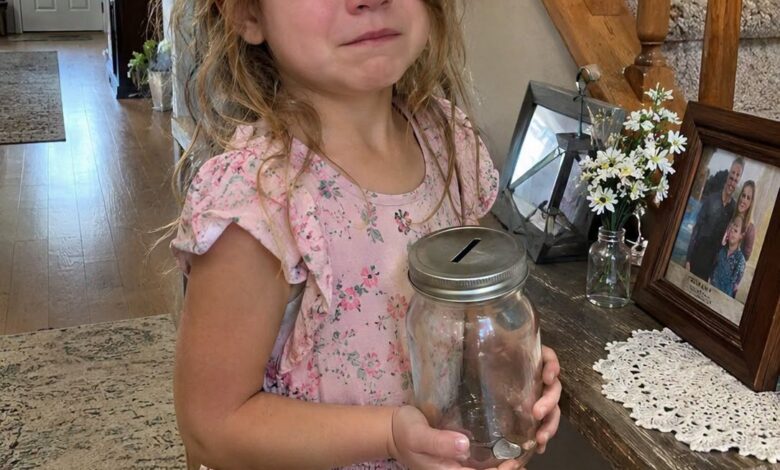
Elsie stood next to me in the kitchen. She was holding her pink jar. The empty one. The BIKE MUNY one. With the taco for luck.
She held it out toward her cousins.
“You can put it in here,” she said. “When you earn it.”
They worked all day that Saturday.
Tucker pulled weeds in the front flower bed for an hour. He got them all. Elsie checked. She found two he missed. He went back and pulled those too.
Three dollars.
Brody washed my car. With a bucket and a sponge and the hose. He got more water on himself than on the car. Elsie checked. She said he missed the hubcaps. He went back and did the hubcaps.
Five dollars.
They swept the garage. They folded laundry. Tucker cleaned out the cat litter box and gagged the whole time and almost threw up. Brody wiped down every cabinet in our kitchen.
Matt mowed the back yard with Tucker. He showed him how to go in straight lines. How to overlap a little so you don’t leave stripes. How to empty the grass catcher.
“Uncle Matt?” Tucker said, halfway through. “Did you really never get your bike?”
Matt stopped the mower.
“I really never got it,” he said.
“Because of Mom?”
Matt looked at him for a long moment.
“Because of a lot of things,” he said. “But yeah. Partly because of your mom.”
Tucker looked down at the grass.
“Did you cry?” he said.
“A lot,” Matt said.
“Elsie cried,” Tucker said. “When we took it.”
“I know.”
“I didn’t think she’d cry that much,” Tucker said. “Mom said she wouldn’t even care.”
Matt started the mower again.
“Your mom was wrong,” he said.
By five o’clock, they’d earned thirty-one dollars and fifty cents.
Every time they finished a job, Elsie checked it. And every time she said it was done right, I handed one of the boys the money. And they walked over to Elsie and put it in her pink jar.
One dollar at a time.
Elsie counted it every single time. Out loud. On the floor of the kitchen.
At five, Craig pulled up at the curb.
The boys came out the front door covered in dirt and grass and cat litter. Brody was still wet from washing the car.
Craig looked at them.
“How’d they do?” he asked me.
“Thirty-one fifty,” I said.
Craig nodded slowly.
“Same time next Saturday?” he said.
“Same time next Saturday,” I said.
They came back the next Saturday.
And the one after that.
By the third Saturday, something had changed.
They didn’t look terrified anymore when they got out of the car. They came up the front walk and went straight to the refrigerator to look at the list. They argued about who got to wash the car.
Tucker started bringing his own work gloves.
Brody asked Elsie if he could check his own work before she did. “So I don’t have to do it twice,” he said.
“You can check it,” Elsie said. “But I still have to check it too.”
Brody sighed. “Fine.”
On the third Saturday, at three forty-five, Brody put a dollar in the jar.
Elsie counted it.
Out loud. On the kitchen floor. Every single coin and every single bill.
Then she looked up.
“Eighty-seven dollars and forty cents,” she said.
The kitchen was very quiet.
Tucker and Brody looked at each other.
“That’s it?” Tucker said. “We’re done?”
“You’re done,” I said.
Brody let out a long breath. Then he sat down on the kitchen floor next to Elsie. He was covered in grass stains.
“That was a lot of work,” Brody said.
“I know,” Elsie said. “It took me four months.”
Brody looked at her.
“It took us three Saturdays,” he said. “And we’re bigger than you.”
He was quiet for a moment.
“How did you do it by yourself?” he said.
Elsie thought about it.
“I wanted it really bad,” she said.
We went to Target that evening.
All of us. Matt and me and Elsie. And Tucker and Brody, because Elsie asked if they could come.
“They earned it,” she said. “They should see.”
Craig drove them over. He came too. He stood at the back of the bike aisle with his hands in his pockets.
The purple bike was still there.
With the white tires and the white basket with the plastic daisies. And the purple and silver streamers coming out of the handlebars.
Elsie stood in front of it for a long time.
Then she held out her pink jar.
“Can I carry it?” she said. “To the lady? Myself?”
“You can carry it,” I said.
Matt lifted the bike off the rack. He wheeled it up to the front of the store.
Elsie walked in front of him. Holding her jar with both hands. Like it was the most important thing in the world.
The cashier was a teenage girl with braces and a red Target vest. Her name tag said MADISON.
Elsie set the jar on the counter.
“I’m buying this bike,” she said. “With my own money. Eighty-seven dollars and forty cents. And my dad’s matching it.”
Madison looked at the jar. At the unicorn stickers. At the BIKE MUNY sign. At the taco.
Then she looked at Elsie.
“Did you save all this yourself?” Madison asked.
Elsie thought about it.
“Some of it,” she said. “And then some of it got stolen. And then my cousins earned it back.”
Madison looked at Tucker and Brody, standing behind Elsie. Covered in grass stains. Looking at their shoes.
“Wow,” Madison said. “That’s a really good story.”
She counted the money. All of it. Every coin.
“Eighty-seven forty,” she said.
Matt handed her his debit card for the rest.
Madison rang it up.
And Elsie stood there in the front of Target holding the handlebars of her purple bike with the daisies on the basket.
She didn’t say anything.
She didn’t have to.
On the way out, Tucker stopped by the checkout lanes.
There was a display. A little rack of bike accessories. Lights and reflectors and water bottles.
And bells.
Tucker picked one up. A little silver bell with a purple flower painted on top. Two dollars and ninety-nine cents.
He looked at it for a long time.
Then he reached into his jeans pocket.
He pulled out three crumpled one-dollar bills.
“I did the recycling extra,” he said, not looking at anyone. “Six times. Fifty cents each. Aunt Caroline paid me. I didn’t put it in the jar.”
He walked to the closest register.
He paid for the bell himself.
Then he came back and held it out to Elsie.
“For your bike,” he said. “So you can ring it.”
Elsie looked at the bell.
She looked at Tucker.
Then she took it.
“Thank you,” she said.
Tucker shrugged. His ears were red.
“Sorry I pushed you,” he said.
“I know,” Elsie said. “You said.”
“I’m saying it again.”
Elsie looked at him for a long moment.
“Okay,” she said.
Piper didn’t come to Sunday dinner for six weeks.
Craig brought the boys. Every Sunday. He sat at the far end of the table next to Grandpa Ron and didn’t say much. Nobody asked where Piper was.
Grandma Linda made pot roast. Every single Sunday. But she didn’t laugh as much.
Then, on the seventh Sunday, in July, Piper came.
She came in the front door quietly. Not loud. Not “We’re here! Sorry we’re late!”
She just came in. And stood in the front hall.
She looked thinner. She was wearing jeans and a plain gray T-shirt. No jewelry. No makeup.
She was holding something. A shoebox. With a lid.
She looked across the living room at me.
“Caroline,” she said. “Can I talk to you? And Matt?”
We went out on Grandma Linda’s back porch.
The three of us. Piper and Matt and me.
Piper sat down on the porch swing. She held the shoebox in her lap.
She didn’t say anything for a long time.
“Craig and I have been going to counseling,” she said finally. “Every Tuesday. It was his idea. Well. It was his ultimatum.”
She laughed a little. Not really.
“The counselor asked me why I did it,” Piper said. “Why I told the boys to take it. And I said what I said at dinner. It’s just money. Family shares. You can afford it.”
She looked down at the shoebox.
“And the counselor asked me,” Piper said, “who taught me that.”
She looked up at Matt.
“Mom did,” she said. “When I took your coffee can. She told you I needed it more. She told you family shares. And she let me keep the Walkman.”
Matt didn’t say anything.
“I thought it was funny,” Piper said. “All these years. I told it at parties. ‘The Great Walkman Heist.’ Everybody laughed.”
She swallowed.
“I never once thought about you,” she said. “Seven years old. Crying. Never getting the bike. I never once thought about it. Not one time. Not until I watched Elsie push that money back across the table at Craig.”
She opened the shoebox.
Inside was a Walkman.
A yellow Sony Sports Walkman. Scratched. The headphones were missing. The battery door was cracked.
“I still had it,” Piper said. “In Mom’s attic. In a box of my old stuff. I went up and found it last week.”
She held it out to Matt.
“It’s yours,” she said. “It was always yours. It’s thirty years too late. And it’s worthless. I know. It doesn’t even work.”
Her voice cracked.
“But it’s yours,” she said.
Matt took the Walkman.
He turned it over in his hands. He looked at it for a long time.
“Nineteen dollars and eighty cents,” he said quietly.
“I know,” Piper said.
“Twenty cents short.”
“I know, Matty.”
Then Piper reached into her back pocket.
She took out an envelope.
She held it out to me.
“For Elsie,” she said.
I opened it.
There was a check inside. Made out to Elsie Ellis.
Eighty-seven dollars and forty cents.
And a note. In Piper’s handwriting.
Elsie — I’m sorry I said you were selfish. You’re not selfish. You’re the least selfish person in this family. I’m the one who’s selfish. I’m trying to learn. — Aunt Piper
“I know she won’t take it,” Piper said. “I know she’ll push it back. Craig told me. About the dinner. How she said it’s not hers if somebody else gives it.”
She looked down.
“So I’m not giving it to her,” Piper said. “I earned it. I got a part-time job. At the Hallmark store in the mall. On Saturdays. While the boys are at your house.”
I stared at her.
“I’ve been working there five weeks,” Piper said. “This is my first paycheck. Well. Part of it.”
She looked at me.
“Tell her I earned it,” Piper said. “Tell her I folded a lot of greeting cards.”
Elsie took the check.
She held it for a long time. She read the note three times. Out loud. Slowly. Sounding out “selfish.”
“Did Aunt Piper really earn it?” she asked me.
“She really earned it,” I said. “At the Hallmark store. Folding greeting cards.”
Elsie thought about that.
“Okay,” she said. “Then I’ll take it.”
She didn’t put it in her pink jar.
She got a new jar. A big glass one. The one I’d bought at Target. The Sharing Jar. With the pink ribbon and the glittery letters.
She peeled off the glittery letters. One at a time.
Then she wrote a new sign. In purple marker. With her tongue sticking out of the side of her mouth.
She taped it on the front.
DADDYS BIKE.
I looked at it.
“Elsie,” I said. “Daddy has a bike. He got it two years ago. At Dick’s.”
“Not that bike,” Elsie said. “The red one. With the banana seat. From when he was little. That Aunt Piper took.”
She looked up at me.
“Grandma told me about it,” she said. “At dinner. She said Daddy saved and saved and then it got taken and he never got it.”
She put Aunt Piper’s eighty-seven dollars and forty cents in the jar.
“I’m going to get it for him,” she said. “For his birthday.”
I didn’t say anything.
I couldn’t.
It took her until October.
Matt’s birthday is October fourteenth.
She put her allowance in it every week. A dollar. She sold lemonade on the porch again, three Saturdays in a row. Mr. Kowalski bought nine cups. She found two quarters in the car.
Tucker and Brody put in money too. Their own. Not from the chore list. They asked if they could.
“It’s for Uncle Matt,” Tucker said. “Because of Mom.”
Brody put in a five-dollar bill. His whole birthday money from Aunt Carol.
Craig put in twenty.
Grandpa Ron put in forty. He walked over to the jar at Sunday dinner, without saying anything, and folded up two twenties and dropped them in. Then he went back to his recliner.
Grandma Linda put in nothing.
But in September, she drove all over Kansas City. To antique shops. To flea markets. To the Goodwill on Noland Road. To a man in Raytown who restores old bicycles in his garage.
On October fourteenth, at Sunday dinner, Elsie made everybody go out in the front yard.
Grandma Linda’s front yard. On Delaware Street. Where Matt grew up.
And there, in the middle of the grass, was a bike.
A red Huffy. With a banana seat. Silver and white streamers on the handlebars. A little silver bell with a purple flower painted on top.
A 1995 model. The man in Raytown had restored it. New tires. New chain. New paint.
It was too small for a grown man. Way too small. Matt’s knees would come up to his chest if he tried to ride it.
Matt stood on the front porch and looked at it.
He didn’t say anything.
He didn’t move.
Elsie took his hand and pulled him down the porch steps. Across the yard. To the bike.
“Happy birthday, Daddy,” she said. “It’s your bike. The one from when you were little.”
Matt knelt down in the grass.
He put his hand on the red seat.
He touched the streamers.
He rang the little silver bell. Once.
Ding.
Then he put his face in his hands.
And my husband, who didn’t cry at our wedding, or when our daughter was born, or when his father died, knelt in his mother’s front yard on Delaware Street next to a red Huffy with a banana seat and cried like he was seven years old.
Elsie put her arms around his neck.
She didn’t say anything.
She just held on.
Behind us, on the porch, the whole family was standing there.
Grandma Linda. Grandpa Ron. Danny and Sabrina and the twins. Aunt Carol. Craig. Tucker and Brody.
And Piper.
Piper was crying too. Standing at the edge of the porch. Holding onto the railing with both hands.
She didn’t come down.
She didn’t say anything.
She just watched her brother kneel in the grass next to the bike she took from him thirty years ago.
Then Grandma Linda went down the porch steps.
Slowly. One at a time. Holding onto the railing.
She walked across the yard to where Matt was kneeling. She stood over him for a long moment.
Then she put her hand on the back of his head. The way you’d touch a little boy.
“I’m sorry, Matthew,” she said. “I should have made her give it back.”
Matt looked up at his mother.
He didn’t say anything.
He just nodded.
The red Huffy is in our garage now.
Matt can’t ride it. He tried, once, on Elsie’s insistence, down our driveway. His knees hit the handlebars. He fell off into the hydrangeas. Elsie laughed so hard she had to lie down on the driveway.
So he doesn’t ride it.
But he keeps it. Next to Elsie’s purple bike with the daisies on the basket. And his gray mountain bike from Dick’s.
Three bikes. In a row.
On Saturdays, Matt and Elsie ride together. Around our cul-de-sac. Down to the park at the end of Rice Road.
Sometimes Tucker and Brody come. They have bikes too. Craig got them used ones off Facebook Marketplace.
Tucker rides in front. Brody rides in back. Elsie rides in the middle. Ringing her bell at every single thing she sees. Dogs. Mailboxes. Squirrels. Mr. Kowalski on his porch.
Ding. Ding. Ding.
Elsie still has her pink jar.
It’s back on her dresser. Right in the middle. Where she can see it from her bed.
She peeled off the old sign. The one that said BIKE MUNY.
The new one says something else.
She wrote it herself. In purple marker. With her tongue sticking out of the side of her mouth.
I asked her about it the night she made it. I was standing in the doorway of her room. She was sitting on the floor with her legs crossed, counting. Out loud. Like always.
“What’s that one for, Els?” I asked.
She looked up at me.
“For when somebody needs something,” she said. “Then I can give it to them.”
“Like sharing?”
Elsie thought about that for a long time. She takes things very seriously.
“No,” she said. “Sharing is when you choose.”
She went back to counting.
I looked at the jar. At the unicorn stickers. At the rainbow. At the taco, for luck.
And at the new sign. In big, careful, crooked purple letters.
FOR GIVING.