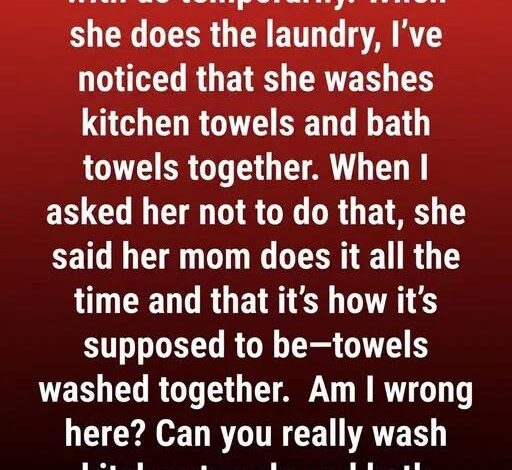
The Disgusting Reason You Should Never Mix Your Kitchen and Bathroom Towels
You think you are keeping your home clean, but you are likely participating in a silent, cross-contamination nightmare every time you throw your laundry into the washing machine. Most of us blindly toss kitchen towels and bath towels into the same load, assuming that a splash of detergent and a cycle of hot water will magically sanitize everything. This is a massive, hygiene-defying mistake. Your kitchen is a breeding ground for raw meat bacteria and grease, while your bathroom is home to entirely different pathogens. By mixing them, you are effectively wiping your face with the remains of last night’s dinner.
The allure of the “everything-in-one-load” laundry philosophy is easy to understand. It saves time, energy, and water, and it simplifies a chore that many of us already find tedious. However, the reality of microbiology does not care about your schedule. Kitchen towels and bath towels serve fundamentally different purposes and encounter vastly different contaminants. When you treat them as interchangeable pieces of fabric, you ignore the reality that your towels are essentially sponges that trap everything they touch—bacteria, oils, food particles, and dead skin cells. Failing to distinguish between these items is not just a laundry error; it is a breakdown in home sanitation that can have real health implications.
It is important to acknowledge that not all towels are inherently dangerous. In a household where kitchen towels are treated with the utmost care—used exclusively to dry clean hands or wipe down sanitized surfaces—the risk is minimal. If your kitchen routine is pristine, washing these towels alongside your bath towels with a high-quality detergent and warm water is generally acceptable. The mechanical action of the washing machine, combined with the chemical power of modern detergents, is more than enough to neutralize standard household bacteria. However, the true danger lies in the assumption that all kitchen towels fall into this “lightly used” category.
The risk profile shifts dramatically when we look at how kitchen towels are actually used in the heat of cooking. Think about the last time you prepared dinner. Did you wipe up a spill from raw chicken? Did you scrub away oil or grease from a pan? Did you wipe down the counter where you sliced vegetables? In these instances, your kitchen towel becomes a repository for high-level pathogens like Salmonella and E. coli. These are not merely dirt; they are biological hazards. When you wash a towel saturated with greasy food residue and raw meat juices alongside your fresh bath towels, you are creating a recipe for cross-contamination. Even the most powerful detergent can struggle to fully sanitize a load that contains a mixture of heavy grease and delicate fibers, meaning you could be transferring microscopic remnants of your dinner onto the very towel you use to dry your clean body after a shower.
To protect your home, you must move toward a more intelligent laundry strategy. You do not need an overly complicated system, but you do need to be conscious of the towel’s “laundry history.” Heavily soiled kitchen towels should be treated as their own distinct category. If a towel has been used to clean up a meat-based spill or a particularly greasy countertop, it belongs in a high-heat, intensive wash cycle, preferably on its own. Using high heat is one of the most effective ways to break down oils and kill the stubborn bacteria that thrive in organic residue. By isolating these high-risk items, you eliminate the possibility of that residue transferring to your bath towels.
Furthermore, the drying process is just as critical as the washing cycle itself. A towel that lingers in a damp, folded state is a thriving environment for mold, mildew, and bacteria. Even if your towels come out of the wash sparkling clean, leaving them in a wet heap for hours will quickly negate the work of your laundry machine. Ensure that your towels are dried completely, preferably in a dryer on a high setting or by hanging them in a well-ventilated area where they can receive sunlight. The heat and UV light act as natural sanitizers, ensuring that your towels remain fresh and scent-free for longer.
When you notice that a towel continues to have an “off” smell even after a thorough cleaning, it is time to face the truth: the bacteria have likely colonized the fibers in a way that standard laundry cannot fix. Don’t be afraid to retire these items. Towels are workhorses, but they are not meant to last forever. Regularly replacing them and keeping a dedicated, color-coded system—such as using one color for the kitchen and another for the bathroom—can go a long way in preventing confusion. This simple visual cue makes it much easier to keep your laundry loads organized and minimizes the temptation to throw everything together at the last minute.
Ultimately, keeping your home hygienic is about establishing small, consistent habits that prevent the spread of unseen dangers. By taking a moment to assess the state of your towels before throwing them into the wash, you are taking proactive steps to safeguard your family’s health. It is a minor adjustment to your routine, but the peace of mind that comes with knowing your towels are genuinely clean is well worth the extra effort. Treat your laundry with the respect it deserves, separate the high-risk items from the daily essentials, and enjoy the comfort of knowing that your home is not just tidy, but truly sanitized. A little bit of awareness in the laundry room goes a long way toward creating a safe and healthy environment for everyone in your household.