Can You Spot the Tiny Change in This Study Desk Puzzle?
A good spot-the-difference puzzle does not need a crowded scene to be tricky. Sometimes the hardest challenge is hidden in a simple picture, where everything looks familiar enough for your brain to stop checking closely.
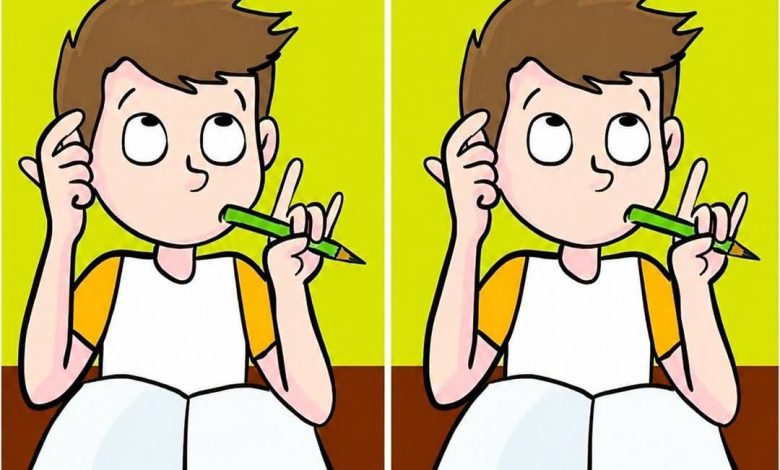
This visual puzzle shows two nearly identical study-room illustrations. In both images, a young student sits at a wooden desk, holding a bright green pencil while looking upward as if he is thinking through a school question. An open book is on the desk, and a small blue calculator sits nearby.
At first glance, the two pictures may appear exactly the same. But one detail has changed. Your task is to find it.
How to Approach the Puzzle
If you want to make the challenge harder, give yourself ten seconds before reading further. Quick observation tests like this are fun because they push you to notice small differences under pressure.
If the answer does not jump out right away, slow down and compare the images in sections. Start at the top of the picture and work your way down instead of trying to scan everything at once.
Look carefully at the student’s hair, eyebrows, eyes, nose, and mouth. Small changes in facial features can be easy to miss because the overall expression still looks the same.
Next, check the student’s clothing and hands. Compare the white shirt, orange sleeves, arms, fingers, and the green pencil. A slight shift in shape, angle, or position can be enough to hide the difference in plain sight.
Do Not Forget the Desk
Once you have checked the student, move to the objects on the desk. Study the open book closely, including the page lines, edges, and any shadows around it.
Then look at the blue calculator. Compare its screen, buttons, outline, and placement on the desk. In puzzles like this, small school supplies can be just as important as the main character.
The trick is to avoid assuming that repeated objects are identical. Our brains often fill in familiar details automatically, which is why a tiny change can remain unnoticed even when it is right in front of us.
Why These Puzzles Feel Harder Than They Look
Spot-the-difference puzzles are simple, but they make you use focused attention. Instead of recognizing a scene as a whole, you have to slow down and inspect the details one by one.
That is also what makes them satisfying. Whether you solve it in seconds or need a little longer, the challenge is less about speed and more about careful looking.
Take another look at the two study-room pictures and compare each section closely. The hidden difference is there — you just have to catch the detail your eyes skipped the first time.