My Husband Lied About A Business Trip Until Karma Exposed The Truth
I heard Martin laugh before I saw him.
It’s a big laugh. It starts low and goes up at the end, like a car shifting gears. I’ve known that laugh for seventeen years. I’d know it in a stadium. I’d know it underwater.
I was sitting in the lobby of the Harmon Hotel, on a gray velvet couch by the restaurant entrance, holding a menu I wasn’t really reading. I was early for lunch with my friend Rachel. I’m always early. Martin used to tease me about it.
The laugh came from the front desk.
I looked up.
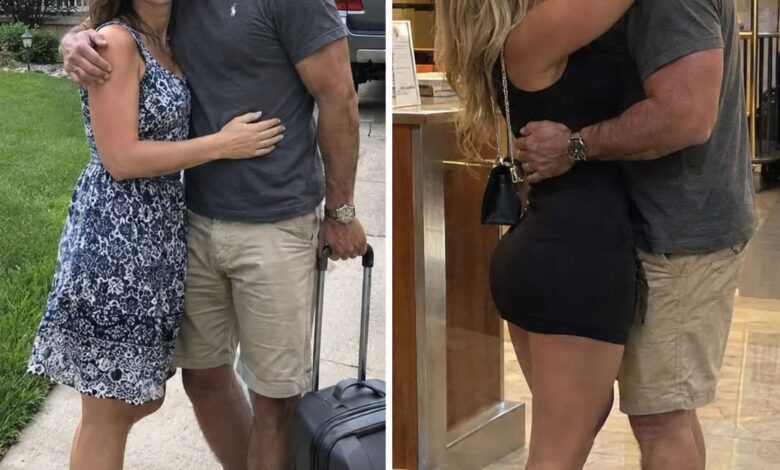
And there was my husband. In the blue checked shirt I’d ironed for him on Sunday night. With his arm around a woman’s waist.
She was younger than me. Maybe thirty-five. Dark hair, long and shiny, falling over one shoulder. A cream-colored coat. She was leaning into him the way you lean into somebody when you’re sure they’ll hold you up.
Martin was handing his credit card across the desk to the clerk. Our credit card. The joint one. I could see the blue edge of it.
Beside his leg was his black rolling suitcase. The one with the broken zipper pull that I’d fixed with a paper clip.
I’d watched him carry that suitcase out our front door four hours earlier.
The clerk said something. Martin laughed again.
Then he turned his head and kissed the woman. Right there. At the front desk of the Harmon Hotel, under the brass chandelier.
I stood up so fast the menu slid off my lap.
There was a big marble column a few feet away. I stepped behind it before I’d even decided to.
I stood there with my back against the cold stone. My heart was slamming so hard I could feel it in my throat.
He kissed me goodbye this morning, I thought. He kissed me on the cheek in our kitchen. He knew exactly where he was going.
I wanted to walk out from behind that column. I wanted to walk right up to the desk and make him look at me. I took one step. I opened my mouth.
Then Martin spoke.
“Relax, sweetheart,” he said. Loud enough for me to hear across the lobby. “My wife thinks I’m hundreds of miles away.”
The woman laughed. A light, pretty laugh.
“Poor thing,” she said. “She really has no idea?”
“Not a clue,” Martin said.
I stepped back behind the column.
They weren’t just hiding something from me.
They were laughing about it. About how easy it had been.
Seventeen years of believing him. And he was standing in a hotel lobby, bragging about it.
My name is Laurel Hayes. I’m forty-four years old.
Until that afternoon, I was the kind of wife who knew where everything was.
That morning had been completely ordinary.
Martin came downstairs at seven-fifteen with his suitcase. I was at the counter making coffee. Our kitchen has yellow walls I’ve been meaning to repaint for three years and a window over the sink that looks out at the neighbor’s fence.
“Don’t wait up for me, honey,” he said. “I’ll be away on business until Friday.”
He kissed my cheek and reached for his car keys.
“Another trip?” I said. “You just got back last week.”
“I know, babe. But Adrian needs me there. The Lexington account.”
He’d been saying the Lexington account for two months. I didn’t really know what it was. Something about distribution. A warehouse. A contract that kept almost getting signed.
I picked up his phone charger. He’d left it plugged in beside the toaster, the way he always did.
“Your boss might need you to answer your phone,” I said, holding it out.
He grinned and took it from me.
“What would I do without you?”
For seventeen years, I’d liked being the person who knew where his things were.
His charger. His reading glasses. His good pen. The folder with our tax documents. The spare key to his car. His mother’s birthday. His dentist appointment. Which shirt went with which tie.
I liked being that person. I liked being needed for small things. It felt like a kind of love.
Lately, though, I hadn’t known where he was half the time.
“Friday, then,” I said. “We still need to decide about the windows.”
“They can wait. That’s an expensive job.”
“The bedroom one doesn’t close properly. It’s November, Martin. I sleep in a sweatshirt.”
He touched my shoulder.
“Let me just get through this busy period,” he said. “Then we’ll figure it out.”
I’d heard that promise a lot lately.
About his late nights. About his distracted dinners, where he’d look at his phone under the table and laugh at something and then say “Nothing, work stuff” when I asked. About the phone he’d started taking into the bathroom with him. About the password he’d changed in August.
Let me get through this busy period.
The week before, I’d bought tickets to a movie. A spy thriller we’d both wanted to see since we watched the trailer in June. It was playing at the old theater downtown, the one with the red velvet seats and real butter on the popcorn.
He canceled from the office at five-thirty. A text.
So sorry babe. Adrian’s got me stuck on a call. Go without me?
I didn’t go. I sat at home and ate leftovers and watched a cooking show I didn’t care about.
The next morning, at breakfast, he asked me, “So how was the movie?”
I looked at him.
“I didn’t go,” I said.
“Oh.” He took a bite of toast. “You should’ve.”
“I wanted to go with you.”
He shrugged. “Well, there’ll be other movies.”
And somehow I ended up feeling unreasonable. For wanting to see a movie with my own husband.
That’s how it had been for months. Every time I was hurt, I somehow ended up apologizing.
We moved to Brookfield three years ago. For Martin’s job.
Adrian Kessler owned a logistics company called Kessler Freight. Warehouses and trucking contracts across four states. He’d met Martin at a conference in Chicago and offered him a job on the spot. Regional operations director. Almost twice what he’d been making in Columbus.
“It’s the opportunity of a lifetime, Laur,” Martin said, sitting on the edge of our bed in Columbus with his hands clasped between his knees. “I can’t say no to this.”
I had a job I loved in Columbus. I was a senior project manager at an architecture firm. Fourteen years there. I’d managed the renovation of a children’s hospital wing. I had my own office with a window. I had colleagues who’d been to my wedding.
But I said yes. Because it was his dream. Because I loved him. Because that’s what you do.
In Brookfield, the only job I could find in my field was part-time, then three-quarter time, as an office manager at a small engineering firm. Twenty-six dollars an hour. No office. No window.
“It’s temporary,” Martin said. “Just until something better comes up.”
Nothing better came up.
And somewhere in those three years, work became the explanation for everything.
And now here I was.
Standing behind a marble column in the Harmon Hotel. Twenty minutes from our house.
Hundreds of miles away.
I took out my phone. I don’t know why. I didn’t plan it. My hands just did it.
I held it up at the edge of the column.
Through the screen, I watched Martin reach over and tuck a piece of the woman’s dark hair behind her ear. Gently. The way he used to do for me when we were first dating, in the back of his old Honda, at the drive-in.
Then he kissed her again.
I took a photograph.
The shutter sound was off. Nobody turned around.
“Hey! Sorry I’m late, the parking garage was a…”
Rachel stopped beside me.
She was out of breath, holding her purse and her car keys and a coffee cup. She looked at my face.
“What’s wrong?” she said.
I couldn’t answer her. My mouth wouldn’t work.
I just turned my phone around so she could see the screen.
She looked at it. Then she looked across the lobby. Martin and the woman were walking toward the elevators now, his suitcase rolling behind them, her hand in his back pocket.
Rachel looked back at me.
Rachel lives two houses down from us on Maple Ridge Drive. She was the first person who knocked on our door when we moved in, with a plate of lemon bars and a list of the best plumber, the best dentist, and the best Thai restaurant in Brookfield.
She’s fifty-one. She’s been divorced for nine years. Her ex-husband left her for his dental hygienist. She says she doesn’t recommend it, but she’s had very clean teeth ever since.
She’s the only real friend I’ve made in three years.
“Do you want me to go over there?” she said quietly.
I watched the elevator doors close on my husband.
I shook my head.
“Okay,” Rachel said. “Then we’re going somewhere else.”
She took my arm. Not hard. Just firm. Like you’d take the arm of somebody who might fall over.
She walked me out of the Harmon Hotel and onto the sidewalk.
The air was cold. November. It smelled like wet leaves and car exhaust.
“I’ll drive you home,” Rachel said.
“I can drive.”
“Laurel.”
“I can drive,” I said again. “I’m fine. I’m fine.”
She looked at me for a long moment.
“You’re not fine,” she said. “But okay. Call me the second you get home.”
I walked to my car in the parking garage.
I got in. I shut the door. I put my hands on the steering wheel.
And I sat there.
For forty minutes, I sat there, and I didn’t start the car. I just sat in the cold garage and watched my hands shake on the wheel.
Every few minutes, I’d look at the photograph again.
Martin’s arm around her waist. Her hand on his chest. Their faces together under the brass chandelier.
The blue checked shirt I’d ironed.
At home, I cried until my face hurt.
I didn’t do it the way people do in movies. I didn’t throw anything. I didn’t scream. I just sat on the floor of our bedroom with my back against the bed and cried with my mouth open until my throat was raw.
The bedroom window was letting in cold air again. I could hear it whistling through the gap at the top.
That’s an expensive job. It can wait.
Martin sent a text at 6:04 p.m.
Made it. Long evening ahead. Love you.
I read it three times.
Made it. Twenty minutes across town.
Long evening ahead.
Love you.
I didn’t reply.
I sat there on the bedroom floor and thought about what would happen next if I did nothing.
Tomorrow, he’d send another message. Busy day. Meetings till late. Miss you.
Thursday, maybe a call. He’d sound tired. He’d say the client was being difficult.
And Friday, he’d come home. He’d drop his suitcase by the stairs. He’d want clean clothes and dinner. He’d kiss my cheek and ask what I’d done all week.
And I’d be expected to act like I didn’t know anything.
To help him pretend those four days had been work.
I opened the photograph again.
No, I thought. I’m not going to help him pretend.
He’d have to look at that picture. And answer for what he’d done.
Rachel called at seven.
“Have you talked to him?”
“Not yet.”
“You don’t have to decide everything tonight, Laurel.”
“He was laughing at me,” I said.
My voice broke on laughing.
Rachel didn’t say anything. She just stayed on the line while I tried to breathe. In. Out. In. Out. She stayed quiet for almost a full minute. She didn’t try to fill it.
“When he comes home Friday,” I said finally, “I’m putting the picture in front of him. And he can explain what I saw.”
“Call me before you do it.”
“What if I can’t say it without crying?”
“Then you cry,” Rachel said. “He can still answer you. Crying doesn’t make the question any less real.”
I’d spent the whole afternoon rehearsing how I’d look when I faced him. Calm. Cold. Strong. Like a woman in a movie.
I hadn’t let myself imagine needing help.
“Okay,” I said.
Before we hung up, I asked her something.
“Will you check on me Friday? When he comes home? I just… I want somebody to know.”
“I’ll be watching from my kitchen window,” Rachel said. “If you need me, turn your porch light on and off twice. I’ll be there in thirty seconds.”
“That’s very dramatic.”
“I’ve been divorced for nine years,” Rachel said. “I’ve earned dramatic.”
I almost laughed.
After she hung up, I emailed the photograph to myself. Then I saved a copy to a folder on my laptop. Then I saved another copy to a cloud account Martin didn’t know the password to.
I’m a project manager. I know about backups.
Then I turned off the kitchen light and went upstairs.
His pillow still had the dent in it from that morning. The shape of his head.
I stood there and looked at it for a long time.
Then I turned it over. So the dent was underneath.
I lay down on my own side of the bed. I didn’t touch the empty space. I pulled the blanket up to my chin and listened to the wind whistling through the broken window.
I didn’t sleep much.
I kept thinking about Columbus.
About our first apartment, on High Street, above a bakery. The whole place smelled like bread at four in the morning. Martin used to go down in his pajamas and buy day-old croissants from the baker, a big Polish man named Stan, for fifty cents each.
We had a mattress on the floor for the first year. A card table for a dining table. We ate takeout Chinese food on the floor and played Scrabble until two in the morning, and Martin always cheated and tried to say made-up words were real.
“ Quizzle is absolutely a word.”
“It is not a word, Martin.”
“It’s a cross between a quiz and a puzzle. Very common in Ohio.”
I married him two years later in my parents’ backyard in Dayton. He cried during his vows. He promised to always tell me the truth, even when it was hard.
I used to think about that vow every time we had a fight. He promised to tell me the truth.
I lay there in the dark and thought about it again.
Not a clue.
The hospital called at 8:40 the next morning.
I was at the kitchen table with a cup of coffee I hadn’t touched. I’d called in sick to work. I’d told my boss I had a migraine. It was the first sick day I’d taken in three years.
My phone rang. A number I didn’t know.
“Is this Laurel Hayes?”
“Yes.”
“This is Brookfield Memorial Hospital. Your husband, Martin Hayes, has asked us to contact you. He’s awake and being assessed. He’d like you to come in.”
For a moment, I couldn’t say anything at all.
I’d spent the whole night imagining confronting him. Planning what I’d say. Where I’d stand. What my face would look like.
And now a stranger was telling me he was in the hospital.
I stood up so fast my chair scraped across the floor.
“What happened? How badly is he hurt?”
“He’s being assessed for a wrist injury,” the woman said. “He’s conscious and he’s able to speak with you.”
A wrist.
I sat back down.
The relief came first. A big wave of it.
And right behind the relief came anger. Because I hated that I was relieved. I hated that after everything I’d seen, after not a clue, after the photograph and the night on the bedroom floor, he could still scare me that easily.
I could still be afraid for him.
He could still reach me.
She gave me the address. Brookfield Memorial. Twenty minutes away.
My car was in the driveway. But after that call, I didn’t trust myself to drive. My hands were shaking again.
I ordered a cab.
During the ride, I held my phone in my lap. I kept opening the photograph and closing it. Opening it. Closing it.
The cab driver had the radio on. An oldies station. “Stand By Me.”
I almost asked him to turn it off.
I wanted to demand an explanation. I wanted to walk into that hospital and throw my phone at Martin’s head.
But first, I needed to see for myself that he was all right.
I hated that too.
At the front desk, I gave Martin’s name. A nurse with purple scrubs and a tired face pointed me down a hallway to a small waiting area by the emergency treatment rooms.
I walked down the hall.
He was sitting in a plastic chair by the window.
When he saw me, he stood up.
“Thank God,” he said.
He sounded relieved to see me. Really, truly relieved.
I couldn’t understand it.
Surely I was the last person in the world he wanted to see right now.
And then I saw who was sitting two chairs away from him.
The woman from the hotel.
She looked different without the cream coat and the shiny hair. Her hair was scraped back into a crooked ponytail. She was wearing a gray sweatshirt that was much too big for her. Her face was pale and blotchy. No makeup.
She was holding her left wrist against her stomach.
I stopped walking.
Martin reached for me. He tried to take my arm.
I moved it away.
“What happened?” I said.
“Can we talk somewhere else?” Martin said. “Just for a minute?”
The woman stood up.
“Martin,” she said sharply. “We don’t have time for that.”
“I’m talking to my wife, Vanessa.”
Vanessa.
I looked down at Martin’s right wrist.
There was a small white dressing taped around it. Just below the hand. The skin around it was red and scraped.
Vanessa’s left wrist looked the same. Red. Raw. Swollen.
Matching.
“Were you in an accident?” I asked.
Martin didn’t answer. He glanced over at the chair beside him.
There was a clear plastic bag on it. The kind the hospital gives you for your belongings.
Inside lay a pair of silver handcuffs.
They’d been cut apart. Right through the chain in the middle. With bolt cutters, it looked like. The edges were shiny and jagged.
I stared at them.
For a long, long moment, I just stared at that plastic bag.
“Please,” I said. “Please tell me those belong to somebody else.”
Vanessa sat back down heavily.
“They wouldn’t unlock,” she said. “We lost the key. And then my wrist started hurting. It was swelling up. We had to call the front desk for help. They called the fire department. They had to cut them off.”
Martin looked down at the floor.
I’d come to this hospital afraid for him.
I’d sat in the back of a cab with my heart pounding, thinking about car accidents, thinking about heart attacks, thinking about Martin lying in a hospital bed with tubes in his arms.
And he’d been sitting here this whole time. Next to the woman he’d spent the night with. Waiting.
I lowered myself into a chair across from them. My legs wouldn’t hold me.
I didn’t know whether to cry or walk straight out the door.
“Why did you call me?” I said. My voice was very quiet. “I know about your affair, Martin.”
I expected him to look shocked. Ashamed. Something.
He didn’t.
He let out a breath.
“That makes this easier,” he said.
He pulled his chair closer to mine.
“We need you to help us cover for this,” he said. “Before she has to call her husband.”
I looked over at Vanessa.
“You’re married?”
She nodded. She didn’t look at me.
“And you want me to lie for you?” I said.
“Just hear me out,” Martin said.
He leaned toward me. He used his calm voice. His work voice. The voice he uses on the phone with clients.
“Tell him the three of us met at the hotel this morning,” he said. “We were having coffee in the restaurant. Vanessa had the cuffs in her bag as a joke. Some kind of gag gift, a bachelorette party thing. She took them out. I put one on as a joke. The lock jammed. You were sitting right there. Nothing happened.”
I stared at him.
“You brought me here,” I said slowly, “to be your alibi? ”
“Keep your voice down,” Martin said.
Vanessa leaned forward. Her eyes were red.
“Listen,” she said. “I have to tell my husband something. I have to. If I use our insurance for this, he’ll see the paperwork. He’ll ask what happened. And the hotel already called security, and the fire department came, and there’s a report…”
“Then pay for it yourself,” I said.
“I can’t. I don’t have money of my own. Everything’s in his name. I need to explain it to him before he finds out some other way. If you were there with us, he wouldn’t think…”
“That you were sleeping with my husband?” I said.
She looked down at her wrist.
Martin leaned in closer. His knee was almost touching mine.
“Please, Laur,” he said. “This could get so much worse.”
“Then you shouldn’t have done it.”
He glanced over at Vanessa. Then back at me.
“You don’t understand who we’re talking about,” he said. “Or what’s at stake here.”
I turned to Vanessa.
“Who is he?” I asked. “Your husband.”
She looked up at me.
“Adrian,” she said.
The room went very quiet.
I turned to Martin.
“Your boss? ”
Martin closed his eyes.
“Adrian Kessler,” I said. “Your boss. The man who hired you. The man who moved us here. That Adrian.”
“Laurel…”
“You’ve been sleeping with your boss’s wife? ”
“If he finds out,” Martin said, “I could lose my job.”
He opened his eyes. He looked straight at me.
“My income pays most of our mortgage, Laurel. And the car. And the bills. You know we can’t cover everything on your salary.”
I’d been about to stand up.
I’d been about to walk out of that waiting room and out of that hospital and never come back.
Instead, I stayed in my chair.
Because he was right.
I knew our monthly expenses. I’m the one who paid them. I had a spreadsheet. The mortgage was twenty-one hundred a month. The car payment was four-ninety. Utilities, insurance, groceries.
I knew my own paycheck. Twenty-six dollars an hour. Thirty-two hours a week.
The numbers didn’t work. Not without Martin.
And for the first time since I’d seen them in that hotel lobby, our house came into my mind. Not the marriage. The actual house. The yellow kitchen. The roof. The bedroom window that didn’t close.
For the first time, it became something I was afraid of losing.
“I left a better job when we moved here for your promotion,” I said slowly.
“And it was the right decision,” Martin said. “Look how well we’ve done.”
“And now you’re using it,” I said, “to explain why I have to protect you.”
He didn’t say anything.
He watched me. He watched me hesitate.
I tried to work it out in my head. What could I afford alone? A one-bedroom apartment. Maybe. In the cheaper part of town. If I sold the car. If I got more hours.
Rent. Groceries. Insurance. My student loans, which I’d almost paid off.
Martin waited. He just sat there and waited while I did the math in my head.
Like my silence meant he was winning.
“So that’s it,” I said. “I either sit here and help you fool him. Or I worry about where I’m going to live.”
“I’m asking you to think about yourself too,” Martin said. “Not just me. Yourself.”
Vanessa got up and moved to the chair right beside him.
“We’ll end it,” she said. “I promise. We’ll never see each other again. If you help us, it’s finished. Completely.”
I looked at her.
“You’re offering to stop sleeping with my husband,” I said, “as a favor to me?”
She flushed.
“He told me your marriage was over,” she said. “In every way that mattered. He said you were basically roommates. He said you hadn’t…”
She stopped.
“And yesterday?” I said. “At the front desk? When he said I didn’t have a clue? Did you think I knew it was over then?”
She didn’t answer.
Martin held out his hand to me. Palm up. Across the space between our chairs.
“Seventeen years, Laurel,” he said softly. “Surely we can keep one terrible mistake from taking all of it.”
I looked at his hand.
I looked at his wedding ring. The plain gold band. I’d bought it at a jewelry store on High Street in Columbus with my first paycheck from the architecture firm. Four hundred dollars. I’d had our wedding date engraved inside.
They were offering me things. Martin and Vanessa. Sitting there in that hospital waiting room with their matching wrists.
They were offering me an end to the affair.
A husband who’d come home………………………..CONTINUED ON NEXT PAGE