My Husband Lied About A Business Trip Until Karma Exposed The Truth
Money for our bills.
Things that should never have needed bargaining for in the first place.
And in return, I was supposed to make them believable.
I folded my hands in my lap.
Martin’s hand stayed out there in the air between us for a moment. Then he lowered it.
I was stuck between a rock and a hard place. I knew that.
But I knew what I had to do.
“All right,” I said. “Call him.”
Martin’s whole body sagged. His shoulders dropped. He let out a long breath.
“Thank you,” he said. “Thank you, Laur. Thank you.”
Vanessa already had her phone out. She dialed immediately.
She put the phone to her ear. She took a deep breath. And her whole face changed. Just like that. Like flipping a light switch.
“Hi, darling,” she said. Bright. Warm. “Please don’t worry. But I’m at the hospital.”
She paused. Listening.
“No, no, nothing serious! It’s actually a really funny story…”
She laughed. A light, pretty laugh. The same one I’d heard at the hotel front desk.
“I’ll explain everything when you get here. Brookfield Memorial. The ER waiting area. Okay. Love you.”
She hung up.
Martin had been watching me the entire time she was on the phone.
When she hung up, he turned to her.
“How long?”
“Twenty minutes.”
He turned back to me. And he quickly went over the story again. Every detail. Coffee in the hotel restaurant. Nine o’clock. A booth by the window. The handcuffs in Vanessa’s purse, a joke gift from a friend’s bachelorette party. Martin putting one on to be funny. The lock jamming. The key falling through a gap in the booth seat.
“You ordered the eggs Benedict,” he said. “If he asks. You always order eggs Benedict.”
I nodded.
I lifted my bag onto my lap.
We waited. Nobody said anything.
Those were the longest twenty minutes of my life.
Vanessa kept fixing her ponytail. Pulling it out. Smoothing her hair. Putting it back in. Over and over. With one hand, because the other one hurt.
Martin sat with his elbows on his knees, staring at the floor. His foot was bouncing.
I sat with my bag in my lap and thought about my mother.
She was married to my father for forty-one years. He wasn’t a perfect man. He drank too much on weekends and he didn’t talk about his feelings and he forgot her birthday twice.
But once, when I was about twelve, I asked her how she knew she could trust him.
She was peeling potatoes at the kitchen sink. She didn’t even turn around.
“Because he’s never once asked me to lie for him,” she said.
I didn’t understand what she meant back then.
I did now.
Adrian Kessler came through the double doors at 9:52.
I’d met him four times. Twice at company Christmas parties. Once at a barbecue at his house in Lakeview. Once at Martin’s promotion dinner, where he gave a toast and called Martin “the best decision I’ve made in ten years.”
He was about sixty. Tall, with silver hair and a lined face and the kind of quiet voice that makes people lean in. He was carrying a jacket over one arm. He’d clearly left wherever he was in a hurry. His tie was loose.
He looked at Vanessa’s wrist before he looked at anyone else.
“What happened?” he said.
Vanessa stood up. She kissed his cheek.
“It looks so much worse than it is,” she said.
Adrian turned and saw me. He nodded.
“Laurel,” he said. “I’m sorry you got dragged into this.”
“So am I,” I said.
Martin stood up. He moved next to Vanessa. He was smiling a little. A sheepish, embarrassed smile. A good-sport smile.
“It’s honestly the dumbest thing,” he said. “We ran into each other at the Harmon this morning. Vanessa was meeting a friend for brunch and her friend canceled. We ended up having coffee with Laurel and me in the restaurant. And Vanessa had these in her purse…”
He nodded at the plastic bag.
“From some bachelorette party,” Vanessa said. “Jenny’s. You remember Jenny.”
“And I put one on as a joke,” Martin said. “And the lock jammed. And the key fell through the booth. And it just got worse from there.”
Adrian looked into the plastic bag. At the cut chain.
He was quiet for a moment.
“You brought handcuffs,” he said slowly, “to coffee.”
“It was so silly,” Vanessa said. “I’m so embarrassed.”
Adrian looked at her. Then he turned.
And he looked at me.
“You were there?” he said.
I took my phone out of my bag.
Martin’s warning hadn’t stopped being true. I knew that. Sitting there, holding my phone, I still didn’t know how I’d pay the mortgage. Or where I’d live. Or what Martin might lose. Or what I’d lose with him.
The fear didn’t go away. It sat right there in my chest the whole time.
But I couldn’t lie to protect his affair.
I couldn’t do it. I’d known I couldn’t do it the moment Martin said That makes this easier.
I opened the photograph.
“I was at the hotel,” I said. “Yesterday afternoon.”
I turned the screen toward Adrian.
He stepped closer. He bent down a little to see it.
His eyes stayed on the picture.
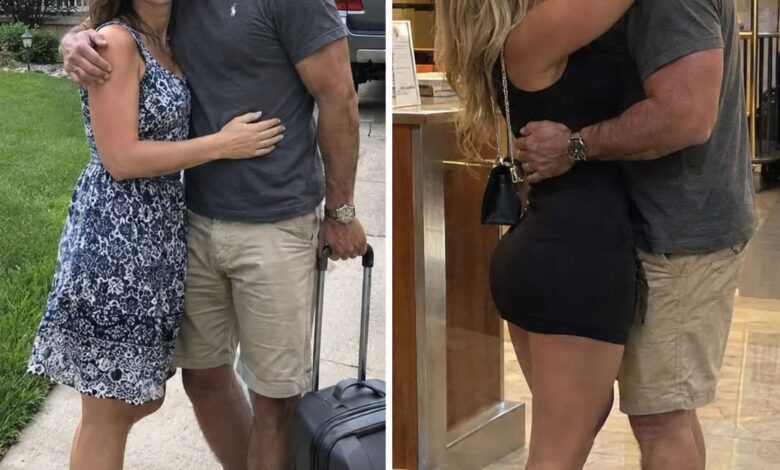
Martin’s arm around Vanessa’s waist. Her hand flat against his chest. Their mouths together under the brass chandelier. The time stamp in the corner.
Yesterday. 12:47 PM.
“They were checking in,” I said.
Vanessa grabbed Adrian’s arm.
He moved it away from her. Not roughly. Just away.
“Wait,” Vanessa said. “Adrian, wait. Martin told me…”
“I heard him tell her not to worry,” I said. I kept my eyes on Adrian. “He said, Relax, sweetheart. My wife thinks I’m hundreds of miles away. ”
Martin stared at me. His face had gone gray.
“And she asked if I really had no idea,” I said. “And he said, Not a clue. ”
Adrian slowly lifted his eyes from my phone.
He looked at his wife.
“Yesterday?” he said.
Just that. One word. Very quiet.
Vanessa’s face crumpled.
“He said his marriage was finished,” she said. “He told me. He said they were basically roommates.”
“That’s not true,” Martin snapped.
I lowered the phone. Just enough to see both of them over it.
“Which part isn’t true, Martin?” I said. “That you said it? Or that our marriage was finished?”
Martin opened his mouth.
Nothing came out.
He just stood there in the waiting room of Brookfield Memorial with his mouth open and a bandage on his wrist.
Adrian looked at me for a long moment.
His face was very calm. Too calm. Like a lake right before a storm.
“Could you send me that photograph?” he asked.
He held out his own phone, with his contact information on the screen, so I could see his number.
“Don’t!” Martin said.
I sent it.
Adrian’s phone chimed in his hand.
He looked down at it. He looked at it for a long time.
Then he put it in his jacket pocket.
Martin stepped toward me.
“You agreed to help,” he said. His voice was low and hard. “You agreed. ”
“You asked me to protect your job,” I said, “by lying to the man whose wife you were sleeping with.”
“You know what this could cost us. Both of us.”
“I know exactly what you asked me to pay,” I said.
He reached for my elbow.
I stood up before he could touch me.
“We need to talk at home,” he said. “Laurel. At home. Not here.”
“We’re separating, Martin,” I said. “I’m not negotiating that here. Or anywhere.”
Behind him, Vanessa had grabbed Adrian’s sleeve again. She was talking fast. Crying.
“He pursued me, Adrian. You have to believe me. He wouldn’t leave me alone. He kept texting me. He kept saying…”
Martin spun around toward her.
“Are you kidding me right now?”
“You did! You know you did!”
“You’re the one who brought the…”
I stepped out into the corridor before I heard the rest of it.
I didn’t need to hear the rest of it.
I walked down the hallway, past the vending machines, past a man in a wheelchair with his leg in a cast, past the nurse in purple scrubs.
I took out my phone. I called Rachel.
She answered on the second ring.
“Are you okay?”
“I’m at the hospital,” I said. “Brookfield Memorial. I’m not hurt. Could you come get me?”
“I’m coming. I’m getting in the car right now.”
“Rachel?”
“Yeah?”
“Could you stay with me for a while? After?”
“Of course,” she said. “As long as you want.”
I looked back down the hallway, toward the waiting area.
Until yesterday, Martin would have been the person I called to come get me.
For seventeen years, he was the person I called. When my car broke down on I-71 in a snowstorm. When I got food poisoning at a conference in Detroit. When my father had his first heart attack. When I found a lump that turned out to be nothing. I called Martin. Every time.
“I told him we’re separating,” I said into the phone.
There was a pause on the other end.
“Okay,” Rachel said gently. “We’ll talk about it when I get there. You don’t have to explain it all on the phone.”
I went outside.
There was a bench by the front entrance, under a little metal awning. I sat down on it.
I finally unbuttoned my coat. I’d been wearing it buttoned all the way up to my chin since I got out of the cab.
My hands started shaking again. Badly.
Now that nobody needed to see them steady, they just shook. I held them together in my lap and let them.
Martin came out through the sliding doors about ten minutes later.
He was carrying the plastic bag with the cut handcuffs in it. His face was red. His hair was messed up on one side, like he’d been running his hand through it.
He stopped in front of my bench.
“Adrian left,” he said. “With her. He didn’t say anything to me. Not one word. He just left.”
I didn’t answer.
He looked down at the plastic bag in his hand like he didn’t know how it got there.
“How am I supposed to get back to the hotel?” he asked.
I looked up at him.
And seventeen years of things crowded into that one question.
Seventeen years of chargers left by the toaster. Reading glasses on top of his head while he looked for them. Car keys in the freezer. A dentist appointment he forgot three times in a row. His mother’s birthday, which I’d remembered every year for him. Our anniversary, which I’d started reminding him about a week in advance.
Seventeen years of me knowing where his things were.
How am I supposed to get back to the hotel?
“You’ll have to work it out,” I said.
He stared at me.
“And afterward?” he said. “What about after?”
“We’ll arrange a time to talk,” I said. “Not today.”
A silver car pulled up to the curb.
Rachel. She leaned over and pushed open the passenger door from the inside.
I stood up. I walked to the car. I got in the passenger seat.
Martin started walking around the back of the car. Toward the other door. The back door.
Like he was coming with us.
Like it was just assumed.
I pressed the button. The window rolled down.
He stopped, with his hand reaching for the handle.
“This ride isn’t for you,” I said.
I rolled the window back up.
And Rachel drove away.
We didn’t say anything for the first five minutes.
Rachel drove. I looked out the window at the gray November sky and the bare trees and the strip malls going by.
At a red light on Brookfield Avenue, Rachel reached over without looking at me. She put her hand on mine.
“That,” she said, “was the single most satisfying thing I’ve ever watched through a car window.”
I laughed. It came out like a sob.
Then I put my face in my hands and cried all the way home.
Rachel stayed with me until almost midnight.
She made grilled cheese sandwiches. She found a bottle of wine in the back of my pantry that Martin had been saving for something. We drank it out of coffee mugs at my kitchen table.
I told her everything. The handcuffs. The alibi. Adrian. That makes this easier.
When I got to the handcuffs, Rachel put down her mug.
“No,” she said.
“ Cut apart? By the fire department?”
“With bolt cutters.”
Rachel stared at me across the table. Then she started laughing. She tried to stop. She couldn’t. She laughed so hard she had to put her head down on the table.
“I’m sorry,” she gasped. “I’m so sorry. It’s not funny. It’s terrible.”
And then I was laughing too. At my kitchen table. At eleven at night. With tears running down my face. Laughing until my stomach hurt.
It was the first time I’d laughed in two days.
Martin came to the house on Saturday to pack his things.
I’d asked Rachel to be there. She sat at my kitchen table with a cup of coffee and a crossword puzzle and didn’t look up once. But she was there.
Martin came through the front door with two empty suitcases and a box of garbage bags. He looked terrible. He hadn’t shaved. His eyes were red.
He stopped in the kitchen doorway and looked at Rachel.
“Really?” he said to me.
“Really,” I said.
He went upstairs.
I listened to him moving around up there. Drawers opening. Closing. Hangers sliding on the closet rod.
After about an hour, he came back down. He set the suitcases by the front door.
Then he came into the kitchen and stood across the counter from me.
“Adrian fired me,” he said.
I’d figured. But I hadn’t known.
“Thursday night,” he said. “He called me into the office at nine o’clock at night. He had HR there. And a lawyer. They had a whole folder. Expense reports. Hotel charges. On the company card.”
He looked down at the counter.
“I put some of the hotel rooms on the company card,” he said. “For the… the business trips. The ones that weren’t business trips.”
I closed my eyes.
“He’s saying it’s fraud,” Martin said. “Misuse of company funds. He says if I don’t resign quietly and pay it back, he’ll take it further.”
“How much?”
He told me the number.
I sat down on a kitchen stool.
“I don’t have it,” Martin said. “Not without the savings.”
“Our savings.”
“Our savings,” he said quietly.
Rachel, at the kitchen table, turned a page in her crossword book very loudly.
“This is your fault, you know,” Martin said. He didn’t say it angrily. He said it tiredly. Like a fact. “If you’d just said you were there. If you’d just gone along with it. He’d never have looked at the expense reports. I’d still have a job.”
I looked at him across the counter. Across the yellow kitchen.
“No, Martin,” I said. “If you hadn’t done it, you’d still have a job.”
He opened his mouth.
“If you hadn’t lied to me for months,” I said. “If you hadn’t put your girlfriend’s hotel rooms on your boss’s credit card. If you hadn’t slept with your boss’s wife. If you hadn’t stood at the front desk of a hotel twenty minutes from our house and told her I didn’t have a clue.”
My voice didn’t shake. I was surprised.
“Any of those,” I said. “Any one of those, and you’d still have a job. I didn’t do any of it. I just took a picture.”
He stood there for a long time.
Then he nodded. Once.
“I know,” he said.
It was the first true thing he’d said to me in months.
He picked up his suitcases. At the front door, he stopped.
“The bedroom window,” he said. “I’m sorry I never fixed it.”
“Me too,” I said.
He left.
Rachel put down her crossword.
“Well,” she said. “That was very mature of both of you. I’m deeply disappointed. I was hoping for at least one thrown plate.”
The next few months were the hardest of my life.
I’m not going to pretend they weren’t.
I hired a lawyer. A woman named Diane Okafor, with an office over a dry cleaner downtown. She was blunt and fast and charged two hundred dollars an hour and was worth every penny.
“Okay,” she said at our first meeting. She looked at my spreadsheet. “This is very organized. Most people come in with a shoebox of receipts and a lot of crying.”
“I did the crying already,” I said.
“Good. Get it out of the way.” She tapped the spreadsheet. “You can’t keep this house on your income. You know that, right?”
“I know.”
“Do you want to keep it?”
I thought about it. The yellow kitchen. The bedroom window. The dent in his pillow, which I’d finally thrown out.
“No,” I said. “I don’t think I do.”
We put the house on the market in February.
It sold in nine days. To a young couple with a baby. The wife cried when she saw the yellow kitchen. She said it reminded her of her grandmother’s house. She said she’d never repaint it.
I told her about the bedroom window.
“My husband’s handy,” she said. “He’ll fix it in an afternoon.”
I believed her.
After the mortgage was paid off and Martin’s half went to him and the lawyers were paid, I had enough left for a deposit and six months’ rent on a small two-bedroom apartment near the river.
Martin used most of his half to pay back Kessler Freight.
Adrian didn’t take it further. Diane told me he’d signed an agreement. Repayment, a resignation letter, a nondisclosure. Martin wasn’t allowed to talk about it. Neither was Adrian.
I heard later, from Rachel, who heard it from somebody at her gym, that Adrian and Vanessa were divorcing too. That he’d moved into a condo downtown. That Vanessa had moved back to Indiana to live with her sister.
I never saw either of them again.
Martin moved to an apartment in Milwaukee. He got a job at a smaller logistics company. Less money. A lot less.
He called me once in March. Late at night.
“I just wanted to say I’m sorry,” he said. His voice was thick. He’d been drinking. “For all of it. For the hotel. For the hospital. For not a clue. I’m sorry.”
I sat on the edge of my new bed in my new apartment.
“I know you are,” I said.
“Can you forgive me?”
I thought about it for a long time.
“Someday, maybe,” I said. “Not yet. And not because you need me to. Because I don’t want to carry it anymore.”
He was quiet.
“That’s fair,” he said.
“Martin,” I said. “Your charger’s in a box by my front door. And your reading glasses. And your good pen. I’ll mail them to you.”
“You don’t have to.”
“I know,” I said. “I want to. I don’t want to know where your things are anymore.”
In April, I called my old boss in Columbus.
Gwen Pratt. She’d run the architecture firm for twenty-two years. She’d been at my wedding. She’d cried when I told her I was leaving.
“Laurel Hayes,” she said, when she picked up. “As I live and breathe.”
“Hi, Gwen.”
“I heard,” she said. “Not the details. Just that you’re on your own now. Columbus is a small town for gossip.”
“I’m sorry I never called.”
“Don’t be sorry. Tell me what you need.”
I took a deep breath.
“A job,” I said. “If you have one.”
Gwen was quiet for a second.
“Laurel,” she said. “I’ve had your old job posted three times in three years. I hated every single person who applied for it. When can you start?”
I moved back to Columbus in June.
I got an apartment in German Village. Old brick buildings, narrow streets, a coffee shop on the corner. Three blocks from the bakery on High Street where Martin used to buy day-old croissants.
The bakery’s still there. Stan retired. His daughter runs it now.
I went in the first morning. I bought a croissant. Not day-old. Fresh.
It cost four dollars and fifty cents.
I ate it on the bench outside in the sun, and it was the best thing I’d tasted in a year.
Rachel came to visit in August. She stayed for a week. We went to the art museum and a Clippers baseball game and the old theater downtown, the one with the red velvet seats.
They were showing a revival of a spy thriller from the 1970s.
We went. We ate real butter popcorn.
“Is this the one?” Rachel whispered halfway through. “The one he canceled on?”
“No,” I said. “That one’s out on streaming now.”
“Have you watched it?”
“No.”
“Why not?”
I thought about it.
“I don’t know,” I said. “I think I wanted to see it in a theater. With somebody.”
Rachel reached over and stole a handful of my popcorn.
“Well,” she said. “You’re in a theater. With somebody.”
My new apartment has a bedroom with two big windows that face east.
The first week I moved in, one of them stuck. It wouldn’t close all the way. There was a gap at the top, about half an inch. I could feel the cold coming through at night.
I didn’t call anybody.
I watched a video online. I went to the hardware store on Third Street. I bought a can of silicone spray and a small rubber mallet and a roll of weather stripping.
It took me two hours on a Saturday morning.
When I was done, I closed the window. It slid all the way down. It sealed. Tight.
No whistle. No draft.
I stood there with the rubber mallet in my hand and looked at it for a long time.
It wasn’t expensive. The whole thing cost me twenty-three dollars.
It just needed somebody who cared enough to do it.
It’s November again now.
A year since the Harmon Hotel. A year since the hospital. A year since This ride isn’t for you.
Last week, I was having lunch with a coworker at a restaurant downtown, and I heard a man laugh across the room. A big laugh. Starting low and going up at the end.
I turned around.
It wasn’t him. Just a stranger in a gray suit, laughing at something his friend said.
I turned back to my salad.
And I realized my heart hadn’t even sped up.
I don’t know where Martin’s things are anymore.
I mailed him the box in April. Charger, reading glasses, good pen, the spare key to a car he’d already sold. I don’t know if he got it. I didn’t ask.
I don’t know where he is tonight. I don’t know who he’s with or what he’s telling her.
And for the first time in seventeen years, I don’t need to.
Tonight, it’s cold outside. The first real cold of the year.
I’m in bed with a book. I’m not wearing a sweatshirt. The window is shut tight, and the room is warm, and the only thing I can hear is the radiator ticking and somebody’s dog barking down the street.
My phone is on the nightstand. It’s quiet.
Nobody’s going to text me Made it. Long evening ahead. Love you.
Nobody’s going to call me from a hospital to ask me to lie.
I know exactly where I am. I know exactly where my own things are.
And I’m not hundreds of miles away from anything.
I’m right here.