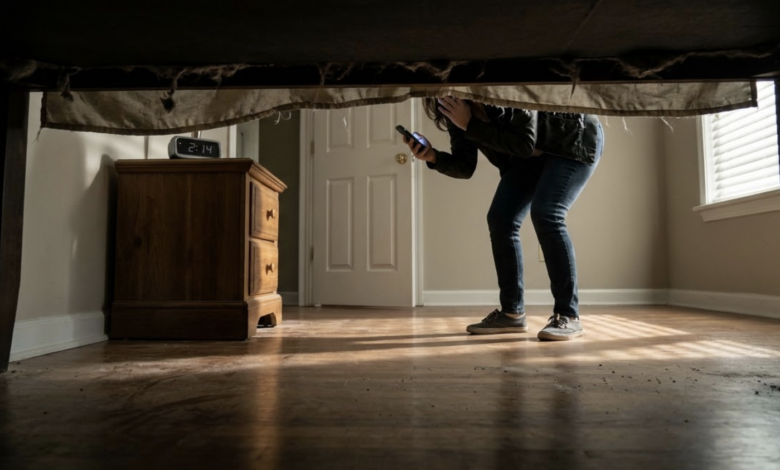
My Husband Had Been Dead for 26 Months—Until I Hid Under My Bed and Heard His Voice on the Phone…
“Then I met Derek.”
I felt my hands go cold.
“He told me he was your husband. He said you had become dangerous and that he needed evidence to protect himself.”
I looked toward Natalie.
“Did you tell her he was dead?”
Natalie nodded.
“He said he couldn’t reveal his identity until the investigation was complete.”
I couldn’t believe what I was hearing.
My sister had helped a man fake his death, and that man had used a woman who looked exactly like me to manufacture evidence against me.
But I still didn’t understand the money.
“What does our birth have to do with my property?”
Clara reached into the pocket of her sweater.
She pulled out a folded document.
“This.”
I took it.
It was an old legal document with my father’s signature.
My father had died when I was sixteen. He had been a quiet businessman who rarely discussed money. I remembered him as a man who loved gardening, old jazz records, and Sunday breakfasts.
I had never known him to be particularly wealthy.
But the document was a trust agreement.
It stated that a portion of his business holdings had been placed into a family trust.
The beneficiaries were his two daughters.
Claire and Clara Bennett.
I read the figures.
My hands began shaking.
The trust was worth several million dollars.
It included commercial property, investment accounts, and shares in a company that had continued growing after his death.
But there was another clause.
The trust could only be distributed after both daughters were located and their identities independently verified.
If either daughter was missing, the assets would remain protected.
And if anyone attempted to obtain control through fraud, coercion, or false medical declarations, the trustees were required to freeze the entire arrangement and notify the authorities.
I looked up.
“So that’s what this is about.”
Clara nodded.
“Derek discovered the trust. He believed he could get control of it by having you declared mentally incompetent and making Natalie your guardian.”
I turned toward my sister.
“Why would he need you?”
Natalie finally broke down.
“Because I’m your closest living relative on the documents everyone knew about. I was supposed to become your temporary guardian. Once that happened, I could sign certain financial papers on your behalf.”
“And you agreed?”
She covered her face.
“Yes.”
I felt tears gathering in my eyes.
“Why, Natalie?”
She looked up.
“Because I was drowning in debt.”
I said nothing.
“My husband left me. My business failed. I owed money to people I couldn’t pay. Derek contacted me and promised to help.”
“So you sold your sister for money?”
“No!”
Her voice cracked.
“I thought you would only be placed under temporary supervision. I thought the house would be sold, the money divided, and everyone would walk away.”
I stared at her.
“You thought I would simply accept losing my home, my independence, and my life?”
“I didn’t think about it that way.”
“That’s the problem, Natalie. You didn’t think about me at all.”
She started sobbing.
But I wasn’t ready to forgive her.
Not yet.
Not after everything.
Then the phone in my hand crackled.
Derek was still listening.
“Enough,” he said.
His voice had changed.
The gentle, familiar tone was gone.
“Claire, you have no idea how complicated this is. Give me the documents, and I’ll explain everything.”
I looked at the phone.
“You’ve had twenty-six months to explain.”
“Don’t be dramatic.”
I almost laughed.
There it was.
The same man who had once promised to protect me was now standing somewhere outside my home, ordering me around as though I were an employee.
“Where are you, Derek?”
“That’s not important.”
“Are you coming here?”
“Give me the folder.”
“No.”
Silence.
Then he said something that made Natalie stand up.
“Then I’ll come and get it myself.”
The call ended.
I looked at the staircase.
“Natalie, where is he?”
She shook her head.
“I don’t know.”
“Don’t lie to me.”
“He’s outside.”
My blood ran cold.
I moved toward the front window and carefully pulled the curtain aside.
A black SUV was parked across the street.
The driver’s door was open.
And a man was standing beside it.
Even from a distance, I recognized the way he held his shoulders.
Derek.
My supposedly dead husband was standing outside my house.
Then my phone vibrated.
A message appeared from Margaret.
CLAIRE, DO NOT LEAVE THE HOUSE ALONE. POLICE ARE ON THEIR WAY. I HAVE FOUND THE ORIGINAL DOCUMENTS.
I read it twice.
Then another message arrived.
YOUR HUSBAND’S DEATH CERTIFICATE WAS OBTAINED THROUGH FRAUD. THE MAN IDENTIFIED AFTER THE CRASH WAS NOT DEREK.
I looked through the window again.
Derek was walking toward the front door.
I backed away.
“Natalie, call the police.”
She didn’t move.
“Now!”
Clara suddenly grabbed my hand.
“There’s another way out.”
She pointed toward the kitchen.
“There’s a back entrance through the laundry room. They never check it because the security system doesn’t cover that corner.”
I looked at her.
“How do you know?”
“Because I tried to escape three times.”
My heart ached.
“Why didn’t you tell anyone?”
“Because Derek told me that if I escaped, he would make sure my sister was arrested for kidnapping me.”
I squeezed her hand.
“Not anymore.”
We moved toward the kitchen.
But before we reached the door, three heavy knocks echoed through the house.
Then Derek’s voice came from the other side.
“Claire. Open the door.”
I stopped.
He knocked again.
“Please, sweetheart. Let’s talk like adults.”
For a moment, I was transported back to our first apartment.
Back to the evenings when he came home carrying groceries.
Back to the man who kissed my forehead before leaving for work.
I remembered the sound of his wedding ring tapping against his coffee mug.
I remembered dancing with him in the kitchen on our fifth anniversary.
And I remembered standing beside a closed casket, begging God to give me one more day.
Then his voice came again.
“Claire, I know you’re in there.”
I walked toward the front door.
Clara grabbed my arm.
“Don’t.”
I stopped.
Then I heard another voice.
“Police! Open the door!”
Derek immediately stepped away from the entrance.
Through the window, I saw two police vehicles pulling up.
He turned and began walking toward his SUV.
But the officers were already approaching.
“Sir! Stop where you are!”
Derek ran.
One officer chased him around the vehicle while another moved toward the house.
A few seconds later, I heard shouting.
Then a struggle.
Then silence.
Derek was on the ground with his hands behind his back.
For the first time in twenty-six months, I saw my husband being taken away by police.
And this time, I knew he wasn’t going to disappear.
The next few hours were a blur.
Police officers photographed the house, collected the Bluetooth speaker, copied the security recordings, and interviewed everyone.
I gave them the USB drive.
I showed them the messages.
I explained the strange medication, the repeated intrusions, and the conversations I had overheard.
Clara provided her own account.
She told the investigators how Dr. Evans had contacted her, how she had been taken to the recovery center, and how she had been instructed to impersonate me.
Natalie initially refused to answer several questions.
But when the officers showed her the recordings from my security system, she finally began talking.
She admitted that Derek had contacted her before his supposed death.
She admitted that she had helped him obtain access to my house.
She admitted that she had supplied information about my medical appointments.
And she admitted that she had received money.
Not a small amount.
Over the previous eighteen months, Derek had transferred nearly $180,000 into accounts controlled by Natalie.
She had used the money to pay debts, purchase a car, and rent an apartment.
But the investigators discovered something even more disturbing.
Dr. Evans had been preparing medical reports about me for months.
Some of the reports described symptoms I had never experienced.
One claimed I had threatened a neighbor.
Another stated I had repeatedly forgotten my own address.
A third suggested I had become convinced that my deceased husband was secretly entering my home.
The last report was dated only four days before the police arrived.
It recommended immediate psychiatric hospitalization and temporary guardianship.
I stared at the papers.
“They were writing my future without ever asking me what was happening.”
The detective nodded.
“That’s what the evidence appears to show.”
He explained that investigators had already obtained a warrant for Dr. Evans’ office.
They discovered altered patient notes, prescription records, recordings, and communications between him, Derek, and Natalie.
Some of the messages were difficult to read.
One from Derek said:
Claire is getting suspicious. Increase the pressure. We need the evaluation before the trust investigation begins.
Another from Dr. Evans read:
Her sister is cooperating. I can arrange the emergency recommendation once the recordings establish a pattern.
I felt sick.
But there was one message that made me cry.
It was from Natalie.
She’s still my sister. Please promise me she won’t get hurt.
Derek’s response was only five words.
That’s no longer your concern.
I put the papers down.
For all her betrayal, Natalie had apparently reached a point where she understood what they were doing.
But understanding something was wrong wasn’t the same as stopping it.
And I wasn’t ready to excuse her.
The following morning, Margaret arrived at the police station.
She brought the original documents from my father’s estate.
She also brought a folder containing copies of the legal agreements Derek had signed before his supposed accident.
When she saw me, she hugged me.
Then she stepped back and looked into my eyes.
“I’m so sorry, Claire.”
I shook my head.
“You didn’t do this.”
“No, but I should have recognized what was happening earlier.”
She sat beside me and opened the folder.
“There is something important you need to understand about your father’s trust.”
I looked at the documents.
“What?”
“Your father anticipated that someone might attempt to manipulate his daughters financially. He created an independent trusteeship specifically to protect the assets.”
She pointed to a paragraph.
“Neither you nor Clara can be forced to transfer your share. Neither can your guardian, spouse, or any other representative.”
I looked at Clara.
“So Derek couldn’t have taken it?”
“Not legally,” Margaret answered. “That’s why he needed to manufacture evidence of incapacity and obtain control of your personal finances first.”
She paused.
“He was hoping to frighten you into signing documents before the trustees discovered what he was doing.”
I looked down.
All those months of grief.
All those appointments.
All those strange incidents.
They had been designed to make me doubt myself.
But Margaret wasn’t finished.
“There is another thing. Derek had debts far larger than the ones he admitted to you.”
She placed a financial statement on the table.
It showed that his business had been losing money before the accident.
He had borrowed from private lenders, used company assets as collateral, and moved money between several accounts.
He had also taken out insurance policies that would pay substantial benefits upon his death.
His supposed death was meant to solve several problems at once.
He could disappear from his creditors, leave his financial obligations behind, and eventually return to claim the family trust.
But he had made one mistake.
He had underestimated how carefully my father had protected the documents.
And he had underestimated Mrs. Higgins.
Three days later, Mrs. Higgins came to visit me.
She stood on my porch wearing her familiar yellow gardening gloves.
When I opened the door, she immediately began crying.
“Oh, Claire.”
I hugged her.
She held me tightly.
“I knew something was wrong.”
“I know.”
“I should have called the police sooner.”
I shook my head.
“You tried to warn me. I didn’t listen.”
She looked toward the living room.
“Is that woman safe?”
I knew she meant Clara.
“Yes. She’s staying with me for now, under the protection of the authorities.”
Mrs. Higgins nodded.
Then she reached into her handbag and pulled out a small notebook.
“I thought you might need this.”
I opened it.
Inside were dates and times.
Every afternoon she had heard screaming.
Every time she had seen someone entering my house.
Every time a vehicle had been parked outside longer than usual.
She had even written down the license plate numbers.
“Mrs. Higgins, you’ve been keeping records?”
She nodded.
“After the third time, I started writing everything down. I didn’t want anyone telling me I was imagining things.”
I hugged her again.
That little notebook became one of the most important pieces of evidence in the investigation.
It helped investigators establish a pattern of unauthorized visits.
It also confirmed that the recordings had been played repeatedly while I was away at work.
For the first time in months, I felt that someone had believed me.
Not because of my money.
Not because of my documents.
Simply because she had seen something wrong and refused to ignore it.
A week later, the investigation expanded.
Police discovered that Dr. Evans had falsified records for other patients.
Some had been placed under unnecessary supervision.
Others had been pressured into signing financial authorization forms.
Derek had used the clinic as a place to hide Clara and manipulate medical documentation.
The authorities also discovered that he had been using a false identity during the months following his disappearance.
The man identified after the crash was Thomas, a former business associate.
Thomas had died in the accident.
His family had never been told the full truth about the circumstances.
Derek had arranged the vehicle switch, and investigators found evidence that he had concealed information about the accident from authorities.
His actions had not only destroyed my life.
They had stolen another family’s chance to understand what happened to their loved one.
That revelation stayed with me.
I had spent months mourning a man who was alive.
Meanwhile, another family had been mourning a man whose death had been hidden behind someone else’s lie.
I thought about Thomas’ family often.
And I hoped they would eventually receive the truth.
The legal proceedings took months.
Derek was charged with multiple offenses connected to fraud, identity deception, financial misconduct, and the scheme to have me declared mentally incompetent.
Dr. Evans faced charges related to falsified medical records, fraudulent prescriptions, and his involvement in the conspiracy.
Natalie was also charged for her role.
Her cooperation helped investigators uncover the full operation, but it did not erase what she had done.
On the morning of the first major hearing, I stood outside the courthouse with Margaret.
I wore a simple navy-blue dress.
My hands were cold.
“Are you ready?” Margaret asked.
I looked toward the entrance.
“No.”
She smiled sadly.
“That’s okay. You don’t have to be ready to tell the truth.”
Inside, Derek sat beside his attorney.
He looked older.
His hair was thinner, and the confidence I remembered had disappeared.
When he saw me, he stared for several seconds.
Then he tried to smile.
I didn’t smile back.
During the hearing, the prosecution presented the recordings.
The court heard Derek discussing my supposed mental instability.
They heard Natalie searching through my drawers.
They heard the instructions to manufacture evidence.
They heard the recorded woman screaming from the Bluetooth speaker.
Then the prosecutor played the conversation in which Derek explained that he intended to have me placed under psychiatric supervision.
I sat completely still.
When the recording ended, the courtroom was silent.
The prosecutor approached the witness stand.
“Mrs. Bennett, when you heard your husband’s voice for the first time after his supposed death, what did you feel?”
I looked toward Derek.
“I felt like I was losing my mind.”
“Why?”
“Because I had spent twenty-six months believing he was dead. I had buried him. I had mourned him. I had tried to rebuild my life. Then I heard his voice inside my home.”
I paused.
“And the person I thought would protect me had become the person I needed protection from.”
The prosecutor nodded.
“Did you ever give your husband permission to enter your home during those months?”
“No.”
“Did you ever give your sister permission to search your personal documents?”
“No.”
“Did you ever agree to have someone impersonate you?”
“No.”
“Did you ever consent to the medical treatment described in those falsified reports?”
“No.”
I looked at the jury.
“I wasn’t crazy. I was being watched, manipulated, and frightened in my own home.”
My voice trembled.
“But the worst part wasn’t the money. It wasn’t even the house.”
I looked directly at Derek.
“The worst part was that I trusted him enough to believe he was gone forever. And he used that trust against me.”
Derek looked down.
For once, he had nothing to say.
The case continued.
Evidence from the clinic, the financial records, the security footage, and the testimony of Clara and Mrs. Higgins established the pattern of deception.
The court ultimately found Derek guilty of the principal offenses related to the fraud and conspiracy.
Dr. Evans was also convicted for his involvement in the scheme and the falsification of medical records.
Natalie accepted responsibility for her role and entered a plea agreement.
She received a sentence that reflected both her cooperation and the seriousness of her actions.
Derek received a lengthy prison sentence.
He would not be returning to my house.
He would not be controlling my money.
And he would never again decide what kind of life I was allowed to live.
When the proceedings ended, I walked outside into the sunlight.
I had imagined that day would feel like victory.
Instead, I felt exhausted.
Margaret put a hand on my shoulder.
“It’s over, Claire.”
I looked at the courthouse doors.
“No,” I said quietly. “Now I get to start again.”
Clara and I began spending time together after the trial.
At first, it was awkward.
We were strangers who happened to share the same face.
We had different childhood memories, different habits, and different ways of seeing the world.
I liked tea.
She preferred coffee.
I loved old movies.
She enjoyed crime documentaries.
I had grown up believing my parents were my entire family.
She had grown up wondering why she never felt completely connected to hers.
But slowly, we began discovering the little things we shared.
We both hated thunderstorms.
We both liked the smell of fresh bread.
We both had a habit of reading the last page of a book before starting it.
And we both tapped our fingers three times against a table when we were nervous.
One afternoon, Clara brought over a box.
“I found something in the documents the police returned to me,” she said.
She opened it.
Inside were several old photographs.
One showed my mother holding two newborn babies.
My father stood beside her, looking exhausted but happy.
I stared at the picture.
For the first time, I saw my mother holding both of us.
My eyes filled with tears.
“She knew,” I whispered.
Clara nodded.
“She knew we were both alive.”
The next photograph showed a handwritten letter.
It was addressed to both daughters.
The letter had been written by my father shortly before he died.
I unfolded it carefully.
To my two beautiful girls,
If you are reading this together, then I hope life has finally given you the chance to know each other.
You were born together, but circumstances separated you. I spent many years trying to correct what happened, but I made mistakes and trusted people I should not have trusted.
I want you to understand something.
Neither of you was ever less loved.
If there is one thing I hope you remember, it is that money can be replaced, property can be rebuilt, and mistakes can be forgiven. But time cannot be returned.
Do not waste your lives fighting over what I leave behind.
Use it to build something meaningful.
And please, take care of each other.
With all my love,
Dad.
I couldn’t hold back my tears.
Clara sat beside me.
For a long time, neither of us spoke.
Then she reached for my hand.
“I wish we had met twenty years ago.”
“So do I.”
“But we can’t change that.”
I looked at her.
“No. But we can decide what happens next.”
She smiled.
And for the first time, I felt that I had gained something rather than lost something.
I had lost a husband.
I had lost my trust in my younger sister.
But I had found a sister I never knew existed.
And somehow, that gave me hope.
Six months after the trial, I received a letter from Natalie.
I almost threw it away.
But curiosity got the better of me.
The envelope contained four handwritten pages.
She apologized for everything.
She admitted that greed, desperation, and resentment had made her blind.
She explained that she had always felt overshadowed by my life.
I had a stable marriage.
A beautiful home.
A successful career.
And she had spent years comparing herself to me.
When Derek offered her money, she convinced herself that helping him was only a temporary arrangement.
She told herself that I would never be seriously harmed.
She told herself that everything would be returned once the paperwork was completed.
But she knew those were excuses.
One sentence stood out.
I knew you trusted me, Claire. That’s why I was able to hurt you so easily.
I read that sentence several times.
Then I folded the letter.
I didn’t immediately forgive her.
I didn’t call her.
I didn’t invite her home.
But I didn’t throw the letter away either.
Several weeks later, I agreed to meet her at a small café.
She arrived fifteen minutes early.
When she saw me, she stood up.
She looked thinner.
Older.
And much less confident than the woman who had once walked through my bedroom searching my drawers.
“Hi, Claire.”
“Hello, Natalie.”
We sat down.
For a while, neither of us spoke.
Then she began crying.
“I don’t expect you to forgive me.”
“Good.”
She looked up.
I continued.
“Because I’m not ready.”
She nodded.
“I understand.”
“I loved you, Natalie. You were my little sister. When Derek died, you were the person I leaned on.”
“I know.”
“You held me while I cried. You told me everything would be okay. And then you went behind my back and helped him destroy my life.”
She lowered her head.
“I was wrong.”
“Yes, you were.”
I took a breath.
“But I don’t want to spend the rest of my life hating you.”
She looked at me.
“Does that mean there’s a chance?”
“It means there’s a chance that someday we might have a relationship again. But it won’t be the same as before.”
“I understand.”
“You will have to earn my trust. And that will take time.”
She nodded through her tears.
I stood up.
Before leaving, I looked at her one last time.
“I hope you find a way to become someone you can respect, Natalie.”
Then I walked out.
It wasn’t a perfect reconciliation.
It wasn’t a magical ending.
But it was honest.
And honesty was something I had learned to value more than promises.
One year later, my life looked completely different.
I had changed the locks.
Installed a new security system.
Replaced the bedroom furniture.
And repainted the walls.
I donated Derek’s belongings, except for a few personal items I wanted to keep as reminders of what I had survived.
I also stopped using the bedroom where I had hidden under the bed.
Instead, Clara and I turned it into a small library.
We filled the shelves with books, placed two comfortable chairs beside the window, and added a little table where we could drink coffee.
Sometimes we spent entire afternoons reading.
Other times, we talked.
About our childhoods.
About our parents.
About the years we had missed.
The family trust was eventually restored under the independent trustees.
After legal fees and other expenses, both Clara and I retained our protected shares.
But neither of us became obsessed with the money.
We remembered our father’s letter.
We decided to use part of the inheritance to establish a small charitable foundation.
It helped women who had experienced financial abuse, coercive control, or exploitation by people they trusted.
We called it the Second Chance Foundation.
The first woman we helped was a sixty-seven-year-old widow whose son had been pressuring her to sign over her home.
She reminded me of the person I might have become if Mrs. Higgins hadn’t spoken up.
I sat with her for nearly two hours.
When she finished explaining her situation, she asked me a question.
“How did you know you weren’t imagining everything?”
I thought about it.
Then I answered.
“I didn’t know at first. I questioned myself every day. But I learned something important.”
“What?”
“Just because someone tells you that you’re confused doesn’t mean they’re telling the truth.”
She held my hand.
And I knew exactly why Clara and I had started the foundation.
Two years after the day I hid under my bed, I was sitting in my kitchen with Clara.
It was a quiet Saturday afternoon.
Sunlight fell across the table.
A pot of coffee was brewing.
And Mrs. Higgins was outside trimming her roses.
Everything felt ordinary.
Then someone knocked on the front door.
Three rhythmic beats.
Tap.
Tap.
Tap.
My body froze.
For one brief moment, I was back in that bedroom.
I could almost smell the perfume.
I could almost hear Derek whispering into his phone.
Clara looked at me.
“Are you okay?”
I took a breath.
Then I stood up.
“I’m fine.”
I walked to the door and looked through the security camera.
It was Mrs. Higgins.
She was holding a small basket of freshly baked muffins.
I opened the door.
“Good afternoon, Claire.”
“Good afternoon.”
She smiled.
“I made too many again.”
I laughed.
“That’s becoming a habit.”
She handed me the basket.
Then she looked over my shoulder and saw Clara.
“Hello, dear.”
Clara smiled.
“Hello, Mrs. Higgins.”
Mrs. Higgins looked between us.
“You two really do look alike.”
We laughed.
After she left, I carried the basket into the kitchen.
Clara poured the coffee.
And for the first time in years, I realized that the sound of three knocks no longer frightened me.
The house was quiet.
But it wasn’t the lonely silence I had known after Derek’s funeral.
It was peaceful.
That evening, I went upstairs and opened the drawer of my nightstand.
Inside was a photograph of Derek and me on our wedding day.
I looked at it for a long time.
I didn’t hate the woman in that photograph.
She had loved someone.
She had trusted someone.
She had built a life around someone she believed would always protect her.
She hadn’t been foolish for loving him.
He had been cruel for taking advantage of it.
I placed the photograph inside a small box and closed the drawer.
Then I walked to the window.
Across the street, Mrs. Higgins was turning on her porch light.
I smiled.
Twenty-six months of grief had taught me that losing someone doesn’t always mean they are gone.
And discovering the truth doesn’t always mean you get your old life back.
Sometimes the truth destroys the life you thought you had.
Sometimes it exposes the people you trusted most.
But sometimes, after everything falls apart, you discover that you are stronger than the person who tried to break you.
I had spent so long believing my husband’s death was the worst thing that could ever happen to me.
I was wrong.
The worst thing was discovering that the man I mourned had been alive, watching me suffer, and waiting for the perfect moment to take everything I owned.
But the best thing was discovering that he hadn’t taken everything.
He hadn’t taken my voice.
He hadn’t taken my freedom.
And he hadn’t taken my future.
Clara was downstairs waiting for me.
Mrs. Higgins was next door.
The house was finally mine again.
And tomorrow, I would wake up knowing that nobody was secretly entering my home, nobody was recording my screams, and nobody was planning to decide how I should live.
For the first time in years, I wasn’t afraid of the afternoon.
I was looking forward to it.
Because I finally understood that a second chance doesn’t mean returning to the life you had before.
Sometimes, it means building a better life with the pieces that remain.
**THE END.**