My Father in Law Said the House We Built Was His Because It Sat on His Land So We Moved the Entire House Three Miles Away
Gordon set his coffee cup down on my kitchen table. He folded his hands the way he does before grace.
And he told me the house I was sitting in belonged to him.
“That house sits on my ground, Kayla,” he said. “Anything on my ground is mine. That’s just how it works out here. Ask anybody.”
He didn’t raise his voice.
Gordon Rasmussen never raises his voice. He said it the way a man reads the price of diesel off the sign at the Cenex. Flat. Certain. A little bored.
It was a Tuesday night in April. The kids were in bed. My husband Jake was in the shower after a long day at the implement shop. And I’d made a fresh pot of coffee because Gordon had stopped by “to talk about the lease.”
There was no lease.
There had never been a lease.
There was a check for five hundred dollars that Jake wrote on the first of every month and walked across the yard to his father’s house.
“I don’t understand,” I said. “We built this house. We paid for every stick of it. You know that. You watched us do it.”
“I know you did,” Gordon said. “And I’m glad you did. But you built it on my ground. You put a house on another man’s land, it goes with the land. That’s the law.”
I looked over at the refrigerator.
My son Cole’s spelling test was stuck up there with a gold star on it. My daughter Hailey’s drawing of a horse from fourth grade was still up there too, curling at the corner.
“Why are you telling me this now?” I asked.
He shrugged.
“Because I’m getting older. Because I’ve been to see Bill Hanson about my will. And because I think you two ought to know where things stand.”
Then he picked his cup back up and finished his coffee. Like we’d been talking about the weather.
My name is Kayla Rasmussen. I’m thirty-nine years old. I’m a paraprofessional at the elementary school in Hemingford, Nebraska.
And until that Tuesday night, I thought I lived in my own house.
Eleven years earlier, it had been Gordon’s idea.
Jake and I were renting a drafty little place in Alliance from a landlord who never fixed anything. Hailey was a baby. I was working as a para at the elementary school. Jake was turning wrenches at the implement dealer.
Gordon came by one Sunday afternoon. He sat on our sagging couch and looked up at the brown water stain on the ceiling for a long minute.
“I’ve got that corner by the road,” he said. “The one past the shelterbelt. Where the old granary used to be. Two acres, more or less. Build there. Save yourselves buying a lot.”
Jake’s mother, Ruthann, was sitting next to him on the couch. She squeezed his arm. And she smiled at me.
I remember thinking it was the kindest thing anybody in Jake’s family had ever said to us.
We didn’t have much.
What we had, we put into that house.
It was a plain one-story. Twelve hundred square feet. Three bedrooms. One bath. Jake drew it out on graph paper at the kitchen table in our rental.
We built it on a concrete block crawl space, because a basement was more than we could afford.
My dad, Lowell Olson, came over every Saturday for two whole summers with his own tools in the back of his Ford. He and Jake framed every single wall. I hung drywall with a borrowed lift until my shoulders burned so bad I couldn’t lift my arms to wash my hair.
We paid for it with everything we’d saved. Plus a small loan from the credit union against Jake’s tools and his truck. Plus every overtime hour Jake could get.
No bank would write a mortgage on a house sitting on somebody else’s land. We found that out early.
We moved in the October Hailey turned two.
She toddled across the bare plywood floor in her socks and laughed at the echo.
Ruthann cried in the doorway. And she brought us a cherry pie.
The first of the next month, Gordon came by at suppertime.
“I’ll need five hundred a month for the ground,” he said. “My dad charged me for mine when I started out. It’s how a man learns what things cost.”
Jake looked at me.
I looked at Jake.
We’d just spent every dollar we had in this world.
But it was his father. And it was his father’s land. And Jake was raised not to argue.
“Okay, Dad,” Jake said.
He wrote the first check that night at the kitchen table.
I kept the carbon copy. In a shoebox. On the closet shelf.
I don’t know why I kept it. I guess part of me already knew I’d want to count them someday.
Specialty: Emotional Turning Points
Rachel Monroe writes character-driven stories about betrayal, second chances, and unexpected resilience. Her work highlights the emotional side of family conflict — the silences, the misunderstandings, and the moments when someone quietly decides they’ve had enough.
For eleven years, Jake wrote that check.
He wrote it the winter the transmission went out in my car.
He wrote it the month Cole had his tonsils out and our deductible ate the whole savings account.
He wrote it the spring the shop cut everybody’s hours.
We never missed one. Not one single month. Jake would rather have skipped a meal than show up at his father’s door short.
Gordon would take the check. Fold it once. And slip it in the pocket of his work shirt.
He never said thank you.
He never said anything.
He’d just nod. And sometimes ask Jake to help him with a calf or a stuck gate while he was standing there.
Ruthann used to slip me things.
A pound of hamburger from the locker in town. A sack of sweet corn from her garden. A twenty-dollar bill for the kids’ school pictures that she’d press into my palm and fold my fingers over.
“He’s not a bad man, Kayla,” she told me once, in her kitchen. “He’s just a hard one. His daddy was harder. You should have seen how that old man treated him.”
Ruthann died six years ago. A stroke. In March. While she was out hanging sheets on the clothesline.
After that, there was nobody left to soften Gordon.
And nobody left to soften the first of the month.
One night I couldn’t sleep. I got up and sat at the kitchen table with a calculator.
Five hundred dollars. Twelve months. Eleven years.
One hundred and thirty-two checks.
Sixty-six thousand dollars.
That’s what a two-acre corner of pasture grass in the Nebraska Panhandle had cost us.
Grass that the land men in Alliance told me rented for maybe fifty dollars an acre. A year.
I never said it to Gordon. I barely said it to Jake.
But I carried that number around with me like a stone in my shoe.
Specialty: Emotional Turning Points
Rachel Monroe writes character-driven stories about betrayal, second chances, and unexpected resilience. Her work highlights the emotional side of family conflict — the silences, the misunderstandings, and the moments when someone quietly decides they’ve had enough.
When Jake came out of the shower that April night, Gordon was already gone.
I was still sitting at the kitchen table with his empty coffee cup in front of me.
I told Jake everything his father said. Word for word.
I watched my husband’s face go from confused to gray.
“He said that?” Jake asked. “He actually said the house is his?”
“He said anything on his ground is his. He said he’s been to see Bill Hanson about his will.”
Jake sat down hard in his chair.
He’s forty-one. He’s built like a fence post. And I’d never once seen him look small.
He looked small that night.
“Mom would never have let him say that,” he said quietly.
“I know, honey.”
“What do we do, Kay?”
I didn’t have an answer.
I had a shoebox full of carbon copies. And a knot in my chest.
The first thing everybody asks me is why I didn’t sue him.
I did call a lawyer. One. A woman in Alliance who does farm and family law. She sat across her desk from me and listened for forty-five minutes without interrupting once.
“I’ll be honest with you,” she said. “This is messy. In Nebraska, a house built on somebody else’s land generally becomes part of the land. Unless you had something in writing, you’d be arguing about what he promised eleven years ago. And he’ll say you were renting.”
“We have the checks,” I said.
“You have checks that say you paid him money for the use of his ground,” she said gently. “That helps him as much as it helps you.”
She told me it might take two years. She told me what it might cost.
And then she asked me the question I couldn’t get past.
“Do you want your husband on a witness stand across from his own father?”
I drove home with the radio off.
Jake’s mother was gone. Jake was an only child. Gordon was all the family Jake had left on that side.
I wasn’t going to put my husband in a courtroom against his own dad. Not for a house. Not for any amount of money.
Some things you don’t get back once you break them.
So I did nothing.
All through May. And June. And July.
I went to work. I packed lunches. I watched Jake walk that check across the yard on the first of every month with his shoulders hunched up around his ears.
And I swallowed it.
That was the summer I found out exactly how much a person can swallow.
Specialty: Emotional Turning Points
Rachel Monroe writes character-driven stories about betrayal, second chances, and unexpected resilience. Her work highlights the emotional side of family conflict — the silences, the misunderstandings, and the moments when someone quietly decides they’ve had enough.
It was my dad who finally broke it open.
Lowell Olson is seventy years old. He farmed wheat and ran cattle three miles down the same county road for forty-four years, before he leased out his cropland.
He doesn’t waste words. And he never calls after nine at night.
He called at nine-thirty on a Thursday in late August.
“Your mother’s friends say you’ve been crying in the school parking lot,” he said. “Mrs. Kramer saw you.”
I should’ve known.
Nothing on our road stays a secret. My mother’s been gone nine years now, but she still has friends who report to my dad like a sheriff’s posse.
So I told him. All of it.
The April night. The lawyer. The shoebox.
He didn’t say one word the whole time I talked.
When I finished, he was quiet for so long I thought the call had dropped.
“I’ve got two acres by the windbreak,” he finally said. “North side of the yard. Where your mother always wanted that garden she never got around to. Good ground. Well’s close. It’s yours. I’ll go to the abstract office in the morning and put it in your names.”
“Dad. I can’t take your land.”
“You’re not taking it. I’m giving it. There’s a difference, and I’d like you to learn it from me. Not from Gordon.”
I sat on the edge of the bathtub with the phone in my lap and cried so hard Hailey knocked on the door to ask if I was okay.
“But Dad,” I said, when I could finally talk again. “The house is here. Even if we had the ground, the house is still here.”
“Well,” he said.
I could hear him leaning back in his recliner.
“Houses move, honey. I watched one go down this road in 1971. Ask Jake.”
I didn’t ask Jake that night.
I lay awake beside him and turned it over and over in my mind.
A house isn’t a pickup. You can’t just drive it away.
But the next morning, while I was making eggs, Jake came in from the porch with his coffee. And he stood in the kitchen doorway looking at the walls he’d framed with his own hands.
“Your dad called me at the shop yesterday,” he said.
I put down the spatula.
“He told me about the two acres,” Jake said. “And he told me he watched a house go down the road in seventy-one.”
“What did you say to him?”
Jake ran his hand slowly along the door frame. The one by the pantry. The one with the pencil marks.
“I didn’t say anything to him,” Jake said. “But I’m saying it to you.”
He looked at me. His eyes were wet. But his voice was steady.
“Call a house mover, Kay.”
His voice cracked on the very last word. Just that one.
I’ll never forget it.
Specialty: Emotional Turning Points
Rachel Monroe writes character-driven stories about betrayal, second chances, and unexpected resilience. Her work highlights the emotional side of family conflict — the silences, the misunderstandings, and the moments when someone quietly decides they’ve had enough.
I want people to understand something about my husband.
Jake is not a man who walks away from his father.
He hauled hay for that man every summer of his life. He pulled calves for him at two in the morning in February with the wind chill at thirty below.
Choosing this cost him a whole lot more than it cost me.
But he had a wife and two kids sleeping under a roof that his own father said wasn’t theirs.
And Jake decided, standing there in that kitchen doorway, that his children were going to grow up in a house that belonged to them.
There’s a company out of Scottsbluff that’s been moving buildings across the Panhandle for three generations.
The man who came out was named Arnie Kessler. He looked like he’d been moving houses since before I was born.
He was short and wide. Gray mustache. A seed cap so faded you couldn’t read the logo.
He walked around our house twice with a tape measure and a flashlight. Then he got down on his belly and crawled underneath it.
He came out with cobwebs on his shoulders. And he grinned.
“One story. Block crawl space. No basement. Good square framing,” he said. “Whoever built this knew what they were doing. She’ll go.”
“My husband and my dad built it,” I said.
“Well, they built it right. Makes my job easy.”
Then he told me what it would cost.
And my stomach dropped right through the floor.
Twenty-three thousand, eight hundred dollars. To jack the house up, put it on steel beams, load it on the trailer, and set it down on a new foundation.
And that didn’t count the county moving permit. Or what the power co-op would charge to send a crew to lift the lines at the crossings. Or the new foundation itself.
It didn’t count a new well line and a septic system at Dad’s place either. Dad said the old yard well would reach, but we’d need a line trenched. The septic was its own bill.
That night I sat at the kitchen table with a yellow legal pad and added it all up.
A little over thirty-eight thousand dollars.
We had nineteen thousand in savings. It took us nine years to save it. A little at a time. For the kids. For emergencies.
Jake was standing behind me, reading over my shoulder.
“This is an emergency, Kay,” he said.
Dad covered the rest.
He wouldn’t take a note. He wouldn’t even let us talk about it.
“Your mother would haunt me,” he said. “Now hush.”
Specialty: Emotional Turning Points
Rachel Monroe writes character-driven stories about betrayal, second chances, and unexpected resilience. Her work highlights the emotional side of family conflict — the silences, the misunderstandings, and the moments when someone quietly decides they’ve had enough.
Jake told his father himself.
He wouldn’t let me go with him.
“He’s my dad,” Jake said. “It’s mine to say.”
He walked across the yard on a Sunday afternoon in September to his father’s shop, where Gordon was greasing the swather.
I watched from the kitchen window. The big shop door was open. I could see the two of them standing a few feet apart. Not looking at each other.
They talked for maybe ten minutes.
Gordon never once stopped working that grease gun.
When Jake came back, he didn’t come inside.
He got into his pickup. And he sat there with both hands on the steering wheel for almost half an hour.
Finally, I took him a cup of coffee. I climbed into the passenger side.
“What did he say?” I asked.
Jake stared out through the windshield at the shelterbelt.
“He said he wasn’t going to stop us,” he said. “He said it’s our lumber. Take it if we want it. He said the ground stays with him.”
“That’s all?”
“He said we’d be back by Thanksgiving.”
Jake laughed. But it wasn’t a laugh.
“He said nobody moves a house over five hundred dollars a month.”
I took his hand. His knuckles were black with grease from the shop.
We sat there together in that pickup until the coffee went cold.
People have asked me since if Gordon could’ve stopped it.
Maybe.
He could’ve called somebody. He could’ve stood right in front of the jacks.
He never did.
I think, even then, some part of him didn’t want to win that way.
Moving a house isn’t one day.
It’s six weeks of a hundred little jobs. And every single one of them costs something.
Dad and Jake and two men from church poured the new foundation at Dad’s place. Concrete block on a footing. The exact same twelve hundred square feet, laid out to the inch.
Jake measured it four times. Dad measured it twice more after Jake went home.
The county engineer came out to look at the route. Three miles of gravel county road. One cattle guard. One culvert that Arnie didn’t trust. And two places where the power lines crossed low.
The power co-op scheduled a crew for the second Saturday in October. They’d ride ahead of the house in a bucket truck and lift the lines at every crossing.
Jake shut off the water and the propane. A plumber from Hemingford came and disconnected the septic. An electrician pulled the meter.
Our house went dark for the first time in eleven years.
We lived out of Dad’s spare rooms for those last two weeks. The kids thought it was a big adventure. They slept on air mattresses in my old childhood bedroom and ate cereal at my mother’s kitchen table.
Every evening after work, I drove back over to the house and packed. Dishes wrapped in newspaper. Pictures off the walls.
Arnie said we could leave most of the furniture in place if it was strapped down tight. But anything that could fall would fall.
I left the curtains up.
I can’t tell you why. I just couldn’t take them down.
I wanted our house to look like a home while it went.
Specialty: Emotional Turning Points
Rachel Monroe writes character-driven stories about betrayal, second chances, and unexpected resilience. Her work highlights the emotional side of family conflict — the silences, the misunderstandings, and the moments when someone quietly decides they’ve had enough.
The night before the move, Jake and I took the kids over to the house one last time. To check that everything was tied down.
Arnie’s crew had been under it for two days already.
Our house was up on cribbing now. Sitting on two long steel beams. Three feet higher than it was supposed to be. We had to climb in the back door on a step stool.
It was strange inside. Empty and echoing. Just like it was the October Hailey turned two.
Our footsteps sounded way too loud.
I was checking the kitchen cupboards when I realized Cole wasn’t behind me anymore.
I found him standing in the pantry doorway. His flashlight pointed up at the door frame.
He’s nine years old. He’s a tough little boy. He plays flag football. He catches frogs in the stock tank. He doesn’t cry much anymore.
He was crying.
“Cole? Baby, what’s wrong?”
He wouldn’t look at me. He just kept his flashlight pointed up at that door frame.
Every birthday since Hailey was two, we’d stood the kids up against that pantry door frame and marked their height in pencil. With the date next to it.
Hailey’s marks went up the left side. Cole’s went up the right. Jake’s handwriting on some. Mine on others.
And there was one mark at the very bottom. Barely a foot off the floor.
Cole. 1st birthday. Wouldn’t stand still.
Ruthann wrote that one. In her handwriting. Slanted and careful.
“Do we have to leave them?” Cole asked. His voice was very small. “Grandpa’s going to keep the marks, isn’t he? Because they’re on his ground.”
And that’s when I understood just how much my kids had heard that summer.
No matter how quiet we’d tried to be.
I knelt down on the linoleum and put my arms around him.
“No, baby,” I said. “They’re part of the house. They’re nailed right into it. Wherever this house goes, they go too.”
Hailey had come up behind us. She’s thirteen. She doesn’t let me hug her in public anymore.
She sat down on the floor right next to us anyway. And she leaned her head on my shoulder.
“Can I write tonight’s date?” she asked. “So we always know it was the night before?”
Jake took a carpenter’s pencil out of his shirt pocket.
Hailey stood on her tiptoes. And at the very top of that door frame, higher than anybody had ever been tall enough to reach, she wrote the date.
And under it, she wrote:
The night before we took our house home.
Specialty: Emotional Turning Points
Rachel Monroe writes character-driven stories about betrayal, second chances, and unexpected resilience. Her work highlights the emotional side of family conflict — the silences, the misunderstandings, and the moments when someone quietly decides they’ve had enough.
The second Saturday in October came up bright and cold.
There was frost on the stubble in the fields. And the sky over the Panhandle was that hard, clean blue you only get in October.
Arnie’s crew showed up at six in the morning.
By nine, they’d rolled the big trailer under the beams, let the jacks down, and chained everything tight.
Our house sat up on that long trailer behind a big red Peterbilt with yellow lights flashing on top.
It looked smaller than I expected.
And bigger, too.
I don’t know how to explain that.
Jake rode up front in the escort pickup with Arnie’s nephew. An orange flag on the bumper. The light going. The co-op bucket truck went ahead of them.
I stayed behind with Hailey and Cole to walk the first stretch along the road.
I didn’t expect anybody else to be there.
The whole road came.
The Petersons pulled up first. Mel and his wife, in their old Chevy, with their dog in the back.
Then the Kramers.
Then the family from the Lutheran church who live past the section line, with all four of their kids piled in the back seat to see.
By the time Arnie eased that truck out of our driveway and onto the county road, there were nine pickups lined up behind the trailer with their hazards blinking.
Two beet trucks headed for the sugar beet piling ground in Hemingford pulled over onto the shoulder to wait. The drivers got out to watch.
Somebody’s grandma, a tiny woman in a quilted coat, came walking down the line with a thermos and a sleeve of paper cups. She poured me a cup of coffee without even asking.
“I saw one of these go down this road in 1971,” she said. “The old Swanson place. I was younger than your girl there.”
“My dad says he saw it too,” I said.
“Well, then he remembers it went just fine.” She patted my arm. “This’ll go fine too, honey.”
Our house rolled down the county road at walking speed.
I mean that exactly. Hailey and Cole and I walked beside it on the shoulder for the first quarter mile and kept pace without even trying.
The gravel popped under the tires. The trailer creaked. Every so often the whole house rocked. Just a little.
And my heart jumped up into my throat.
And then it settled.
My kitchen curtains were still hanging in the window. Yellow, with little white flowers. Ruthann helped me sew them that first winter.
I watched them sway with every bump.
Cole kept his hand pressed flat on the front of his coat. Like he was holding something in.
“Are the marks okay?” he whispered.
“The marks are fine, baby,” I said. “Arnie’s the best there is.”
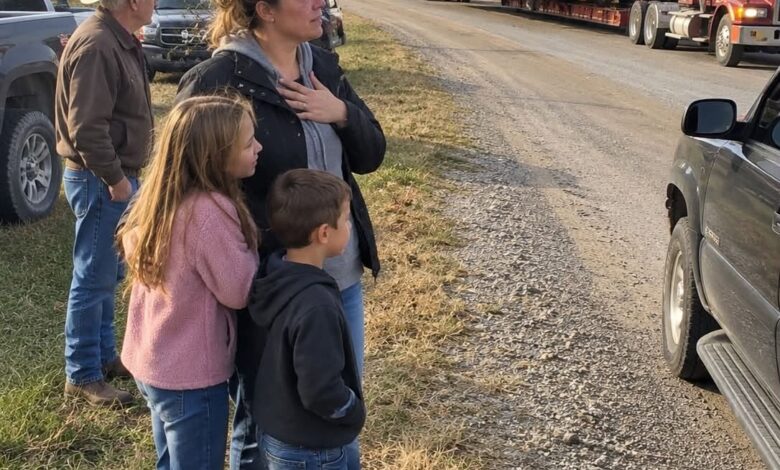
I put my own hand on my chest.
I didn’t even know I was doing it. Not until later, when Hailey showed me the picture she’d taken with her phone.
The first power line went up and over like it was nothing. The co-op man in the bucket lifted it with a long fiberglass pole. Arnie crept the house underneath.
A cheer went up from the pickups behind us. Somebody honked.
Then we came around the bend by the shelterbelt.
And I saw the end of Gordon’s driveway.
Specialty: Emotional Turning Points
Rachel Monroe writes character-driven stories about betrayal, second chances, and unexpected resilience. Her work highlights the emotional side of family conflict — the silences, the misunderstandings, and the moments when someone quietly decides they’ve had enough.
He was standing there alone.
He had on his good hat. The gray felt one he wears to church and to funerals. A clean pearl-snap shirt. His good jacket.
Sixty-eight years old. Hands at his sides. Standing at the very end of his gravel drive where it meets the county road.
He didn’t wave.
He didn’t move.
He just watched our house come.
I stopped walking. Hailey stopped beside me.
The pickups behind us slowed down. And I could feel that whole road go quiet.
Everybody on that road knew Gordon Rasmussen.
And everybody knew whose ground that house had been sitting on.
Arnie’s truck crept past him.
Then the front of the trailer.
Then the porch. The porch Jake and my dad built in one long weekend in July, with the radio playing country music.
Gordon watched the porch go by.
Then he watched the kitchen window go by. The window right next to the table where he’d sat in April with his coffee and his folded hands.
Hailey reached over and took my hand.
She hadn’t held my hand in public since she was eight years old.
And then Gordon stepped down off his driveway onto the gravel of the county road.
And he lifted one hand toward Arnie’s cab.
Arnie hit the brakes.
The whole house rocked on the trailer. And settled.
Nobody on that road said a single word.
Up ahead, Jake was already out of the escort pickup.
I watched him walk back along the road toward his father. Slow. The way you’d walk toward a horse you weren’t sure of.
I let go of Hailey’s hand and went too.
Gordon didn’t look at either one of us at first.
He walked right up to the side of the house, next to the porch. He took off his good hat.
And he put his bare hand flat against the siding.
He stood there like that for a long moment. His hand on the house. His hat held against his chest.
“I helped your mother pick out this color,” he said to Jake.
He didn’t turn around.
“She said it was too yellow. I told her it was fine.”
Jake didn’t say anything.
I don’t think he could.
Gordon took his hand off the siding.
Then he turned around and walked up to the cab of the Peterbilt. He looked up at Arnie through the open window.
“That culvert on the Olson stretch is soft on the north side,” Gordon said. “Has been since the flood in ’19. Put a couple planks under your left wheels when you cross it. Or you’ll drop a corner.”
Arnie looked down at him for a long second.
Then he nodded.
“Appreciate it.”
Gordon stepped back off the road. He put his hat back on.
And then he looked at me. For the first time since April.
“I’m going to follow you down,” he said. “If that’s all right.”
I didn’t know what to say.
I looked at Jake. Jake looked at his father.
“It’s a public road, Dad,” Jake said.
But his voice was thick. And he didn’t say it mean.
Gordon nodded once. He walked back up his driveway to his pickup.
Arnie eased the truck forward. The house rolled on.
And when the line of pickups came past the end of Gordon’s drive, his old brown Ford pulled out at the very back.
And fell in behind them.
Hazards blinking. Just like everybody else’s.
Specialty: Emotional Turning Points
Rachel Monroe writes character-driven stories about betrayal, second chances, and unexpected resilience. Her work highlights the emotional side of family conflict — the silences, the misunderstandings, and the moments when someone quietly decides they’ve had enough.
Arnie put two planks under his left wheels at the Olson culvert.
Our house crossed it without dropping a corner.
I looked back down the line of pickups. And at the very back, I saw Gordon lift two fingers off his steering wheel.
It took until almost three in the afternoon to back that trailer up beside the new foundation and slide our house onto it.
Most of the neighbors stayed the whole time. Somebody brought a cooler of sandwiches. The Lutheran kids sat on a tailgate and cheered every time the hydraulic jacks hissed.
Gordon stood by himself at the edge of Dad’s yard all afternoon.
He didn’t offer advice. He didn’t get in anybody’s way.
Once, when one of Arnie’s crew dropped a cribbing block, Gordon bent down and picked it up and handed it back.
Around noon, my dad walked over to him.
I watched them from across the yard. Two old men in good hats, standing side by side with their hands in their jacket pockets. They’ve known each other fifty years.
I couldn’t hear a single word.
When the last jack came out, and our house sat level on its new blocks, Arnie climbed down out of the truck. He slapped the siding with his open hand.
“She’s home,” he said.
Everybody clapped.
Cole ran straight for the back door to check the pantry.
Gordon was still standing at the edge of the yard when Arnie’s crew pulled out.
Jake walked over to him.
I went too. Because I was done letting Jake carry things by himself.
“Why, Dad?” Jake asked.
Just that.
Gordon looked at the house for a long time before he answered.
“My dad charged me for my ground,” he said. “Every month for nineteen years. Until the day he died. Fifty dollars. Then a hundred. Then two hundred. He said that’s how a son learns what things cost. That a man doesn’t get anything for free. Not even from his father.”
He turned his hat around slowly in his hands.
“I hated him for it,” Gordon said. “Hated him. And then I turned around and did the exact same thing to you. I thought that was just how it was done. I thought that’s what made me a man.”
“And the house?” I asked. “Telling me the house was yours?”
He was quiet for a long moment.
“Bill Hanson asked me what happens to the place when I’m gone,” he said. “And I got scared. I got it in my head that if the house was mine, you’d always stay. You’d have to.”
He looked down at his boots.
“I never once thought you’d leave,” Gordon said. “It never even crossed my mind that you could.”
Jake’s jaw worked.
“You told your own grandson his height marks were on your ground, Dad.”
“I never told him that.”
“He heard it anyway, Dad,” Jake said. “They hear everything.”
Gordon closed his eyes.
When he opened them again, they were wet.
In eleven years, I had never once seen Gordon Rasmussen with wet eyes.
Not even at Ruthann’s funeral.
Specialty: Emotional Turning Points
Rachel Monroe writes character-driven stories about betrayal, second chances, and unexpected resilience. Her work highlights the emotional side of family conflict — the silences, the misunderstandings, and the moments when someone quietly decides they’ve had enough.
We had no power yet. The electrician wasn’t coming until Monday. The water wasn’t hooked up. The house was level, but it wasn’t ready.
I didn’t care.
I wanted supper in my own kitchen.
Dad hauled over his old green Coleman camp stove from the shop, and two lanterns. I had a pot of chili in his refrigerator from the night before, and a jug of water.
Hailey found the box marked KITCHEN – BOWLS. She unwrapped six of them from the newspaper.
Six.
She’d counted us without even thinking about it. Jake. Me. The kids. Dad.
And Gordon.
He was still out in the yard. Standing by his pickup. Keys in his hand. Like he couldn’t decide whether to go.
I went out on the porch.
The sun was going down red over the windbreak. The air was getting sharp.
“Gordon,” I said. “Supper’s on. It’s just chili.”
He looked up at me like I’d said something in a foreign language.
“Kayla, I don’t think I ought to.”
“I made too much,” I said. “Come in. Wipe your boots.”
He came in.
He wiped his boots on the mat by the back door. The same mat that had been sitting in front of that same door for eleven years. Three miles up the road.
We ate by lantern light around the kitchen table. Sitting on overturned five-gallon buckets, because the chairs were still strapped down.
The chili was good. Nobody talked much.
Cole was the one who got up first.
He went over to the pantry door. He pointed his flashlight up the frame. And he looked over his shoulder at his grandpa.
“Grandma wrote that one,” he said. He pointed at the very bottom mark. “When I was one.”
Gordon got up off his bucket.
He walked over and crouched down, slow, his knees popping. And he looked at his wife’s handwriting in the lantern light for a long, long time.
Then he reached out and touched it. With one finger.
“She did,” he said.
And his voice broke right in half.
“That’s her.”
Cole leaned against his grandpa’s shoulder.
And Gordon put his arm around him. And didn’t let go for a long time.
Specialty: Emotional Turning Points
Rachel Monroe writes character-driven stories about betrayal, second chances, and unexpected resilience. Her work highlights the emotional side of family conflict — the silences, the misunderstandings, and the moments when someone quietly decides they’ve had enough.
The checks stopped.
Nobody had to say so. The first of November came and went. And Jake didn’t walk anywhere.
Gordon came by twice that November. Once to help Jake reset the gutters that had shifted on the trip. Once to bring a box of apples from somebody’s tree in town.
He knocked both times.
He’d never knocked once in eleven years.
The Sunday before Christmas, he came to our back door after church. In his good hat. And he asked Jake to step out on the porch with him.
I watched through the kitchen window.
Gordon took a long white envelope out of the inside pocket of his jacket. He held it out.
Jake opened it. And stood there very, very still.
When Jake came back inside, he set the envelope down on the kitchen table in front of me without a word.
It was a cashier’s check. From First National Bank in Alliance. Made out to Jake and Kayla Rasmussen.
Sixty-six thousand dollars.
There was a note folded around it. In Gordon’s square, careful printing.
Every dollar. I sold the bred heifers and cashed out the savings account your mother started. It was never mine to keep. I’m sorry it took a house going down the road for me to see it.
Dad.
I sat there at my kitchen table and cried.
Not because of the money.
Because he’d signed it Dad. To both of us.
We paid my father back the first week of January. Every dollar he’d put into the move.
He tried not to take it.
I made him.
Specialty: Emotional Turning Points
Rachel Monroe writes character-driven stories about betrayal, second chances, and unexpected resilience. Her work highlights the emotional side of family conflict — the silences, the misunderstandings, and the moments when someone quietly decides they’ve had enough.
It’s been a year now.
Our house sits on two acres by my dad’s windbreak. Three miles down the county road.
The garden my mother never got around to is finally planted. Hailey grew tomatoes in it this summer. Big ones. She entered one in the county fair and got a red ribbon.
Dad comes over for coffee most mornings. He sits at our kitchen table in the same chair every time.
The marks are still on the pantry door frame. Hailey’s date at the very top. Cole’s added a new one since. He grew two inches this year.
People on our road still talk about the day the house went by. The grandma with the thermos told me she’s told the story at every single quilting since.
I don’t tell it as a story about winning.
Nobody won.
Gordon lost eleven years of his son’s trust. And he knows it.
Jake lost the idea of his father that he’d carried around his whole life.
And I lost a whole summer to swallowing.
But we all got something back too.
Last spring, Gordon showed up on a Saturday morning with his post-hole digger in the back of the Ford. He and Jake and Dad spent all day building a fence around Hailey’s garden. To keep the deer out.
Three men. Three generations of stubborn.
They argued about every single post.
When it was done, Gordon stood back and looked at it with his hands in his pockets.
“Ruthann would’ve liked that,” he said.
“She would’ve said it was crooked,” Jake said.
Gordon laughed. A real laugh. I’d never heard it before.
“She would’ve,” he said. “She’d have been right, too.”
And every Sunday after church, a little before noon, I hear the gravel pop out on the county road.
I look out the kitchen window. Past the yellow curtains Ruthann helped me sew.
And there comes Gordon’s old brown Ford. Driving the three miles for Sunday dinner.
He knocks every single time.
I tell him every single time that he doesn’t have to.
He wipes his boots anyway.
Then he goes straight to the pantry door. Before he even sits down. Before he even takes off his hat.
He finds the mark at the very bottom. Barely a foot off the floor.
Cole. 1st birthday. Wouldn’t stand still.
And he touches it once. With one finger.
Then he sits down at our table.
And I pour him a cup of coffee.
In his own cup. The one I bought him at the hardware store in Hemingford. A plain brown mug with a chip on the handle.
He doesn’t know I kept it on the shelf all through November. Waiting.
He just drinks his coffee. And talks to my dad about the price of cattle. And asks Cole about flag football.
Like he’s been coming here his whole life.
Like this house was always home.
It was.
It just had to go three miles down the road before everybody could see it.
Specialty: Emotional Turning Points
Rachel Monroe writes character-driven stories about betrayal, second chances, and unexpected resilience. Her work highlights the emotional side of family conflict — the silences, the misunderstandings, and the moments when someone quietly decides they’ve had enough.