My Mother Fed a Homeless Man for 20 Years, but His Words After Her Passing Changed My Life
I spent most of my childhood believing my mother cared more about a homeless man living behind our house than she cared about me. For nearly twenty years, she prepared meals for him, brought him warm clothes, and made sure he had something to eat every day. Meanwhile, we struggled to pay our bills, and sometimes there wasn’t enough money for the things I needed.
I never understood her attachment to that man. His name was Victor, and although he lived just beyond our backyard fence, he seemed to have a permanent place in my mother’s life.
Even after growing up and moving away, I couldn’t forget those years. I remembered the arguments, the unanswered questions, and the strange sadness that appeared whenever I mentioned his name.
Then my mother passed away.
The day after her funeral, I returned to her little house carrying a container of homemade beef stew. Before she died, she had asked me to make one final promise: I would continue bringing Victor his meals.
I had agreed, although I still didn’t understand why it mattered so much to her.
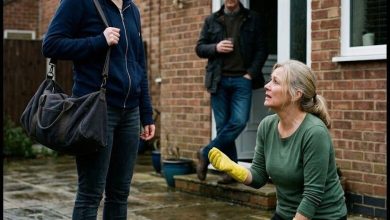
But when I arrived, Victor’s small shelter was empty. His blankets had been folded, his belongings were gone, and the familiar place behind the fence looked completely different.
Then I noticed a black SUV parked near the driveway.
A moment later, a man wearing a clean dark coat stepped toward me.
It took me several seconds to recognize him.
“Victor?”
He nodded.
But something in his appearance had changed. Without the thick beard and worn clothing, he looked like an entirely different person.
“I brought you dinner,” I said, still trying to understand what was happening.
He looked down at the container and smiled faintly.
“Your mother would have liked that.”
Then I noticed something in his hand.
It was a small silver locket.
I recognized it immediately. It was the necklace my mother had worn in old family photographs. She had told me years earlier that she lost it when I was eight.
“Where did you get that?” I asked.
Victor gently opened his hand.
“Your mother gave it to me.”
I shook my head.
“That’s impossible. She lost that necklace years ago.”
Victor looked toward the kitchen window.
“Fiona, your mother didn’t lose it. She wanted you to believe she had.”
I felt a strange chill.
“What are you talking about?”
He took a deep breath.
“Your mother asked me to keep something private until she was gone. She believed the truth would eventually bring our family together again.”
I looked at the locket.
“Who are you, Victor?”
His answer changed everything I thought I knew about my childhood.
“I’m your mother’s brother.”
For a moment, I couldn’t speak.
My mother had always told me she had one brother, Uncle Mark. I had never heard of another sibling.
Victor watched my expression carefully.
“I know this is difficult to understand,” he said. “But there is something you need to see.”
And then he began telling me a story that went back many years.
When I was growing up, our family didn’t have much money.
We lived in a modest rental house with an old kitchen, uneven floors, and a backyard that became muddy whenever it rained.
My mother, Stephanie, worked hard to make sure I had what I needed. She prepared meals, managed household expenses, and found ways to make ordinary days feel special.
But there was one thing I never accepted.
Every afternoon, she prepared an additional meal for Victor.
Sometimes it was chicken and vegetables. Other days, it was soup, rice, or whatever we had available.
I used to watch her carefully place the food inside a plastic container.
“Why do you always make so much for him?” I once asked.
“Because he needs it, Fiona.”
“But we need it too.”
She stopped stirring the pot.
I was eleven, and I didn’t understand the responsibilities adults carried. I only knew that we sometimes struggled, and I couldn’t understand why my mother kept sharing what little we had.
“He’s important to me,” she finally answered.
“Then why doesn’t he live somewhere else?”
My mother became quiet.
“Some things are more complicated than they appear.”
I didn’t like that answer.
I wanted an explanation, but she simply handed me the container.
“Please take this to Victor.”
I walked toward the backyard, frustrated that once again I was being asked to deliver food to someone I barely knew.
Victor always thanked me.
Sometimes he asked about school. Other times, he asked whether my mother was feeling well.
I rarely gave him more than a short answer.
I couldn’t understand why a stranger seemed to know so much about our family.
As the years passed, Victor remained nearby.
Although he had very little, he occasionally helped around the property. He repaired a loose fence board, cleared fallen branches after storms, and helped my mother carry groceries.
Once, during a particularly cold winter, I noticed a new pair of boots beside my schoolbag.
They were exactly my size.
“Mom, where did these come from?”
“A donation,” she answered.
I looked through the kitchen window and noticed Victor arranging firewood near the fence.
I wondered whether he had something to do with the boots, but I never asked.
There were other small things too.
Whenever the porch needed attention, Victor seemed to notice. When my mother had difficulty carrying something heavy, he was usually nearby.
He never asked for recognition.
At the time, I interpreted his actions as an attempt to repay my mother for the meals she provided.
I never imagined there was a much deeper reason.
Years later, my mother became seriously ill.
The energetic woman who had once managed everything in our household gradually needed more help with ordinary tasks.
I visited frequently, spending afternoons beside her hospital bed and helping arrange things at home.
One afternoon, she asked me to sit closer.
“Fiona, I need you to promise me something.”
“Of course, Mom.”
“Please don’t stop looking after Victor.”
I sighed.
“Mom, why are we still talking about him?”
She gently took my hand.
“Because he matters more than you realize.”
I looked at her.
“Why have you never explained anything?”
She remained silent for a moment.
Then she mentioned something unexpected.
“If your Uncle Mark comes around after I’m gone, don’t let him take the blue box from my bedroom.”
I was confused.
“What blue box?”
“The one beneath the blankets in my closet.”
“What’s inside it?”
“Everything you deserve to know.”
I wanted to ask more questions, but she was tired.
Before I left, she whispered something I would remember for the rest of my life.
“I never loved you any less because I helped Victor.”
I squeezed her hand.
“I know, Mom.”
But honestly, I wasn’t sure I did.
A few days later, she passed away peacefully.
After the funeral, relatives gathered at her house.
Uncle Mark immediately began sorting through documents, photographs, and household belongings.
He said he wanted to make things easier for everyone.
But I remembered my mother’s instructions.
“Mark, please leave her bedroom alone for now.”
He looked at me.
“Fiona, someone needs to organize everything.”
“I’ll take care of it.”
He gave me a brief smile.
“You’re emotional. Don’t make decisions while you’re upset.”
I didn’t argue.
Instead, I remembered the blue box.
Later that evening, I found it beneath a stack of old blankets.
My name was written across the lid in my mother’s handwriting.
Inside were photographs, envelopes, and several handwritten letters.
The first photograph showed two young children sitting together on the steps of an old house.
One was my mother.
The other was Victor.
I turned the photograph over.
My mother’s handwriting read:
“Victor walked me home again.”
I stared at the picture.
They looked close, like two children who had shared countless memories.
Then I opened the first letter.
“Dear Fiona,
If you are reading this, I probably didn’t find the courage to explain everything while I was still here.
There is something important about Victor that I should have told you years ago.
He is my brother.
When we were children, he was the person who looked after me whenever life became difficult. Our family didn’t have much money, and there were times when we depended on each other for even the smallest things.
Victor was protective, thoughtful, and generous.
One winter, when our home became extremely cold, he took an old family bracelet and tried to exchange it for blankets. He wanted to make sure we had something warm.
Unfortunately, our parents misunderstood what he had done.
They remembered the bracelet but never truly understood his intentions.
Over time, misunderstandings grew between family members.
Victor eventually found himself separated from the people he loved.
I never stopped caring about him………………CONTINUED ON NEXT PAGE