My Father Called Me Birdie Until Vietnam Took Him Away
“It’s okay,” I kept saying. “It’s okay, Hank. It’s okay. I’m right here.”
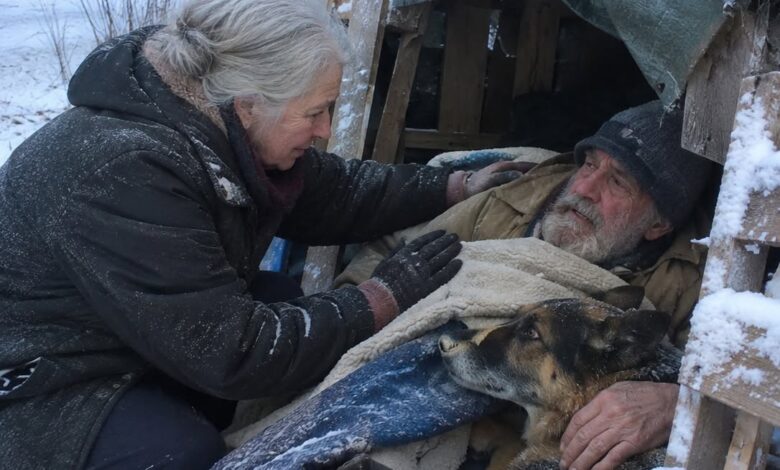
We wrapped him in every blanket we had. Rudy poured hot coffee from the thermos into the cap and held it to Hank’s lips. He couldn’t drink it. He just let the steam warm his face.
Glen drove the snowmobile down the trail slowly, so slowly, picking his way around rocks and fallen branches. Rudy rode on the back. I walked beside the sled, holding Hank’s hand through the blankets. The dog walked on the other side, pressed against the sled, and wouldn’t leave him for a second.
When we got to the bottom of the trail, the ambulance was waiting on the shoulder of the highway with its lights flashing. Somebody at the diner had called them too. One of the Lindahl brothers, I found out later.
The paramedics lifted Hank onto a stretcher. They cut his jacket open and put warm packs under his arms. They took his temperature, then looked at each other.
“Eighty-nine,” one of them said quietly. “We need to go. Now.”
“I’m coming with him,” I said.
“Ma’am, are you family?”
“I’m his sister.”
The paramedic looked at me. Then he nodded.
“Get in.”
The dog tried to get in too.
She jumped up on the back bumper of the ambulance and tried to climb inside. The paramedic grabbed her collar.
“No, no. Sorry, buddy. Can’t have a dog in here.”
She whined and pulled against his hand, desperate to get to the stretcher.
“I’ve got her,” Glen said.
He came up behind her and put his big hand on her back. She turned and growled at him, low in her throat. Glen didn’t move his hand.
“I know,” he said to her quietly. “I know, girl. I’m not the guy you trust. I get it.” He crouched down so he was eye level with her. “But he’s in good hands now. Okay? You did your job. You can rest now.”
The dog looked at him for a long time.
Then she stopped pulling.
Glen looked up at me.
“I’ll take her to my place,” he said. “Get her fed. Get that leg looked at.”
“Glen…”
“Go, Dot,” he said. “Go with your brother.”
They took Hank to the hospital in Ely first. Then by helicopter to Duluth, because of the hypothermia and the leg.
I rode in the helicopter with him. I’d never been in a helicopter in my life. I sat strapped into a little seat by his head and held his hand the whole way. Out the window, the whole north woods was white and gray and endless.
He woke up once, halfway there. He looked at me.
“Birdie,” he said. “You got old.”
I laughed. It came out as a sob.
“So did you,” I said. “You look terrible.”
He almost smiled.
“Scout,” he said. “Where’s Scout?”
“Is that the dog?”
He nodded.
“She’s safe,” I said. “Somebody’s taking care of her.”
He closed his eyes.
“Good girl,” he whispered. “She’s such a good girl.”
He was in the hospital in Duluth for nineteen days.
His leg was broken in two places. He’d slipped on the ice down by the creek two weeks earlier, going for water. That was the Tuesday he didn’t come in. He’d dragged himself back to the lean-to and hadn’t been able to move since. The blood on Scout’s collar was his. She’d lain against his leg the first night, and it had bled into her fur.
He’d had pneumonia too. His feet were frostbitten. The doctors took two toes off his right foot. He was down to a hundred and thirty-one pounds. He was six-foot-two.
“Frankly,” the doctor told me in the hallway, “I don’t know how he survived. Eleven days, in that cold, with a broken leg and no food.”
“He had food,” I said.
The doctor looked at me.
“Biscuits,” I said. “The dog brought him biscuits. From my diner. Every morning.”
The doctor stared at me for a moment.
“Well,” he said finally. “I’ll be damned.”
I stayed in Duluth the whole time.
Rudy ran the diner. He called me every night to tell me how things were going. Fine, he said. Busy, actually. Busier than it’s been in months.
I didn’t understand what he meant until the third night.
“Dot,” he said, “the story got out.”
“What story?”
“Yours. The dog. Your brother. Marlene told her sister, and her sister told the newspaper, and the newspaper put it on the internet.” He paused. “It’s everywhere, Dot. The Duluth TV station called. Somebody from Minneapolis called. There’s a line out the door every morning. People are driving up from the Cities just to eat here.”
“You’re kidding.”
“I ran out of biscuits by eight-thirty this morning,” Rudy said. “I’ve never run out of biscuits in nineteen years.”
Most of the time, I just sat with Hank.
The first few days, he slept. When he woke up, he’d look around the room like he didn’t know where he was. Then he’d see me in the chair beside his bed, and his face would go soft and confused, like he was trying to decide if I was real.
On the fifth day, he was awake enough to talk.
I’d been waiting for it. I’d been waiting fifty-eight years for it. I’d had a thousand questions stacked up in my head since I was thirteen years old.
But when it finally came, I couldn’t think of a single one.
So I just said, “Why?”
Hank looked at the ceiling for a long time.
“I don’t know how to answer that, Birdie,” he said.
“Try.”
He was quiet. The machines beeped beside his bed.
“When I left the farm,” he said finally, “I thought I’d get my head straight and come back. A couple months. Maybe a year.” He swallowed. “But it didn’t get straight. It got worse. I drank. I drifted. Minneapolis, Chicago, Milwaukee. Washed dishes. Picked apples in Washington. Worked on a fishing boat in Alaska for a while. Slept in a lot of places I’m not proud of.”
“You could have written.”
“I did,” he said. “Once.”
I stared at him.
“In 1971,” he said. “From Seattle. I wrote to the farm. I told Mom and Dad I was sorry. I asked if I could come home.” He closed his eyes. “Dad wrote back. Two lines. You made your choice. Don’t come back here.”
I felt like the floor had dropped out from under the chair.
“Mom never told me,” I said. “She never said anything.”
“Maybe she never knew,” Hank said. “Maybe Dad never showed her.”
I thought about my mother, keeping Hank’s room exactly the way he’d left it until the day she died. The bed made. His baseball glove on the dresser. His high school picture on the wall.
I thought about my father, sitting at the kitchen table every evening with his newspaper, never once saying his son’s name.
“After that,” Hank said, “I figured that was it. I figured you all had moved on. Better off without me.” He looked at me. “I thought about you every day, Birdie. Every single day. But I figured you’d forgotten me.”
“I never forgot you,” I said. “Not for one day. I looked for you for thirty-seven years, Hank. I hired a private detective. I drove to Minneapolis. I wrote to the VA so many times they knew my name.”
He looked at me for a long moment. His chin started to shake.
“I didn’t know,” he said.
“I know you didn’t.”
“How did you find me?” I asked him the next day. “At the diner. How did you know?”
Hank smiled a little.
“I didn’t,” he said. “Not at first.”
He’d come back to Minnesota two years ago, he said. He didn’t know why. He was seventy-seven, and he was tired, and he just wanted to see the north woods one more time before he died. He’d been living in the forest outside Tower in the summers, and in a VA shelter in Virginia, Minnesota, in the winters.
Last spring, he found Scout.
She was a puppy then, a stray, starving, tied to a fence post outside an abandoned cabin near Lake Vermilion. Somebody had left her there to die. He untied her and shared his dinner with her. She followed him for three miles. After that, she never left his side.
The VA shelter didn’t allow dogs.
So that winter, he didn’t go back to the shelter. He built the lean-to by Burntside Creek instead.
“I wasn’t going to leave her,” he said. “Not after somebody already did that to her once.”
In October, he’d walked into town to buy supplies and passed my diner.
He saw the sign. DOT’S DINER. Something made him stop.
“I used to call you Dot sometimes,” he said. “When I was teasing you. Remember? Dot, Dot, Dorothy Dot.”
I didn’t remember. But I believed him.
“I went in and sat in the corner,” Hank said. “Just to get warm. And then you came out of the kitchen.” He shook his head slowly. “You walk exactly like Mom. You know that? Exactly. The way you wipe your hands on your apron. The way you tilt your head when someone’s talking.”
I put my hand over my mouth.
“And when you laughed,” he said. “At something one of those old miners said. That was when I knew. It was you. My Birdie. Seventy years old and running a diner.”
“Why didn’t you say anything?”
He looked down at his hands on the hospital blanket. They were so thin. The knuckles were huge.
“Look at me, Birdie,” he said. “I was a bum in a torn-up Army jacket counting out quarters for a cup of coffee. You had a life. A business. Friends. I saw your husband’s picture on the wall by the register.” He swallowed. “I didn’t want to show up at the end of my life and drag you down with me. I just wanted to see you. Once a week. That was all. Just see that you were okay.”
“And the extra biscuit?” I asked. “Every Tuesday?”
His eyes filled.
“I knew it wasn’t a mistake,” he said. “You always did that when you were a kid. Gave away half your lunch to the Paulson boys because their family was poor. Pretended you weren’t hungry.” He wiped his eyes. “I’d take that second biscuit home to Scout. Every week. She loved them.”
I sat in that chair for a long time without saying anything.
Then I understood.
That was why Scout had come to the diner. She knew the smell. She knew the biscuits. When Hank couldn’t get up anymore, when he was lying under that tarp with his leg broken and nothing to eat, she’d gone to the one place she knew had biscuits.
To the one person who’d been feeding her all along.
And every morning, she’d carried that biscuit back up a mile and a half of logging trail in the snow, without eating a single bite, and given it to him.
On Friday, while I was still in Duluth, the county inspector came to the diner.
Rudy told me about it on the phone that night. He was laughing so hard he could barely get the words out.
The inspector’s name was Carol Anders. She was about forty, with reading glasses and a clipboard, and she’d been inspecting restaurants in Saint Louis County for fifteen years. She walked in at ten in the morning in the middle of the rush. There was a line out the door into the snow.
She went through the whole kitchen. The walk-in. The grill. The fryers. The dish station. The bathrooms. She checked the temperature on every refrigerator and looked under every shelf.
Then she came out front and stood by the register and looked at her clipboard for a long time.
Glen Hobart was sitting at the end of the counter. He’d come in that morning like always. Rudy said he hadn’t said a single word to anybody.
“I had a complaint,” Carol Anders said, “about an animal in the establishment.”
The whole diner went quiet.
“That was me,” Glen said.
Everybody turned and looked at him.
“I made the complaint,” Glen said. “Last week. About a dog.” He set down his coffee cup. “I’d like to withdraw it.”
Carol Anders looked at him over the top of her reading glasses.
“Withdraw it?”
“The dog never came past the register,” Glen said. “Not once, until the last day, and she had a good reason that day. I was wrong. I’d like to withdraw the complaint.”
Carol Anders studied him for a long moment.
“Is this the dog from the newspaper?” she asked. “The one who brought biscuits to the veteran?”
“That’s her,” Glen said.
Carol Anders looked down at her clipboard. She wrote something on it. Then she looked up at Rudy.
“Your walk-in’s at thirty-six degrees,” she said. “That’s perfect. Your kitchen’s cleaner than mine at home. I’m writing you up for a missing light bulb cover over the dish station. Get it fixed in thirty days.” She tucked her pen into her clipboard. “And put a sign by the door that says no animals beyond this point. That’ll cover you.”
“That’s it?” Rudy said.
“That’s it.” She paused at the door. “Tell Mrs. Kincaid I’m glad her brother’s okay. My dad was in Vietnam too.”
Then she left.
“Glen withdrew the complaint?” I said into the phone. “Glen Hobart?”
“In front of the whole diner,” Rudy said. “I almost dropped a plate.”
I didn’t know what to say.
“There’s more,” Rudy said.
“What?”
“He’s been coming by every morning with the dog,” Rudy said. “Scout. He brings her in at 6:40 on the dot. She waits by the register. And Glen buys her a biscuit.”
“Glen buys her a biscuit.”
“Pays for it and everything. A dollar fifty.” Rudy laughed. “Then he takes her back to his truck. She sits in the front seat with him while he drinks his coffee. He talks to her. I’ve seen him through the window.”
Hank was discharged from the hospital on the twenty-third of December.
He couldn’t walk yet. He’d be in a wheelchair for at least two months, then crutches, then a cane for the rest of his life. The VA had gotten involved by then. A social worker named Mr. Okafor came and sat with us for two hours and went through a stack of paperwork as tall as a phone book.
It turned out Hank had never once, in fifty-five years, applied for any benefits. No disability, no medical, no pension. Nothing.
“Why not?” Mr. Okafor asked him gently.
Hank shrugged.
“Didn’t figure I’d earned it,” he said. “I came home in one piece. Lot of guys didn’t.”
Mr. Okafor looked at him for a long time over the top of his folder.
“Mr. Lindqvist,” he said, “you came home. That’s not the same as coming home in one piece.”
He started the paperwork that afternoon.
I took Hank home with me.
Not to a shelter. Not to a VA home. Home, to my little apartment above the diner, with the window that looks out over the highway toward the pines.
He argued about it.
“I’m not moving in on you, Birdie. I won’t be a burden.”
“You’re not a burden. You’re my brother.”
“You’ve got your own life.”
“I’ve got two bedrooms and nobody in one of them,” I said. “Ed’s been gone six years. My kids live in Arizona and Oregon. I talk to them on Sundays. That’s my life, Hank.” I took his hand. “Please. Let me have you back. Just let me have you.”
He looked at me for a long time.
“Okay,” he said finally. “Okay, Birdie.”
Glen Hobart drove us home from Duluth.
I don’t know how it happened. Rudy must have told him when Hank was getting discharged. He just showed up in the hospital parking lot in his big white pickup truck with Scout sitting in the front seat.
When Scout saw Hank in the wheelchair coming through the hospital doors, she went crazy. She jumped out of the truck window. She actually jumped out of the open window and ran across the parking lot, limping, whining and crying. She put her front paws up on Hank’s lap and licked his face. She licked his beard and his ears and his hands, over and over and over.
Hank put his face in her fur and cried.
Glen stood by the truck with his hands in his pockets, looking at the ground.
He helped me get Hank into the back seat. He folded up the wheelchair and put it in the bed of the truck. He drove the whole two hours back to Ely without saying much. Scout lay across Hank’s lap in the back seat the whole way, with her head on his chest.
When we got to the diner, Glen helped get Hank up the stairs to the apartment. It took twenty minutes. Glen and Rudy carried him between them, one step at a time, while Hank cursed at them both.
When Hank was finally settled in the spare bedroom, Glen came back out into the kitchen. He stood by my kitchen table with his cap in his hands.
“Dot,” he said. “Can I talk to you a minute?”
“Of course.”
He was quiet for a long time.
“I owe you an apology,” he said finally. “For what I said. About you losing it. About the dog. About the diner.” He turned his cap around in his hands. “I’ve been a horse’s behind about this place for years. I’m sorry.”
“Thank you, Glen.”
“And there’s something else.”
He pulled a folded piece of paper out of his jacket pocket. He set it on the kitchen table in front of me.
It was a letter, on Lake Superior Property Management letterhead. The company in Duluth that owned my building.
Dear Mrs. Kincaid: Please be advised that the rent increase scheduled to take effect January 1 has been rescinded. Your lease will continue at the existing rate for a period of no less than five years…
I looked up at Glen.
“How did you…”
“I’ve been talking to them about buying this building for six years,” Glen said. “They know me. I called them on Tuesday.” He shrugged. “I told them I wasn’t interested anymore. And I told them that if they raised your rent, every person in this town would know exactly who did it. Especially now. With the story on the TV and everything.” He almost smiled. “Turns out they don’t like bad press much.”
I stared at the letter. Then at him.
“Glen,” I said. “Why?”
He didn’t answer right away. He looked toward the spare bedroom door, where Hank was asleep with Scout curled up at the foot of the bed.
“My dad was in Korea,” he said quietly. “He came home and never talked about it. Not once. He drank himself to death when I was twenty-two.” He swallowed. “I used to see that fella in your corner booth on Tuesdays. In that Army jacket. Counting his quarters. I’d look at him and think, There’s a guy who gave up.”
He turned his cap around again.
“I never once thought to buy him a cup of coffee,” he said. “Not once. And you gave him a biscuit every week for nothing.” He shook his head. “You were right, and I was wrong, Dot. That’s all there is to it.”
Hank’s been living with me for ten months now.
His leg healed slowly and badly. He walks with a cane, a heavy oak one that Rudy made for him in his garage. He has a VA disability check now, and a pension, and a doctor in Duluth he sees once a month. He doesn’t drink anymore. He says he hasn’t had a drink in eleven years, since a church in Spokane let him sleep in their basement one winter and he decided he didn’t want to die drunk.
He has nightmares sometimes. I hear him through the wall. When it’s bad, I get up and go sit on the end of his bed in the dark, the way I used to sit with him in the hayloft when I was thirteen.
I don’t say anything. I don’t need to.
The diner is busier than it’s been in ten years.
People still come up from the Cities on weekends, because of the story. They take pictures of the counter and the corner booth. They ask for “the biscuit.” Rudy started making twice as many. Then three times. We hired a high school girl named Kelsey to help on weekends.
We’re going to make it to Christmas this year. And the one after that.
Glen still comes in every morning for coffee.
He still complains. About the weather, the government, the Vikings, the price of diesel. But he sits in the second booth now instead of at the end of the counter. Most mornings, Hank sits across from him.
They argue about everything. Fishing. Politics. Whether the Vikings will ever win a Super Bowl. Whether you’re supposed to put ketchup on eggs. They argue for an hour every single morning like two old roosters.
I’ve never seen either of them so happy.
Hank still sits in the corner booth on Tuesdays.
Just Tuesdays. He says it’s tradition. He sits with his back to the wall and looks out the window toward the pines. He orders black coffee and one biscuit.
I still bring him two.
He still pretends it’s a mistake.
And every morning at 6:40, Scout walks through the front door.
She doesn’t push it open with her nose anymore. Rudy put a little bell on a string by the door, and she taps it with her paw, and somebody lets her in. Usually it’s Glen.
She walks three steps and stops by the register, beside the little sign that says NO ANIMALS BEYOND THIS POINT.
She looks at me with those steady brown eyes.
I hold out a biscuit. She takes it gently.
For a long time after Hank came home, she still carried it across the diner to wherever he was sitting. She’d lay it down on the seat beside him or on his lap, very carefully. Then she’d lie down at his feet and wait for him to eat it.
He always did. Every single time. He’d break off a piece and give it back to her.
Then one morning in August, something changed.
It was a bright, cool morning, the windows were open, and you could smell the pines. Scout came in at 6:40. She took her biscuit. She turned toward the corner booth, where Hank was sitting with his coffee.
Hank looked at her. He smiled.
“Go on, girl,” he said quietly. “That one’s yours.”
Scout looked at him for a long moment.
Then she lay down right there by the register, at my feet. She put the biscuit between her front paws.
And she ate it.
I stood behind the counter, watching her, and I had to put down my coffee pot.
Glen saw it too. He stopped arguing about walleye mid-sentence. Rudy came out of the kitchen and leaned in the doorway, wiping his hands on a towel.
Scout finished the biscuit in four bites. She licked the crumbs off the floor. Then she got up and walked across the diner and lay down under the corner booth with her head on Hank’s good foot.
She sighed, a big, long, satisfied sigh.
“Well,” Rudy said quietly. “Would you look at that.”
A hungry dog eats. Always.
Unless it’s not for her.
For eleven days, Scout carried every biscuit up that trail, because the man she loved was lying in the snow and couldn’t feed himself. She didn’t eat a single bite. She went hungry so he wouldn’t.
Now she doesn’t have to carry anything anymore.
Neither does Hank.
Neither do I.
Ed’s counter still glows like honey in the morning light. Most mornings I still pour two coffees by mistake. Except now, when I set that second cup down by the register, somebody picks it up.
My brother takes it over to the corner booth and drinks it, slowly, looking out the window toward the pines.
“Morning, Birdie,” he says.
Every single morning.