My Boss Asked Me To Take His Daughter To Prom Until She Revealed His Real Reason
“My dad didn’t choose you by accident. And it wasn’t for my sake.”
I stared at Georgia.
We were sitting in my uncle Frank’s car in the parking lot of Ridgeview High School. The engine was off. The radio was off too, finally, after changing stations by itself three times on the drive over. Through the windshield, I could see the gym doors propped open, with colored lights and music spilling out.
Georgia had her hand on the door handle. She’d opened her door a crack, but she hadn’t gotten out.
“What does that mean?” I said.
She glanced toward the gym. Then back at me.
“Brent,” she said, “my dad’s been watching you for months.”
My stomach tightened.
“Watching me do what?”
“How you handle problems. How you treat people. Whether you lose your temper.”
I frowned. I could feel sweat starting under the collar of my only suit.
“Wait,” I said. “Did I do something wrong? You’d tell me if I did something to make him upset, right?”
“No,” Georgia said. “That’s the problem.”
Before I could ask what that meant, her phone buzzed in her lap.
She glanced at the screen and groaned.
“It’s Dad.”
She turned the phone around so I could see the message.
Remember our agreement. Don’t make things too easy for him.
I read it twice.
“Georgia,” I said slowly, “what exactly did I agree to?”
She sighed and leaned her head back against the seat.
“Something my father thinks is brilliant,” she said.
I’d started working for Sheldon Pryce when I was nineteen.
His company was called Pryce Supply. We were in a big gray warehouse out by the interstate, between a tire shop and a church that used to be a bowling alley. We supplied restaurants and grocery stores all over the county with food packaging and cleaning products. Takeout boxes, plastic cups, deli paper, napkins, gallon jugs of degreaser, and floor cleaner in drums so heavy it took two people to roll them.
It wasn’t exciting work. Nobody grows up dreaming about restaurant napkins.
But I needed that job more than Sheldon probably realized.
My mom, Denise, was raising my younger sister, Janelle, by herself. My dad left when I was eleven and Janelle was four. He moved to Texas with a woman he met at his gym, and the child support checks came for about two years and then stopped coming.
Mom worked as a receptionist at a dentist’s office. She was good at it. Everyone loved her. The patients brought her cookies at Christmas. But it didn’t pay much, and our apartment wasn’t cheap, and Janelle kept growing out of everything.
So when I got the job at Pryce Supply, I started giving Mom part of every paycheck. For groceries. For the electric bill. For whatever Janelle needed for school. Field trips, a calculator, new sneakers.
Mom hated taking it.
The first time I put cash on the kitchen counter, she pushed it back across to me.
“Brent, no. You’re nineteen. You should be saving for yourself.”
“I am saving.”
“How much?”
“Some,” I said.
She looked at me with her tired eyes.
“Brent.”
“Mom. Janelle’s shoes have a hole in them. I saw it yesterday. Take the money.”
She looked at the money for a long time. Then she picked it up and folded it and put it in the coffee can on top of the fridge, where she kept the bill money.
She didn’t say thank you. She didn’t have to. She just hugged me hard, the way she used to when I was little and had a nightmare.
I never showed up late to work.
I never called out unless I absolutely had to. Once I had a fever of a hundred and two, and Sheldon sent me home himself.
If Sheldon asked me to stay an extra hour, I stayed. If a delivery driver called in sick, I drove the route. If somebody needed to sweep the warehouse floor at the end of the day, I picked up the broom before anyone asked.
I wasn’t trying to impress anybody. I just knew what that paycheck meant to my family, and I didn’t want to give anybody a reason to take it away.
Within a year, I’d become the guy Sheldon trusted with everything. Deliveries, inventory counts, closing up at night. He gave me a key to the building after four months. He gave me the alarm code after six.
“Don’t tell Kyle I gave you this,” he said, handing me the little card with the code written on it.
Kyle had worked there for three years. He still didn’t have a key.
Sheldon was a decent boss.
He was in his fifties, tall and a little stooped, with reading glasses that lived on top of his head. He had a big laugh and a bad habit of eating sunflower seeds at his desk and spitting the shells into a coffee mug. He knew everybody’s kids’ names. When Rosa from the front office had her baby, he paid for a cleaning service for her house for a whole month.
But he had strange habits.
He loved asking questions.
He’d come up behind me while I was loading a truck or counting boxes, lean on a shelf, and say something like:
“Brent. Quick question. What would you do if a customer refused to pay an invoice?”
Or: “What if two employees wanted the same day off and you could only give it to one of them?”
Or: “What if a supplier delivered the wrong order and the restaurant needed it by tomorrow morning?”
I’d stop what I was doing and think about it. Then I’d answer as best I could.
Sheldon would nod slowly, like he was grading an exam in his head. Sometimes he’d ask a follow-up question. Why would you do it that way? What if the customer got angry? What if the employee quit?
Then he’d walk away, eating sunflower seeds, without telling me whether I’d gotten it right.
I assumed he was just obsessed with running the business well. Or bored. Or both.
There was one day I remember especially.
It was a Tuesday in March, about two months before prom. A man named Mr. Castellano came storming into the warehouse at ten in the morning. He owned an Italian restaurant downtown called Castellano’s. Good lasagna. Terrible temper.
He was holding a box of takeout containers. He slammed it down on the front counter so hard the lid popped open.
“These are the wrong size!” he shouted. “I ordered the thirty-two ounce! These are twenty-four! I’ve got a catering order for two hundred people tonight! Two hundred! What am I supposed to put my pasta in, my hands?”
Kyle was at the counter. He took one look at Mr. Castellano’s face and disappeared into the back.
So it was me.
I looked at the box. He was right. They were the wrong size. I pulled up his order on the computer. He’d ordered the thirty-two ounce. Somebody on our end, probably Kyle, had grabbed the wrong pallet.
Mr. Castellano was still yelling. Something about how he’d been a loyal customer for eleven years, and how this was the last straw, and how he was going to switch to the big company in Columbus.
I let him finish.
Then I said, “You’re right, Mr. Castellano. That’s our mistake. I’m sorry.”
He stopped yelling. I think he’d been expecting an argument.
“We have the thirty-two ounce in stock,” I said. “I’m going to load them into my car right now and drive them to your restaurant myself. You’ll have them by eleven. And I’ll take the wrong ones back so you don’t have to deal with them. No charge for the delivery.”
He stared at me.
“Eleven?”
“Eleven,” I said. “Maybe ten forty-five, if the lights are good.”
He looked at me for a long time. Then he grunted.
“Fine,” he said. “Eleven.”
I had them at his back door by ten-fifty. He was standing in the kitchen in his apron, and when he saw me carrying in the boxes, he didn’t say thank you. But he handed me a foil tray of lasagna to take home.
“For your trouble,” he said gruffly.
When I got back to the warehouse, Sheldon was standing in the doorway of his office, eating sunflower seeds.
“Heard you had a visit from Castellano,” he said.
“Yes, sir.”
“Heard you drove his order over yourself.”
“Yes, sir. It was our mistake. I didn’t want him losing his catering job over it.”
Sheldon spat a shell into his mug.
“Why didn’t you get Kyle to do it?” he asked. “He’s the one who pulled the wrong pallet.”
I thought about it.
“Because Mr. Castellano was standing in front of me,” I said. “Not Kyle. And he needed somebody to fix it, not somebody to blame.”
Sheldon looked at me for a long moment. Then he nodded slowly and went back into his office.
I didn’t think anything of it at the time.
Then, one Friday afternoon in May, Sheldon called me into his office.
It was almost five. I was sweeping. He leaned out of his office door and waved me over.
“Brent. Got a minute?”
“Sure.”
I leaned the broom against a shelf and went in. His office was small and cluttered. Invoices in piles. A dying plant on the windowsill. A framed photo on the desk of a woman with dark curly hair, laughing at the camera. That was Georgia’s mom, Lauren. She died of breast cancer when Georgia was twelve. Sheldon never talked about her, but the photo had been on his desk every single day since I started.
Next to it was another photo. Georgia at about ten, missing two front teeth, holding up a fish almost as big as she was.
Sheldon sat down behind his desk. He didn’t eat any sunflower seeds. That’s how I knew something was up.
“I need a favor, Brent,” he said.
“Sure. What do you need?”
He hesitated. He took his reading glasses off his head and turned them over in his hands.
“My daughter’s prom is tomorrow,” he said.
Georgia was eighteen. She was a senior at Ridgeview High.
I’d seen her around the office a few times. She’d come by after school sometimes to get a ride home, or to drop off lunch for her dad. She’d sit in the front office doing homework with her earbuds in. Once, she’d helped Rosa re-file about three hundred invoices when the filing cabinet broke.
We’d said hi a handful of times. Maybe “nice weather” once. That was about it. We barely knew each other.
“The boy she was supposed to go with backed out,” Sheldon went on. “Last minute. And now she doesn’t have a date.” He put his glasses back on his head. “I want you to take her.”
I laughed. I thought he was joking.
He wasn’t laughing.
“Me?” I said.
“You.”
“Sir, I’m twenty. I graduated two years ago. I don’t think…”
“You’re responsible,” Sheldon said. “I trust you.” He leaned forward and folded his hands on the desk. “It’s one night. You pick her up, you take her to the dance, you make sure she has a good time, you bring her home by midnight. That’s all.”
I didn’t say anything. I was trying to imagine walking into a high school gym in a suit, two years after I’d walked out of my own for the last time.
“Do this for me,” Sheldon added, “and I’ll make it worth your while.”
I thought about our washing machine.
It had broken three weeks earlier. It made a horrible grinding sound in the middle of the spin cycle and then just stopped, full of soapy water. The repairman said it would cost more to fix it than to buy a new one. So every Sunday since then, Mom had been hauling garbage bags full of clothes to the laundromat on Fourth Street and sitting there for three hours on her one day off.
I thought about Janelle’s school shoes. She was fourteen now and in eighth grade. Her sneakers had a split along the side where the rubber was coming away from the canvas. She’d been wrapping them with duct tape and coloring the tape with a black marker so nobody would notice.
I’d noticed.
If my boss wanted to give me a little extra money for taking his daughter to prom, it would make things a little easier for Mom and Janelle.
“Okay,” I said.
Sheldon let out a big breath and leaned back in his chair.
He looked relieved.
Almost too relieved.
That night, I told Mom and Janelle at dinner.
We were eating spaghetti, the cheap kind, with sauce from a jar. Janelle was reading a book under the table, which she wasn’t supposed to do.
“I’m going to prom tomorrow,” I said.
Janelle’s head snapped up.
“You’re going to prom?”
“My boss’s daughter needs a date.”
Janelle put her book down on the table. She stared at me.
“Your boss is paying you to take his daughter to prom?”
“He didn’t say paying. He said he’d make it worth my while.”
“That’s paying, Brent,” Janelle said. “That’s like… that’s like a movie. A weird movie. Is she pretty? Is she mean? Is this a prank? It sounds like a prank.”
“It’s not a prank.”
Mom was quiet. She was looking at me across the table with a little line between her eyebrows.
“Brent,” she said. “You don’t have to do this. Not for the money.”
“It’s not just for the money,” I said. “He’s my boss. He asked me for a favor. And he’s been good to me.”
Mom looked at me for a long moment.
“Do you have a suit?” she asked finally.
“I have the suit from Grandpa’s funeral.”
Mom winced.
“The gray one?”
“It still fits.”
“It does not still fit,” Janelle said. “You’ve grown like three inches since then.”
“It fits enough.”
Mom sighed and got up from the table.
“Go get it,” she said. “Let me look at the sleeves.”
She stayed up until one in the morning letting out the sleeves and the hem of the pants. She did it by hand at the kitchen table, with her reading glasses on and a cup of tea going cold beside her. I offered to help, and she told me to go to bed.
In the morning, the suit was hanging on the back of my bedroom door. It was pressed. The sleeves were the right length. There was a little note pinned to the lapel in her handwriting.
Be a gentleman. Be home by 1. Love you. — Mom
The next evening, I borrowed my uncle Frank’s car.
My own car, a 2006 Corolla with two hundred and forty thousand miles on it, had been making a noise for a week like a bag of bolts in a dryer. I didn’t trust it to get across town.
Uncle Frank is my mom’s older brother. He lives two streets over. He has a 1998 Buick LeSabre the color of old mustard, which he’s owned since it was new and treats like a member of the family.
He handed me the keys in his driveway like he was handing over a newborn baby.
“Don’t touch the radio,” he said.
“Why not?”
“It changes stations by itself.”
“Why?”
“Because it has personality,” Frank said seriously.
“Okay.”
“Also, it squeaks when you turn left.”
“Squeaks?”
“Squeaks,” Frank said. “Like a shopping cart. Don’t worry about it. It’s been doing it since 2011. It’s fine.”
“Is it safe?”
“It’s perfectly safe. It just has opinions.” He patted the hood. “Also, if it won’t start, jiggle the battery cable. The left one. It gets loose.”
“Uncle Frank…”
“It probably won’t happen,” he said.
He clapped me on the shoulder.
“Have fun, kid,” he said. “Your mother says this is weird. Is this weird?”
“It’s a little weird.”
“Weird’s good,” Frank said. “Weird makes stories.”
I drove to Sheldon’s house that evening at six-fifty-five.
The car squeaked every time I turned left. There were eleven left turns between Frank’s house and Sheldon’s. I counted. It sounded exactly like a shopping cart with a broken wheel, a high, sad eeeeek that got louder the sharper I turned.
I prayed Georgia wouldn’t notice.
The radio turned on by itself halfway there. I hadn’t touched it. It came on in the middle of a Spanish-language talk show. I turned it off. Two minutes later, it came back on, this time to a country station playing a song about a man whose truck was the only thing that understood him.
I left it on. It seemed appropriate.
Sheldon lived in a nice neighborhood on the north side of town, with big trees and wide sidewalks and houses with columns. His was a two-story brick house with black shutters and a basketball hoop over the garage.
I pulled into the driveway. The car squeaked. I turned off the engine. The radio stayed on for three more seconds, playing the end of the country song, and then shut itself off.
Sheldon opened the front door before I’d even gotten out of the car.
“Brent!” he said. “You’re early!”
“Only by five minutes, sir.”
“Excellent! Excellent!”
He was wearing a sweater vest. I’d never seen him in a sweater vest. He had a digital camera hanging around his neck on a strap.
He came down the front steps and looked me up and down. Then, without asking, he reached out and straightened my tie.
“There,” he said. “Better.”
For some reason, he seemed more nervous than I was.
“Just make sure Georgia has a good night,” he said.
“I will, sir.”
“And if anything unexpected happens,” he added, “just stay calm.”
I frowned.
“Uh,” I said, “what kind of unexpected thing?”
“Oh,” Sheldon said. He waved his hand. “Nothing. Nothing at all.”
Right then, Georgia came down the stairs.
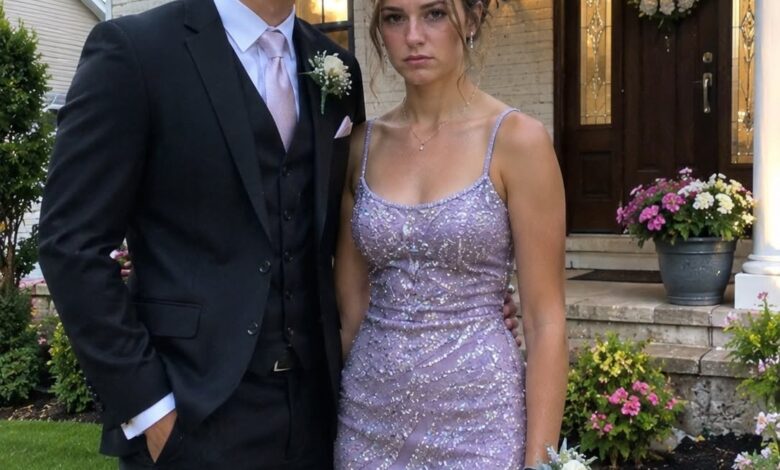
I could see her through the open front door. She was wearing a long dark green dress, with her dark curly hair pinned up. She looked a lot like the woman in the photograph on Sheldon’s desk.
She looked beautiful.
But the moment she saw me standing in her driveway, her smile vanished.
Sheldon immediately started taking pictures.
“Okay! Okay! Out front! By the hydrangeas! Stand closer!”
We moved closer.
“Closer! You’re not strangers!”
We were basically strangers. We moved an inch closer.
“Brent, give her the corsage!”
I’d bought a corsage at the grocery store that afternoon on my way home from work. It was a white rose with a little green ribbon. It cost twelve dollars. I’d agonized over it for twenty minutes in the floral section.
I held it out. Georgia took it and slid it onto her wrist without looking at me.
“Smile!” Sheldon said.
I smiled.
Georgia smiled too, technically. It was the kind of smile people give at the DMV.
Sheldon took about forty pictures. He took pictures by the hydrangeas, by the front door, by the car, and then by the car again from a different angle. Georgia barely said a word the whole time. She stood there in her green dress with her arms at her sides and looked like she’d been sentenced to three hours of accounting.
“Okay, Dad,” she said finally. “I think you have enough.”
“One more! One more!”
“Dad.”
“Okay, okay.” Sheldon lowered the camera. He looked at me. “Midnight, Brent.”
“Midnight, sir.”
“Have fun, sweetheart,” he said to Georgia. He kissed her on the forehead.
She let him. Then she walked to the passenger side of Uncle Frank’s mustard-colored Buick without a word and got in.
The drive was painfully quiet.
I turned left out of the driveway. The car squeaked. Georgia glanced at me sideways. I pretended not to notice.
“So,” I said, “are you excited about prom?”
“Sure.”
“Are your friends going to be there?”
“Yeah.”
“What kind of music do you like?”
“Lots of kinds.”
I turned left at the stop sign. Eeeeeek.
Georgia looked at the dashboard. Then at me.
“It does that,” I said. “My uncle says it has personality.”
“Okay,” Georgia said.
She turned and looked out the window.
The radio came on by itself. A man was shouting about mattress sales. I turned it off.
Eventually, I stopped trying.
When we pulled into the Ridgeview High parking lot, it was packed. There were limousines lined up by the front doors. Kids in tuxedos and sparkly dresses were taking selfies on the steps. Somebody had rented a white Hummer.
I parked Uncle Frank’s Buick between a BMW and a pickup truck with a flag in the back.
I turned off the engine. I sat there for a second with my hands on the wheel.
“Well,” I said, forcing a smile. “I hope tonight won’t be too terrible. I guess your dad really wanted you to go to prom.”
Georgia didn’t smile back.
She opened her door, but she didn’t get out.
Instead, she turned in her seat and looked me straight in the eyes.
“Wait,” she said.
That’s when she told me her father hadn’t chosen me by accident.
And she showed me his strange message.
I stared at her phone.
Remember our agreement. Don’t make things too easy for him.
“Don’t make things too easy for him?” I read out loud.
Georgia nodded. “My dad wants me to make tonight difficult.”
“Why?”
“To see how you react.”
I blinked.
“What?”
“He suggested I complain about everything,” she said. “Make unreasonable requests. Be rude. Be a total nightmare. And then he wants me to tell him whether you lose your patience.”
I looked out the windshield toward the gym. I looked down at my grandfather’s funeral suit and the shoes I’d borrowed from my neighbor, which were half a size too small. I thought about the mustard-colored Buick with its squeaking left turns and its haunted radio.
“So,” I said slowly, “I’m wearing borrowed shoes and driving a car that sounds like a shopping cart because your father wants to test my patience?”
Georgia stared at me for a second.
Then she burst out laughing.
It was a real laugh, loud and surprised, like it had escaped from her.
“Pretty much,” she said.
“Does he know there are easier ways to annoy me?”
“Brent!”
“I’m serious. He could just ask me to reorganize the warehouse again. I did it in February. Took three weeks. He changed his mind about where the paper towels go four times.”
Georgia laughed harder. She put her hand over her mouth.
“He told me about that,” she said. “He said you didn’t complain once.”
“I complained,” I said. “Just not out loud.”
Then her expression changed.
“I told him I wouldn’t do it,” she said. “The whole difficult thing. It wasn’t fair to you.”
“Then why did you look so miserable back at your house?”
“Because my dad was standing right there taking forty pictures, and I didn’t want him to think I’d agreed to his ridiculous plan.” She shrugged. “And because I was annoyed with him. Not with you. Sorry. I should’ve said something sooner.”
“Then why are we here?” I asked.
“Because I still wanted to go to prom,” Georgia said. “It’s my senior prom. I bought this dress in February. And I thought you deserved to know what he was planning before you spent the whole night wondering why I was being horrible.”
I studied her.
“Planning for what?” I said.
Georgia hesitated.
“That’s the part I can’t explain yet.”
“Why not?”
“Because I want you to hear it from him,” she said. “It’s not my news to tell.”
I groaned and put my forehead on the steering wheel.
“Georgia,” I said, “you’re making this sound like I’m about to inherit a castle.”
She smiled. It was a real smile this time.
“No castle,” she said. “But you might be surprised.”
Inside, the gym was covered in balloons and string lights.
The theme was “A Night Under the Stars.” Somebody had hung hundreds of little silver paper stars from the ceiling on fishing line. They turned slowly in the air from the heat of the crowd. The basketball hoops were wrapped in white fabric. There was a DJ booth under one of them with colored lights that pulsed with the music.
It smelled like floor polish, hair spray, and too much cologne, which is exactly what every high school dance smells like.
I felt about a hundred years old.
Georgia grabbed my arm and pulled me through the crowd toward a table near the back.
“Come on. I want you to meet Madison.”
Madison was Georgia’s best friend. She was short and blond and wearing a bright red dress with sequins that caught the light every time she moved. She was sitting at the table eating a cupcake.
When she saw us, she put the cupcake down and looked me up and down.
Then she grinned.
“So,” she said. “You’re Brent.”
I blinked.
“Why does everybody say my name like that?” I asked.
Georgia rolled her eyes.
“Madison knows about Dad’s little experiment,” she said.
I stared at them both.
“Wonderful,” I said. “Does the DJ know too?”
Madison laughed.
“Not yet!” she said. “But the night is young.”
Her date was a tall, quiet boy named Theo who played on the basketball team. He shook my hand and said, “Hey, man,” and then went back to looking at his phone. I liked him immediately.
We found our seats. A waiter, actually a junior from the culinary club, put plates of chicken and green beans in front of us.
“So,” Madison said, leaning forward on her elbows. “How’s the test going so far?”
“I don’t know,” I said. “Nobody’s told me what the test is.”
“That’s part of the test,” Madison said wisely.
“Madison,” Georgia said.
“What? It probably is.”
About thirty minutes later, we were standing by the edge of the dance floor. Georgia handed me her purse.
“Hold this,” she said.
I took it. It was small and sparkly and weighed about as much as a sandwich.
Then she handed me her phone.
“And this.”
“Okay.”
Then she handed me her drink, a cup of red punch.
I stood there holding a purse, a phone, and a cup of punch. I looked at her suspiciously.
“Is this the test?” I asked.
“No,” Georgia said. “I’m tying my shoe.”
She bent down, fiddled with the strap on her high heel, and stood back up. Then she looked at my face and started laughing.
“You’re going to question everything I do tonight, aren’t you?” she said.
“Your father,” I said, “has destroyed my ability to recognize normal behavior.”
For the next hour, Georgia teased me by pretending to make ridiculous demands.
“Brent,” she said, with a completely straight face, “could you ask the DJ to play ‘Midnight Sparrow’ by The Clementines?”
“Sure. Who are The Clementines?”
“They don’t exist.”
“Then how am I supposed to…”
“That’s your problem.”
I walked to the DJ booth. I actually walked over there. The DJ was a bored-looking guy in his thirties with headphones around his neck.
“Hi,” I said. “Do you have ‘Midnight Sparrow’ by The Clementines?”
He looked at me.
“Never heard of it.”
“Okay. Thanks.”
I walked back to the table.
“He’s out of stock,” I told Georgia. “He offered me a substitute. Something by Taylor Swift.”
Madison choked on her punch.
Then Georgia complained that the punch wasn’t cold enough.
I went to the drink table, filled a cup with ice, and poured the punch over it. I brought it back to her with a napkin folded into a triangle on top.
“Chilled to perfection,” I said. “And I’ve added a complimentary napkin.”
Georgia took it and sipped it.
“Hmm,” she said. “Acceptable.”
Then she requested a chair facing exactly northwest.
“Northwest?” I said.
“Exactly northwest. Not north. Not west. Northwest.”
I pulled out my phone. I opened the compass app. I turned around in a slow circle in the middle of the gym while Madison and Theo watched.
Then I looked at Georgia.
“Georgia,” I said, “I can offer you north or west. The budget doesn’t cover both.”
Madison laughed so hard she nearly dropped her cupcake. Theo actually looked up from his phone and grinned.
Georgia was laughing too. Really laughing, with her head tipped back and her eyes squeezed shut.
For the first time all evening, I relaxed.
Then a woman came over to our table.
She was in her forties, with short gray hair and reading glasses on a beaded chain around her neck. She was wearing a black dress and a name tag that said CHAPERONE.
“Brent?” she said.
I stood up. “Yes?”
“I’m Evelyn. Georgia’s aunt. I teach chemistry here.” She held out her hand. “I’m one of the chaperones tonight.”
I shook her hand.
“Nice to meet you, ma’am.”
“So,” Evelyn said, smiling, “you’re the young man Sheldon keeps talking about.”
I glanced at Georgia. She was suddenly very interested in her green beans.
“Hopefully nothing terrible,” I said.
“Oh, no. Not at all.” Evelyn’s smile got bigger. “He says you’re excellent under pressure.”
I frowned.
“Does everyone in your family discuss my job performance?” I asked.
“Aunt Evelyn!” Georgia said, covering her face with both hands.
Evelyn laughed. She patted my shoulder.
“Have a nice night, Brent,” she said. “Don’t let my niece make you fetch the moon or anything.”
She walked away toward the punch table.
I sat back down slowly.
I couldn’t stop thinking about what she’d said.
Excellent under pressure.
Later, Georgia and I stepped outside for some air.
The night was warm and smelled like cut grass. There were a few other couples out there, sitting on the steps or standing by the flagpole. The music from the gym was muffled through the brick wall, a thumping bass line I could feel in my feet.
We stood by the bike rack.
“Okay,” I said. “Enough games.”
Georgia looked at me.
“What?”
“Your dad keeps asking me strange, unexpected questions at work,” I said. “Like, all the time. For months. Then he asks me to take you to prom. Then he wants you to test me. Your aunt apparently knows my entire employment history. Madison knows. Probably the guy who sold me the corsage at the grocery store knows.”
Georgia sighed. She leaned against the bike rack.
“He’s been thinking about something important,” she said.
“Yes, and?”
“Something involving the company.”
My stomach tightened.
“Is he selling it?!”
“No.”
“Is he closing it?!”
“No.”
“Am I getting fired?!”
“No,” Georgia said. “Brent, calm down. It’s definitely not that. I promise.”
“Then what, Georgia?”
She hesitated. She looked at me for a long moment.
“You’ll know soon,” she said.
I put my hands on my head.
“Your family is exhausting,” I said.
She laughed.
“Imagine growing up with them!”
Before I could respond, Madison burst out the gym doors in her red sequin dress.
“Georgia! Group pictures! Right now! The photographer’s leaving in ten minutes!”
Georgia grabbed my arm.
“Come on!”
As we walked back inside, I noticed something.
Georgia had stopped acting annoyed with me. Completely. She was holding my arm. She was smiling. She kept glancing at me like we were sharing a joke.
Whatever her father was planning, she seemed to be on my side.
That made me feel a little better.
Only a little.
The photographer had set up in the corner of the gym, under an arch made of silver and white balloons. There was a long line of couples waiting. When it was finally our turn, he waved us forward.
“Couples, stand together! Closer!”
Georgia moved beside me.
“Put your arm around me,” she whispered.
I hesitated.
“Another test?”
She rolled her eyes.
“Brent. It’s a picture.”
“Right,” I said. “Sorry.”
I put my arm around her shoulders. She leaned against me.
“Smile!” the photographer said.
I smiled.
My phone buzzed in my pocket a few seconds later.
I pulled it out. It was a text from Sheldon.
Everything going smoothly?
I showed Georgia.
She grinned. “Tell him I’m being difficult.”
I thought about it. Then I typed:
Georgia has requested a chair facing northwest. Negotiations are ongoing.
Sheldon replied immediately. He must have been sitting there staring at his phone.
Interesting. How are you handling it?
I stared at the response.
Georgia peeked over my shoulder and started laughing.
I typed:
I’ve offered her a north-facing chair and a complimentary napkin.
Three dots appeared. Then disappeared. Then appeared again.
Then:
Good thinking.
I shook my head……………………..CONTINUED ON NEXT PAGE