My Ex Left Me Pregnant With Twins Until Our Sons Both Won Gold
My hands would not stay still. I sat on them.
Question one. Mason buzzed in first. Correct. His academy took the lead.
Question two. Cedar Grove. Owen. Correct. Tied again.
Question three. Nobody buzzed. Dead silence in that whole room. For eight seconds. I counted them. The moderator read the answer, and everybody groaned.
Question four. Mason buzzed.
Wrong.
Five-point penalty. His team dropped five behind.
Across the aisle, I saw Daniel put both hands over his mouth.
Then the last question.
It was a logic problem. Four conditions. A diagram on the big screen. Boxes and arrows.
The moderator read it out loud.
Thirty seconds on the clock.
Twenty.
Ten.
Eli leaned toward his brother and whispered something. Owen whispered back. Eli shook his head. Owen pointed at the screen.
Five seconds.
Owen hit the buzzer.
“Cedar Grove,” the moderator said.
Owen leaned toward his microphone. He said the answer.
The whole room went silent.
The moderator looked down at his card.
He looked up.
Then he smiled.
“Correct.”
For one full second, nobody moved.
Then our whole section came apart.
Mr. Reynolds jumped up so hard he knocked his chair over. It hit the floor with a bang. Parents were screaming. The grandmother with the hand-painted sign was waving it over her head. A woman I’d never met before in my life grabbed my arm and shook it.
I put my hands over my face and cried in front of four hundred strangers.
A public middle school with a duct-taped buzzer had just won a national championship.
And that wasn’t even the biggest thing that happened that afternoon.
After the team trophy, they gave out the individual medals.
Mathematics first. Bronze. Then silver. A girl from Texas. A boy from Oregon.
“And the gold medal for individual mathematics,” the announcer said, “goes to…”
I knew. I don’t know how. But I knew before the name came out of his mouth.
“Eli Bennett, Cedar Grove Middle School.”
I have never made a louder sound in my life. I didn’t know I could make a sound that loud.
Eli walked up to the front of the stage. Embarrassed. Grinning. Ears bright red. His teammates were losing their minds behind him.
They put a gold medal on a blue ribbon around his neck.
And then he looked out into the audience.
Not at Daniel.
At me.
He found me in row eleven. And he held up the medal. Just a little. Just for me.
Then science and engineering.
Bronze. Silver.
“And this year’s gold medal goes to Owen Bennett, Cedar Grove Middle School.”
Owen’s mouth actually fell open. He just sat there at the table like somebody had unplugged him.
Eli grabbed his brother by the back of the jacket and physically shoved him toward the front of the stage. The whole crowd laughed.
Two brothers. Two gold medals. One mother in row eleven crying so hard she couldn’t see the stage anymore.
Then I looked across the aisle.
Daniel had gone dark red. Vanessa’s face was something close to purple.
Neither of them was clapping.
Mason was.
That mattered enormously to me. It still does.
That thirteen-year-old boy was standing up next to his chair, clapping hard, for two kids his parents had spent the whole weekend treating like they’d crashed a private party.
The announcer asked the medalists to stay on stage for photographs.
Eli put an arm around Owen’s shoulders. They held their medals up together.
I got out my phone.
And then Daniel stepped into the aisle.
For a second, I thought he was coming for me. He wasn’t. He was heading for the stage.
I stood up.
“Daniel.”
He stopped.
“I want a picture with them,” he said.
“A picture.”
“They’re my sons.”
And there it was.
Not I want to congratulate them.
Not I want to tell them I’m proud of them.
Not I want to know them.
A picture.
Thirteen years of nothing. And what he wanted was documentation.
Maybe for himself. Maybe for the foundation’s website. Maybe because two hundred people were watching, and half of them had figured out the math by then. Same last name on the banner. Same jaw on the stage.
I don’t know. I’ll never know.
But Eli had heard him.
He came down the steps at the side of the stage with the medal still around his neck. He walked up the aisle. He stopped in front of the man who gave him half his DNA and almost none of his time.
Daniel smiled. Nervously.
“Eli,” he said. “You were incredible up there.”
“Thank you.”
“I’m proud of you.”
My son looked at him for a long moment. Long enough that Daniel shifted his weight from one foot to the other.
And then Eli said the thing I’ll be repeating for the rest of my life.
“Mom’s the one who should be proud,” he said.
Daniel blinked.
“She was there for the work,” Eli said. “Before there was a medal.”
Nobody said anything.
Then Owen came down off the stage and stood next to his brother.
Daniel looked from one of them to the other.
“I know I haven’t been around,” he said.
Owen raised one eyebrow.
“That’s one way to put it,” he said.
“Owen,” I said quietly.
“I’m not being rude, Mom. I’m being accurate.”
Daniel took a breath.
“I made mistakes.”
Eli said, flatly, “We know.”
“I’d like a chance to explain.”
Owen looked over at his brother. Then at me.
And finally he said, “Maybe someday.”
Standing there in that auditorium, I knew I’d done the job right.
Not because they won anything.
Because they didn’t humiliate him. They didn’t shout. They didn’t say one single word about Mason. They didn’t use two gold medals as weapons.
They just refused to pretend that thirteen years hadn’t happened.
We were packing up our things in row eleven when somebody said my name.
“Ms. Bennett?”
It was Mason. Alone. No Daniel. No Vanessa.
He looked really nervous. He kept tugging at the cuff of his blazer.
“Hi,” he said.
“Hi, Mason.”
He glanced past me at the twins. They were stuffing their jackets into their backpacks.
“I wanted to say congratulations,” he said. “To them.”
“You can tell them yourself,” I said.
He hesitated. Then he walked over.
Eli and Owen stopped talking.
And for one deeply awkward moment, three boys stood in a little circle looking at each other. Connected by a history none of them had any hand in making.
Mason spoke first.
“You guys were really good.”
“You too,” Owen said.
“I blew that second-to-last question.”
“I blew four in the prelims,” Eli said.
Mason laughed. And about ten percent of the tension went out of the air.
Then he looked over at me.
“My parents didn’t really tell me anything about you,” he said.
“I figured,” I said.
He looked back at the twins.
“I knew Dad was married before. I didn’t know…”
“That he had sons?” Eli said.
Mason nodded.
And there it was. A consequence Daniel had never once thought about in thirteen years.
His silence hadn’t only cost my sons a father.
It had cost three boys the knowledge that they were brothers.
Mason looked down at the floor.
“I’m sorry about how they acted this weekend,” he said. “My parents. I’m really sorry.”
I put my hand on his shoulder.
“You don’t have to carry your parents’ choices, Mason,” I said. “Not any of them.”
Then Owen stuck his hand out.
“You still want to argue about the bridge problem from the engineering round?” he said. “Because I think you were right. And I think the rubric was wrong.”
Mason’s whole face changed.
“Yeah,” he said. “Yes. Absolutely.”
Five minutes later, all three of them were sitting on the auditorium steps, arguing happily about load distribution and truss angles. Owen was drawing on the back of a program. Mason was pointing at it and shaking his head. Eli was doing the math on his phone.
I stood a few feet away and watched.
Across the auditorium, by the exit doors, I saw Daniel and Vanessa standing together, looking at the three of them on the steps.
Vanessa was talking fast, low. Daniel wasn’t listening to her. He was just watching his three sons.
He didn’t come over.
Something in me went soft, watching the boys on the steps. Not toward Daniel. Not yet. Maybe never, in the way he’d want.
But toward the strange possibility that kids can sometimes build something decent out of the wreckage adults leave lying around.
Back at the hotel that night, the boys dropped their medals on the desk like they were room keys.
They ordered a pizza. Pepperoni and mushroom, half and half, because they’ve never agreed on a single topping in thirteen years.
Owen complained that his dress shoes had destroyed his feet. He held up one foot and showed me a blister.
Eli lost his room key within four minutes. It turned out to be inside the pizza box.
And within half an hour, the two of them were sprawled across the beds watching stupid videos on their phones and arguing about who had answered more questions correctly.
Just my kids.
Not prodigies. Not trophies. Not evidence that their father had been wrong about anything.
My sons.
At some point, Eli looked over at me. I was sitting in the armchair by the window, eating a slice of pizza.
“Mom?”
“Mm.”
“Were you happy today?”
I laughed. “Are you kidding?”
“No,” he said. “I mean before. Before we won.”
I thought about it. Because I realized what he was really asking.
Were you happy before the applause? Before the validation? Before he saw?
I put down my pizza. I went and sat on the edge of his bed.
He studied my face.
“Really?”
“Really.”
I looked at both of them.
“I was happy when you were babies,” I said, “and neither one of you slept more than two hours at a time, and I was so tired I saw a man standing in the hallway who wasn’t there.”
Owen laughed.
“I was happy on your first day of kindergarten,” I said. “I was happy the day Eli superglued his hand to his science project.”
“That happened one time,” Eli said.
“I was happy when Owen got cut from the soccer team in fifth grade and went back and tried out again the next year anyway.”
Owen smiled up at the ceiling.
“I was happy before today,” I said. “I’ve been happy the whole time.”
Then I got up and picked one of the gold medals up off the desk.
“This is wonderful,” I said, holding it up. “I’m going to be completely insufferable about this at work for a year.”
I pointed at the two of them on the beds.
“But this was never the prize,” I said.
Eli made a face.
“What?”
“You’re doing the emotional speech thing.”
“I have earned the emotional speech thing.”
Owen threw a pillow at my head.
And the three of us laughed in a hotel room in Washington, D.C., with two gold medals lying on the desk next to a pizza box.
We drove home Monday morning.
Six hours on the turnpike. The trophy rode in the back seat between the boys, buckled in with a seatbelt, because Owen insisted.
When we pulled onto Hollis Street, there was a banner hanging across the front of our house. Somebody had painted it on a bedsheet.
CONGRATULATIONS ELI & OWEN — NATIONAL CHAMPS!
Half the street was standing on our lawn. Mrs. Kowalski from next door had made a sheet cake. Mr. Reynolds was there in his cardigan. The man in the fishing hat from the Giant Eagle was there too. I never did learn his name. He shook both boys’ hands and said, “Knew it,” and walked back to his truck.
Daniel called three days later. On a Wednesday.
I almost didn’t pick up.
I was at the kitchen table, paying bills. His name came up on my phone screen, and I just looked at it for four rings.
On the fifth ring, I answered.
“Claire,” he said.
“What do you want, Daniel?”
He didn’t sound angry. That was the first difference.
“I’ve been thinking about the weekend,” he said.
I waited.
“I looked up their school,” he said.
I didn’t say anything.
“I found the article about the regional championship. From January. In the Lancaster paper.”
Still nothing.
“And Owen’s science fair project from last year. The one about the solar oven. It won first place in the county. And Eli’s math league ranking. He’s ranked ninth in the state, Claire. Ninth.”
I closed my eyes in my own kitchen.
Because every single one of those things had been on the internet for years. Publicly. With their names on them.
He’d just never looked.
His voice went thin.
“I missed everything,” he said.
“I thought sending money meant I was doing what I was supposed to do.”
“No,” I said. “It meant you were doing the easiest part.”
He didn’t argue with that.
And then he said:
“Do they hate me?”
It would have been so easy to hurt him. I had the shot lined up. I could have said yes, and he’d have believed me, and he’d have hung up and maybe never called again.
Instead I told him the truth. Which was worse.
“Daniel,” I said. “They don’t know you well enough to hate you.”
I heard that land. On the other end of the line, there was a long, slow breath.
Then:
“What do I do?”
For the first time in thirteen years, my ex-husband asked the right question.
Not how do I get them to forgive me.
Not how do I get a picture.
Not what will people think.
What do I do.
“You start small,” I said.
“Okay.”
“You don’t make promises. Not one. Not ever.”
“You don’t show up unannounced. Not at the house. Not at school. Not at practice.”
“And you don’t expect them to call you Dad. That word isn’t owed to you.”
A long silence.
“Okay,” he said.
“And if they decide they’re not ready, you accept it. And you don’t push.”
“I will.”
I had no idea whether he would.
But I gave him the chance to prove it.
Not for him. For Eli and Owen. Because if there was a version of this where they got something good out of it, I wasn’t going to be the reason it didn’t happen.
That night, I told the boys about the call.
We were eating tacos. It was Friday.
“He wants to get to know you,” I said. “If you want. Only if you want.”
Owen put down his taco.
“Do we have to?”
“No.”
“Do you want us to?”
I thought about it.
“I want you to decide for yourselves,” I said. “Not for me. Not for him. For you. And whatever you decide, I’m on your side. Today, tomorrow, and in five years if you change your mind.”
Eli looked at his brother.
“I want to ask him why,” Eli said finally. “Just why. I don’t need anything else. I just want to hear him say it.”
Owen didn’t say anything. He picked his taco back up.
“I don’t want to,” he said. “Not yet.”
“That’s okay,” I said.
“Is it?”
“It’s okay,” I said again.
There was no perfect ending. I’ve made my peace with that.
Daniel didn’t transform overnight. Life doesn’t work like that.
The boys didn’t start spending weekends at his big house in Virginia. We didn’t become one of those blended families you see on holiday cards. Vanessa and I are not friends, and never will be.
There were awkward dinners. Eli met him for the first time at a Cracker Barrel off the turnpike in June, halfway between us. I sat in the car in the parking lot for an hour and twenty minutes with a book I didn’t read.
When Eli came out, he got in the car and buckled his seatbelt and didn’t say anything for ten miles.
Then he said, “He said he was scared. He said he was a coward. He said he picked the easy life and he’s been ashamed of it for a long time.”
“How did that feel?” I asked.
Eli looked out the window.
“Honest,” he said. “First honest thing I ever heard from him.”
There were cancelled plans. Daniel was supposed to come to a math league meet in September and called the night before to say a client emergency had come up.
Eli shrugged it off.
I didn’t.
I called Daniel back that night.
“You said no promises,” I said.
“I didn’t promise. I said I’d try.”
“Daniel. To a thirteen-year-old, I’ll try is a promise. You know that. You were thirteen once.”
He was quiet.
He came to the next meet. And the one after that. He sat in the back. He didn’t make a speech. He left right after.
There were two very hard conversations at my kitchen table. One in October, with Daniel sitting across from me, the same way he had fourteen years earlier. Only this time there was no envelope.
There were months when Owen wanted nothing to do with him at all. I let that stand. I never once pushed.
There were nights when Eli asked questions about Daniel’s childhood. About his parents. About what he was like at twenty-seven. About the deep-sea fish with the flashlights. And I answered them honestly.
Daniel had to learn that money can’t speed up trust. Trust moves at its own speed. And it doesn’t care about your calendar.
Mason texts the twins.
It started with puzzle links and complaints about homework. Then memes. Then long arguments about whether a hot dog is a sandwich. Then real things. His grandmother dying. Owen’s first girlfriend. Eli’s fight with a teacher.
That relationship grew more naturally than any relationship between any of the adults ever has.
Over Thanksgiving break, Mason came up to Cedar Grove for a day. Vanessa didn’t come. Daniel drove him and waited at a coffee shop downtown.
The three of them spent eight hours in my basement building a trebuchet out of two-by-fours. They launched a pumpkin into Mrs. Kowalski’s backyard.
Mrs. Kowalski came over with the pumpkin. I apologized. She said it was the most exciting thing that had happened on Hollis Street since 1987.
And about seven months after the competition, Daniel showed up at Owen’s science fair.
It was in the Cedar Grove Middle School gym. Folding tables and poster boards and the smell of floor wax.
He came alone. No photographer. No foundation staff. No expensive gift.
He stood at the back of the gym in a regular jacket, holding a paper cup of terrible coffee from the PTA table.
Owen saw him. I watched Owen see him. His face did something complicated.
He didn’t wave.
But when Owen finished his presentation for the judges, Daniel walked over.
“That was impressive,” Daniel said.
“Thanks,” Owen said.
There was a long pause. I held my breath from across the gym.
And then Owen started explaining the project.
It was a solar-powered water pump. He showed Daniel the panel. The pump. The filtration rate. The thing he’d gotten wrong twice, and how he’d figured out what was wrong with it at two in the morning.
And Daniel listened.
That’s it. That’s the whole scene. Ten minutes.
No dramatic hug. No forgiveness speech. No tears.
Just a father finally listening to his son talk about something the son cared about.
At one point, Daniel pointed at a part of the pump and asked a question. Owen stopped. He looked at Daniel like he was surprised.
“That’s actually a good question,” Owen said.
“I used to be curious about things,” Daniel said. “A long time ago.”
“What happened?”
Daniel looked at him for a long time.
“I stopped,” he said. “I’m trying to start again.”
Owen nodded slowly. Then he went back to explaining the pump.
Sometimes healing starts so quietly that nobody in the room notices it happening.
I noticed.
People who hear this story always assume my favorite moment was watching Daniel and Vanessa’s faces when they called both my sons’ names.
I’ll admit there was satisfaction in it. I’m not a saint.
For thirteen years, that man lived like the family he walked out on had stopped existing the second the door closed behind him.
And then two boys he’d ignored walked onto a national stage and got gold medals put around their necks.
You couldn’t write it.
But that’s not the part that stayed with me.
What stayed was the hotel room. The pizza box. The pillow hitting me in the head.
What stayed was Eli asking me if I’d been happy before.
Because the answer was yes. And the answer had always been yes.
Thirteen years earlier, a man sat across from me at a kitchen table. He looked at an ultrasound with two heartbeats on it. And he said, This can’t be happening.
Thirteen years later, those two heartbeats stood under stage lights in front of four hundred people with gold medals around their necks.
Daniel finally saw them.
But here’s what I want said. It’s the only part that really matters.
They never needed a stage to be worth seeing.
They were worth seeing at two in the morning when they both had croup and I sat on the bathroom floor with the hot shower running, holding one on each knee.
They were worth seeing when they failed a test.
They were worth seeing when they won absolutely nothing at all, and the only person clapping was their mother in a folding chair.
That weekend didn’t prove that my ex-husband lost and I won. That’s not what it was.
It proved something better.
A person can walk out on you. They can underestimate you. They can build a whole other life and act like yours stopped moving the day they left.
Your life doesn’t stop.
You keep going. You raise the children. You fix the flooded basement every April. You get through the ten thousand ordinary days that nobody claps for and nobody takes pictures of.
And one day, you look up and realize that while somebody else was busy protecting an image, you were quietly building something real.
The official photographer sent us the picture from the awards ceremony a few weeks later.
I had it framed. It hangs in my hallway now, right by the front door, where you see it every time you come home.
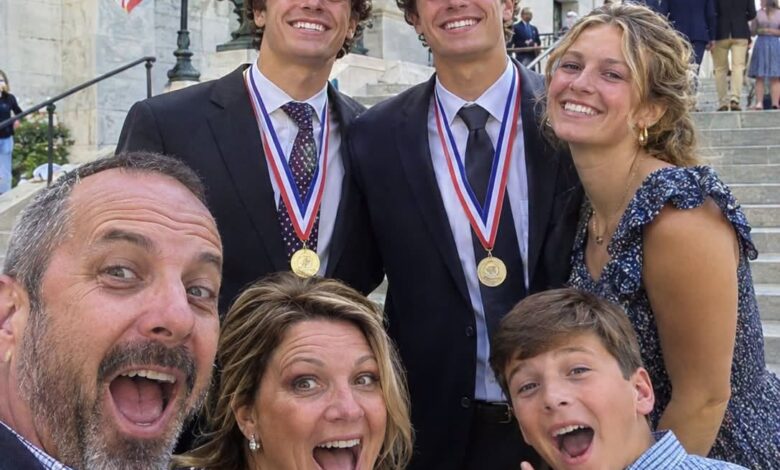
Eli on one side. Owen on the other. Two blue ribbons. Two gold medals. And me in the middle, my face a wreck from crying, mascara everywhere.
Daniel isn’t in it. Neither is Vanessa.
And when I look at that photograph now, I don’t see revenge.
I see thirteen years of early mornings and late nights. Cheap groceries and a toaster that only toasts on one side. Stubbornness and laughter and fear and love.
I see everything Daniel missed.
And everything the three of us built anyway.
There’s a second photo next to it now. Smaller. Not framed as nicely.
Three boys sitting on the steps of an auditorium in Washington, arguing over the back of a program. One in a navy blazer with a gold crest. Two in plain navy jackets that say Cedar Grove.
Owen took it with his phone, holding it out at arm’s length. Their heads are crowded together. Mason’s eyes are half closed. Eli’s mouth is open, mid-sentence.
It’s a terrible picture.
It’s my favorite thing in the house.