My Own Son Evicted Me From My House: The Shocking Truth That Saved My Life
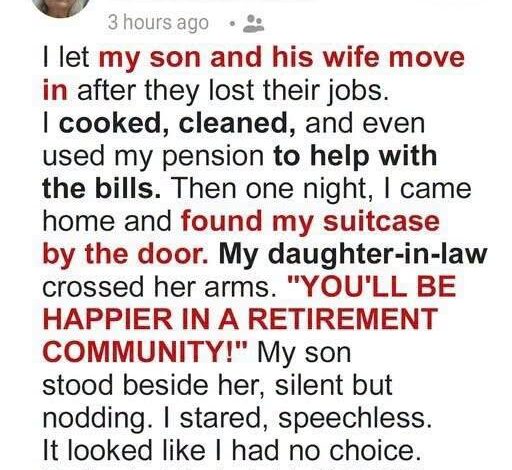
I opened the front door to my own home, the place where I had raised my children and tucked away every happy memory, only to find my suitcase sitting on the porch like a piece of discarded trash. My son, Ethan, and his wife, Claire, stood in the doorway with cold, unrecognizable expressions. They told me I didn’t belong here anymore—that the house was theirs, and it was time for me to find somewhere else to live. My heart stopped. I had sacrificed everything for them, and in a single, cruel instant, I became a stranger in my own life.
The nightmare began months earlier when Ethan and Claire lost their jobs. I had always believed that family was the ultimate safety net, so when they came to me, desperate and adrift, I didn’t hesitate. I threw open the doors of my house, welcoming them into the life I had spent decades building. I covered the groceries, handled the utilities, and poured my savings into making sure they didn’t feel the weight of their failure. I loved Ethan with the fierce, blind devotion of a mother who would walk through fire for her child.
Then came the “financial opportunity.” Ethan sat me down one evening, his eyes filled with a hollow, rehearsed sincerity. He talked about tax advantages, investment leverage, and protection for the family. He told me that by transferring the deed of the house into his name, we could secure low-interest loans that would get them back on their feet and ensure the property was shielded for my future. I didn’t question him. Why would I? He was my son. I signed the documents, believing I was performing one last act of motherly love to set my children up for success.
In the weeks that followed, the atmosphere in the house soured. The warm, shared meals turned into stiff, silent affairs. I found myself retreating to the guest bedroom, feeling like an uninvited houseguest in the very rooms where I had painted the walls and hung my family photos. They stopped asking how I was and started asking when I planned to downsize. I blamed the stress of their job searches, telling myself they were just overwhelmed. I was so blinded by my desire to be the “good mother” that I ignored the way they looked at my belongings as if they were already theirs to sell.
The day I found my suitcase on the porch was the day the scales finally fell from my eyes. There was no argument, no tearful confession—just a cold, administrative dismissal. They had decided that I was an obstacle to their new life. They had stripped me of my home and, they thought, my dignity.
I spent that night in a cheap motel, shivering not from the cold, but from the realization of how deeply I had been betrayed. I was humiliated, but deep down, a flicker of something else was growing—a cold, sharp anger that demanded justice. I thought of Richard, an old friend who had spent his career in real estate law. I called him the moment the sun came up, my voice shaking as I recounted the ordeal.
Richard listened in silence, his tone growing grave. He asked for the details of the transfer, the dates, and the specific wording of the documents. He told me to meet him at his office. When I arrived, he was waiting with a stack of papers and a grim smile. “Hannah,” he said, “Ethan is arrogant, but he’s also careless.”
He explained that the transfer had been rushed. Because of a specific oversight in the county filing process, the deed had never been legally recorded or finalized. The house was still, in the eyes of the law, entirely mine. They hadn’t just failed to steal it; they had unknowingly left me with total control.
I returned to the house the next morning. Ethan and Claire were sitting at the kitchen table, nursing mugs of coffee and looking entirely too comfortable. When I walked in, they didn’t offer a greeting; they looked annoyed that I had returned. I didn’t shout. I didn’t beg. I walked to the table and placed the legal documents Richard had provided in front of them.
“The house is mine,” I said, my voice steady, stripped of the trembling doubt that had defined my life for months. “And you have forty-eight hours to vacate the premises.”
The look on Ethan’s face was one I will never forget—a mix of confusion, indignation, and finally, genuine, gut-wrenching terror. He tried to argue, to play the victim, to tell me about their “rights” as residents, but I simply turned and walked toward the back garden. I didn’t need to hear his lies anymore.
They left two days later. The silence they left behind wasn’t empty; it was a sanctuary. I spent the first week scrubbing every surface, clearing out the remnants of their presence, and reclaiming the rooms that had felt so hostile. I changed the locks and put away their photographs. I didn’t just clean a house; I exorcised the shame of my own blind loyalty.
I still love my son, but the love is different now. It is a distant, guarded thing. I learned that boundaries are not barriers to love; they are the foundation upon which self-respect is built. I spend my evenings now in the chair by the window, watching the sun set over a property that is truly, legally, and spiritually mine. The pain of the betrayal remains, but it has hardened into a protective shell, a reminder that my house is not just a building—it is a testament to the fact that no matter how much you give, you must never, ever give away your right to be the master of your own life.