My Brothers and I Sent Our Sister Money Every Year for Mom’s Heating, but I Found Mom Sleeping in Her Coat With an Empty Propane Tank
**Part One: Thirty-One Below**
The cold snap hit the third week of January.
It came down out of Saskatchewan on a Tuesday night like a freight train. By Wednesday morning, the radio in Bismarck was saying thirty-one below on the farm roads east of Harvey. Fifty-five below with the wind. The kind of cold that freezes your nostrils shut on the first breath and makes your car door handle burn your bare fingers.
The kind of cold that kills people out here.
Mom didn’t answer her phone Wednesday evening.
I didn’t worry much at first. She’s eighty-two. She falls asleep in her chair watching Lawrence Welk reruns on the public station. Sometimes she leaves the phone in the bedroom and can’t hear it ring from the living room.
I called again at nine. Then at nine-thirty.
Nothing.
Thursday evening, she didn’t answer again.
I called six times. Seven. I called the Schmidts, her nearest neighbors, two miles down the gravel road. Their line was busy. I called again. Still busy.
I stood in my kitchen in Bismarck with my phone in my hand and my heart pounding.
My husband, Steve, drives a plow for Burleigh County. During a cold snap, they don’t come home. He’d been out since Tuesday afternoon, sleeping in the cab of his truck at the county shop between shifts, keeping the roads open.
I called him.
“Go,” he said. “I can’t get away. Take the Suburban. Fill the tank in Washburn. Take the emergency kit and the extra blanket. Call me when you get there.”
“Steve—”
“Go, Connie,” he said. “I’ll pray the whole way.”
So I drove out from Bismarck alone.
A hundred and fifteen miles. North on Highway 83, then east on 200 through Turtle Lake and McClusky. The sky was black and enormous and full of stars so sharp they looked like broken glass. The snow on both sides of the road glowed blue in my headlights.
I passed one other car the whole way.
**Part Two: The Farm**
The farm is twelve miles east of Harvey, North Dakota. Eight miles off the blacktop on a gravel section-line road that the county plows maybe once a week in winter.
My grandfather homesteaded it in 1912. Three hundred and twenty acres of wheat and sunflowers and pasture. A white two-story farmhouse with green shutters. A red barn with the roof caved in on the north end. A shelterbelt of caragana and ash trees my grandmother planted against the wind.
And next to the house, a big white propane tank on concrete blocks.
Five hundred gallons. Shaped like a giant pill.
There’s no natural gas out here. There never has been.
Every farmhouse in Wells County heats with propane or fuel oil or wood. The co-op trucks drive out on the gravel roads all winter long, filling tanks. If your tank runs dry, your furnace goes out. If your furnace goes out at thirty below, your pipes freeze in a few hours.
And then you do.
I pulled into the farmyard at eleven-twenty.
The yard light was on. That was something. The kitchen window was dark.
I parked by the back door. I grabbed my flashlight and the blanket. I got out.
The cold hit me like a wall. My eyes watered and the tears froze on my lashes before I’d taken three steps.
The kitchen door was unlocked, the way it always is out there.
I pushed it open. I stepped inside.
No furnace hum.
That’s the first thing I noticed. That farmhouse has had the same furnace since 1987. It’s loud. It rumbles in the basement like a sleeping animal. You hear it every few minutes all winter long, kicking on and off.
It wasn’t running.
Just the clock.
The old Westclox on the wall above the kitchen table. The one with the rooster on the face that Dad bought at the Harvey hardware store in 1970. Ticking.
That was the only sound in the house.
I could see my breath in the kitchen.
**Part Three: The Recliner**
I walked through the kitchen into the living room. My boots left snow on the linoleum.
I found her in the living room.
She was asleep in Dad’s old recliner.
The brown La-Z-Boy by the picture window. The one with the cracked vinyl on the right arm and the lever that sticks. Dad sat in that chair every evening for thirty-four years. After he died, Mom started sitting there instead.
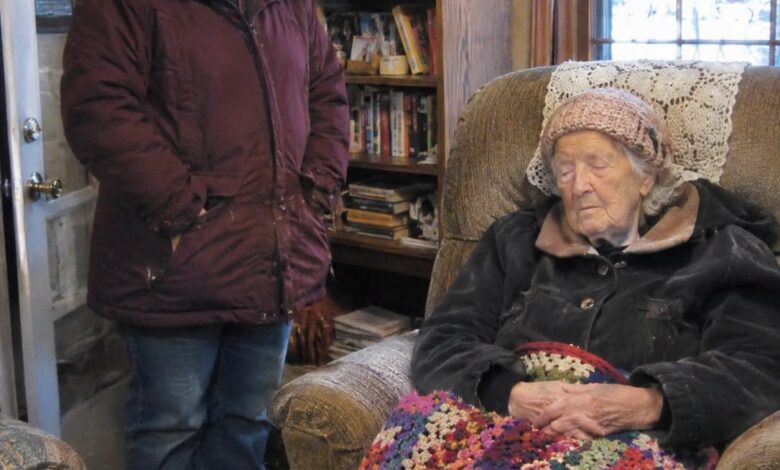
She was wearing her long brown winter coat.
The wool one. With the big buttons and the fake fur collar. The one she’s worn to church every winter since 1995. Zipped and buttoned all the way to her chin.
She had a knit hat pulled down over her white hair. Red and green, with a pom-pom on top. My niece made it for her two Christmases ago.
The crocheted afghan was over her lap. The orange and brown and gold one Grandma Heinz made in 1974.
Her hands were folded on top of it. In knit gloves.
There was frost on the inside of the windows.
Not on the outside. On the inside. The big picture window behind the recliner was covered in white feathers of ice, so thick you couldn’t see the yard light through it.
I stood in the doorway in my red parka.
Car keys still in my hand. Snow melting on my shoulders. My flashlight pointed at the floor.
I couldn’t move.
For a long, terrible moment, I didn’t know if she was breathing.
Then I saw the afghan move. Just a little. Up and down.
I let out a breath I didn’t know I was holding.
I looked at the thermostat on the wall by the hallway.
An old Honeywell. Round. Beige. With the little arrow you turn with your thumb.
It said 58.
That was the setting. The arrow pointed at 58.
The little mercury thermometer under it, the one that shows the actual room temperature, said 51.
Mom is eighty-two.
She has lived alone out there since Dad passed four years ago. She won’t move to town. She won’t move in with any of us. She says she was born in that house, married in that house, raised four kids in that house, and she’ll die in that house.
I stood in her living room at fifty-one degrees and thought, *Not like this. Not tonight.*
**Part Four: Why I Didn’t Call**
I didn’t call my sister from that doorway.
I want to say why.
My name is Connie Weber. I’m fifty-four years old.
I’m the second of four. Pam is the oldest. Then me. Then Rob. Then Dean.
Pam lives in Harvey. Twelve miles away. She’s lived there her whole married life. She works at the clinic as a receptionist. Her husband, Mark, drives a truck for the elevator.
She’s the one closest to Mom. She’s the one who checks on her.
I live in Bismarck. I’m a payroll clerk for the school district.
Rob farms his own place near Rugby, an hour north. Dean lives in Fargo. He sells farm equipment.
We’re spread out. We’re busy. We have kids and grandkids and jobs and mortgages.
So Pam does most of it. Because she’s closest.
Every October, my brothers Rob and Dean and I each send Pam two hundred and fifty dollars for Mom’s propane.
It’s been that way since Dad died. We talked about it at the funeral lunch in the church basement. Pam said she’d handle the propane account with the co-op, since she was in town. Rob said we’d all chip in. Dean said, “Two-fifty each? Pam puts in the same?”
Pam nodded.
A thousand dollars. Four kids, two-fifty each. Enough for a fill in the fall and a top-off after Christmas.
We’ve done it every October for four years.
I’d never once asked Pam for the receipts.
Why would I? She’s my sister. She’s the one who drives out every Sunday. She’s the one who takes Mom to her doctor appointments in Harvey. She’s the one who picks up her groceries and her pills.
She’s the one who’s there.
So standing in that doorway at fifty-one degrees, I didn’t call Pam.
Not because I didn’t trust her.
Because if I called her at midnight and said Mom’s freezing, she’d drive out on those roads at thirty-one below. She’d come in crying and apologizing. There’d be a fight. And at the end of it, Mom would still be cold.
And because of something else.
Something I’d learn in about ten minutes.
**Part Five: Five Percent**
I didn’t wake her up right away.
I went back out through the kitchen. I grabbed my flashlight. I walked out to the propane tank in the side yard.
The snow was up to my knees. The wind was coming off the field like knives. I couldn’t feel my face.
There’s a gauge on top of the tank. A little round dial under a metal cover, like a speedometer. It reads from zero to a hundred. Percent.
It was covered in snow and ice.
I brushed it off with my glove. I scraped the ice off the glass with my car key.
I shined the flashlight on it.
Five percent.
The needle was sitting just above the red zone.
On a five-hundred-gallon tank, that’s twenty-five gallons. In a cold snap like this, with an old furnace, that’s maybe a day. Maybe less.
And when it gets that low, the pressure drops. The furnace can’t get enough fuel to stay lit. It flickers. It cuts out.
That’s why the house was cold.
I stood there in the snow with my flashlight on that needle.
My hands were shaking. Not just from the cold.
Back inside, I went to the refrigerator.
Mom keeps everything on her refrigerator. Grandkids’ school pictures. Church bulletins. A calendar from the Harvey Farmers Elevator. Coupons she’ll never use.
And under a seed corn magnet shaped like an ear of corn, there was a delivery ticket.
It was from the co-op in Harvey. Pink carbon copy. October 19.
Delivery: 200 gallons propane.
Customer: Pamela Ruff for Elsie Heinz.
Tank reading after delivery: 47%.
I stood in my mother’s cold kitchen and read it twice.
Two hundred gallons.
A five-hundred-gallon tank fills to about four hundred. They only fill them to eighty percent, for safety. The propane needs room to expand.
So a full fill, from empty, is somewhere around three hundred and fifty to four hundred gallons.
Two hundred gallons is half.
I did the math standing there.
Last October, propane was about two dollars a gallon in Wells County. Four hundred gallons is eight hundred dollars. A top-off after Christmas, another two hundred.
With Pam’s share, that was a thousand dollars.
A fill and a top-off.
Two hundred gallons was four hundred dollars.
There had been no top-off.
I went back through the stack of papers on the refrigerator. The calendar. The church bulletins. The coupons.
I looked for another delivery ticket. December. January. Anything.
There wasn’t one.
**Part Six: Mom Wakes Up**
I went back into the living room.
I knelt down in front of Dad’s old recliner. I put my hand on Mom’s knee, on top of the afghan.
“Mom,” I said. “Mom, wake up. It’s Connie.”
Her eyes opened slowly.
She looked at me. Confused. Then she blinked.
“Connie?” she said. Her voice was thin and hoarse. “What are you doing here? It’s the middle of the night.”
“You didn’t answer your phone,” I said. “Two nights. I got worried.”
She looked around the room. At the frost on the windows. At her own breath in the air.
Then she looked back at me.
And she saw my face.
I don’t know what she saw on it. Anger, probably. Fear. The pink delivery ticket in my hand.
Whatever it was, her own face changed. Fast.
She reached out and grabbed my wrist with her gloved hand.
“Don’t you start with your sister,” she said.
I stared at her.
“Mom—”
“Don’t you start with Pam,” she said again. Her grip on my wrist was surprisingly strong. “She’s got enough going on.”
“Mom, the tank’s at five percent,” I said. “It’s fifty-one degrees in here. You’re sleeping in your coat.”
“I’m fine,” she said.
“You’re not fine. Your hands are like ice.”
I took her hand in mine. Even through the knit glove, it was freezing.
“Pam’s husband had back surgery,” Mom said. “In September. Did you know that?”
I did know that. Mark had ruptured two discs lifting a grain auger at the elevator. They’d done surgery at Trinity in Minot. Pam had mentioned it at Thanksgiving.
“He hasn’t worked since,” Mom said. “Not a day. The elevator doesn’t have disability. They’re living on what Pam makes at the clinic.”
She looked down at her hands in my hands.
“Pam says propane’s dear this year,” Mom said quietly.
She tried to smile.
“I don’t mind it cool,” she said.
**Part Seven: The Phone Call**
I didn’t argue with her.
I didn’t have time. It was almost midnight. The tank was at five percent. The furnace was going to quit for good any minute.
I tried the co-op in Harvey. Their after-hours line. It went to a recording.
I called again. And again.
At 12:40, a man answered. Sleepy. Annoyed.
“Harvey Farmers Co-op, emergency line.”
“This is Connie Weber,” I said. “My mother is Elsie Heinz. Out east of town on 64th Street. Her tank is at five percent. Her furnace is going out. She’s eighty-two.”
There was a pause on the line.
“Elsie Heinz,” the man said. “Art Heinz’s wife?”
“Yes.”
“Ma’am, this is Duane Kessler,” he said. “I’ve been driving propane out there for twenty-two years. I knew your dad.”
His voice had changed. He wasn’t sleepy anymore.
“Is she okay?” he asked. “Is she warm?”
“She’s in her coat and hat,” I said. “It’s fifty-one degrees in the house.”
Duane didn’t say anything for a second.
“I can’t get the truck out tonight,” he said. “Roads are drifted shut. County won’t plow 64th till morning. I’ll be there first thing. Soon as I can get through.”
“Thank you,” I said.
“In the meantime,” Duane said, “turn the thermostat down to fifty-five. I know that sounds crazy. But it’ll make what’s left last longer. Get her in the warmest room. Close the doors to the other rooms. Is there a space heater?”
“I don’t know.”
“Look in the basement,” Duane said. “Art always kept one down there. A little electric one. For the well pump.”
I found it.
A small electric heater with an orange glow. Dusty. Behind the water softener.
I carried it upstairs. I plugged it in next to Dad’s recliner. I closed the doors to the kitchen and the hallway and the dining room.
I tucked the afghan tighter around Mom’s legs. I took off my red parka and put it over her too.
Then I sat down on the floor next to her chair, with my back against the vinyl, and I didn’t sleep.
**Part Eight: Morning**
At seven, the county plow came down 64th Street.
I heard it before I saw it. The scrape of the blade on the gravel. The orange light flashing on the frost-covered windows.
At ten-forty, I called the co-op again. The main office this time.
A woman answered. Marlene. She’s worked the front desk at the Harvey co-op since I was in high school.
“Connie Heinz!” she said. “Duane told me. He’s loading up right now. How’s your mother?”
“Cold,” I said.
“I need to ask you something, Marlene,” I said. “The account. Mom’s propane account. Whose name is it under?”
There was a pause.
“It’s under Pam’s name,” Marlene said. “Pamela Ruff. She set it up after your dad passed. She’s the billing contact.”
“Can I change that?”
Another pause.
“Well,” Marlene said slowly. “The account just needs one name for billing. Whoever’s responsible for the payments. If Pam agrees, or if you just want to open a new one in your name and close hers, we can do that.”
“I want to open a new one,” I said. “In my name. Today.”
Marlene didn’t ask why.
She’d been working the front desk at the Harvey co-op for thirty years. She’d seen every kind of family trouble there is.
“Okay, honey,” she said. “I’ll set it up.”
I’ll be honest.
Pam is my sister. Mom had begged me not to start with her. And the propane company only needed one name on the account.
I made it mine.
**Part Nine: The Driver**
The driver came out by two.
Duane Kessler. He’s sixty-one, with a gray beard and a Harvey Hornets stocking cap and a face red from thirty years of North Dakota wind. He backed the big white propane truck up to the tank in the side yard.
He got out and walked up to the back door.
He knocked.
Mom answered it. In her brown coat. In her red and green hat.
Duane took one look at her and pulled off his stocking cap.
“Mrs. Heinz,” he said. “I’m sorry I couldn’t get here sooner.”
“Oh, Duane,” Mom said. “You shouldn’t have come out in this. It’s not that cold in here.”
Duane looked past her. At the frost on the kitchen windows.
He didn’t say anything. He just nodded and went back to his truck.
He filled it to eighty percent.
Three hundred and seventy-five gallons. At two dollars and nine cents a gallon.
He brought the ticket to the back door. He handed it to me.
375 gallons. $2.09/gal. $783.75.
I put seven hundred and eighty-four dollars on my card.
Right there in Mom’s kitchen. Standing at the counter. Duane ran it on a little card reader he carried in his coat pocket.
Then I asked him something.
“Duane,” I said. “Can you put the tank on keep-full?”
He looked at me.
“Keep-full?” Mom said. “What’s that?”
“It’s a program,” Duane said. “Automatic delivery. We put a little monitor on the tank. It sends a signal to the office. When it gets down to thirty percent, we come out and fill it. You don’t have to call. Nobody has to remember.”
He looked at me.
“It bills to the account holder,” he said. “Every time.”
“Put it on keep-full,” I said. “In my name.”
Duane nodded slowly.
“Yes, ma’am,” he said.
They watch the tank now.
Nobody has to remember.
**Part Ten: Seventy**
After Duane left, I went to the thermostat.
The old round Honeywell. I put my thumb on the little arrow.
I turned it to seventy.
The furnace caught.
I heard it click in the basement. Then a pause. Then a soft *whump* as the burner lit.
I felt it through the floor. Through the soles of my boots. The whole house seemed to breathe in.
Then the fan kicked on, and warm air came rushing out of the floor registers. Smelling like dust and old metal and every winter of my childhood.
Mom was sitting in Dad’s recliner. Still in her coat and hat.
She heard it too. She closed her eyes.
An hour later, the house was sixty-eight degrees.
The frost on the windows had melted into little rivers running down the glass.
Mom stood up from the recliner.
Slowly. Her knees are bad. She held the arm of the chair.
She pulled off her knit gloves. She set them on the side table.
She pulled off her red and green hat. Her white hair was flat and staticky underneath. She smoothed it with her hand.
Then she unbuttoned her brown coat.
She unzipped it.
She walked across the living room. Into the kitchen. To the row of hooks by the back door.
She hung the coat on the hook.
She stood there with her hand on it for a long moment.
“I forgot,” she said quietly, “what this felt like.”
**Part Eleven: The Text**
That night, after Mom went to bed under two quilts in her warm bedroom, I sat at the kitchen table and texted my brothers.
Not Pam. Just Rob and Dean.
*Mom’s tank is full. Next October, send the propane money to me. I’ll explain at Easter.*
Dean called inside a minute.
“Connie, what happened? Is Mom okay?”
“Mom’s fine,” I said. “She’s warm. She’s asleep.”
“What do you mean, she’s warm?” Dean said. “Was she cold?”
I didn’t answer right away.
“Dean,” I said. “I’ll tell you everything at Easter. Face to face. I don’t want to do it on the phone.”
He was quiet.
“Is it Pam?” he asked.
“At Easter,” I said.
Rob was out feeding cows. He called that night at ten. Rob always calls late.
“Got your text,” he said. “What’s going on?”
“Mom’s warm,” I said. “The tank’s full. It’s on automatic now. In my name.”
Rob didn’t say anything for a long time.
Rob doesn’t say much. He’s the one most like Dad.
“Was she cold?” he asked finally.
“Yes,” I said.
“How cold?”
“Fifty-one degrees in the house,” I said. “She was sleeping in her coat.”
I heard him breathe out. A long, slow breath.
“Okay,” Rob said. “Easter.”
He hung up.
I told them Mom was warm.
The rest would be face to face.
**Part Twelve: Pam**
Pam called on Thursday.
Five days later. I was at my desk at the school district office in Bismarck, running payroll.
I saw her name on my phone. I almost didn’t answer.
I did.
“The co-op called me,” Pam said. No hello. “They said Mom’s tank was moved off my account.”
“It was,” I said.
“To your name.”
“Yes.”
There was a long silence on the line.
“You went behind my back,” Pam said.
Her voice was shaking. Not with anger. Something else.
“I went to the co-op,” I said.
She didn’t say anything for a long time.
I could hear her breathing. I could hear the clinic phones ringing in the background. Somebody calling her name.
“Pam,” I said. “I found Mom in her coat. In Dad’s chair. The tank was at five percent. It was fifty-one degrees in the house.”
Nothing.
“Pam.”
She hung up.
We didn’t speak for eleven weeks.
**Part Thirteen: Eleven Weeks**
Those eleven weeks were the hardest of my life.
I want to be honest about that.
I called Mom every night. She was fine. She was warm. The keep-full monitor worked. Duane came out in February and topped off the tank without anyone calling.
“Pam still comes Sundays,” Mom told me in February. “She brings my groceries. She takes me to church.”
“Does she talk about me?” I asked.
Mom was quiet.
“No,” she said.
I thought about it every night.
Lying in bed next to Steve, after he came home from the cold snap. Staring at the ceiling.
I thought about the pink delivery ticket. Two hundred gallons.
I thought about the three of us. Rob and Dean and me. Sending our two-fifty every October. Feeling good about it. Feeling like we’d done our part.
I did the math over and over.
Seven hundred and fifty dollars from the three of us. Two hundred gallons cost four hundred.
Where did the other three-fifty go?
And Pam’s share? Had she ever put in her two-fifty at all?
Steve tried to talk to me about it.
“Have you thought about calling her?” he asked one night in March.
“She hung up on me.”
“That was eight weeks ago.”
“She went behind our back first,” I said. “She took our money and let Mom freeze.”
Steve was quiet for a long time.
“Connie,” he said. “Do you know that’s what happened?”
I opened my mouth. I closed it.
“No,” I said finally. “I don’t know.”
“Then maybe,” Steve said gently, “you ought to find out before Easter.”
I didn’t call her.
I was too angry. Too hurt. Too proud.
I’m the second oldest. Pam’s always been the one in charge. The one who knew best. The one who lived in town and took care of Mom while the rest of us sent money.
I didn’t want to be the one to call.
**Part Fourteen: Easter**
Easter, we all came home to the farm, the way we always do.
Every Easter since we were kids. Even when Dad was alive. Even the year Dean was in the hospital with his appendix and we brought Easter dinner to him in Fargo.
We come home.
I drove out from Bismarck Saturday afternoon with Steve.
The snow was mostly gone. Just dirty patches in the ditches and on the north side of the shelterbelt. The fields were brown and wet. The sky was big and blue and full of geese heading north.
The propane tank in the side yard was clean and white in the sun. The little keep-full monitor on top blinked green.
Mom met us at the back door.
No coat. No hat. Just her blue cardigan and her apron and her house slippers.
The kitchen was warm. Seventy-one degrees. I checked.
By Sunday noon, we were all there.
Ham in the oven. Scalloped potatoes. Green bean casserole. Rolls rising on the counter under a dish towel.
Mom’s kuchen on the counter. Two of them. Peach and prune. The German custard pie her mother taught her to make in this same kitchen in 1950.
Rob and Dean were at the kitchen table with their coffee.
Rob drove down from Rugby with his wife, Linda. Dean drove up from Fargo with his wife, Kelly, and their two teenagers, who were in the living room on their phones.
Steve was in the living room watching the Twins spring training game with Rob’s son.
Mom was in her chair by the window.
Dad’s recliner. In the sun. With the afghan over her knees. Not because she was cold. Just because she liked it there.
No coat. No hat.
Pam came in last……………..READ MORE NEXT PAGE