My Grandson Was Excluded From His Schools Father Son Breakfast but When a Four Star Admiral Saw Me Everything Changed
My grandson, Caleb, is nine years old.
He has his father’s ears, which stick out a little. He has his father’s habit of chewing the inside of his cheek when he’s thinking. He has his father’s way of going very quiet when something hurts, instead of crying.
He carries one photograph of his father everywhere he goes.
It’s a small, square picture. Four inches by four inches. A little bent at one corner.
In it, my son Danny is sitting on the back steps of our house in Norfolk, Virginia. He’s wearing a gray Navy T-shirt and jeans. He’s holding Caleb on his knee. Caleb is about eighteen months old, with a sippy cup in one hand and a fistful of his father’s shirt in the other.
They’re both laughing at something off-camera. I know what it was. It was me, pretending to be a dog.
Caleb keeps that photo in a plastic sandwich bag, zipped shut, in the inside pocket of his backpack. The one with the zipper that nobody else uses.
He’s carried it there since kindergarten. Every single day.
He doesn’t show it to people. He doesn’t talk about it. But sometimes, when he thinks nobody’s looking, I see him unzip the pocket and slide the bag out just far enough to see his father’s face.
Then he zips it back up.
His father died in 2019.
Danny was a Navy corpsman. A medic attached to a Marine unit in Helmand Province, Afghanistan. On a hot afternoon in August, his patrol was hit by a roadside bomb. Danny ran into the smoke to reach two wounded Marines.
He saved both of them.
He didn’t make it back himself.
He was thirty-one. Caleb was two.
My name is Frank Halloran. I’m eighty-one years old.
I served in the United States Navy from 1963 to 1991. Twenty-eight years. I retired as a Chief Petty Officer. Aviation Boatswain’s Mate. I spent most of my career on the flight decks and hangar decks of aircraft carriers, moving planes, fighting fires, and yelling at nineteen-year-olds to keep their heads down.
After the Navy, I worked fifteen years as a fire safety inspector for the City of Norfolk. My wife, Peg, and I raised three kids in a little brick house a mile from the naval station.
Danny was our youngest.
Peg died in 2015. Cancer.
Danny died four years later.
I won’t pretend I handled either one well.
After Danny’s funeral, his wife, Jess, moved back to Norfolk from Camp Lejeune with Caleb. She didn’t have family of her own. Her parents died when she was in college.
She moved into the little apartment over my garage. Then, when that got too small, she and Caleb moved into the house. Into the back bedroom where Danny grew up.
We’ve been a family of three ever since. A widow, a widower, and a little boy with his father’s ears.
Caleb goes to Hampton Roads Preparatory Academy.
It’s a private school in Virginia Beach. Brick buildings and white columns and green lawns that somebody mows every Tuesday. Navy blue blazers with a gold crest. Classes of fifteen kids.
We could never have afforded it.
But the academy has a scholarship. The Gold Star Fund. For the children of service members killed in the line of duty. Full tuition, kindergarten through twelfth grade.
Caleb got it when he was five. Jess cried for a week.
Every spring, the academy hosts a Father-Son Breakfast.
It’s a big event. Fathers in tailored suits. Sons in their navy blazers. Round tables with white tablecloths in the gymnasium. A guest speaker. Photographs on the front lawn afterward, under the big magnolia tree.
Caleb has never gone.
In kindergarten, Jess went with him. She wore a blazer and a tie and drew a mustache on her upper lip with eyeliner. Caleb thought it was hilarious. A few of the other mothers thought it was sweet.
The headmaster at the time, an older woman named Mrs. Abernathy, thought it was wonderful. She hugged Jess at the door and seated them at a front table.
Mrs. Abernathy retired the next year.
The new headmaster was Dr. Graham Prentiss.
This year, in April, Caleb brought home a note.
It was on heavy cream-colored paper. The academy crest embossed at the top. Printed in a formal typeface.
I found it on the kitchen island when I came in from the garden. Caleb had dropped it there and walked straight to his room.
I picked it up.
Dear Hampton Roads Preparatory Families,
We are pleased to announce our annual Father-Son Breakfast, to be held Friday, May 9, at 7:30 a.m. in the Main Gymnasium. This year’s distinguished guest speaker will be Admiral James R. Carrick, United States Navy (Retired).
This cherished tradition is designed specifically to honor the unique bond between fathers and sons.
Students lacking a father in attendance may wait in the library during the event. Light refreshments will be provided. Thank you for understanding our policy.
Sincerely,
Dr. Graham Prentiss, Headmaster
I read it three times.
Students lacking a father in attendance may wait in the library.
Light refreshments will be provided.
I went down the hall to Caleb’s room.
The door was closed. I knocked.
“Come in,” he said.
He was sitting on his bed with his back against the wall. He wasn’t crying. He had his backpack in his lap. The inside pocket was unzipped.
He was holding the sandwich bag with the photo in it.
He looked up at me.
“It’s okay, Grandpa,” he said. “I don’t even like pancakes that much.”
He zipped the bag shut. He put it back in the pocket.
He zipped the pocket shut.
Then he picked up a book from his nightstand and opened it and pretended to read.
Jess called the school the next morning.
She’s thirty-five. She works as a dental hygienist in a practice near Town Center. She’s tough. She’s had to be. She was twenty-eight when two Marines in dress blues knocked on her door at Camp Lejeune.
She sat at the kitchen table with her phone on speaker. I sat across from her with my coffee.
“I’m calling about the Father-Son Breakfast,” she said. “My son is Caleb Halloran. Third grade. His father was killed in Afghanistan.”
The woman on the phone was the headmaster’s assistant. Her name was Mrs. Kerr.
“I’m very sorry for your loss,” Mrs. Kerr said. She said it the way people say it when they’ve said it a hundred times.
“Thank you,” Jess said. “I wanted to ask if his grandfather could attend with him. My father-in-law. Danny’s father.”
There was a pause on the line.
“Let me check with Dr. Prentiss,” Mrs. Kerr said.
She put us on hold. Classical music. Something with violins.
Three minutes later, she came back.
“I’m sorry, Mrs. Halloran,” she said. “Dr. Prentiss says the event is specifically designed for fathers. He feels a grandparent would not be appropriate given the core theme.”
Jess stared at the phone.
“The core theme,” she said.
“The father-son bond,” Mrs. Kerr said. “Dr. Prentiss has been very clear. Last year there were some concerns about the event losing focus. Mothers attending. Uncles. Family friends. He wants to restore the original tradition.”
“His father is dead,” Jess said. “He died in Afghanistan. Your school gives my son a scholarship because his father is dead.”
“I understand,” Mrs. Kerr said. “And Caleb is very welcome in the library. We’ll have juice and muffins.”
Jess hung up.
She put her phone face down on the table. She put her face in her hands.
She cried. Not loud. The kind of crying where your shoulders shake and you don’t make any sound. The kind she does when she thinks Caleb might hear.
I didn’t cry.
I sat at the kitchen table and drank my coffee and looked out the window at the backyard. At the old swing set Danny used to play on. At the flagpole I put up in 1978. At the flag, snapping in the wind off the Elizabeth River.
Then I got up.
“Where are you going?” Jess asked.
“Closet,” I said.
There’s a cedar closet in the upstairs hallway of my house.
Peg had it built in 1985. She said it was for winter coats. Really, it was for my uniforms. She said a man who served twenty-eight years ought to have somewhere decent to keep them.
I opened the door. The smell of cedar came out. Sharp and clean.
On the left side, behind Peg’s old winter coat that I’ve never been able to give away, there was a heavy black garment bag.
I unzipped it.
My service dress blues.
The jacket. Double-breasted, dark navy wool, with gold buttons. The trousers. The white shirt. The black tie.
The rating badge on the left sleeve. An eagle over three chevrons and an arch, with a crossed anchor in the middle. Chief Petty Officer.
On the lower sleeve, gold service stripes. Seven of them. One for every four years.
And on the left breast, my ribbons.
Seven rows of them. Twenty-eight years of service in a little colored rectangle. Vietnam Service. Navy Achievement Medal. Good Conduct, six awards. Sea Service Deployment.
And at the very top, alone in the first row, a blue ribbon with a thin white stripe down the middle.
The Navy and Marine Corps Medal.
I hadn’t put the uniform on since Danny’s funeral.
I’d stood at Arlington in it. In the rain. I’d watched six sailors fold the flag off my son’s coffin. I’d watched a Navy captain kneel down in front of Jess and hand it to her and say, On behalf of a grateful nation.
Caleb was two. He sat on Jess’s lap and played with the zipper on her coat.
I came home that night and put the uniform in the garment bag and zipped it shut.
I didn’t think I’d ever wear it again.
I took it out of the bag.
I laid it on my bed.
Then I called Jess upstairs.
She stood in my bedroom doorway. She looked at the uniform on the bed. At the ribbons. At the gold stripes on the sleeve.
She looked at me.
“Frank,” she said. “What are you doing?”
“I’m going to a breakfast,” I said.
I need to tell you something about 1972.
I’ve never told anyone this story. Not Peg. Not my kids. Not even Danny.
Some things you carry by yourself.
In the spring of 1972, I was twenty-seven years old. A First Class Petty Officer. Aviation Boatswain’s Mate, Handling. I’d been in the Navy nine years.
I was stationed on an aircraft carrier in the Gulf of Tonkin, off the coast of North Vietnam. We were launching strikes every day. Sixteen, eighteen hours a day. Planes going off the catapults every few minutes. Planes coming back, some of them shot up, some of them on fire.
I worked on the hangar deck. The big enclosed deck below the flight deck where the planes are stored and repaired and refueled.
It’s a dangerous place. Fuel and bombs and hydraulic fluid and spinning propellers and steel everywhere.
On the afternoon of April 18, there was a fire.
A fuel line on an A-7 Corsair ruptured during refueling. JP-5 jet fuel sprayed across the hangar deck. Somebody’s tow tractor threw a spark.
The whole bay went up.
I remember the sound first. A roar like a freight train. Then the heat. Like opening an oven door, except the oven was the size of a football field.
Then the smoke. Thick and black and greasy. You couldn’t see your hand in front of your face.
The alarms were screaming. The general quarters bell. Somebody on the loudspeaker yelling, Fire, fire, fire, Hangar Bay Two.
I was a team leader on the hangar deck fire party. We ran toward it. That’s what you do. Everybody else runs away from a fire on a ship. The fire party runs toward it.
We had hoses. Foam. Proximity suits for the men on the nozzles.
We had about four minutes before the fire reached the bomb racks on the forward bulkhead.
I found him behind the wheel of a tow tractor.
A seaman apprentice. Nineteen years old. Skinny as a rail. A kid from Ohio who’d been on the ship maybe three months.
He was supposed to be moving a plane away from the fire. Towing it clear. That was his job.
He was sitting in the seat of the tractor, frozen. His hands locked on the steering wheel. His eyes wide open. Staring at the wall of fire thirty feet in front of him.
He wasn’t moving. He wasn’t breathing right. He was just sitting there while the fire came closer.
I’d seen it before. It happens to people. Even brave people.
Your body just stops.
I climbed up on the tractor. I grabbed him by the collar of his shirt. I put my face right in front of his face, so close our noses almost touched.
“Look at me,” I said. “Sailor. Look at me.”
He didn’t.
“ Look at me! ” I yelled.
His eyes moved. They found my face.
“What’s your name?” I said.
He didn’t answer.
“What’s your name, sailor?”
“Carrick,” he whispered. “Seaman Apprentice Carrick.”
“First name.”
“Jimmy.”
“Jimmy,” I said. “You’re going to be fine. You hear me? You’re going to be fine. I’ve got you.”
I put my hand on his shoulder. I held it there.
“Now we’re going to drive this tractor out of here,” I said. “Together. You steer. I’ll tell you where.”
His hands were still frozen on the wheel. I put my hands over his.
“Left,” I said. “Easy. Left.”
He turned the wheel. Left.
“Now forward. Slow.”
He pressed the gas. The tractor moved. The A-7 behind us moved with it.
“Keep going,” I said. “Don’t look at the fire. Look at me. Keep looking at me.”
We pulled the plane clear of the fire. Twenty yards. Thirty. Into the next bay, behind the fire doors.
Then the fire doors came down behind us.
Thirty seconds later, the fire reached the spot where the tractor had been sitting.
The fire party contained it in eleven minutes. Nobody died. Four men were burned. Two of them badly.
We lost one A-7 and part of a hangar bay. We were back launching strikes in three days.
That night, I found Jimmy Carrick in the berthing compartment.
He was sitting on his bunk with his head in his hands. Shaking.
“I froze,” he said. “Chief, I froze. I almost got us killed.”
I sat down next to him.
“I’m not a chief,” I said. “I’m a first class.”
“You will be,” he said.
“Everybody freezes the first time,” I said. “Everybody. You know what matters?”
He shook his head.
“You moved,” I said. “When somebody grabbed you and told you where to go, you moved. That’s all courage is, Jimmy. It’s moving when somebody’s got their hand on your shoulder.”
I stood up.
“And someday,” I said, “you’ll be the one putting your hand on somebody else’s shoulder.”
Three weeks later, I got the Navy and Marine Corps Medal for the fire. For pulling a plane clear of a burning hangar bay under extreme danger. The citation didn’t mention Jimmy Carrick. Just a junior sailor.
Jimmy transferred off the ship in September. I never saw him again.
I never knew what happened to him.
The morning of the breakfast, I got up at five.
I showered. I shaved. Twice. The way the Navy taught me.
I put on the white shirt. The trousers. The black socks.
Then I sat on the edge of my bed with my old leather shoes and a tin of Kiwi black polish.
I shined them the way I learned in boot camp in 1963. A cotton ball. A little water. Small circles. Over and over. Until you can see your face in the toe.
It took me forty minutes. My hands aren’t what they were.
I put on the jacket.
It still fit. For the most part. It was a little tight across the middle. A little loose across the shoulders. I’ve lost some muscle and gained some other things since 1991.
But it buttoned. All six buttons.
Then I sat down at my dresser with my ribbon bar and a ruler.
I pinned it to the left breast. Exactly one-eighth of an inch above the pocket. Centered. Level. I checked it with the ruler three times.
I pinned my name tag on the right side. Black plastic, white letters. HALLORAN.
The collar was the hard part.
My fingers don’t bend right anymore. Arthritis. I tried four times to fasten the hook and eye at the top of the collar and I couldn’t do it.
I called Jess.
She came into my bedroom. She was already dressed for work, in her scrubs.
She stopped in the doorway.
She looked at me in the dress blues. At the ribbons. At the gold stripes on the sleeve. At the shoes, shining like black glass.
She put her hand over her mouth.
“Frank,” she said. Her voice cracked. “You look like him.”
“Can you help me with this collar?” I said.
She came over. She stood in front of me and fastened the hook at my throat. Her fingers were shaking.
When she was done, she smoothed the front of the jacket with both hands. She straightened my tie.
Then she put her forehead against my chest. Right over the ribbons.
“Thank you,” she whispered. “Thank you for doing this.”
Caleb came out of his bedroom at seven.
He was wearing his school uniform. Khaki pants. White shirt. Navy blazer with the gold crest. Jess had laid it out for him the night before. She’d told him we were going to drive him to school early. That was all.
He walked into the hallway.
He saw me.
He froze.
He stood there for a long time. In his navy blazer, with his backpack hanging off one shoulder. Staring at me.
At the dark uniform. At the ribbons. At the gold buttons and the gold stripes and the white cap I was holding under my arm.
His mouth was open.
“Grandpa,” he said finally.
His voice was very small.
“You look exactly like Dad,” he said.
I knew what he meant.
He’d seen pictures. Danny in his dress blues at his corpsman school graduation. Danny in his dress blues at his wedding. Danny in his dress blues in the photo the Navy sent home after he died. The official one. The one that sits on the mantel in the living room, next to the folded flag.
Caleb doesn’t remember his father’s face. He was two. But he’s memorized that photograph.
And I was standing in front of him in the same uniform.
I knelt down in front of him.
My knees cracked. Both of them. Loudly. Caleb almost laughed.
“Your dad looked like me, son,” I said. “Not the other way around.”
I put my hand on his shoulder.
“Now get your blazer straight,” I said. “We’ve got a breakfast to go to.”
Caleb stared at me.
“But the note,” he said. “The note said—”
“I know what the note said,” I said.
“Dr. Prentiss said grandparents aren’t allowed.”
“I know.”
“Grandpa,” Caleb said. “You’re going to get in trouble.”
I stood up. Slowly. My knees cracked again.
“Son,” I said. “I’ve been in trouble with better men than Dr. Prentiss.”
The breakfast was in the main gymnasium.
Hampton Roads Prep has a beautiful gym. Polished hardwood floors. Banners hanging from the rafters for every state championship since 1952. Big windows along one wall, looking out on the lawn and the magnolia tree.
They’d set up round tables. Thirty of them. White linen tablecloths. Little vases of white roses in the middle of each one. Real silverware. Real coffee cups.
At the front of the room, they’d built a temporary stage. A wooden podium with the academy crest on it. Behind the podium, a massive American flag. Twenty feet wide. Hung from the rafters.
We walked through the double doors together at 7:25.
Caleb was holding my hand.
I need you to understand something.
Caleb is nine. He hasn’t held my hand in public since he was six. Not crossing the street. Not in the parking lot at the grocery store. Not at his own birthday party.
“I’m not a baby, Grandpa,” he says.
He held my hand the entire way across that gymnasium.
He held it tight. His small hand in my old, spotted, arthritic one.
He didn’t let go.
The room was full.
Two hundred men and boys. Fathers in tailored suits. Navy and charcoal and gray. Silk ties. Shiny watches. Sons in their navy blazers, sitting up straight, the way their mothers had told them to.
There was a buffet along the side wall. Scrambled eggs and bacon and fruit and stacks of pancakes. Pitchers of orange juice.
A string quartet was playing in the corner. Students from the upper school orchestra.
The volume in the room dropped to an immediate halt.
It happened like a wave. The tables closest to the door went quiet first. Then the ones behind them. Then the whole room.
Two hundred faces turned and looked at us.
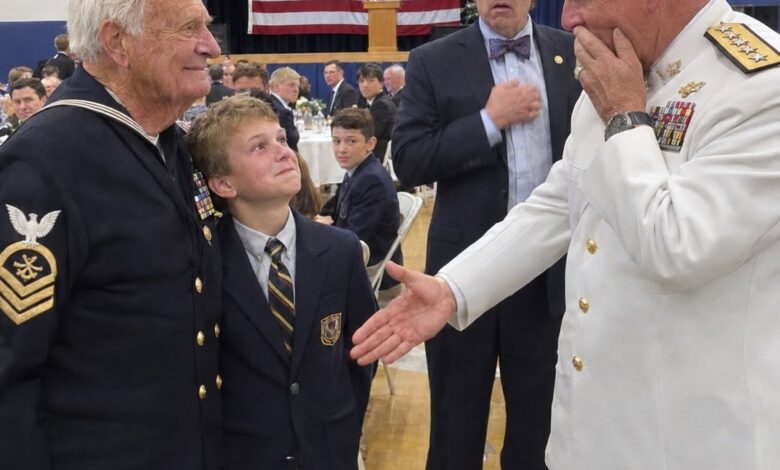
At an eighty-one-year-old man in Navy dress blues. Seven rows of ribbons. Seven gold service stripes. A white cap under his arm.
And a nine-year-old boy in a navy blazer, holding his hand.
The string quartet stopped playing.
I didn’t look at anybody.
I walked across the gymnasium floor. My shoes clicked on the polished hardwood. Caleb walked beside me.
I found an empty table. Way in the back, in the far corner, by the bleachers. Nobody was sitting there. It was the one nobody wanted. Too far from the stage.
I pulled out a chair for Caleb. He sat down.
I pulled out a chair for myself. A metal folding chair. I sat down.
I set my white cap on the table in front of me. Brim forward.
Then I looked at Caleb.
“You want pancakes?” I asked.
He didn’t answer. He was looking around the room. At all the faces staring at us.
“Grandpa,” he whispered. “Everybody’s looking.”
“Let them look,” I said. “Pancakes or eggs?”
He looked at me.
“Pancakes,” he said.
Dr. Prentiss intercepted us within two minutes.
He came striding across the gymnasium from the front of the room. A young man. Late thirties, maybe. Slim. Clean-shaven. Wearing a perfectly tailored gray suit and a silk bow tie with little gold anchors on it.
He had the kind of polish you get from a lot of expensive schools. Princeton, I found out later. Then a doctorate in education from Columbia.
He stopped beside our table.
“Mr. Halloran,” he said.
He said it quietly. Pleasantly. With a smile that didn’t reach his eyes.
“I respect the emotional sentiment here,” he said. “I truly do. But this is a father-son event. I communicated those parameters to your family.”
“You did,” I said.
He waited for me to say something else. I didn’t.
“So I’m going to have to ask you to escort Caleb to the library,” Dr. Prentiss said. “There are refreshments there. Juice. Muffins. He’ll be very comfortable.”
He glanced at the stage.
“Our speaker is preparing to begin,” he said. “And frankly, Mr. Halloran, your uniform is—”
He paused. Choosing his words.
“—a bit of a visual distraction,” he said.
I looked at him for a long moment.
Then I looked around the room.
At the tables of men in expensive suits. At their sons in navy blazers.
Several of the men refused to meet my gaze. They looked down at their plates. At their coffee cups. At their phones.
One or two of them looked visibly ashamed.
There was one man at a table near us. Mid-forties. A gray suit. A boy about Caleb’s age sitting beside him.
He was looking at my ribbons. At the top row. At the blue one with the white stripe.
His face had gone pale.
He looked away.
I turned back to Dr. Prentiss.
“I’ll leave,” I said, “when my grandson has finished eating his breakfast.”
I picked up my coffee cup. Somebody had already filled it.
“Not one second before,” I said.
Dr. Prentiss’s jaw tightened.
He looked at me. He looked at Caleb, who was staring up at him with wide eyes.
He looked at the two hundred people watching.
“Very well,” he said quietly.
He turned and walked away. Toward the front of the room. Toward a woman in a red suit standing by the stage. The chair of the academy’s board of trustees, I found out later.
Caleb was looking at me.
“Grandpa,” he whispered. “Are we going to get kicked out?”
“Probably,” I said. “Go get your pancakes.”
He got up. He walked to the buffet table. Every head in the room turned and watched him go.
He picked up a plate. He put two pancakes on it. Then a third. He poured syrup over all of them.
He walked back to our table with his plate. He sat down. He started eating.
At 7:45, a man in a dark suit walked up to the podium.
The chair of the board. A tall man with silver hair. He tapped the microphone.
“Good morning, fathers and sons,” he said. “Welcome to the fifty-third annual Hampton Roads Preparatory Academy Father-Son Breakfast.”
Polite applause.
He talked for a few minutes. About tradition. About the importance of fathers. About the academy’s proud history of producing leaders.
Then he introduced the guest speaker.
“It is my great honor,” he said, “to introduce a man who embodies leadership and service. Admiral James R. Carrick.”
A man stood up from the head table.
He was tall. Broad-shouldered. Gray hair cut short. He was wearing a dark civilian suit, but he walked like a man who’d worn a uniform for most of his life. Back straight. Chin up. Every step measured.
He was about seventy, I guessed.
The board chair kept reading from his notes.
“Admiral Carrick served thirty-eight years in the United States Navy,” he said. “He enlisted as a seaman apprentice in 1971 and rose through the ranks to become one of only a handful of enlisted sailors in Navy history to reach four-star rank.”
The room murmured.
“He commanded two carrier strike groups. He served as Commander of United States Pacific Fleet. He briefed three presidents. He retired in 2009 and now lives here in Virginia Beach.”
He looked up from his notes.
“His grandson is in our fifth grade,” he said…………………..CONTINUED ON NEXT PAGE