My Boss Asked Me To Take His Daughter To Prom Until She Revealed His Real Reason
“Your father needs a vacation,” I said.
Georgia grabbed my phone out of my hand.
“I’ve got an idea,” she said.
She typed something quickly and handed it back to me. I looked at the screen. She’d already sent it.
Georgia has also requested that I obtain the moon. Please advise.
My boss didn’t answer for two minutes.
Georgia and I stood under the balloon arch, staring at my phone, waiting. The photographer was trying to take our picture again. He kept saying, “Look up, please! Look at the camera!”
Then:
Um, well, use your judgment.
I laughed so hard I bent over. Georgia was laughing so hard she had to hold onto the balloon arch, and one of the balloons popped.
The photographer sighed and took our picture again. Then again. In the end, I think he gave up and just used one where we were both laughing with our eyes closed.
By the end of prom, Georgia and I were actually having a great time.
We danced badly. Really badly. I’m not a dancer. Georgia isn’t either, it turns out, but at least she’s confident about it.
We ate too many cupcakes. The culinary club had made about four hundred of them, chocolate with silver sprinkles, and they were stacked on a tiered tray by the drink table. Georgia ate three. I ate four. Madison ate so many we stopped counting.
We watched Madison convince the DJ to play an old disco song. It took her twenty minutes and a lot of pleading. When “September” finally came on, the whole gym groaned, and then everybody started dancing anyway.
Georgia taught me a dance move during that song.
“You put your arms like this,” she said, demonstrating. She bent her elbows and swung them back and forth in a sort of chopping motion. “And then you kind of bounce. And then you spin.”
I tried it.
Georgia stopped dancing and just stared at me.
“What?” I said, still swinging my arms.
“You look like you’re fighting invisible bees,” she said.
“That’s the move!”
“That is not the move!”
Madison was crying from laughing. Theo filmed the whole thing on his phone.
I didn’t stop doing it for the rest of the night.
The dance ended at eleven-thirty. The lights came up, the DJ played one last slow song, and the chaperones started herding everyone toward the doors.
When we finally walked out to the parking lot, Georgia was still laughing about the invisible bees.
“Okay,” I said as we reached Uncle Frank’s Buick. “I survived prom. Can you tell me what’s happening now?”
Georgia stopped smiling.
“There’s something Dad hasn’t announced at work yet,” she said.
My stomach tightened again.
“Please don’t keep me in suspense, Georgia. I have a weak heart.”
“You’re twenty.”
“I have a weak twenty-year-old heart.”
She took a breath.
“He’s opening another location,” she said.
I blinked.
“Another warehouse?”
She nodded.
“In Westfield. He signed the lease in March. It’s going to open in the fall.” She paused. “And he needs someone to manage it.”
I stared at her.
“Okay,” I said slowly.
“He’s been watching a few different employees,” Georgia said. “Seeing who might be ready. But you’re the one he’s most interested in.”
For a moment, I couldn’t speak.
The parking lot was emptying out around us. Limousines were pulling away. Somebody honked. A group of girls ran past barefoot, carrying their high heels.
Then I managed to squeak out, “Me?”
“Yes.”
“But I’m practically new!”
“You’ve been there more than a year.”
“I still call my mom when I don’t know how long to cook chicken!”
Georgia laughed.
“That doesn’t mean you’re bad at your job,” she said.
I shook my head. I leaned back against the car.
“Why didn’t he just tell me?” I said. “Why didn’t he just call me into his office and say, ‘Hey, Brent, want to apply for this job?’”
Georgia was quiet for a moment.
“Because he’s convinced you’re too young to recognize your own potential,” she said. “He thought if he asked you straight out, you’d say no. You’d say you weren’t ready. You’d say somebody else deserved it more. Kyle, or somebody older.”
I didn’t say anything. Because that’s exactly what I would have said.
I thought about the questions Sheldon had asked me over the past year.
The customer who refused to pay. The two employees who wanted the same day off. The supplier who delivered the wrong order.
Mr. Castellano and his takeout containers.
Why didn’t you get Kyle to do it?
“Those questions he kept asking me,” I said slowly. “Those were all tests?”
“Some of them,” Georgia said. “He wanted to know how you think. How you solve problems. Whether you blame people or fix things.”
“And tonight?”
Georgia sighed.
“He thought an awkward social situation would show whether you could stay calm when someone was being unreasonable,” she said. “Like a difficult customer. Or a difficult employee. He said, and I quote, ‘If he can handle a cranky teenager for four hours without losing his temper, he can handle anybody.’”
I stared at her.
“Your father turned prom into a management interview?!”
“That was his plan,” Georgia said.
“That’s ridiculous!”
“I told him!” Georgia threw up her hands. “I told him it was ridiculous! I told him it was weird and unfair! He said it was ‘an unconventional assessment environment.’”
Then I remembered something.
“Wait,” I said. “What happened to your original date? Your dad said he backed out at the last minute.”
Georgia smiled, a little guiltily.
“Oliver’s my friend,” she said. “We were supposed to go together. Just as friends. But then Dad started talking about this whole plan two weeks ago. And he asked if Oliver would mind going with his other friends instead.”
“So Oliver didn’t exactly back out?”
“No,” Georgia said. “He’s here tonight. He was the guy in the blue tux who did the worm during ‘Uptown Funk.’”
I remembered him. He’d knocked over a chair.
“Dad just preferred the ‘backed out’ explanation,” Georgia said. “It sounded more urgent.”
I rubbed my face with both hands.
“Everyone knew,” I said. “Everyone. Madison. Your aunt. Oliver. Except me.”
“Pretty much,” Georgia said.
Then Georgia pulled out her phone.
“And I already told Dad what I think,” she said.
She turned the screen toward me. She’d sent the message twenty minutes earlier, during the last slow song.
Brent failed your test. He let me eat three cupcakes, couldn’t obtain the moon, and danced like a washing machine with a loose wheel. We had a great time. Stop treating people like experiments.
I burst out laughing.
Then I saw Sheldon’s reply underneath.
Understood. We need to talk.
Suddenly, I was nervous again.
That was when the car wouldn’t start.
I got in, put the key in, and turned it.
Nothing happened. There was a click and a faint whine, and then silence. The dashboard lights flickered once and went out.
I turned the key again.
Click.
I sat there with my hands on the steering wheel.
It was eleven forty-two. Georgia’s curfew was midnight. Sheldon’s house was twenty minutes away. The parking lot was almost empty now, just a few cars left and a janitor rolling a trash can toward the dumpster.
Georgia looked at me from the passenger seat.
“Is this the unexpected thing?” she said slowly. “Did my dad do this?”
“I don’t think your dad sabotaged my uncle’s Buick,” I said.
“Are you sure?”
“Pretty sure.”
I tried the key one more time. Click.
And then I remembered.
If it won’t start, jiggle the battery cable. The left one. It gets loose.
“Hang on,” I said.
I pulled the hood release. I got out of the car. I propped the hood open with the little metal rod and leaned in under it in my grandfather’s funeral suit. I used my phone flashlight.
There it was. The left battery cable, the black one, was sitting loose on the terminal. It had wiggled off just enough to lose contact.
I took off my jacket and handed it to Georgia, who’d gotten out and was standing beside me holding up her own phone flashlight.
“Hold this,” I said.
She took it.
“Is this the test?” she said.
I laughed.
I pushed the cable back down onto the terminal as hard as I could. I wiggled it. I pushed it again. It felt tight.
“Okay,” I said. “Try it now.”
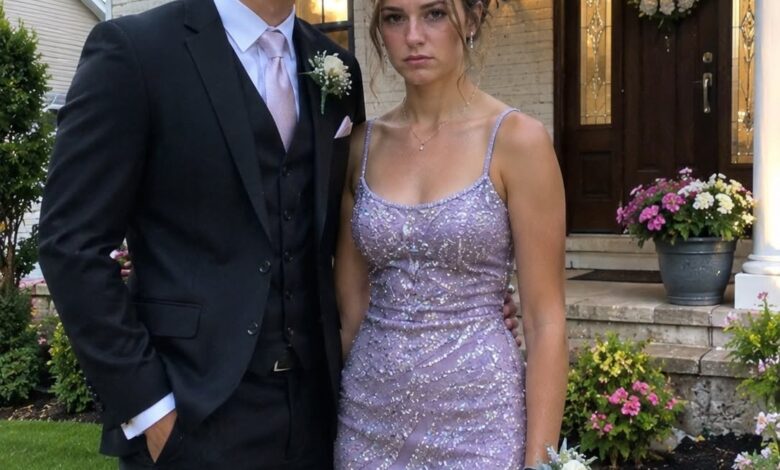
Georgia got into the driver’s seat, holding up her long green dress with one hand. She turned the key.
The engine roared to life.
So did the radio. It came on full blast, all by itself, playing “September.”
Georgia shrieked with laughter. I stood there in the parking lot with grease on my hands, laughing so hard I had to lean on the fender.
I got her home at 12:04.
Four minutes late. I’d driven as fast as I legally could, squeaking around every left turn. Georgia laughed at every single squeak.
When we pulled into the driveway, the porch light was on. Through the front window, I could see the blue glow of the TV.
Georgia leaned forward and looked.
“He fell asleep,” she said. “On the couch. He always does.”
“Should I come in and tell him we’re home?”
“No,” she said. “Let him sleep. He’ll pretend he was awake the whole time anyway.”
She opened her door. Then she stopped and looked back at me.
“Brent?” she said.
“Yeah?”
“Thanks. For tonight. For not being weird about any of it. And for the napkin.”
“Anytime,” I said.
She smiled.
“Your hands are covered in grease, you know.”
I looked down. They were.
“Occupational hazard,” I said.
She laughed and got out and went up the front steps. At the door, she turned around and waved. Then she went inside.
I sat in the driveway for a second, listening to the engine tick. The radio was off for once.
Then I backed out. I turned left at the end of the driveway.
Eeeeeek.
When I got home, Mom was waiting up at the kitchen table in her bathrobe, with a cup of tea.
“Well?” she said.
“It was fine.”
“Just fine?”
I sat down across from her. I thought about it.
“It was actually really fun,” I said. “And really weird.”
“Weird how?”
I told her about the test. The text messages. The chair facing northwest. The moon. The new location in Westfield.
Mom put down her tea. She stared at me.
“Brent,” she said. “He wants you to manage it?”
“Maybe. Georgia said he’s thinking about it.”
Mom didn’t say anything for a long time. Then her eyes filled up.
“Mom,” I said. “Don’t. It’s not even real yet.”
“I know,” she said. She wiped her eyes with the sleeve of her bathrobe. “I know. I’m just… I’m proud of you. That’s all. Somebody else sees it too. What I’ve always seen.”
From the hallway, Janelle’s bedroom door creaked open. She stuck her head out.
“Did you get paid?” she whispered loudly.
“Go to bed, Janelle,” Mom and I said at the same time.
Monday morning, Sheldon called me into his office.
He was sitting behind his desk with his reading glasses on top of his head. There was no sunflower seed mug in sight. He looked uncomfortable, like a man who’d been caught doing something embarrassing and knew it.
“Sit down, Brent,” he said.
I sat.
“How was prom?” he asked. “We never really got to talk when you brought Georgia back. I was…” He cleared his throat. “Resting my eyes.”
“Educational,” I said.
Sheldon sighed. He took off his glasses and rubbed the bridge of his nose.
“Georgia told you,” he said. “Didn’t she?”
“Yep. Everything.”
He covered his face with both hands.
“I should’ve known she couldn’t keep a secret,” he said into his palms. “She’s never been able to keep a secret. When she was seven, she told her mother what we got her for Christmas. Before Thanksgiving.”
I sat across from him and waited until he took his hands off his face.
“Sir,” I said, “why didn’t you just ask me whether I wanted to apply for the position?”
He looked at me.
“Because I wasn’t sure you’d believe you were ready,” he said.
“Honestly,” I said, “I’m still not sure.”
“That’s why you’ll get training,” Sheldon said.
He opened a folder on his desk and turned it around so I could see it.
He explained everything.
The new location in Westfield would open in six months. It was a smaller warehouse than ours, about half the size, serving the restaurants and grocery stores on the west side of the county. It would need a manager to run it day to day. Scheduling, inventory, supplier management, customer accounts, hiring.
He wanted me to train for the next six months with Marcus, our operations manager. Marcus was in his forties, a quiet, organized man who’d been with the company for fifteen years. He knew every single thing about how the business worked.
“Marcus will teach you everything he knows,” Sheldon said. “You’ll shadow him for the first two months. Then he’ll start handing you pieces of the job. Scheduling first. Then ordering. Then the customer accounts.” He tapped the folder. “If you do well, at the end of six months, you’ll interview for the management position. A real interview. With me, Marcus, and our accountant. No tricks.”
“No tricks,” I repeated.
“No tricks,” Sheldon said. “I promise.”
Then he slid another piece of paper across the desk.
It was the salary range for the manager position.
I nearly fell out of my chair.
I read it twice. Then I read it again, because I thought I’d read it wrong.
It was more than twice what I was making. Almost three times.
It was enough to help Mom properly. Not just a little cash in the coffee can on top of the fridge, but really help. Pay off the credit card she’d been carrying since Dad left. Buy Janelle new shoes before the old ones fell apart. Fix the car, or replace it. Start saving for my own future, for real, for the first time in my life.
I sat there staring at that piece of paper. My eyes were stinging.
But I still had something to say.
I put the paper back down on the desk. I made myself look Sheldon in the eye.
“Sir,” I said, “I really appreciate this. More than I can say. But using Georgia’s prom to test me wasn’t fair. Not to me. And not to her.”
Sheldon didn’t argue. He nodded slowly.
“You’re right,” he said. “Georgia said the same thing. Several times. Loudly.”
He leaned back in his chair. He looked at the photograph on his desk, of Lauren laughing with her dark curly hair, and the one beside it of ten-year-old Georgia with her missing teeth and her giant fish.
He was quiet for a long time.
“But it was more than a test, Brent,” he said finally. “I didn’t tell my daughter this part. But I didn’t ask you to take her to prom just to see how you’d handle pressure.”
He picked up the photo of Georgia and the fish. He looked at it.
“Her mom died when she was twelve,” he said quietly. “Since then, it’s just been the two of us. I’ve been a nervous wreck about her for six years. About everything. Who she hangs out with. Who she trusts. Who’s going to take care of her when I’m not around.” He put the photo down. “I asked you to be her date because I wanted to see how you’d treat the most precious person in my life.”
He looked up at me.
“If I could trust you with Georgia,” he said, “I knew I could trust you with anything.”
I couldn’t help it. My eyes filled up.
I looked down at my hands. There was still a little grease under my thumbnail from Uncle Frank’s battery cable.
“It was an honor, sir,” I said. My voice came out rough. “Really. She’s great. We had a great time.” I took a breath. “But if you want to know how I handle pressure, you can just watch me at work.”
Sheldon smiled.
“I already have,” he said.
Then he held out his hand across the desk.
“No more surprise tests,” he said.
I shook it.
“Good,” I said. “Because I still haven’t figured out how to get Georgia the moon.”
Sheldon threw his head back and laughed, his big booming laugh that you could hear all the way out in the warehouse.
The next six months were the hardest of my life.
Marcus was a good teacher, but he didn’t go easy on me. The first week, he handed me a binder three inches thick with every procedure the company had. Ordering, receiving, invoicing, returns, and safety. He told me to read the whole thing by Friday.
I read it by Thursday.
He handed me another one.
I shadowed him everywhere. I sat in on his phone calls with suppliers. I watched him build the weekly schedule, juggling fourteen employees’ availability like a puzzle. I watched him handle customers who were angry, customers who were confused, and customers who wanted discounts they didn’t deserve.
“You don’t have to be the smartest guy in the room,” Marcus told me once, while we were eating lunch in his truck. “You just have to be the calmest. People can smell panic. They can also smell calm. Calm’s contagious.”
I wrote that down on a napkin and stuck it in my wallet.
Not everybody was happy about it.
Kyle found out in the second week. He’d been at the company two years longer than me. He thought the job should’ve been his.
He came up to me in the break room while I was microwaving leftover spaghetti.
“So I hear you’re the golden boy now,” he said.
I didn’t say anything. I just waited for the microwave.
“Took the boss’s daughter to prom and got a promotion,” Kyle said. “Nice move. Real smart.”
The microwave beeped. I took out my spaghetti. I turned around and looked at him.
“Kyle,” I said. “I didn’t know anything about the job until after prom. And I haven’t gotten anything yet. I’m training. If I mess up, I don’t get it.”
“Sure,” Kyle said.
“And if you want to be a manager someday,” I said, “I’ll help you. I mean it. I’ll show you everything Marcus shows me.”
Kyle stared at me. I think he was waiting for me to get angry.
I didn’t.
He shook his head and walked out of the break room.
But two months later, when I took over the weekly schedule, I gave Kyle the Saturday off he’d been asking for since spring so he could go to his brother’s wedding. Marcus had always said no. Kyle had always been the one who covered.
On Monday, there was a can of soda on my desk. No note. Just the soda.
I knew who it was from.
There were bad days too.
In August, a refrigerated truck broke down on the highway with four thousand dollars of food-safe packaging inside, on a ninety-five-degree day. Marcus was on vacation. I was in charge.
I didn’t panic. Okay, I panicked a little, in the bathroom, for about two minutes. Then I washed my face, called three different truck rental companies, found one with an available truck in the next town over, drove out there myself, and spent the afternoon transferring boxes in the heat with two of our drivers.
We lost one pallet. We saved the rest.
When Marcus got back, he looked at my incident report for a long time.
“You called the customers before they called you,” he said. “All of them. Told them about the delay before they even noticed.”
“Yeah.”
“Why?”
I thought about Mr. Castellano slamming that box of containers on the counter.
“Because it’s worse to find out from your own empty shelves,” I said. “People get angrier when they think you’re hiding something.”
Marcus nodded slowly.
“Good,” he said. That was all he said. But I knew from Marcus, good was practically a standing ovation.
In November, I had my interview.
It was in the conference room, which was really just the break room with the coffee maker unplugged. Sheldon sat at the head of the table. Marcus sat next to him. Our accountant, a serious woman named Mrs. Oduya who never smiled, sat at the end with a legal pad.
They asked me questions for two hours. Real ones. Hard ones. How I’d handle a budget shortfall. How I’d fire somebody who was stealing. How I’d keep good employees from quitting. What I’d do in my first week. My first month. My first year.
Some of the questions were ones Sheldon had asked me before, leaning on a shelf in the warehouse with a mouthful of sunflower seeds.
This time, I knew why he was asking.
At the end, Mrs. Oduya put down her pen.
“One more question,” she said. “Why do you want this job?”
I thought about it.
“Because my mom’s been carrying everything by herself for nine years,” I said. “And I want to carry some of it. And because I’ve figured out that I’m good at this. At fixing things. At helping people figure stuff out. And I didn’t know that about myself until somebody made me find out.”
I glanced at Sheldon.
“Even if he did it in a really weird way,” I added.
Marcus snorted. Sheldon laughed.
Mrs. Oduya smiled.
It was the first time I’d ever seen her smile.
They called me that Friday.
I was at the laundromat on Fourth Street with Mom. We’d gone together that week because her back was hurting and she couldn’t carry the bags herself. We were sitting in the hard plastic chairs watching our clothes spin around.
My phone rang. It was Sheldon.
“Brent,” he said. “You got it.”
I didn’t say anything. I couldn’t.
“Brent? You there?”
“I’m here,” I said. “I’m here.”
“Welcome to management,” Sheldon said. “God help you.”
When I hung up, Mom was staring at me.
“Well?” she said.
“I got it.”
Mom put her hands over her mouth.
Then she started crying. Right there in the laundromat on Fourth Street, in front of a dryer full of our towels and a woman folding her husband’s work shirts. She cried so hard that the woman came over and asked if she was okay.
“My son,” Mom said, pointing at me, still crying. “My son just got a promotion.”
The woman smiled and patted her shoulder.
“Congratulations,” she said to me. “Your mom’s proud of you.”
“I know,” I said. My eyes were wet too. “I know she is.”
When we got home, Janelle was sitting at the kitchen table doing her homework.
“I got it,” I said.
She looked up.
“The manager thing?”
“The manager thing.”
She stared at me for a second. Then she said, very seriously, “Does this mean we can finally replace the washing machine?”
“Yes,” I said.
Janelle jumped up out of her chair and raised both arms over her head.
“BEST PROM EVER!” she shouted.
We bought the washing machine that Saturday. A brand new one, white and shiny, with eleven different settings that none of us understood. The delivery guys installed it in the little closet off our kitchen.
Mom stood in front of it for a long time after they left. She ran her hand over the top of it.
“No more laundromat,” she said quietly.
“No more laundromat,” I said.
The same afternoon, I took Janelle to the shoe store at the mall. She picked out a pair of white sneakers without a single hole in them. She wore them out of the store. She carried her old duct-taped ones in the bag, and when we got home she threw them straight in the trash.
“Goodbye forever,” she told them.
Georgia and I stayed friends.
She started college that fall at the state university, an hour away, studying engineering. She came home some weekends. Sometimes she’d stop by the warehouse to see her dad, and she’d come find me and steal my lunch.
She texted me the night before my interview.
Good luck tomorrow. If they ask you to get the moon, tell them it’s not in the budget.
I texted back: I’ll offer them north or west.
She sent back about forty laughing emojis.
The new location in Westfield opened on the first Monday in December.
It wasn’t much to look at. A gray metal building in an industrial park, between a plumbing supply store and a place that sold restaurant equipment. There was a sign over the door that said PRYCE SUPPLY — WESTFIELD in blue letters.
I had six employees. One of them was Kyle. He’d asked to transfer. He said he wanted to learn from the “golden boy.” He was smiling when he said it.
Sheldon came for the ribbon cutting. So did Marcus, Mrs. Oduya, Mom, Janelle, and Uncle Frank, who drove the mustard-colored Buick and parked it right in front of the door like a guest of honor.
“That car got you this job,” Frank told me, very seriously. “Never forget it.”
“It almost made me late.”
“It made you calm under pressure,” Frank said. “That’s personality.”
Georgia came too.
She’d driven down from school that morning. After the ribbon cutting, while everybody was eating sheet cake in the break room, she pulled me aside and handed me a flat package wrapped in brown paper.
“Open it,” she said.
I tore off the paper.
It was a framed photograph from prom, from under the balloon arch, the one where we were both laughing with our eyes closed.
But that wasn’t the one in the frame.
The one in the frame was a different picture. Theo must have taken it on his phone. It was me in the middle of the dance floor in my grandfather’s gray funeral suit, doing the invisible bee dance. My arms were bent and swinging. My face was scrunched up in total concentration. Behind me, Georgia was laughing so hard she was bent over with her hand on her knees.
Underneath the picture, on a little white card tucked into the frame, she’d written in black marker:
Employee of the Month: Survived One Prom, Three Cupcakes, and a Very Strange Boss.
I laughed so hard I had to sit down.
I hung it in my office.
It’s still there, on the wall right behind my desk, next to the napkin from Marcus that says Calm is contagious. Every person who comes into my office asks me about it.
Sheldon saw it the first time he visited. He stood in front of it for a long time with his hands in his pockets.
“She gave you that?” he said.
“She did.”
He shook his head slowly.
“I’m never going to live this down, am I?” he said.
“No, sir,” I said. “Probably not.”
He laughed. Then he looked at the photo again, at Georgia bent over laughing in her green dress.
“She hasn’t laughed like that since her mom died,” he said quietly. “Not really. Not until that night.”
He didn’t say anything else. He just patted me on the shoulder and went back out to look at the inventory.
I’ve been a manager for almost a year now.
I still call my mom when I don’t know how long to cook chicken. Some things don’t change.
But now, when one of my newer guys looks scared about something, when he’s dealing with an angry customer or a broken truck or a schedule that won’t come together, I lean on a shelf beside him and ask him a question.
“Hey. Quick question. What would you do if a supplier sent the wrong order?”
He answers. Then I tell him, right then, whether he got it right. And I tell him he’s good at this. Out loud. To his face. I don’t make him wait. I don’t make him wonder. I don’t turn anything into a test.
I learned that much from Sheldon. Mostly by watching what he did wrong.
Last month, Georgia came home for fall break. She stopped by the Westfield warehouse to drop off a box of cupcakes from her dad, chocolate with silver sprinkles.
She stood in my office doorway and looked at the framed photo on the wall.
“You kept it,” she said.
“Of course I kept it.”
She came in and sat down across from my desk. She took a cupcake out of the box. She peeled the paper off very slowly.
“Brent,” she said, with a completely straight face. “This chair isn’t facing northwest.”
I looked at her.
Then I got up, came around the desk, and turned her chair a quarter turn to the left.
“West,” I said. “Best I can do.”
“Hmm,” Georgia said. She took a bite of her cupcake. “Acceptable.”