Fiona Left Me With Christmas Dinner for Seventeen
I cooked Christmas dinner for seventeen people, and not one of my children came.
Three months later, I disappeared with every dollar they thought was waiting for them.
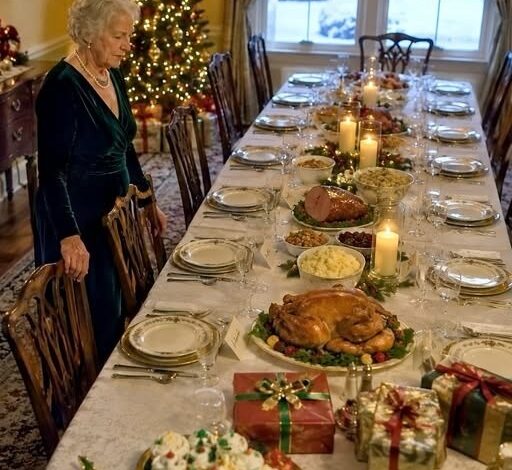
On Christmas Eve, my kitchen smelled like roasted turkey, honey ham, cinnamon cider, buttered potatoes, and the pecan bread Richard used to bake every December before his heart gave out. The candles threw soft gold across the dining room walls, the windows had gone black with winter, and the clock above the stove clicked so loudly it felt like it was counting my humiliation out loud.
Seventeen place settings waited on the table.
Seventeen chairs.
Seventeen names written by my own hand.
Laura. Michael. Fiona. Their spouses. My eight grandchildren.
And at 8:40 p.m., I was still standing there alone in my green velvet dress, touching the pearl necklace Richard gave me on our thirtieth anniversary, pretending the next set of headlights would turn into my driveway.
They never did.
It was not snow. It was not traffic. It was not some last-minute emergency. My children simply decided that Christmas dinner at their mother’s house was not worth showing up for.
I called Laura first. Straight to voicemail. I called Michael next. Voicemail. Fiona let it ring twice before sending me away.
So I sat at the head of that beautiful table like a woman hired to decorate her own abandonment.
Nine o’clock passed. Then ten. Then eleven.
By 12:15 a.m., the gravy had formed a skin, the cider had gone cold, and the turkey had changed from perfect to pitiful. The little stockings I had bought for the grandchildren sat near the mantel, full of candy I had no one to hand to.
That was the night something inside me finally went still.
Not broken. Clear.
Richard had been gone ten years by then. One ordinary morning, he was standing in our bathroom knotting his tie for work, and the next, paramedics were counting over his chest while I gripped the doorframe so hard my fingers cramped.
After the funeral, my three children sat around me in the living room and said all the words children say when grief is fresh and everybody is watching.
“We’ll get through this together, Mom,” Laura promised.
“You’re not going to be alone,” Michael said.
Fiona cried into my shoulder and whispered, “We’ll take care of you.”
For a little while, they almost did.
Laura brought casseroles. Michael mowed the lawn. Fiona came by with the kids, and for a few noisy hours the house sounded alive again.
Then I became inconvenient.
The calls shortened. The visits thinned out. Sunday dinners disappeared. Mother’s Day became flowers ordered online. My birthday became a text message with a heart emoji and no voice behind it.
I made excuses for them for years because mothers are fluent in excuses. We can turn scraps into hope and silence into understanding until the truth has to knock the breath out of us.
The truth started showing itself in little places.
One year, I drove almost two hours to bring Michael the chocolate cake I had baked for every birthday since he was six. When I pulled into his driveway, balloons were tied to the mailbox, cars lined the curb, and music floated through the front door.
Michael opened it, saw me holding the cake, and lowered his voice like I was a problem he needed to hide.
“Mom,” he said, glancing over his shoulder. “I didn’t know you were coming.”
“It’s your birthday, sweetheart.”
His face tightened. “It’s just a thing with Anna’s family. This really isn’t a good time.”
He left me on the porch with the cake in my hands.
I cried so hard on the drive home that I had to pull into a gas station and sit there until the road stopped blurring.
I learned about my granddaughter Emily’s graduation from Facebook. I mailed her five hundred dollars and a handwritten letter telling her how proud her grandfather would have been.
She texted back, “Thanks, Grandma.”
Nothing else.
When I slipped in the garage and fractured my wrist, Laura said she would come after work. She never did. When doctors found a lump in my breast and I spent four days waiting for scan results with fear lodged in my throat, I told no one.
Not because I was brave.
Because by then, I understood there was no one to tell.
The hospital intake desk had my emergency contact on file, but that paper meant more than the people listed on it. The biopsy came back benign, and I folded the results into the same kitchen drawer where I kept old warranties, Richard’s insurance letters, and birthday cards my children no longer bothered to send.
A document can be colder than a room. At least a room does not pretend to love you.
Still, that Christmas, I tried one last time.
I called weeks in advance. I told them I did not want gifts. I did not need anything fancy. I only wanted one evening together, one proper family dinner, one night that felt like the old days when Richard was alive and the grandchildren still ran through the hallway in socks.
Laura said, “We’ll see.”
Michael said, “I’ll try.”
Fiona smiled and said, “That sounds nice.”
And because I was their mother, I translated those scraps into hope.
So I cooked for seventeen people.
I scrubbed the baseboards. I polished the silver until I could see my own tired eyes in it. I wrapped presents. I set out red napkins, white linen, candles, name cards, and all the pretty little proofs that I had not stopped loving them just because they had stopped making room for me.
The dining room froze around me that night. Candles leaned and flickered. The silverware stayed perfectly straight beside untouched plates. One chair creaked when the heat came on, and for half a second my heart lifted like somebody had finally walked in.
Nobody had.
At midnight, I looked at the food, the gifts, the empty chairs, and the driveway outside my window with no headlights in it.
Then I understood.
My children had not forgotten me.
They had decided I no longer mattered unless I was useful.
So I stood up, blew out the candles, and made the first honest decision I had made in years.
If my children wanted to live as though I were already gone, I would give them exactly that.
What they did not know was simple.
The widow they ignored still controlled everything.
The house. The acreage. Richard’s investment accounts. The lake property he bought before any of them were born. Every dollar they had privately counted a hundred times while pretending their questions were concern.
“Have you updated your will, Mom?”
“Who’s handling the lake house when you’re gone?”
“You should make things easier now so there won’t be confusion later.”
They never asked what I needed. Only what would be left.
In January, I hired a lawyer. In February, I signed documents they could not undo. I reviewed account statements, deed records, beneficiary forms, trust paperwork, and every old file Richard had kept in the locked cabinet under the stairs.
I did not rage. I did not call and beg. I did not send one angry message.
I cataloged.
I transferred.
I arranged.
By March, I was gone.
When my children finally came looking for me, it was not because they missed their mother. It was because they had gone to check on the fortune and discovered the accounts were empty, the lake property was no longer waiting for them, and the house they thought would someday become theirs had already slipped beyond their reach.
Laura called first, voice sharp and breathless.
“Mom, where are you?”
Michael called seven minutes later.
“What did you do?”
Fiona left a message at 3:42 p.m. that sounded almost like crying until she said, “You can’t just make decisions like this without talking to us.”
That made me laugh once, quietly, in a small apartment they did not know existed, with my suitcase by the door and Richard’s old photograph on the counter.
Because I had talked to them for ten years.
They just had not listened.
And when they finally opened the final envelope my lawyer left waiting for all three of them, the room went so quiet even Laura stopped breathing like she owned the air.
Because the first page was not a will.
It was a letter.
And the first sentence said—— (Full Details Below
)
(I know you’re curious about the next part, so please be patient and read on in the comments below. Thank you for your understanding of the inconvenience. please leave a ‘INHERITANCE’ comment below and give us a “Like ” to get full story )
Fiona told me she wasn’t coming while I was still holding the list of people who had promised to be there.
“Mom, please don’t make this difficult,” she said. “We’ve decided to do something different tonight.”
I looked at the seventeen handwritten place cards I’d arranged for Christmas dinner. Fiona’s was near mine, just as it had been every Christmas since Richard passed away.
“You told me you were coming,” I said. “You said you’d bring the dessert.”
“I know, and I’m sorry. Things have gotten complicated. Laura and Michael have their own plans, and we’re going to spend Christmas together another way.”
“Another way with everybody?”
There was a short pause.
“Yes, Mom. Everybody.”
I waited for her to mention another date, perhaps Christmas morning or the following afternoon. She didn’t.
“Fiona, I’ve prepared dinner for seventeen people. Emily was looking forward to seeing me. You know that.”
“You can always freeze some of it. It’s not the end of the world.”
She said it gently, almost as if she were offering me useful advice. That made it harder to answer.
“Will you at least come by for a few minutes?”
“Mom, I have to go. You know I love you.”
Then she ended the call.
I kept the telephone in my hand for several seconds before putting it beside the place cards. Fiona had been the last one to confirm she was coming. She had sounded cheerful when we’d spoken earlier in the week, asking whether I’d made Richard’s favorite pecan bread and whether Emily could bring a friend.
I had taken those questions as signs that the family was looking forward to being together.
Now I had a different answer.
At 8:47, I sent Fiona a message asking her to reconsider. I didn’t ask her to stay for the whole evening. I said even a short visit would mean something to me.
Her reply came a few minutes later.
“Please understand. We already made arrangements.”
I read it twice, then put the telephone down.
Andrew Collins Andrew Collins is a contributor who enjoys writing about everyday topics, people, and ideas that spark curiosity. His approach is simple and conversational, aiming to make stories easy to read and relatable. Outside of writing, Andrew follows current trends, enjoys long walks, and likes turning small observations into meaningful stories.
Andrew Collins is a contributor who enjoys writing about everyday topics, people, and ideas that spark curiosity. His approach is simple and conversational, aiming to make stories easy to read and relatable. Outside of writing, Andrew follows current trends, enjoys long walks, and likes turning small observations into meaningful stories.
I had worn my green velvet dress because Fiona had told me she wanted us to take a family photograph. I’d even left room beside me for the children and grandchildren who usually arrived at different times. There was no photograph to take now, but I didn’t change clothes.
At 9:05, Laura’s message appeared.
“Mom, just letting you know we’ve changed our plans for tonight. Nobody will be coming. We should have told you sooner. We’ll talk after Christmas.”
I called her immediately.
She answered after several rings.
“Laura, what does this mean, nobody?”
“It means we’re not coming tonight.”
“Does Michael know you’re speaking for him?”
“Yes. We discussed it.”
“And Fiona?”
“Yes, Mom. We’re all doing something else.”
I looked at the place cards again. I’d written each name myself, including the children’s spouses and Emily’s name. I had counted everyone carefully before deciding how much food to prepare.
“Why didn’t anyone tell me before today?”
“Mom, let’s not turn this into an argument. Everybody has responsibilities. We thought you would understand.”
“I thought we had an understanding, too.”
Laura didn’t answer that. Instead, she asked whether I’d be able to manage the evening by myself.
“I suppose I won’t have much choice.”
“You could ask somebody to take the extra food.”
“I could. But I wasn’t planning to feed somebody else tonight. I was planning to feed my family.”
Laura told me she’d call after Christmas and ended the conversation.
I didn’t send another message.
For years, I’d been the one who made sure the family had a place to gather. Richard used to say that Christmas dinner wasn’t about having everything perfect. He cared more about everybody getting through the door.
After he passed away, I’d kept the arrangement because the children seemed to expect it. I thought if I continued doing my part, they would continue doing theirs.
That evening, the arrangement had changed without anyone asking me.
At 10:15, I tried Michael.
He answered, but I could hear that he wasn’t interested in having a conversation.
“Hi, Mom. What’s up?”
“Michael, I wanted to know whether you were coming by tonight.”
“We aren’t, Mom. Laura explained that.”
“Your sister told me. I was hoping there might have been some mistake.”
“There wasn’t.”
“Could you stop in tomorrow? Even for breakfast?”
“Everybody’s busy, Mom. We’ve got plans.”
“Are you speaking for Anna, too?”
“Yes. We’re all together.”
I asked whether he could at least tell me when he might visit next. He said he’d have to check his schedule, then told me he needed to go.
“Michael, before you hang up, I want you to hear one thing.”
He waited.
“I made room for every one of you, Michael. Every single one.”
“I know, Mom.”
But he didn’t offer another date. The call ended, and I didn’t try again.
I had spent years finding reasons not to take these disappointments personally. Laura had work. Michael had his own household. Fiona had a busy life. I understood that grown children couldn’t always arrange their holidays around their mother.
But I’d never considered that all three might decide not to come after allowing me to prepare for them.
I went through the names on the place cards, not to count them again, but to make sure I hadn’t forgotten anybody. Seventeen people had been invited, and none of my children had come.
I left the cards where they were.
The following morning, I received a telephone call from Emily.
“Grandma, Merry Christmas.”
Her voice was cheerful, and for a moment I answered as though nothing unusual had happened.
“Merry Christmas, sweetheart. I was hoping you’d call.”
“Are you still having dinner today?”
I looked toward the dining room.
“Yesterday was supposed to be our dinner. I thought you’d be coming.”
“Oh.” She paused. “Mom said the plans had changed.”
“Did she tell you why?”
“She said everybody had decided to do Christmas differently this year.”
I sat down with the telephone.
“Did you want to come here, Emily?”
“Yes. I thought I was going to see you. I even asked Mom what time we were leaving.”
I hadn’t expected that answer. I had assumed Laura had explained the change to Emily before the evening began.
“Well, I would have liked to see you, too.”
“Can I still come over sometime?”
“Of course you can. You’re always welcome.”
I looked at the presents I’d set aside for her. There was a small package with her name on it, and beside it was the envelope containing a Christmas card I’d written several days earlier.
“Grandma, did you get my picture from graduation?”
“I did, sweetheart. You looked wonderful.”
“Mom said you hadn’t been able to come.”
I didn’t correct her. Emily had no responsibility for the arrangements her mother and the others had made.
“I was sorry to miss it,” I told her. “I was very proud of you.”
“Thank you. I wish I’d known you wanted to come.”
“So did I.”
She asked whether I’d saved her a present. I told her I had, and she laughed when I said I’d put her name on it so nobody could accidentally take it home.
“That’s good. You know how my family is with presents.”
For the first time that morning, I laughed, too.
We talked for a few more minutes about her plans and the things she had received. She asked me to keep her present until we could meet, and I promised I would.
When we finished, I placed her envelope with the package rather than putting it away with the others.
I returned to the dining room and picked up the photograph I’d taken of the table the previous evening. I had taken it before the planned arrival time because I wanted to remember how I’d arranged everything for the family.
I looked at the picture for a long time.
There were seventeen place cards, each with a handwritten name. There was a place for Laura, a place for Michael, a place for Fiona, and places for all the people who belonged to their households.
Not one of them had been used.
I put the photograph in a drawer instead of throwing it away.
For the first time, I didn’t make a list of possible dates when the children might be available. I didn’t begin planning another meal or think of an excuse to bring everyone together again.
I had spent Christmas Eve waiting for my children to decide whether they could spare an evening for me. I wasn’t going to spend Christmas Day asking the same question.
There were arrangements I had always taken for granted, and I had some decisions of my own to make. I didn’t discuss them with anybody that morning.
I simply left the seventeen place cards standing and sat down at the head of the table.
Laura came back the morning after Christmas with an empty container under her arm and asked whether I had found someone to take the extra food.
“I thought I’d bring this home for the children,” she said. “There’s no reason for it to go to waste.”
She had not asked how I had managed the night before. She had not asked whether I had slept or whether I wanted company. She stood at my kitchen counter, waiting for me to fill the container.
“I can give you some of the ham,” I said.
“That would be nice.” Laura set the lid beside it. “You know, Mom, I’ve been thinking about the lake property.”
I stopped reaching for the serving spoon.
“What about it?”
“Have you considered making it easier for us to manage? The taxes, the maintenance, the paperwork. It would be sensible to get everything organized while you’re still comfortable handling decisions.”
She spoke as if she were discussing a household bill that had been overlooked.
“I’ve been managing it.”
“I know, but there’s no reason you should have to do all of it yourself.”
“Who is going to help?”
Laura looked at me.
“Well, eventually, all of us. Michael and I have talked about it.”
I put the ham into her container.
“What did you decide?”
“Nothing definite. We just think it would be better to have a plan.”
She took the container but didn’t move toward the door.
“Have you had the property valued recently?”
“No.”
“That might be a good place to start.”
I remembered how quickly she had found time to visit after Christmas, although she hadn’t found time to sit at my table the evening before. I didn’t mention it. I wanted to hear what else she had come to ask.
“Would you like to have lunch with me next week?” I asked.
Laura looked toward the container.
“Next week is difficult. I’ll check with Michael.”
She kissed my cheek and left with the leftovers. I had offered her a meal together, and she had offered me a property assessment.
Before she reached the end of the walk, I called her back.
“Laura, did you enjoy Christmas?”
She looked surprised.
“Of course, Mom. We had a nice day.”
“Where did you have it?”
“At home with the family.”
I nodded and let her go. She had answered the question I asked, but not the one I had meant.
The following afternoon, Michael came to the house carrying a folder. He said he had been looking for some of Richard’s old records and thought he might help me organize them.
“I found these in the study cabinet,” he said, laying the folder on the living room table.
“Your father kept everything.”
“He really did.” Michael opened the folder and separated several papers. “Do you remember when the lake property was last valued?”
“Not exactly.”
“Was it before or after Dad passed away?”
“Before, I think.”
He studied one of the pages.
“Property values have changed quite a bit. We should probably get a current number.”
“Why?”
“So we know what we’re dealing with.”
I sat opposite him.
“Are you planning to sell it?”
“No, Mom. Nobody said that.”
“Then why do we need to know what it’s worth?”
Michael placed the paper back in the folder.
“It’s just practical. You don’t want to leave these matters until they become difficult.”
“Are they difficult now?”
“Not necessarily.”
He turned another page, looking for something in particular.
I remembered that he had once told me he couldn’t promise regular visits. Now he had spent part of his afternoon examining property records.
“Michael, when was the last time you went out to the lake?”
He closed the folder.
“Probably last summer.”
“You haven’t been there since?”
“Not recently. I’ve had work.”
He put his phone face down on the table.
“Look, Mom, I’m only trying to help.”
“I didn’t say you weren’t.”
He stayed another ten minutes, then took photographs of two pages with his phone. Before leaving, he promised to call about getting the property valued.
I didn’t ask him to make that call.
Two days later, I received a routine notice from the local clinic asking me to review my emergency contact information. I took the form with me when I met Laura there on January 3. She had agreed to come because she was already in the area.
At the records counter, I asked her to look over the names listed on the form.
“Could you confirm these numbers for me?” I said. “They may have changed.”
Laura read the page.
“Mine is still correct.”
“What about Michael’s?”
“I believe so.”
“And Fiona’s?”
“She hasn’t changed hers, as far as I know.”
The clerk explained that each person listed should be someone who could be reached and was willing to respond if the clinic needed assistance.
I turned toward Laura.
“Have you been getting the calls from the clinic?”
She looked at the form again.
“Some of them, yes.”
“They tried several times last year.”
“I know. I haven’t always been available.”
“Was there a particular reason?”
Laura handed the form back to me.
“Mom, I have responsibilities of my own. Sometimes I can’t just leave work.”
“I understand that.”
“I don’t want you thinking I don’t care.”
“I haven’t said that.”
The clerk pointed to the space for the person completing the form.
“Would you like to update the information today?”
Laura looked at me, then at the counter.
“Maybe we should leave it as it is.”
I asked whether I could list someone else later if I found a person who could reliably help.
“Certainly,” the clerk said.
Laura picked up her purse.
“I have to get going, Mom.”
I signed the form myself.
Before we separated, I asked Laura whether she would accompany me to another appointment if I needed someone next time.
“I’d have to see what day it was,” she said.
She gave me a quick hug and left. I folded the notice into my handbag, but kept the signed form in my hand.
There had been three names on it for years. I had never replaced them because I had always thought there would be another chance for the children to take their places.
The next afternoon, Fiona came to the house and found me in the study. She had brought a small bag of groceries and said she wanted to make sure I had what I needed.
“You shouldn’t have gone to the clinic alone,” she said when I showed her the form.
“Laura came with me.”
“Well, that’s good.”
“She couldn’t stay.”
Fiona took the paper and read the emergency contact section.
“Mom, you shouldn’t worry about this sort of thing. We’re all here.”
I waited for her to finish reading.
“When was the last time you came with me to an appointment?”
She looked up.
“Well, I don’t remember exactly.”
“Was it last year?”
“I’ve had so much going on.”
“I know you have.”
She put the form down.
“You know I love you, Mom.”
“I know you say that.”
Fiona looked at me, then picked up the form again.
“Why don’t you just leave all three names? There’s no reason to make a big deal out of it.”
“The clinic wants people who can actually come.”
“Then we’ll work something out.”
“Which appointment did you last come to?”
She couldn’t give me a date.
I asked her whether she would be willing to come with me next time, and she said she would try. Then she asked whether I had heard from Laura about the lake property.
I looked at her.
“Why are you asking me about that?”
“Because we should probably get everything organized before it becomes complicated.”
She seemed to hear her own words only after she had said them.
I put the clinic form back on the desk.
“Your sister and brother have both asked about the property.”
“That’s sensible, isn’t it?”
“Perhaps. But neither of them has asked when my next appointment is.”
Fiona didn’t argue. She picked up her grocery bag and said she would come by again soon.
After she left, I signed the remaining section of the emergency contact form, leaving the three names in place until I could decide what to do. I wasn’t ready to remove my children from a list that had carried their names for so long, even if I could no longer depend on them.
I placed the form beside the key to Richard’s locked financial cabinet.
For years, I had thought the key was something I would eventually pass along to one of the children. Now I wondered why they were so interested in what was behind that cabinet when none of them could tell me when they had last helped me through an ordinary day.
I picked up the key, then set it down again.
There were records in that cabinet that Laura and Michael had never seen, and I had a feeling I needed to look at them before I agreed to another conversation about the lake.
Emily was standing beside the graduation gift table when I found her, holding a paper plate and trying to keep three conversations going at once. She looked surprised when she saw me, then smiled and came over.
“Grandma, you came.”
“I wouldn’t have missed it, sweetheart.”
She hugged me, and I handed her the envelope I’d brought. Inside was a check for $500 and a handwritten letter congratulating her on finishing college. I’d written more than I intended, but I wanted her to have something she could keep.
Emily opened the envelope and read the check twice.
“Grandma, you didn’t have to do this.”
“I wanted to. You worked hard for that diploma.”
She looked at the letter, then back at me.
“How did you know about the graduation?”
“I saw your mother’s announcement online.”
Emily stopped reading.
“You saw it online?”
“Laura posted the photographs. You looked very happy.”
Emily lowered the envelope.
“I thought Mom had invited you.”
I let her take my arm and lead me away from the other guests.
“She didn’t, honey.”
“But why not?”
“I couldn’t tell you. I thought perhaps there had been a misunderstanding.”
Emily looked toward the tables where Laura was speaking with her husband.
“I didn’t know you weren’t invited. I thought you just couldn’t come.”
“Well, I’m here now. That’s what matters today.”
She held the envelope against her graduation program.
“Can I call you sometime? Just you and me?”
“I’d like that very much.”
She smiled, and for several minutes we talked about her plans for work. She told me she was considering two opportunities and couldn’t decide which would give her more room to grow. I asked sensible questions, the kind Richard would have asked, and she laughed when I reminded her that a first job didn’t have to determine the rest of her life.
Before I left, she slipped the letter into her handbag.
“I’m going to read this properly tonight,” she said.
“Take your time. It’s yours.”
I went home with the pleasant thought that Emily and I might still have something that belonged only to us.
Laura came to my kitchen that evening.
She had the graduation photographs on her phone and seemed to be looking for something in particular. I offered her a cup of tea, but she declined and placed her handbag on a chair.
“Mom, we need to talk about Emily’s gift.”
I put the envelope containing my own copy of the congratulation letter on the counter.
“Please don’t send her money or personal letters without discussing it with me first.”
“It was a graduation gift, Laura. I gave her a check and a letter.”
“That’s exactly what I’m talking about.”
“She’s twenty-two years old. I don’t think a graduation card requires a family meeting.”
Laura picked up the letter and read the first few lines.
“You wrote quite a bit.”
“I had quite a bit to say.”
“Mom, let’s be sensible about this. Emily has enough decisions to make without feeling she has to respond to gifts from different family members.”
“She didn’t seem troubled when I gave it to her.”
“She might not tell you if she was.”
I looked at Laura.
“Did she tell you she was uncomfortable?”
Laura put the letter down.
“That’s not the point. I need to know what’s being sent to my daughter.”
“Because I’m her mother.”
“And I’m her grandmother.”
Laura took her phone from the counter.
“I’m asking you to coordinate with me. That’s all.”
“I can send Emily a graduation card without asking permission to be her grandmother.”
Laura didn’t answer immediately. She picked up the letter again, folded it along its original crease, and placed it in her handbag.
“She’ll get this when I think it’s appropriate.”
“Laura, that’s my letter to Emily.”
“I’ll decide when she receives it.”
She left before I could take it back.
I didn’t call after her. I had given Emily the check, and I hoped Laura wouldn’t interfere with that part. But the letter was no longer where I’d left it, and I had no way of knowing when Emily would actually read it.
A few weeks later, Fiona came to visit me.
She had brought a small box of biscuits and asked whether I had been thinking about the lake property. She didn’t ask how my appointments were going or whether I needed help with anything around the house.
“Have you decided what you’re going to do with Richard’s lake property?” she asked.
I put the biscuits aside.
“Why are you asking?”
“Just wondering. It’s been sitting there for years, and somebody will eventually have to deal with it.”
“Somebody?”
“Well, the family, I suppose.”
“Richard and I bought that property together. We spent many summers there.”
“I know, Mom. I’m not saying you should do anything right now.”
“Then why does it need doing?”
Fiona sat down across from me.
“You know I love you, Mom. I just think it would be sensible to have a plan.”
“I have a plan for my appointments. I have a plan for my bills. I even have a plan for what I’ll do if I need somebody to take me to the clinic.”
She looked at me.
“That’s not what I meant.”
“Then tell me what you meant.”
She picked up one of the biscuits but didn’t eat it.
“Laura thinks we should get the property valued. That way nobody has to make difficult decisions later.”
“Who is nobody?”
“All of us.”
I pressed my wedding ring against my thumb.
“Fiona, why does the lake property matter more than visiting me?”
She looked down at the box.
“It doesn’t.”
“Then tell me when you last came here simply to spend an afternoon with me.”
“I’ve been here.”
“Yes. You have. But today you came with a question about Richard’s property.”
“Mom, I’m trying to help.”
“I haven’t asked you to manage it.”
Fiona put the biscuit back in the box.
“You make it sound as though we’re doing something wrong by asking.”
“I’m asking why you’re asking.”
She stood and said she had to get home. Before leaving, she promised she would call about having lunch together sometime soon.
I didn’t ask her to choose a date.
After she left, I went into the study and opened the drawer where I’d kept the Christmas photographs. I found the one I’d taken on Christmas morning, showing the dinner I’d prepared for seventeen people and the place cards I’d written by hand.
I took it to the printer and made a copy.
I wanted Fiona to see it, not because I expected an apology, but because I wanted her to remember what had happened before she asked me to plan the future of a property.
The following Sunday, I saw Michael in the church parking lot after the afternoon service.
Anna was with him, holding her handbag with both hands while Michael finished speaking to another man. When he noticed me, he walked over.
“Hi, Mom. How are you doing?”
“I’m doing fine. How about you?”
“Busy, as usual.”
He glanced toward the church entrance.
“I wanted to ask you something about the lake property.”
I almost laughed, but I didn’t.
“Another question about the lake property?”
He looked at me.
“Well, it’s an important family asset.”
“Is it?”
“Of course. We should know what it’s worth.”
“So we can plan ahead.”
I asked him whether he had been able to visit recently.
He shook his head.
“Work has been taking up most of my weekends. I can’t promise regular visits, Mom.”
“But you can promise to find out what the property is worth?”
He looked away briefly.
“That’s different. It doesn’t take much time to get a valuation.”
“Visiting your mother doesn’t take much time either.”
Michael put his phone face down on the hood of his car.
“Everybody has responsibilities. I’m not saying I won’t come.”
“I didn’t ask you to promise something you couldn’t do. I asked why the property keeps coming up.”
He took a folded paper from his jacket.
“Laura has been looking into it. She thinks we should have a professional valuation done.”
“Has she arranged one?”
“Not yet. I thought I’d ask you first.”
“Why would you need my permission to ask a professional what something is worth?”
“Because it’s family property.”
I held his gaze.
“Richard and I owned it, Michael. It wasn’t purchased by a committee.”
Anna stepped closer.
“I don’t want anybody to feel caught in the middle,” she said. “We’re only trying to make things easier.”
I nodded to her.
“I understand.”
Michael unfolded the paper and showed me a short list of names of local property professionals.
“Would you look at these and tell me which one you prefer?”
I didn’t take the paper.
“Why don’t you tell me what you think the property is worth?”
He hesitated.
“I haven’t got an exact figure.”
“But you’ve been discussing it.”
“Laura and I have talked about it, yes.”
“Have you talked about visiting me?”
Michael folded the paper again.
“Mom, that’s not fair.”
I looked at Anna, who had lowered her eyes to her handbag, then back at my son.
“I think it’s a fair question.”
He put the paper in his pocket.
“We’ll talk about it another time.”
I didn’t follow him to the car. Instead, I went back inside the church to return a borrowed program to the woman at the entrance.
When I got home, I placed the printed Christmas photograph in an envelope addressed to Fiona. I decided against mailing it. I wanted to show it to her myself, because I wanted to see whether she could look at it without changing the subject.
I also found the old hospital emergency contact form in the study. My children’s names were still written on the copy I had kept, although the form I’d recently signed had been different.
I put both photographs and the papers back in their proper places.
That evening, I received a message from Laura asking whether I had given Emily any more money. I read it twice before putting my phone down.
She hadn’t asked whether Emily liked her graduation gift.
She hadn’t asked whether we’d spoken.
And she hadn’t mentioned the letter.
The next morning, I called Mr. Cole’s office and asked for an appointment. I didn’t explain the whole matter to the receptionist. I simply said I wanted to discuss the lake property and the financial arrangements Richard had left behind.
The receptionist offered me a date in February.
I accepted it.
I still had questions for my children, but I was beginning to think I needed some answers from somebody who wasn’t expecting to inherit anything.
Michael opened the door only far enough to stand in it, and I had to stop before the cake box touched his shirt.
“Mom, what are you doing here?”
I looked at him, then at the birthday candles tucked beside the cake. “It’s your birthday, Michael. I brought your cake.”
He glanced over his shoulder. I could hear people talking inside, and someone called his name from farther down the hall.
“We’ve got Anna’s family here today,” he said. “It’s already underway.”
“I know. That’s why I came this afternoon. I thought I’d bring dessert.”
He didn’t move aside. I waited for him to smile, or at least take the box, but he kept one hand on the door.
“Mom, you should have checked first.”
“I did check, Michael. You told me Saturday afternoon would be fine.”
He looked at the cake again. “I meant we were busy with family arrangements.”
I had baked that cake for him every year since he was a boy. Richard used to tease him that he could tell his birthday was coming because Michael began asking about the frosting weeks beforehand. Even after he was grown, he still liked the same chocolate icing.
“I brought your birthday cake, Michael. I did not bring an appointment.”
He looked uncomfortable, but he didn’t step back.
“Let me see what I can do.”
He disappeared inside and left me on the porch. I heard Anna ask him something, followed by his reply, but I couldn’t make out the words. A few seconds later, Anna came to the door.
“Here, let me take that for you,” she said, reaching for the box.
I handed it to her because I thought she was going to bring me inside with it. Instead, she carried it a few steps into the hallway and waited while Michael came back.
“There’s really no room for another guest right now,” he said.
I looked past him. There were people inside, and several of them were holding plates.
“I don’t need a place for the whole afternoon. I came to wish you a happy birthday.”
“Mom, please don’t make this difficult.”
Anna stood between us with the cake in her hands. She looked at Michael, then at me.
“Maybe we could find somewhere for her to sit,” she said.
Michael shook his head. “Not today, Anna. We already have our plans.”
Anna brought the cake back to me. She held it carefully until I had both hands underneath the box.
“I’m sorry,” she said.
I thanked her. Michael had already turned away. The door closed before I could say goodbye to him.
I stood there with the cake I’d made for my son, and for once I didn’t try the door again. I had brought him something he had always liked, and he had decided that the people already inside mattered more than the mother standing outside.
Anna came back a moment later, this time without the cake.
“Could I have your address?” she asked. “I’d like to send you something.”
“You have my address, Anna.”
“I mean, I have your old one. I wanted to send you a copy of a photograph.”
I looked at her. “What photograph?”
“From the doorbell camera. It recorded you arriving with the cake.”
“Why would you send me that?”
She glanced toward the closed door. “I thought you might want a copy.”
I didn’t ask her to explain. I took the cake home, and she watched me leave without offering another excuse for Michael.
The following Sunday, I went to Laura’s house and found her in the kitchen with Anna. Laura had invited her for lunch, and neither seemed surprised to see me.
“I need to talk to you about Michael’s birthday,” I said.
Laura put down what she was holding. “What happened now?”
“He wouldn’t let me come in.”
Laura looked at Anna before answering. “Michael had his own arrangements that day.”
“He had arrangements with his wife’s family. I understand that. What I don’t understand is why he couldn’t make room for me.”
“Mom, let’s be sensible about this. You may have misunderstood what he meant when he agreed to Saturday.”
“I asked him if I could bring his birthday cake. He said Saturday afternoon was fine.”
Laura folded her arms. “That doesn’t necessarily mean he invited you to stay.”
“I didn’t ask to stay all afternoon. I wanted to wish him happy birthday.”
Anna spoke quietly. “She did bring the cake, Laura. I saw her at the door.”
Laura turned toward her. “Nobody is saying she didn’t.”
“Then why are we discussing whether I misunderstood?” I asked.
Laura picked up a dish towel and put it down again. “Because Michael has a household of his own, and he gets to decide who comes over. You can’t expect every family occasion to include everybody.”
“I wasn’t expecting everybody. I was expecting my son.”
Laura didn’t answer that directly. Instead, she asked whether I’d brought the cake home.
“I did.”
“Well, at least it didn’t go to waste.”
I looked at her for a moment. She had managed to make the cake sound like the only problem that had needed solving.
Anna moved her handbag from one chair to another. “I don’t want anybody to feel caught in the middle.”
“Neither do I,” I told her. “But I was the one standing outside.”
Laura turned back to me. “You’re making a bigger matter out of something that could have been handled differently.”
I had heard that kind of answer before. When I had asked about Emily’s graduation letter, Laura had decided that my access to my granddaughter was something she could arrange. Now she was explaining that my son’s birthday invitation had not really meant what I thought it meant.
“Would you have told me not to come if you knew Michael didn’t want me there?” I asked.
Laura looked down at the counter.
“Mom, I don’t arrange Michael’s invitations.”
Anna didn’t speak again. I left without asking either of them to change their minds.
On Monday afternoon, I showed Fiona the photograph Anna had sent. Fiona had come to the house to see me, and I thought it was a good chance to ask her about what had happened rather than let another week pass.
She studied the picture on my phone. I was standing on Michael’s porch, holding the cake box, with the closed door behind me.
“That’s you outside his house,” she said.
“Yes. Anna sent it to me.”
Fiona enlarged the picture with two fingers. “Maybe she was just trying to show you what the camera caught.”
“She said she thought I might want a copy.”
“Well, she probably didn’t want anybody to feel caught in the middle.”
I took the phone back. “Fiona, Michael wouldn’t let me inside.”
Fiona set her cup down. “You don’t know that he wouldn’t have eventually.”
“He told me there was no room.”
“Mom, maybe it was awkward. His wife’s family was already there. You know how these gatherings can get.”
“I know how a door works, Fiona.”
She gave me a small smile, as if she thought I was making a joke.
“I’m just saying it might not have been deliberate.”
“He watched me stand there with his birthday cake. Anna carried it inside, and then she brought it back out.”
Fiona looked at the photograph again. “Did you ask him afterward?”
“I spoke to him at the door.”
“Well, maybe you should talk to him when he’s not busy.”
I waited for her to say something else, but she reached for her cup instead. She hadn’t asked whether I had been invited, whether I had eaten the cake, or whether Michael had called afterward. She was trying to find a version of the afternoon that required nothing from anyone.
“Do you think I should apologize to him?” I asked.
Fiona looked up. “I didn’t say that.”
“You’ve explained why he might have done it. I’m asking what you think I should do.”
She paused, then said, “I think you should let it settle down.”
I put the phone away. There wasn’t much use in showing her the picture again.
That evening, I received a message from Anna. She wrote that she hoped I was doing all right and that she hadn’t meant to upset me by sending the photograph. I thanked her for sending it, but I didn’t ask her to take sides against Michael.
The next morning, I printed the photograph. I didn’t want to depend on a message that might be lost among the other pictures on my phone. The printed copy showed exactly where I had been standing, and the timestamp showed when I had arrived.
I took it to the dining room and placed it beside the photograph of the Christmas dinner. Then I brought out the seventeen handwritten place cards I’d kept from that evening.
I hadn’t decided what to do with them. I only knew I wasn’t going to throw them away because my children had found it convenient to pretend that the invitations had meant something different.
There was another matter I had begun thinking about, though I hadn’t spoken to any of them about it. Richard had kept records of the lake property, and I still had the key to the cabinet where he stored them.
I took the key from the drawer and set it near the photographs. For years, whenever one of the children asked about the property, I’d answered as if we were all discussing a future that had already been agreed upon.
I had never asked them what gave them that impression.
On Wednesday, Laura called to ask whether I’d found the original papers for the lake house. She said she wanted to make sure the family had the proper information before anything became complicated.
I looked at the key beside the photographs.
“Why do you need the original papers, Laura?”
“For the family records, Mom. We should have copies of everything.”
“I’ll look into it,” I said.
She thanked me and ended the call.
I picked up Richard’s key again, but this time I didn’t put it back in the drawer.
James Cole reached for the photograph, but I moved it closer to the place cards before he could pick it up.
“I want to ask you something before we discuss Michael,” I said. “Can my children decide what happens to the lake property after I’m gone, or is that still my decision?”
Mr. Cole looked at the key I had brought from Richard’s locked cabinet. He asked whether I had the ownership papers, and I told him I had brought every document Richard had kept.
“Then let’s start with what the records say,” he said.
He opened the folder and checked the deed against the property records. The lake property was mine to decide about, and there was no family authorization waiting for my signature that could change that.
“Your children don’t have to approve a transfer,” he said. “You do have to understand what you’re signing and make sure the transfer is completed properly.”
I asked him whether that meant Laura couldn’t simply arrange for the property to pass to the three children because she believed that was what Richard wanted.
“Correct,” he said. “Richard’s wishes matter to you, but the legal authority belongs to you.”
I had spent years treating the lake property as a family promise. Mr. Cole showed me that a promise I had never made could not be used to take away my choice.
He returned the key to me, then opened a second folder.
“There’s another part of this,” he said. “The investment accounts.”
I followed him into the conference room, where he placed the account statements beside the ownership records. The total was $286,400, and the statements showed that I retained control of the accounts.
“Is there anything in these documents that prevents me from changing the beneficiaries?” I asked.
“No,” he said. “There are procedures, and the bank will verify your instructions. But there is no beneficiary entitlement that stops you from making a change.”
He turned the statements toward me and pointed out the account titles. I read them myself, one by one, because I wanted to be certain I wasn’t agreeing to something I didn’t understand.
“Would I still have enough to live on?” I asked.
“That’s the next question we should answer,” he said. “You need to keep enough liquid money for your housing, medical expenses and independent care.”
We worked through the figures together. My home was worth approximately $318,000 and had no mortgage. The lake property was worth approximately $214,000, and my monthly retirement income was $2,140.
Mr. Cole did not tell me what I should do with any of it. He showed me what I could do, and then he waited while I considered the choices.
“I am not asking whether my children approve,” I said. “I am asking what I am allowed to choose.”
He wrote down the instructions I wanted prepared, but he did not ask me to sign them that morning. First, he wanted the bank to verify the account information and the title office to review the property documents.
When I returned home, Laura was waiting in the study with a paper she had prepared for me. She had expected us to discuss a simple family transfer of the lake property.
“Let’s be sensible about this,” she said. “We can make the arrangements now, while you’re comfortable doing them, and avoid confusion later.”
She placed the authorization in front of me. It was written as though the three children had already agreed on what should happen, and all I needed to do was approve it.
“I haven’t agreed to this,” I said.
Laura straightened the documents before answering. “It’s only a practical arrangement, Mom. Nobody is trying to take anything away from you.”
I read the page again. It gave the children a role in handling the property that I had not chosen to give them.
“Who prepared this?” I asked.
“We talked about it as a family,” she said. “It seemed like the easiest way to keep everything organized.”
I put the paper back in front of her.
“I’m not signing an informal authorization,” I said. “I’m getting independent legal advice.”
Laura looked at the page, then at me. “You already have a lawyer?”
“Yes.”
“Why didn’t you tell us?”
“Because I hadn’t made my decision yet.”
She took the authorization with her, but she left a copy on the desk. I kept it beside Mr. Cole’s notes, where I could compare what Laura wanted with what the law actually allowed.
The following morning, Mr. Cole met me at the local bank branch. A bank representative reviewed the account statements and asked me to confirm that I understood the beneficiary changes I was requesting.
I confirmed each instruction. The representative explained that the bank would verify the forms and that the brokerage account required two business days for processing after the instructions were verified.
“Once verification is complete, the changes will be processed,” Mr. Cole said.
I signed the account review and beneficiary-change forms in front of the representative. Nobody hurried me, and nobody suggested that my children had to be present.
The representative gave me a receipt showing that the instructions had been received for verification. Mr. Cole checked it before placing it inside the folder marked with my name.
I had not transferred the lake property yet, and the final recording still had to be completed. But I had begun the process, and I had done it with my own signature.
Mr. Cole closed the folder and handed it to me.
“Now we can prepare the deed instructions,” he said.
I took the folder home, knowing Laura still believed we were discussing how to make the family transfer easier. On Sunday, Fiona was expected to come by, and I had not yet decided what I would tell her.
Fiona asked whether she could put the groceries away before she left, and I told her where I kept the extra containers.
“I thought I’d come over and make you lunch,” she said. “You shouldn’t have to manage every meal by yourself.”
She had brought enough groceries for several days, including the kind of soup I liked and a small package of the crackers Richard used to keep in his desk. I hadn’t asked her to bring any of it.
“That’s thoughtful of you, Fiona.”
She took the groceries into the kitchen and began putting them away. I followed her, still trying to decide whether this was the beginning of something I had wanted for a long time.
“You know I love you, Mom,” she said. “I’ve been thinking we ought to arrange regular visits. Maybe every Sunday, or every other Sunday if that’s easier.”
“I’d like that.”
“We could make a schedule. Then nobody would have to wonder when they’d see you.”
I looked at her. “You mean you would come?”
“Of course. We all should. Laura could help with appointments, and Michael could take care of anything around the house that needs doing.”
It was the first time in months that Fiona had spoken about my life as though she expected to be part of it.
She pulled a chair out for me and asked whether I would like to have lunch with her the following Sunday. I accepted before she could offer another date.
“Good,” she said. “I’ll put it on my calendar.”
I nearly told her that she didn’t need to organize a visit as though I were another appointment. Instead, I let the invitation stand. I wanted to give her a chance to keep her word.
Before leaving, she asked whether I had finished signing the papers concerning the lake property.
“Mr. Cole is handling the legal work,” I said.
“That’s good. We don’t want any confusion later.”
She kissed my cheek and promised to see me Sunday.
I watched her carry her empty grocery bags outside, then wrote the lunch date on my calendar.
The following afternoon, Laura arrived with a handwritten schedule of proposed family visits.
“I thought this would help,” she said, placing the pages in front of me. “Let’s be sensible about this. We all have responsibilities, but we can make room for you.”
She had divided the coming weeks into dates and assigned names to them. There were visits from Fiona, possible afternoons with Michael, and several appointments that Laura offered to help arrange.
“Have you spoken to the others about this?” I asked.
“Yes. We discussed it as a family.”
“That sounds encouraging.”
Laura turned to the second page. She had included a space for medical appointments and another for household matters.
“I could keep track of your appointments, Mom. It would take some pressure off you.”
“I’ve managed them so far.”
“I know, but you shouldn’t have to do everything yourself.”
I read the proposed dates. One Sunday had been left blank.
“Why isn’t anyone listed for that day?”
“Michael wasn’t sure about his schedule.”
“Then perhaps we should leave his name off until he knows.”
Laura nodded and wrote something in the margin.
She had brought a pen, but I didn’t need her to fill in my calendar. I wanted to know whether the people whose names appeared on those pages would actually come.
“Emily asked about you,” Laura said. “She’s been busy with her own plans, but I’m sure she’d like to see you.”
“I’d like to see her too.”
“We can coordinate that.”
I looked up. “I’d rather Emily and I arrange our own visits.”
Laura gathered the pages into one neat pile.
“Let’s not make everything difficult, Mom.”
“I’m not. I’m asking to see my granddaughter.”
She didn’t argue, and for several minutes we discussed an appointment I had coming up. Laura offered to help with the arrangements, then asked whether Mr. Cole had finished reviewing the lake property.
“He is still working on it.”
“Well, that’s something we should keep organized too. It belongs in the family schedule, eventually.”
I left the pages on the table after she went. Her offer had sounded kind, and I had wanted to believe it. But I couldn’t find a single date when Laura had offered to sit beside me simply because she wanted to.
Two evenings later, Michael called from his house and invited me to dinner.
“Anna thought it would be nice to have you over,” he said. “We haven’t had a proper family meal in ages.”
“I’d enjoy that.”
“We need to get everybody along together. There’s no reason for all this awkwardness.”
I told him I could come on the date he suggested, and he said he would check with Anna before confirming.
Then he changed the subject.
“Have you signed the lake property documents yet?”
I held the telephone a little farther from my ear.
“Which documents do you mean?”
“The deed and the paperwork Mr. Cole has been preparing. I figured you would have taken care of that by now.”
“Mr. Cole has been reviewing the arrangements.”
“Right, but have you signed?”
“I’ve signed some instructions.”
“Okay. That’s good. I just don’t want the property sitting in some uncertain position.”
“Why would it be uncertain?”
Michael paused before answering.
“Because these matters can get complicated. We should all be on the same page.”
I asked whether Anna knew what he meant by all of us.
“She just wants everyone to get along, Mom. That’s what I want too.”
He returned to the dinner invitation and said he would send me the details. I agreed to wait for his confirmation.
After the call, I took out the appointment schedule Laura had brought. The proposed visits looked reassuring when I first read them. Now I noticed that the only firm arrangements concerned the dates when they wanted to discuss my affairs.
Still, I didn’t want to dismiss every kindness as an act. I had spent too many years hoping for ordinary family visits to reject one simply because I was suspicious.
The following Sunday, Fiona and Laura came to the family home together. Fiona brought a small cake, and Laura brought another copy of her schedule.
“We thought we could settle the dates today,” Laura said.
Fiona set the cake down and sat beside me.
“Did you enjoy the lunch invitation I gave you?” she asked.
“I did. I was looking forward to it.”
“We’ll have to find another Sunday. Something came up.”
“What came up?”
“Just a family commitment,” Fiona said. “We can do it later in the month.”
Laura opened her schedule.
“I’ve been trying to coordinate everybody, but we need a little flexibility. We can’t promise every Sunday.”
“I wasn’t asking for every Sunday.”
Fiona looked at her sister, then back at me.
“I know, Mom. We just don’t want you expecting something we can’t manage.”
“Then I’d rather have one date you can keep than six dates you might cancel.”
Laura placed the new schedule in front of me.
“We’re trying to make this work. You have to give us a little time.”
“How much time?”
“Until we settle the arrangements.”
I looked at the page. The lunch Fiona had promised wasn’t listed. Neither was the visit Laura had offered to make that afternoon. The only new entry concerned a discussion about the lake property.
Fiona rubbed the edge of her thumbnail.
“We’re not trying to upset you, Mom. We just want things settled properly.”
“I would like to believe you came because you wanted to see me.”
She looked down at the cake.
“I do want to see you.”
“Then let’s choose a date.”
Laura suggested the second Sunday in March, but Fiona said she might have a commitment that weekend. They discussed another date, then a third. Each time, one of them found a reason to postpone it.
I stopped them.
“Write down the date you can both keep. If neither of you can choose one, we’ll leave the calendar alone.”
Laura wrote a date on the page, although she warned me it might have to change.
Fiona promised she would call before the weekend.
I accepted the paper, but I didn’t enter the date in my calendar.
As they prepared to leave, Laura asked whether Mr. Cole had sent the final deed for my signature.
“Not yet,” I said.
“Well, we should know where that stands before March.”
Fiona picked up her handbag.
“Mom, once the property is settled, everyone can relax a little.”
“Everyone?”
She gave me a small smile and followed Laura toward the door.
I stayed at the table after they left, with their proposed visiting schedule beside the date Fiona had failed to keep.
The next morning, Michael called again. This time he had the family dinner arrangements ready, and he asked me to come over that evening.
Anna greeted me when I arrived and said she was pleased I could make it. Michael had already arranged the places, and he introduced the evening as a chance for us to put the past behind us.
I accepted a cup of tea and asked how his work was going. He told me about a project he had been handling, then asked whether I had heard anything more from Mr. Cole.
“He has been very careful with the paperwork,” I said.
Michael nodded.
“That’s what we need. We don’t want any surprises with the lake place.”
Anna looked from him to me.
“Michael, I thought tonight was supposed to be about having dinner together.”
“It is,” he said. “I’m only asking because we all want to know what the plans are.”
I let him finish his explanation before answering.
“Mr. Cole has my instructions. He knows what I want done.”
“Have you signed the deed?”
Michael asked it as he reached for his glass.
I didn’t answer him then. I had another question to consider, and this time I intended to ask it when all three of my children were present.
Laura came back on Sunday afternoon with a list she had prepared for the three of them, and she placed it in front of me before taking off her coat.
“I’ve been talking with Michael and Fiona,” she said. “We think it’s time to get some family arrangements settled.”
I looked at the first page. It had four headings, including property maintenance, future expenses, account administration and distribution of family assets.
“Which family arrangements?”
Laura pointed to the second heading. “The lake property, mostly. We should decide how that’s going to be handled before it becomes difficult.”
“Handled by whom?”
“By us, Mom. The three of us can work out a sensible arrangement.”
I read the page again. There were suggestions about dividing the costs of repairs, deciding who would use the property, and eventually transferring ownership. Laura had even included a proposed schedule for family discussions.
My name appeared at the top of the page, but nowhere in the list of people responsible for making decisions.
“Did you write this yourself?” I asked.
“Michael helped with the financial parts. Fiona had some suggestions, too.”
“And when did you three have this discussion?”
“Over the past few weeks. We’ve all been trying to figure out what makes sense.”
I placed the pages together and looked at her.
“Did any of you think to ask me what I wanted?”
Laura leaned forward and rested one hand on the list.
“We didn’t want to trouble you with all the details. We thought it would be easier if we came to you with something organized.”
“Organized for whom?”
“For everybody.”
She spoke as if the answer should have been enough.
I picked up the second page. It referred to the lake property as a future family asset. There was a sentence about preserving its value for the next generation, followed by a suggestion that the children take responsibility for its upkeep.
“Laura, I own that property.”
“Of course you do, Mom. Nobody is disputing that.”
“Then why does this read as though the three of you are already deciding what happens to it?”
She took the page from me and looked down at the wording.
“We’re trying to plan ahead. That’s all.”
I thought we had an understanding. Apparently, I was the only one who had been included in it.
“Did Michael tell you what he wanted to do with the property?”
“He thinks we should keep it in the family. Fiona agrees.”
“And what do you think?”
“I think we should be sensible about this.”
She gathered the pages, leaving one behind.
“Michael is concerned about the costs, and Fiona doesn’t want the property sitting unused. We’re trying to help you.”
I slid the remaining page toward her.
“Then perhaps you should have started by asking me whether I wanted your help.”
Laura didn’t take the page. Instead, she told me she would bring the others together once we had agreed on the general arrangements.
I watched her leave with her list, and I kept the page she had forgotten.
Later that afternoon, Fiona came into the kitchen carrying a small bag of groceries. She had called earlier to say she was stopping by, and I had not asked whether she wanted to stay for supper.
She put the bag on the counter and looked at the paper beside my chair.
“What’s that?”
“Something your sister brought me.”
Fiona read the heading and then looked at me.
“Laura showed you?”
“She did. She said the three of you had been discussing the lake property.”
Fiona opened the bag and took out a loaf of bread.
“Well, yes. We’ve talked about it.”
“Did you know she had written a plan?”
“Not exactly that plan.”
I handed her the page.
She read the paragraph about future ownership and put it down again.
“Mom, you know we all assumed the property would eventually be ours.”
I waited a moment before answering.
“All three of you?”
“Yes. I mean, it’s been in the family for years.”
“Richard and I bought it. We paid for it. I have maintained it since he passed away.”
“I know that.”
“Then tell me why you were discussing its future ownership without asking me.”
Fiona picked up the bread and set it beside the bag.
“We weren’t trying to take anything away from you. We just thought it would be better to have a plan.”
“What plan did you have for me?”
She looked at the paper again.
“I don’t think we got that far.”
I had expected Laura to speak for herself. I had not expected Fiona to confirm that the discussion had included her, too.
“Did you talk about the investment accounts?”
Fiona paused.
“A little.”
“What does a little mean?”
“Laura had some questions about how everything would eventually be divided. Michael thought it would be easier if we understood the arrangements.”
“Did either of you ask me about those arrangements?”
She shook her head.
I took the page back and folded it once.
“Fiona, I want you to understand something. I am not a house that needs to be assigned to somebody. I’m still here, and I have my own plans.”
“I hope you do.”
She looked down at the bread………………..CONTINUED ON NEXT PAGE 2