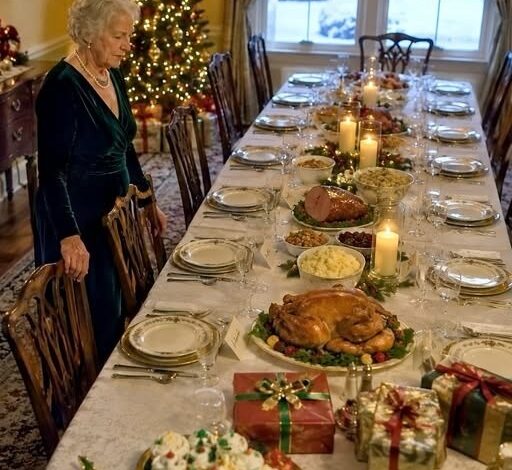
Fiona Left Me With Christmas Dinner for Seventeen
“Would you like me to make you a sandwich?”
I nearly smiled. It was such an ordinary offer, and for a few seconds I wanted to accept it without asking anything more. But I handed her a plate and let her make one for herself.
We sat together for a few minutes, discussing Emily’s work and a problem Fiona had been having with a neighbor. She told me a story about a delivery that had gone to the wrong house, and I laughed when she described the neighbor’s explanation.
Then she picked up her purse.
“Laura will probably want to talk again.”
“She can call me.”
Fiona left without taking the paper.
That evening, I went to Michael’s house. Anna was there when I arrived, and Michael was at the dining table with his phone beside him.
I had decided not to begin with the lake property. I wanted to hear what he would say about the accounts when I asked him directly.
“Michael, have you been discussing my investment accounts with Laura?”
He looked at me, then at Anna.
“Because Laura brought me a written plan, and Fiona confirmed that all three of you have been talking about what happens to my property and money.”
Michael turned his phone face down.
“We’ve been trying to get ahead of some practical questions.”
“Which practical questions?”
“The property needs maintenance. There are expenses. The accounts need to be organized.”
“They are organized.”
“Not necessarily for the future.”
Anna set her handbag beside her chair and joined the conversation.
“I don’t want anybody to feel caught in the middle. I think Michael and Laura were just trying to make sure there wouldn’t be confusion later.”
“Later when?”
“Well, when the property changes hands,” Michael said.
I looked at him.
“Whose hands?”
He moved the phone farther away.
“Mom, you know what we’re talking about.”
“I would like to hear you say it.”
Anna looked toward him, then back at me.
“Michael has been talking about how the property could be divided between the three children eventually. He thought it would be better if everybody understood what their responsibilities would be.”
Michael interrupted her.
“That’s not exactly what I said.”
“Then tell me what you said.”
He picked up his phone but didn’t turn it over.
“I said we should know what to expect. There’s nothing wrong with that.”
“Did you tell Laura that the accounts would be divided three ways?”
“I said that was probably how things would work.”
“Without asking me?”
He looked toward Anna.
She didn’t add anything.
I had spent months wondering why the children could find time to discuss the lake property but not make time to visit me. Now I had the answer, and it was worse than the explanation I had been trying to give them.
“Michael, you have been discussing an inheritance that I haven’t promised you.”
“Nobody said it was an inheritance.”
“What else would you call dividing my accounts after I’m gone?”
He didn’t answer immediately.
Then he said, “We’re your children. We thought we should be part of those decisions.”
“You wanted to be part of the decisions about what happens to my money. You weren’t part of the decisions about what happens in my ordinary life.”
Anna lowered her eyes.
Michael stood and said he didn’t want an argument.
“I didn’t come here to argue. I came to ask you a question, and you’ve answered it.”
On the way home, I decided I would not ask another child to explain what the others had already admitted.
The following morning, I met Mr. Cole at his office. I brought Laura’s list and the page Fiona had read, along with the folder containing the bank receipt from February.
He placed the documents beside his own file.
“Did your children approach you about the property again?”
“Laura brought me a proposed arrangement. Fiona admitted they had all discussed it. Michael confirmed they had been talking about dividing the accounts.”
Mr. Cole took off his reading glasses.
“Did you agree to any of those arrangements?”
“Did you sign anything they presented to you?”
He opened his folder and removed several pages of correspondence.
“I want to show you the distinction between what has already been completed and what is still awaiting final recording.”
He turned the first document toward me.
“The bank has received your verified instructions. The beneficiary changes have been accepted for processing, subject to the required verification period.”
“And the lake property?”
“The deed has been prepared and signed. The title review is complete, but the transfer is awaiting final recording.”
I read the second page carefully.
“So the children cannot stop it simply because they expected something different?”
“Not on the basis of the expectation you’ve described. You retained legal authority over the property and the accounts. Their private discussions do not create an ownership interest.”
He showed me the ownership records Richard had kept in his locked cabinet. Richard had recorded the original purchase, the subsequent expenses and the arrangements that established my authority.
“Your husband kept unusually complete records,” Mr. Cole said. “They make the ownership history very clear.”
I ran my finger down the list of documents.
“Richard always wanted the numbers to settle an argument.”
“These numbers settle the ownership question.”
I put the records back in their folder.
“Have Laura, Michael or Fiona been told any of this?”
“No. I haven’t communicated the completed instructions to them because you haven’t authorized me to do so.”
“Good. I don’t want them hearing about it until the proper time.”
Mr. Cole nodded and reached for another sheet.
“There is one matter we should discuss before the end of the month. The remaining recording requirements need to be completed, and I would prefer not to have any delay.”
“Then let’s complete them.”
He wrote a note on the front of the folder and began arranging the documents in order.
Before I left, I told him what Laura had brought and what Michael had admitted. Mr. Cole listened without interrupting, then asked whether I wanted the correspondence preserved with the legal records.
“Yes. All of it.”
He placed Laura’s list inside the folder with the other papers.
I looked down at the three names on the correspondence. Laura, Michael and Fiona had made plans for a future they believed was already settled. None of them had asked what I intended to do with it.
Mr. Cole closed the folder containing the completed transfer instructions, then turned another envelope toward me.
“There’s something else you may want to consider before your children approach you again,” he said. “It concerns your arrangements for the coming year.”
Laura reached across the desk and pulled the top page back toward herself.
“Mom, I don’t think you’ve understood what you’ve signed.”
“I understood every page.”
“Then you understand that this affects all three of us.”
I took the page from her and returned it to the folder. “It affects my property, Laura. That’s what it does.”
She had come that morning expecting me to reconsider. She had brought a copy of the proposed family authorization, the same document she’d wanted me to sign before I visited Mr. Cole. She placed it between us as if bringing it a second time made it more reasonable.
“Let’s be sensible about this,” she said. “Nobody is trying to take anything away from you. We’re trying to make things easier.”
“For whom?”
“For the family.”
I waited for her to give me a more specific answer, but she began explaining that the lake property needed attention, that the investment accounts would eventually have to be divided, and that making arrangements now would prevent disagreements later.
“Richard and I made arrangements,” I told her. “You just haven’t seen all of them.”
“That’s exactly the problem. You won’t let us help.”
Laura said it as though I had refused a kindness. I thought of the hospital form with my own signature beneath the emergency contact section, and I let her finish without reminding her.
She opened her handbag and took out another sheet.
“Michael agrees with me. Fiona does too. We’re all concerned.”
“Did either of them ask what I wanted?”
“They know what makes sense.”
I pressed my wedding ring against my thumb. “I thought we had an understanding, Laura. You would ask me before making decisions about my property.”
“We’re your children.”
“Yes. That’s why I expected you to ask.”
She pushed the paper toward me again. I didn’t sign it.
Instead, I told her that Mr. Cole would handle the legal work and that I would follow his advice. Her expression changed when I used his name.
“You’re paying a lawyer to do something your own children could handle?”
“I’m paying him to make sure my wishes are followed.”
Laura gathered her papers, but she left the proposed authorization on my desk.
“You’re making this much harder than it needs to be, Mom.”
I handed it back to her. “Then you won’t have to do it.”
She left without agreeing to anything, and I watched her carry away the document she’d expected me to sign.
By lunchtime, Michael had called twice. He came to the house that afternoon with a different concern.
He had been using my house keys when I needed groceries collected or a small repair arranged. He’d always described it as a convenience, and I’d been grateful not to have to ask a neighbor.
“Mom, I heard about Laura’s visit.”
“That was quick.”
“She was upset. I think you should give everybody a chance to talk this through.”
I asked him what he thought needed talking through.
He put his phone facedown on the hallway table.
“Well, if you’re going to change the arrangements, you can’t expect us to keep doing all the little things we’ve been doing.”
“What little things?”
“Helping with the property. Checking on the house. Taking care of the lake place when something comes up.”
“I haven’t asked you to take care of the lake place in months.”
“That’s not the point.”
He explained that if I insisted on making decisions without consulting the family, the family couldn’t be expected to keep taking responsibility for matters connected to my home.
I looked at the keys in his hand.
“Are you telling me you won’t help me anymore?”
“I’m saying there have to be boundaries.”
He sounded like someone repeating a sentence he’d practiced before arriving.
I remembered when Michael was younger and used to call me whenever he couldn’t find something in his own house. Once he’d driven across town because he thought he’d lost his wallet, only to discover it inside the refrigerator beside the milk.
I had laughed about that for years, and he laughed too when I reminded him.
“That was a ridiculous afternoon,” he said.
“It was. You were convinced somebody had stolen your driver’s license.”
For a few seconds, we were simply mother and son again. Then he held out his hand for the keys.
I took them from him instead.
“These belong to my house, Michael.”
“Fine. But don’t expect me to come running when you need something.”
“I won’t.”
I opened the small drawer beside the telephone and placed the keys inside. Michael watched me do it, then picked up his phone and left.
I had not expected him to offer so little, but I had also stopped pretending that an offer was the same as help.
That evening Fiona came to see me. She didn’t bring groceries or a schedule of visits. She came with the news that Laura was upset and Michael was considering stepping away from helping with the property.
“Mom, you know I love you,” she began.
“I hope so, Fiona.”
“Then why are you doing this without talking to us?”
“I have talked to you.”
“You never asked what we thought about the money being redirected.”
I asked her whether she meant the lake property or the investment accounts.
“Both. These are family assets.”
“They’re my assets.”
“That’s a technical distinction.”
“No, Fiona. It’s a legal distinction.”
She rubbed the edge of her thumbnail and looked down at the paper she’d brought. It was a handwritten list of concerns, with the lake property at the top and the accounts beneath it.
“I just think we should have been consulted before you made such a big decision.”
I sat across from her.
“You had years to consult me about your own lives. You could have asked me to dinner. You could have invited me to Michael’s birthday. You could have come with me when I needed help with an appointment.”
“That’s not fair.”
“Which part?”
She put the list down.
“We all have responsibilities, Mom. You can’t expect us to arrange our lives around every request.”
“I didn’t ask you to arrange your lives around me.”
“Then what did you want?”
“I wanted to be included without having to offer something in return.”
Fiona looked toward the list again.
“Nobody thinks that way.”
“Then why is the first page of your list about the lake property?”
She turned the paper over, but the writing was still visible through it.
“I don’t want us to become enemies over money.”
“Neither do I.”
“Then change the instructions.”
I didn’t answer immediately. I reached for the glass of water she’d poured herself and moved it away from the papers before it could spill.
“Fiona, I’m not changing my instructions.”
She stood and collected her list. At the doorway she said she’d hoped I would be more reasonable.
I told her I hoped she would visit again when she wanted to see me rather than discuss my accounts.
She didn’t promise to do that.
The following morning, Laura accompanied me to Mr. Cole’s office. She had requested the meeting, saying she wanted a proper explanation of what was happening. I agreed because I wanted the explanation given in front of her, not passed between siblings through telephone calls.
Mr. Cole invited us to sit and asked Laura what specifically she wished to challenge.
“My mother is making financial decisions without consulting her children,” Laura said. “She’s changing arrangements that Richard and she intended for the family.”
Mr. Cole removed his reading glasses.
“Do you have a document showing that your mother agreed to transfer ownership or control of these assets to you or your siblings?”
Laura looked at him.
“We understood that the lake property would eventually belong to the children.”
“An understanding is not an ownership document.”
He opened the folder and placed the property ownership record in front of her.
“This identifies your mother as the person with legal authority over the property. Your father’s records also establish the financial arrangements made during their marriage.”
Laura read the page without touching it.
“What about the investment accounts?”
“Your mother retains authority over those accounts. The beneficiary arrangements can be changed through the proper verified instructions.”
“Can she really do that without our signatures?”
Laura turned toward me.
“Mom, surely you see why this is upsetting.”
“I see that you expected something I never promised you.”
Mr. Cole placed the next document beside the ownership record. He explained that the bank had received my signed instructions and that the required verification was underway. The property transfer was being handled separately, with the deed subject to title review and recording.
Laura looked at the date on the bank receipt.
“So you’ve already started?”
“Yes,” I said.
“And there’s nothing we can do?”
Mr. Cole answered before I could.
“You may express your disagreement, but your disagreement does not give you authority over your mother’s property or accounts.”
Laura sat back.
I had expected her to argue about the amounts, perhaps even to ask whether I had considered keeping the lake property in the family. Instead, she asked whether the arrangements could be delayed.
Mr. Cole explained that he would follow the instructions I had signed, not a request from one of my children.
When we stood to leave, Laura took me aside.
“You’re going to need us eventually, Mom.”
“I know I may need help.”
“Then why make it impossible for us to help you?”
“I haven’t made it impossible. I’ve stopped making it a condition that you get what you expect.”
She walked ahead of me toward the door.
Before leaving, I returned to Mr. Cole’s desk and asked him what the next legal steps would require. He began writing a short list, including the remaining property work and the arrangements I would need to make for my own housing.
“Are you considering leaving the house?” he asked.
I looked at the list.
“I don’t think I can keep living there as though somebody will eventually come to help me.”
He didn’t tell me what I ought to do. He asked whether I wanted him to prepare the necessary documents and keep the arrangements between us until I was ready.
He finished writing and waited while I took the house keys from my handbag. I placed them on his conference table.
“Please arrange the next legal steps without involving my children.”
Mr. Cole looked at the keys, then at me.
“All right. But before I proceed, I need to ask one practical question. Are you prepared to give up the house itself, not simply stop relying on your children to help maintain it?”
I looked at the keys I’d carried there.
“I am.”
He reached for a clean sheet of paper, and I gave him the first instruction.
“I can arrange that,” Mr. Cole said, drawing the folder toward him. “But before I do, I need your final instructions on the property and the investment accounts. Once those are completed, I don’t want you having to revisit the same decisions because someone in your family objects.”
“I don’t want to revisit them either,” I said. “I’ve had enough time to think.”
He opened the folder and took out the first document. The lake property was listed with its current value of $214,000, along with the ownership records Richard had kept in his locked cabinet.
“Your husband was unusually thorough,” Mr. Cole said. “His records made it possible to establish the ownership without relying on what your children believe the arrangements were.”
“Richard always wanted the numbers to be right.”
“I’ve noticed that.”
He showed me the transfer instructions, then the pages relating to the investment accounts. Their total value was $286,400, and every change had to follow the instructions I had approved. The bank had already completed its initial verification, but there were still signatures required before the arrangements could become final.
“Are you certain about the lake property?” he asked.
“And the investment beneficiaries?”
“Yes. I want the church kitchen to receive its allocation, the Richard scholarship to receive its portion, and the grandchildren’s share placed in a conditional trust. I also want enough money retained for my housing, medical expenses and independent care.”
He looked at me over the papers.
“That last instruction is particularly important. You shouldn’t leave yourself dependent on anyone else.”
He placed the final instruction sheet in front of me. I read every paragraph, including the provisions about the property recording and the account changes, before signing my name.
Mr. Cole checked each signature against the earlier documents.
“That completes your instructions,” he said. “The remaining work is the formal processing and recording.”
“Then let’s finish it.”
He put the signed papers into a separate folder and wrote the date across the front. I watched him close it before I picked up my handbag.
At the bank that afternoon, Mr. Cole sat beside me while a representative reviewed the revised beneficiary instructions. She compared the account information with the verified documents and asked me to confirm that the changes reflected my wishes.
“Yes,” I said. “They do.”
She turned to the section concerning the money I would retain.
“I want to make sure you understand that these arrangements leave funds available for your own needs,” she said.
“I understand. I receive $2,140 each month in retirement income, but I don’t intend to rely on that alone for every expense that might come along.”
Mr. Cole nodded toward the figures.
“We’ve accounted for housing, medical costs and independent care. Those funds aren’t being committed to the charitable allocations or the trust.”
The representative pointed to the beneficiary confirmation.
“Once the verification is complete, the revised instructions will govern the accounts. The processing period is two business days.”
“That’s fine,” I said.
She gave me a receipt showing that the instructions had been accepted for processing. Mr. Cole checked the reference number before handing it to me.
“Keep that with your copy of the signed instructions,” he said.
I placed both documents in my handbag.
The representative offered me a final copy to review, and I checked the names before leaving the desk. None of my children’s names appeared where I had once assumed they would.
I didn’t ask the bank to explain that absence. I had supplied the instructions, and they had followed them.
In March, I returned to the family home to find Fiona waiting for me at the dining room table. She had brought a notebook and told me she wanted to discuss what the family should do about the house.
“Mom, we need to talk about where you’re going to live,” she said.
I put my handbag beside my chair.
“I’m making arrangements.”
“Are you staying here?”
“I haven’t decided when I’ll tell everyone the details.”
She looked at me for a moment.
“Why wouldn’t you tell us? We could help you find somewhere suitable.”
“I appreciate the offer, Fiona.”
“You know I love you, Mom. I don’t want you making a decision you’ll regret.”
“Then you should understand why I need to make this decision carefully.”
She opened her notebook, although she didn’t write anything.
“Laura thought we could arrange a schedule. Michael could help with the property, and I could come by regularly. We don’t have to make a big change.”
I looked at her notebook.
“When was the last time you came here simply to spend an afternoon with me?”
Fiona didn’t answer immediately. She turned the notebook toward herself and closed it.
“That’s not fair, Mom.”
“I didn’t say it was. I’m telling you what I need now.”
“Are you selling this house?”
“I’m considering my arrangements. When I’ve settled them, I’ll tell the children what they need to know.”
She leaned back.
“You’re making us sound as though we haven’t tried.”
“I won’t argue with you about what you think you’ve tried, Fiona. I have to decide what works for me.”
She asked whether she could at least have the address when I moved.
“I’ll let you know when everything is settled.”
“Promise?”
“I’ll tell you when I’m ready.”
She left without taking the notebook. I put it beside the papers Mr. Cole had given me, then returned it to her when she came back for it the following day.
I didn’t give her an address.
By April, the lease for the small apartment in a neighboring town was ready. Mr. Cole met me there in the morning with the documents and a set of keys.
“The lease is in your name,” he said. “I’ve checked the terms, including the provisions for renewal.”
“Good. I don’t want to have to move again next month.”
He smiled.
“I believe this arrangement will give you the stability you’re looking for.”
He handed me the lease, and I read the sections concerning the rent, the length of the agreement and the responsibilities of the tenant. The monthly cost was within the amount we had set aside for my housing.
“Will the money I retained cover this comfortably?” I asked.
“Yes. Your personal reserve remains separate from the redirected funds. You won’t have to ask your children for assistance to meet the lease.”
I signed the final page.
Mr. Cole placed the keys beside the document.
“There’s one other matter,” he said. “I’ve prepared three personal letters, one for each of your children. They’re sealed and will be delivered through my office when the time comes.”
“Have you included anything about the financial arrangements?”
“No. The letters are personal. The legal instructions are separate.”
“Good. I want them to understand that those are two different matters.”
He put the sealed envelopes back into his briefcase.
“Would you like me to deliver them now?”
“No. Not yet.”
He accepted that without asking me to explain.
I picked up the keys and checked the lease one last time. My new address was written at the top of the first page. Laura, Michael and Fiona didn’t have it, and I wasn’t going to send it to them simply because they might want to know where I had gone.
Mr. Cole helped me confirm that the apartment arrangements were complete, then handed me my copy of the lease.
“Is there anything else you need me to take care of today?” he asked.
“No. I think we’ve covered the important parts.”
He gathered his briefcase and walked toward the door. Before leaving, he turned back to me.
“Your children may have questions when they discover you’ve moved.”
“They can ask you about the legal arrangements.”
“And the address?”
“I’ll decide when they need to have it.”
He nodded and stepped into the hallway.
“For the first time, I am making a home that does not depend on anyone coming through the door,” I said.
Mr. Cole gave me a small smile.
“Then I hope you enjoy living in it.”
I placed two mugs on the apartment counter, one for myself and one for anyone I chose to invite. Mr. Cole stepped outside, and I closed the door behind him.
Before I had finished putting away my copy of the lease, my telephone rang.
Laura’s name appeared on the screen. I let it ring while I looked at the signed document, then picked it up.
“Mom, Michael says you haven’t been answering questions about the house,” she said. “We need to settle the arrangements before another month goes by.”
I looked at the new keys in my hand.
“Laura, the arrangements have been made.”
“What arrangements?”
“The ones I needed to make.”
“Are you still at home?”
I looked toward the door Mr. Cole had just closed.
“No,” I said. “I’m not.”
Laura arrived first, carrying a folder of her own.
“I want to know where Mom is,” she told Mr. Cole. “And I want to know why you won’t give us her address.”
Mr. Cole indicated the three chairs opposite him. “Your mother asked me to meet with all three of you. She also asked me not to disclose her address.”
“She’s our mother,” Michael said as he sat down. “We have a right to know what’s going on.”
“You have a right to receive the information she authorized me to provide.”
Fiona came in last and took the remaining chair. “You know I love her, Mr. Cole. Has something happened to her?”
“Your mother is safe. She has made arrangements for her housing and personal care.”
Laura opened her folder. “Then why hasn’t she contacted us? We’ve been trying to sort out the lake property for months.”
Mr. Cole placed three identical folders on the conference table.
“Before we discuss the property, I want you to understand that your mother’s financial instructions have changed. These folders contain the documents relevant to each of you.”
Michael opened his immediately. “Changed how?”
“Your mother has signed instructions directing the assets according to her own wishes. The necessary reviews and processing have been completed or are being finalized under those instructions.”
Laura looked at the first page, then at Mr. Cole.
“She can’t simply make a decision like this without talking to her children.”
“She can make decisions about assets she legally owns.”
“That’s not what we understood,” Michael said.
Mr. Cole folded his hands over his copy of the documents. “I believe that difference is why we’re having this meeting.”
Laura turned to the second page. Her expression changed when she saw the reference to the lake property.
“Are you telling us the lake house is no longer going to the family?”
“I’m telling you that your mother has directed its transfer according to her signed instructions.”
Fiona looked from Laura to Michael. “I thought we were going to discuss it together.”
“Your mother has already made her decision,” Mr. Cole replied.
Laura pushed her folder away. “Then perhaps we should hear from her directly.”
“She has chosen to communicate through me today.”
Mr. Cole took a separate envelope from his briefcase and placed it beside the folders.
“There is another matter she asked me to address before you leave.”
Laura looked at the envelope. “What matter?”
“Why she made these decisions.”
By late morning, Laura had moved her folder closer again, and Mr. Cole had taken a photograph from the envelope.
“This was taken on Christmas morning,” he said.
Laura looked down.
The photograph showed the table I had prepared for seventeen people. The place cards were still standing. The gifts were still arranged where I had intended each person to sit.
“Where did you get that?” Michael asked.
“Your mother supplied it.”
“She took a picture of the table?”
Fiona leaned toward the photograph. “I remember that Christmas.”
Laura picked it up. “This doesn’t prove anybody meant to hurt her. Plans changed.”
Mr. Cole looked at her. “Would you read the letter in this folder?”
Laura glanced at him. “Why me?”
“Because it concerns the three of you, and your mother requested that one of her children read it aloud.”
Laura unfolded the letter.
“To Laura, Michael and Fiona,” she began. “I invited seventeen people to Christmas dinner. Every one of you accepted. I prepared the meal, wrote the place cards and waited for you to come.”
She stopped.
“Keep reading,” Michael said.
Laura continued. “Fiona had told me she would be there. When she did not come, I tried to reach her. Laura sent a message that the plans had changed. Michael told me everybody was busy. I was left to decide what to do with the evening I had prepared for all of you.”
Fiona lowered her eyes.
Laura folded the bottom of the page back.
“There’s more,” Mr. Cole said.
“I can see that.”
“Your mother asked that you read the whole letter.”
Laura continued, more slowly this time.
“I am not asking you to agree with every decision I have made. I am asking you to look at the record before you tell yourselves that I misunderstood.”
She placed the letter down.
Michael pointed at the photograph. “We had other commitments. That doesn’t mean we stopped caring about her.”
“Then perhaps you can explain why none of you attended,” Mr. Cole said.
“We’ve already discussed that,” Laura replied.
“No,” Mr. Cole said. “You have discussed your reasons. Your mother has provided the record of what happened.”
Fiona picked up one of the place cards.
“She wrote all our names.”
“Yes,” Mr. Cole said. “She did.”
For several seconds, nobody spoke. Then Laura returned to her folder and turned to the documents behind the letter.
“Is this the only photograph she brought?”
Mr. Cole looked at her.
At noon, Michael asked Anna to come to the office.
She arrived carrying her handbag with both hands and sat beside him. Mr. Cole placed another photograph in front of them.
Michael recognized the porch before he looked closely at the person standing there.
“That’s the birthday cake,” he said.
The photograph showed me holding it outside his front door.
Anna looked at him. “It’s the picture I sent your mother.”
Michael turned toward her. “Why would you send that?”
“Because I thought she ought to have the photograph. I didn’t think it would become part of a meeting like this.”
Mr. Cole placed a printed record beside the photograph.
“This image came from the family doorbell record. It shows the visit and the exchange at the entrance.”
Michael pushed his chair back slightly.
“I wasn’t refusing to see her. We had guests.”
Anna spoke before Mr. Cole could answer.
“You told her the gathering was already underway. You didn’t invite her inside.”
Michael looked at Anna. “You handed the cake back.”
“After you went inside and made it clear there wasn’t going to be room for her.”
“I thought you were going to explain it to her.”
“I gave her the photograph because I didn’t want her to think she’d imagined what happened.”
Michael looked down at the picture again.
“She brought that cake every year,” he said.
Mr. Cole did not interrupt.
Anna placed the doorbell record beside the photograph. “I don’t want anybody to feel caught in the middle, but I won’t tell her it was a misunderstanding.”
Michael closed the folder in front of him.
“Can we leave this out of the financial discussion?”
“It isn’t part of the financial calculation,” Mr. Cole said. “Your mother asked that it be shown because it was part of her experience.”
Michael did not pick up the photograph again.
Early that afternoon, Laura, Michael and Fiona returned to the conference table. Mr. Cole had arranged the final legal documents in front of him.
Laura spoke first.
“Let’s be sensible about this. We need to know exactly where the money is going.”
“I’ll explain each instruction, and you may take copies of the documents that concern you.”
He began with the lake property.
“Your mother retained legal control of the property. The transfer instructions were signed in February, and the deed has gone through the required title review and recording process.”
“Who owns it now?” Michael asked.
“The transfer has been completed according to her instructions. You have no ownership interest in it.”
Laura looked at the document. “And the investment accounts?”
“The total value addressed by the instructions was $286,400. Your mother directed the beneficiary arrangements to be changed after the required verification.”
“That money was supposed to stay in the family,” Laura said.
“That was your expectation. It was not a legal agreement.”
Fiona looked at the pages in front of her. “What did she do with it?”
Mr. Cole turned to the distribution instructions.
“A portion was allocated to the church kitchen, where your mother has chosen to volunteer. Another portion supports the Richard scholarship, which assists students who have lost a parent.”
Michael read the next page.
“And the rest?”
“Your mother retained sufficient funds for housing, medical expenses and independent care. The remaining portion was placed in a conditional trust for her grandchildren.”
Laura looked up. “Emily is included?”
“Emily and the other grandchildren are covered under the trust provisions.”
“Can we challenge that?”
“You may seek independent legal advice. However, your mother had the authority to make these decisions, and the documents were properly executed. You cannot reverse them simply because you disagree.”
Fiona looked at the trust provision again.
“Did she leave herself enough?”
“Yes. Her monthly retirement income is $2,140, and she has retained additional funds for her needs.”
Laura turned another page.
“She never told us she was going to do this.”
“She was not required to obtain your approval.”
Michael looked at the church kitchen allocation.
“She actually gave money to the place where she volunteers?”
“Because she wanted to support work she considers worthwhile.”
Laura pushed her copy toward him. “This is unbelievable.”
Mr. Cole returned the pages to their proper order.
“Your mother anticipated that you might have questions. She also anticipated that you might want to contact her immediately.”
Fiona looked up. “Does she not want us to call?”
“She has asked that you receive three individual letters first. She wants each of you to read what she wrote before deciding what to do.”
Mr. Cole opened a drawer and took out three sealed envelopes. Each bore one of their names.
Then he placed a fourth envelope beside them. It was larger, and the handwriting on its front belonged to Richard.
Michael leaned forward.
“What’s that one?”
“Your father’s handwriting,” Mr. Cole said. “Your mother asked me to include it with the other documents.”
Laura reached toward the envelope, but Mr. Cole placed his hand beside it.
“That one is not a financial instruction,” he said. “It’s something your mother wanted you to see after you had read the letters.”
Fiona looked at the three envelopes.
“Are we supposed to open them here?”
Mr. Cole moved the individual envelopes toward the children.
“Your mother has asked me to give each of you your own letter. She has also asked that you read them before making any further demands about where she lives.”
Laura picked up hers, but Michael kept looking at the larger envelope bearing Richard’s handwriting.
“What’s inside?” he asked.
Mr. Cole left his hand beside it.
“Your mother wanted that opened after the three of you had read what she wrote.”
Fiona took her envelope.
“Then I suppose we’d better start with these.”
Laura turned hers over and began to open the seal.
Laura reached for the envelope with her name on it before James had finished explaining what he expected from them.
“These are personal letters from your mother,” James told her. “She has asked that each of you read your own letter and respond in writing. She isn’t accepting visits or telephone demands at this time.”
Laura pulled the envelope closer. “We’re her children. Surely she doesn’t need a lawyer to arrange a conversation with us.”
“She has arranged the conversation herself. This is how she has chosen to have it.”
Michael picked up his envelope but didn’t open it. He asked whether I had given James instructions about where I was living, and James told him that my address was private.
Fiona held her envelope without turning it over. “Does she really not want to see us?”
“Your mother has asked for some space,” James said. “That request needs to be respected.”
According to James, Laura objected to the letters being delivered separately. She wanted all three opened together so nobody would misunderstand what I had written. James declined, explaining that each letter concerned a different relationship and that I had specifically requested individual responses.
Michael asked whether the changes to the accounts were permanent.
“Those arrangements are not the subject of these letters,” James replied.
That was apparently enough for Michael to put his envelope inside his jacket. Laura left hers on the conference table for several minutes before finally taking it. Fiona was the last to leave.
The following afternoon, she returned without Laura or Michael.
James told me later that she sat across from him and asked one question before he had finished offering her a chair.
“Is my mother safe?”
“Yes. She has independent housing and sufficient financial provision for her needs.”
“Is she living alone?”
“She has made arrangements that suit her.”
Fiona looked down at the envelope she had brought back with her.
“Can you at least tell her I asked?”
“I can tell her you came. I cannot promise what she will decide to do with that information.”
She nodded and asked whether I had received any of the children’s letters. James explained that I had requested written responses, not promises delivered through him.
Fiona took her envelope home again. Before leaving, she asked whether she could write something that wasn’t about the money.
James told her she could write anything she wanted, provided she understood that I would decide whether to answer.
Two weeks later, James brought three envelopes to my apartment. He placed them on the kitchen table and told me each had arrived independently.
“Laura sent hers first,” he said. “Michael’s arrived the following day. Fiona’s came after that.”
I looked at the handwriting on the envelopes. Laura’s was neat and familiar. Michael had written his name across the front in large letters. Fiona’s handwriting was smaller, with the last letter of her name running slightly below the line.
“Did they ask you whether I had read them?”
“All three did.”
“And what did you tell them?”
“That I would deliver them and that your response was entirely your decision.”
I moved the three envelopes apart so I could read the names without picking any of them up.
“Did Fiona come back?”
“Yes. She wanted to know whether you were safe. She didn’t ask about the property or the accounts.”
“That was different from her first visit.”
“It was,” James said. “But I wouldn’t make more of it than it was.”
He was right, and I appreciated that he hadn’t tried to sell me a happy ending.
I opened Laura’s letter first.
She wrote that she had always tried to keep the family organized and that some of her decisions had been made under pressure. She said she had never intended to make me feel excluded. She also wrote that I had misunderstood several conversations about the lake property.
There was no apology for the Christmas dinner, the graduation letter or the decisions she had made about Emily.
Near the bottom, she wrote, “I hope you can understand that I was trying to protect what Richard wanted for all of us.”
I put the letter back in its envelope.
Michael’s was shorter. He explained that his work and family responsibilities had made it difficult to keep up with everyone. He said Laura had often handled arrangements and that he had trusted her judgment. He described the birthday gathering as an unfortunate disagreement that had grown larger than it needed to be.
He did not mention the photograph.
“Would you like me to take these with me?” James asked.
“Not yet. I haven’t finished.”
I picked up Fiona’s envelope.
Her letter began with an apology for Christmas, but she didn’t stop there. She wrote about something I had almost forgotten, a small family habit from when she was young.
She remembered how Richard used to cut her toast into triangles because she insisted that square pieces tasted different. She remembered him counting out school-trip money at the kitchen table and asking her to check the amount before putting it in her backpack.
Then she wrote about the angel costume I had helped her make for a school Christmas program. One of the wings had kept slipping, and she had spent the entire afternoon trying to hold it in place.
“I remember you fixing it for me,” she wrote. “You didn’t get to sit down until I was ready to leave.”
I stopped reading and put the letter down.
James didn’t reach for it. He waited while I read the next page.
Fiona wrote that she had spent years thinking about what would eventually happen to the lake property and the money Richard had left behind. She had treated those arrangements as though they were already settled. When Christmas came, she had accepted the invitation because she wanted to keep things pleasant, but she hadn’t considered what it meant to leave me waiting.
Then came the sentence that made me return to the beginning of the paragraph.
“I remembered the inheritance more clearly than I remembered my mother.”
I read it again.
“She wrote that herself?” I asked.
“Yes,” James said.
“She didn’t blame Laura for that sentence?”
I folded the page along its original crease.
For years, I had wanted Fiona to understand that I wasn’t asking her to spend every Sunday with me or rearrange her life around mine. I had wanted her to remember that I was a person she could visit without needing a reason.
Now she had written it down, and I couldn’t pretend the words repaired what had come before.
“Do you think she means it?” I asked.
James considered his answer.
“I think she meant it when she wrote it. What she does afterward will tell you more.”
I put Fiona’s letter beside the other two.
“She may be sorry today,” I said. “That doesn’t tell me what she’ll do next month.”
“No, it doesn’t.”
I asked James to prepare a short reply. I wanted Fiona to know I had received her letter and read every page. I did not want to invite her over, promise forgiveness or suggest that the financial arrangements might be reconsidered.
James wrote while I spoke, then read the words back to me.
“I can forgive a beginning, Fiona. I cannot pretend it is already a relationship.”
I asked him to include that I would be willing to hear from her again, but that I would not be arranging visits on her behalf.
“Are you sure you want to send it that way?” he asked.
“Yes. I don’t want another promise that I have to organize into an actual visit.”
He placed the reply in a separate envelope.
Before he left, I put Fiona’s letter beneath Richard’s photograph. I kept Laura’s and Michael’s letters together, but I didn’t put them away.
There was one practical matter I still needed to decide. If Fiona wrote again, I wanted her to have a way of reaching me that didn’t require James to carry every message.
I picked up my telephone, then set it facedown beside the letters.
I wasn’t ready to call her. I wasn’t ready to tell her she could come whenever she pleased.
James took the reply with him, and I kept the three original letters.
The following morning, he telephoned with one more piece of information.
“Fiona has asked whether she can do something useful rather than simply write again,” he told me. “She mentioned the church kitchen.”
I looked at Richard’s photograph.
“What did you tell her?”
“That you would have to decide whether you wanted her help.”
I didn’t give him an answer immediately. There was no reason to turn one question into another promise.
“Tell her I’ll think about it,” I said.
Then I put the telephone facedown again, with Fiona’s letter still beneath Richard’s photograph.
Fiona looked toward the serving trays and waited for me to tell her where they belonged. She had arrived twelve minutes before the church kitchen’s volunteer shift began, carrying a small purse and wearing the expression of someone who wasn’t certain whether she had been invited or merely permitted to come.
“Where should I put these, Mom?”
“On the lower shelf, please. Then you can help me portion the vegetables.”
She nodded and carried the trays where I’d directed her. I didn’t offer her a hug, and she didn’t ask for one.
It was June, and this was the first time Fiona had come to work beside me since sending her letter. I had read every word of it, including the parts that had taken me two evenings to finish. Her admission had mattered, but it hadn’t changed the years that came before it.
A woman volunteering beside us handed Fiona a stack of containers.
“Are you new here?”
Fiona glanced at me before answering.
“Not exactly. I’m learning where everything goes.”
“Well, we can always use another pair of hands,” the woman said.
Fiona filled the containers while I checked the serving list. She didn’t ask whether James Cole had delivered any new documents or whether the grandchildren’s trust had been changed. She didn’t mention the lake property.
When the first group of people came through for their meals, Fiona carried the containers to the serving counter and asked which ones needed lids.
“Those six,” I told her. “The others are for people eating here.”
She followed the instructions without making a production of it.
At the end of the shift, she came over while I was checking the remaining portions.
“Can I come again next Tuesday?”
“If you want to volunteer, the schedule is posted by the kitchen door.”
“I do want to.”
“Then put your name down.”
She wrote it herself. I didn’t promise to save her a place beside me, but I didn’t discourage her either.
Two weeks later, I saw her name still on the schedule. That was the first small thing I could point to that didn’t depend on what she had written in a letter.
In July, Emily came to my apartment building’s community room carrying a folded piece of paper. She had called me the previous evening and asked whether she could visit, without mentioning her mother or asking whether Laura knew.
“I brought you something,” she said, handing me the paper.
It was a handwritten note. She had written that she wanted to know me better and didn’t want every conversation between us to become about what other people had decided.
I read it twice before folding it along the crease she’d made.
“Would you like some tea?”
“Yes. I was hoping you’d ask.”
We sat together, and Emily told me about her work and a friend who had recently moved away. I asked questions, and she answered without looking toward a telephone or checking whether she was expected somewhere else.
After a few minutes, she asked, “Did you know I thought I was going to see you at graduation?”
“I knew you hadn’t been told I wasn’t invited.”
Emily lowered her cup.
“Mom never said you weren’t allowed to come. She just said the arrangements were already made.”
“I didn’t want you caught between us.”
“I know. But I wish someone had told me you were coming with a gift.”
I reached into my handbag and took out the copy of the graduation letter I’d kept.
“I wrote this for you. I wanted you to have it.”
Emily read the first few lines, then looked up.
“Grandma, I didn’t know you had written all this.”
She folded the corner of the envelope before answering.
“Can I keep it?”
“Of course. It was always meant for you.”
She slipped it into her handbag rather than leaving it on the table. Then she asked whether we could have tea again the following month.
“Call me when you’d like to come,” I told her.
“I will. And I don’t need Mom to arrange it.”
I didn’t criticize Laura or ask Emily to explain what her mother had said about me. I wanted our conversations to belong to the two of us, not become another family meeting with an invisible list of grievances.
Before leaving, Emily asked whether I still had Richard’s old recipe cards.
“I have them,” I said.
“Could I see them sometime?”
“Certainly. Some of his measurements are written in the margins.”
Emily smiled.
“That sounds like something Grandpa would do.”
After she left, I placed her note in the drawer where I kept personal correspondence. I hadn’t gained back the years we had missed, but I had a date for another visit, and this time it had come from Emily herself.
By September, Fiona had kept her name on the church kitchen schedule. One morning, the other volunteers finished their work and began leaving while Fiona was still sorting the remaining serving dishes.
“You don’t have to stay for all of that,” I told her.
“I know. I’ll finish these.”
“You’ve already done your shift.”
“I can manage a few more.”
She took the remaining dishes to the washing area and began stacking them for cleaning. I continued checking the food containers, and we worked without discussing her letter or the family meeting at Mr. Cole’s office.
When she finished, she came to me holding the last clean tray.
“Where does this one go?”
“On the shelf with the others.”
She put it away and returned to the counter.
“Are you coming next week?” she asked.
“If my name is on the schedule.”
“I’ll check before I leave.”
She didn’t ask whether I would be there because she wanted to see me. She asked about the schedule, and I appreciated that she had finally begun making arrangements that involved an actual day and an actual commitment.
As we were leaving, she mentioned that she’d told a friend she was volunteering at the church.
“What did your friend say?”
“She asked whether I was doing it because of you.”
“I told her I started because of you, but I stayed because the work needed doing.”
I looked at the remaining list of volunteers.
“That’s a reasonable answer.”
She smiled, but I didn’t add anything to it.
There were still weeks when she didn’t come. I didn’t telephone to ask why, and I didn’t arrange my own commitments around the possibility that she might appear. When she did come, I gave her work to do, and she did it.
That arrangement suited me better than another promise about regular visits.
In November, James Cole joined Fiona and me in the community room to review the arrangements for Christmas. I had asked him to attend because I wanted the gathering planned clearly, without anyone confusing an invitation with a financial discussion.
Fiona had brought a notebook.
“Have you decided how many people are coming?” she asked.
“I’m still waiting for two confirmations.”
“Would you like me to help with the arrangements?”
“You can help with the serving schedule.”
She opened her notebook.
“All right. How many volunteers do you need?”
“Two, besides you, if they’re available.”
James looked over the list I’d brought.
“Have you considered whether you have enough room for everyone you’ve invited?”
“I have. The community room has already been reserved.”
He nodded and returned the list to me.
Fiona looked at the page.
“Are you inviting Laura and Michael?”
“I haven’t received an answer from either of them.”
“Would you like me to ask them?”
“No. They’re able to contact me if they wish to attend.”
Fiona closed her notebook.
“I don’t want you to think I’m trying to arrange anything with them.”
“I’m not asking you to arrange anything with them.”
James waited until we had finished discussing the practical details before speaking.
“Have you decided what conditions you want attached to Fiona’s invitation?”
“She can attend if she continues showing up without conditions. I don’t want money, the property or the trust brought into the gathering.”
Fiona looked down at her notebook.
“I’d like you to understand something else,” I told her. “You do not have to earn a place here with money. You have to be here.”
“I don’t mean that you have to be here every day. I mean that when you make a commitment, I need to be able to count on it.”
Fiona nodded.
“I can do that.”
James asked whether she had any questions about the arrangements.
“No,” she said. “I don’t need to know anything about the accounts.”
He closed his folder.
“Then I believe we’ve settled the practical matters.”
After James left, Fiona stayed to help me put the papers away.
“Can I ask you something about Christmas?” she said.
“Go ahead.”
“Would you like me to bring anything?”
“You can help with the serving. We’ll decide about food closer to the date.”
She wrote that down.
I had taken the green velvet dress from its storage box earlier that month and arranged to have it ready for Christmas. I wasn’t keeping it for the old family gathering. I simply wanted to wear something I had always liked, without wondering whether anyone would notice.
Fiona saw the garment bag when she helped me move the papers.
“Is that the dress you’re wearing?”
“It’s pretty, Mom.”
“Thank you.”
She didn’t ask whether Laura would be there or whether Michael had changed his mind. Instead, she picked up the list of serving supplies and asked whether I wanted her to check what the church kitchen could provide.
“That would help,” I said.
She took the list with her.
A few days later, I received a message from Emily confirming that she would come for another visit. She also asked whether I might bring Richard’s recipe cards when we met.
I wrote back that I would.
By the time November ended, Fiona had put her name on the Christmas volunteer schedule, Emily had arranged another visit, and I had stopped leaving my calendar open in case one of my children decided to make room for me.
I still wanted my children in my life. I simply wasn’t willing to make promises on their behalf anymore.
In the first week of December, Fiona came to the church kitchen and asked whether I had received the volunteer schedule for the Christmas week.
“I have,” I said.
“Good. I put my name down for the morning shift.”
She picked up the serving tray she’d been assigned to prepare and waited while I checked the remaining list.
Then she placed a clean serving tray on the counter and waited for me to tell her what needed doing next.
“I’d like you to put the bread and the butter at the far end,” I told Fiona. “And leave room for the pie plates. People always bring more than they think they will.”
Fiona moved the serving dishes where I pointed. “Should I put the extra napkins beside the cups?”
“Yes, that would help.”
She didn’t ask whether I had changed my mind about Christmas, whether the trust was still conditional, or whether she might someday receive anything from the lake property. She simply picked up the napkins and divided them between the two ends of the table.
I had given her a place at the table that afternoon, but I hadn’t told her it was a permanent place in my life. There was a difference, and I needed her to understand it.
“Mom, where would you like me to sit?” she asked.
“Over there, beside Emily. You’ll be close enough to help if we need another serving spoon.”
Fiona nodded and put her handbag beneath the chair. She had come to help, not to inspect the arrangements. That was a small thing, but it was the first Christmas in years when I hadn’t had to wonder whether her presence came with a request attached.
“Are you sure you don’t want me to do more?” she asked.
“You can help Emily when she gets here. She’s bringing something for the table.”
Fiona smiled. “I haven’t seen her since Thanksgiving.”
“Then you’ll have something to talk about.”
She laughed at that, and I laughed too. It wasn’t a grand reconciliation. It was two women finding a sensible answer to where the serving dishes belonged.
When Emily arrived, she came straight into the kitchen carrying a folded paper.
“Grandma, I wanted to ask you something.”
“Go ahead, sweetheart.”
“Could you show me Grandpa Richard’s pecan bread recipe? Mom said you still had his original card.”
I stopped arranging the serving spoons.
“Your grandfather wrote that recipe himself. He was very particular about the measurements.”
Emily unfolded her paper. “I want to make it next year. I thought it would be nice to have something of his that I could make myself.”
I went to the small box where I had kept Richard’s recipe cards. I had brought them with me when I moved, along with a few photographs and the things I couldn’t imagine leaving behind. I found the pecan bread card and carried it over to Emily.
She read the handwriting in the margins.
“Is this his writing?”
“Every bit of it. He never trusted a recipe that only said a little or a handful. He wanted numbers.”
Emily smiled. “That sounds like Grandpa.”
“He once measured the flour twice because he thought I had used the wrong cup.”
“Did you?”
“I certainly did, and he reminded me about it for the next twenty years.”
Emily laughed and held the card carefully by its edges.
I looked at the card before answering. Richard had written his measurements in the margins, just as he had done with nearly every recipe he cared about.
“Yes. It’s yours now. You can bring it back if you ever need help with it.”
Emily folded the corner of the envelope she had brought, then tucked the recipe card inside.
“I’ll make it for you sometime.”
Fiona came over and looked at the card.
“Grandpa’s handwriting really hasn’t changed in all these years,” she said.
“He never changed it, either. He said a recipe was supposed to be useful, not pretty.”
Emily slipped the envelope into her bag. I was glad she had asked for something that belonged to her grandfather rather than something that belonged to the family accounts.
By 8:40, six women and two volunteers had settled into their places. They had come from the church kitchen and the apartment building, and none of them needed an explanation about why I had invited them. They knew I had room at my table, and they had accepted.
Fiona had helped arrange the serving dishes, and Emily had carried the bread to the dining area. I wore my green velvet dress, not because I expected anyone to notice it, but because I had kept it for a Christmas when I wanted to dress nicely.
A widower named Frank arrived carrying a store-bought pie.
“I’m sorry I didn’t have time to bake something,” he said. “My daughter had promised to bring a pie, but she couldn’t make it.”
“Then we’re fortunate you brought one,” I told him. “Put it right there, and I’ll find you a plate.”
“I hope nobody minds that it’s from the store.”
One of the women across the table smiled at him.
“Frank, if you brought a pie, you’re already ahead of the rest of us.”
He laughed and handed it to me.
“That’s the nicest thing anyone’s said about my cooking.”
Fiona took the pie from me and found a place for it among the other dishes.
“We have room for another dessert,” she said.
“Good,” I told her. “I don’t believe anybody has ever complained about too much pie.”
Frank took the chair offered to him. He thanked me again, then asked whether the church kitchen was still looking for volunteers.
“It always needs another pair of hands,” Fiona answered. “I was there this morning.”
He looked at her. “Were you? I might come by next week.”
“You should. There’s always something to do.”
I listened without joining their conversation. Fiona had started volunteering in June, and by September she had stayed after the other volunteers left to finish the dishes. She had continued going without asking me whether her work would change the inheritance arrangements.
That mattered more than any promise she could have made in a letter.
When Frank began serving the pie, Emily asked whether she could take a piece of pecan bread home for breakfast.
“Take two,” I told her. “Your grandfather would have approved of that.”
“He’d probably tell me to measure the butter,” she said.
“He would have told you to measure everything.”
The table laughed, and Frank asked whether Richard had been a baker.
“Only when he wanted to prove that he could do something better than I could,” I said.
Fiona laughed with the others. For once, I wasn’t listening for a familiar voice that wasn’t going to come through the door. Laura and Michael had made their choices, and I had made mine. I hadn’t invited them to this gathering, and I wasn’t waiting for an explanation.
Later, when the guests had finished eating, Fiona carried the last serving dish into the kitchen. I followed her with the empty plates.
“Mom,” she said, “can I tell you something?”
“Of course.”
“I went to the church kitchen today. I stayed until the dishes were done, even after the other volunteers left.”
“I know. You told me you had a shift.”
“I wanted you to know I stayed.”
I put the plates down.
“Thank you for telling me.”
“I used to think showing up meant coming when there was something important happening. A holiday, a birthday, something like that.”
“And what do you think now?”
“I think I should have been there on ordinary days, too.”
I didn’t answer immediately. There was no need to make her confession easier by pretending the past had been smaller than it was.
Fiona continued, “I remember writing that letter. I remember what I admitted about the inheritance. I don’t expect you to forget it.”
“I haven’t forgotten it.”
“I know.”
She picked up another plate and carried it to the counter.
“I don’t want to keep asking you whether we’re all right. I’d rather just keep coming and let you decide.”
“That sounds fair,” I said.
She nodded, then asked whether I wanted her to help put the remaining food away.
“Yes, please. And take a piece of Frank’s pie for yourself.”
She smiled. “I think I will.”
When the last of the guests had gone, Emily stayed a little longer to help me collect the recipe cards and make sure Richard’s original card was safely inside her bag.
“Grandma, can I come over next Sunday?”
“You’re welcome to.”
“Just for tea?”
“Just for tea.”
She kissed my cheek before leaving. I watched her go, then returned to the table where Fiona was putting away the last of the serving dishes.
“Do you want me to come back tomorrow?” Fiona asked.
“No, you don’t have to arrange another visit tonight. We had a good evening.”
“All right.”
She picked up her handbag and came over to say goodnight.
“Merry Christmas, Mom. I know I don’t deserve an answer. I just wanted you to know I showed up today.”
“I saw you, Fiona.”
I didn’t tell her that all was forgiven. I didn’t ask her to promise she would never disappoint me again. I had learned not to make a future out of promises that hadn’t yet been kept.
She left, and I took Richard’s pearl necklace off the little dish where I had placed it before dinner. I had worn it with my green dress because it belonged to the Christmases we had shared, and because I wanted to keep some of those Christmases with me.
On the table, beside the pecan bread recipe Emily had taken home, my telephone lit up with a message. I turned it facedown without reading it.
There was no reason to let a message from someone who wasn’t there decide what I did with the people who were.
I returned to the table, where every chair was occupied.