Chapter 1: The Forty-Dollar Decision
The garage was only six weeks from closing when seventeen-year-old Luke Parker gave away something his family desperately needed.
He had no way of knowing that a simple act of kindness toward a stranded elderly woman would bring nearly three hundred motorcycle riders to his father’s doorstep before the next morning was over.
On that Sunday evening, Parker’s Garage looked less like a functioning repair business and more like a place waiting for someone to turn off the lights permanently.
Two empty service bays stretched beneath fluorescent fixtures that buzzed with an irritating electrical hum, while the smell of old motor oil and rubber lingered in the warm air.
At the desk near the rear wall, Tom Parker sat hunched over a collection of invoices, overdue notices, supplier statements, and numbers that refused to cooperate no matter how many times he checked them.
Luke stood beside the open garage door, watching his father from across the concrete floor.
He had seen that same posture almost every evening for the past month: shoulders rounded, one hand pressing against his forehead, and a pencil resting between fingers that had spent most of their working lives handling wrenches.
What frightened Luke wasn’t the paperwork itself, but the way his father had gradually stopped getting angry at it.
There had been a time when Tom would complain about slow weeks, laugh about customers who expected miracles, and promise that things would improve once business picked up.
Lately, he simply sat there, checking figures that both of them already knew were bad.
Three months behind on rent.
A parts supplier preparing to suspend deliveries.
Their only certified mechanic gone after resigning two days earlier.
And a bank that would soon begin making decisions neither of them wanted anyone else to make.
Luke understood those problems far better than most seventeen-year-olds would have.
He had spent enough afternoons helping in the garage to recognize the difference between a difficult month and a business that was running out of options.
The first meant working harder and waiting for customers; the second meant discovering that working harder wasn’t always enough.
Tom pushed another invoice aside and studied a sheet covered with handwritten calculations.
He erased a number, entered it again, and stared at the result as though the pencil might somehow have made a mistake.
Luke walked toward him.
“Any better?”
Tom didn’t look up immediately.
“Not much.”
“Anything we can move around?”
“Already moved everything we can.”
Luke glanced at the invoices.
“What about the supplier?”
Tom gave a tired shake of his head.
“They’ve waited longer than they should’ve.
I can’t blame them for wanting their money.”
Luke hated that answer because it was reasonable.
The supplier needed to be paid, the landlord needed the overdue rent, and the bank wasn’t responsible for keeping a struggling family business alive simply because the people running it were good at what they did.
He pulled an empty chair closer to the desk and sat down.
“We still have some work coming in.”
“Not enough to cover what we owe.”
“We could take smaller jobs.”
“We already are.”
“Maybe I can stay longer after school.”
That finally made Tom lift his head.
“You already spend enough time here.”
“I don’t mind.”
“I know you don’t.”
Tom laid the pencil on the desk and leaned back.
His face looked older beneath the harsh overhead lights, with deeper lines beside his eyes and a tiredness Luke couldn’t remember seeing so clearly before.
“You’re seventeen,” Tom said.
“You shouldn’t be lying awake worrying about overdue rent.”
Luke almost smiled.
“Hard not to when the bills are sitting right in front of me.”
His father looked at the paperwork and then back at his son.
For a moment, he seemed ready to argue, but the words never came.
They both knew Luke was telling the truth.
Parker’s Garage wasn’t some huge operation with dozens of employees, investors, and multiple locations.
It was a modest repair shop that had survived on repeat customers, dependable work, and the reputation Tom had spent years building.
People had come because they trusted him to explain what was wrong with their vehicles without inventing expensive problems that didn’t exist.
That reputation mattered to Tom.
Unfortunately, reputation couldn’t pay an invoice unless enough customers walked through the door.
The empty service bays told the rest of the story.
Luke glanced toward the parts shelves lining the wall.
Their stock had dwindled steadily as money grew tighter, and some spaces that once held boxes of filters, belts, hoses, and replacement components were now bare.
He knew what was left because he’d helped count it twice that week.
There were no comfortable margins anymore.
Every part represented money they had already spent and hoped to recover.
Tom folded one invoice and placed it beneath the others.
“We’ll talk about it tomorrow.”
“Dad—”
“Tomorrow, Luke.”
The words weren’t sharp, but they carried enough exhaustion to end the conversation.
Luke stood and headed toward the entrance.
He understood that another hour spent staring at the same numbers wouldn’t change anything, and his father had reached the point where even talking about the garage seemed painful.
He switched off the lights above one service bay, leaving the fixtures nearest the entrance glowing.
Outside, the last daylight was fading from the gravel lot, and the road beyond the property had grown quiet.
A little after eight, he began lowering the garage door.
Then he heard an engine approaching.
At first, Luke thought it was someone passing along the road.
The sound was uneven, accompanied by a harsh scraping noise that made him look up before the vehicle had fully turned into the lot.
An old blue sedan came creeping over the gravel, moving so slowly that Luke wondered whether it would reach the lights.
The car leaned slightly toward one corner, and its driver brought it to a cautious stop near the garage entrance.
The engine went silent.
For several seconds, nothing happened.
Then the driver’s door opened.
An elderly woman stepped out, placing one hand against the door frame before carefully lowering her feet onto the gravel.
She wore a faded denim jacket, boots that had clearly seen years of use, and an expression so tired that Luke immediately forgot about finishing the garage door.
She stood beside the vehicle, looking from the damaged wheel to the repair shop.
Luke moved toward her.
The woman wrapped her arms around herself.
“I’m sorry to come by so late.
I’ve got a flat tire, and my phone’s completely d.e.@.d.”
Her apology came before she asked for anything.
Luke noticed that, along with the way she kept her voice steady despite appearing exhausted.
Behind him, footsteps sounded on the concrete.
Tom had heard the engine too.
Luke glanced over his shoulder and saw his father approaching from the office, already looking toward the car.
For a moment, Luke could almost see the numbers passing through Tom’s mind.
They were closing.
The mechanic was gone.
Their inventory was low.
And every minute spent helping someone who couldn’t pay meant another cost the business could barely absorb.
But Luke had already reached for the floor jack.
Luke gave the woman a reassuring look.
“You’re not bothering us, ma’am.
Let’s take a look.”
She studied him for a second, apparently surprised that he hadn’t mentioned closing time or asked about payment.
“Are you sure?” she asked.
Luke nodded.
“You’re already here.”
He walked toward the damaged wheel and crouched to inspect it.
The situation was worse than he expected.
This wasn’t a simple puncture or a tire that had slowly lost pressure.
The rubber had been torn badly enough that portions of the sidewall were nearly destroyed, and the wheel appeared to have been rolling directly against the pavement.
Luke ran his gaze over the damaged area without touching the sharp edges.
“You’ve been driving on this for a while,” he said.
The woman looked embarrassed.
“I knew something was wrong.
I just wanted to reach somewhere with lights.”
“You were right to stop.”
“I thought I could make it to a place where somebody could help.”
Luke glanced at the road beyond the garage.
He imagined how slowly she must have been driving, listening to the wheel scraping against the pavement while hoping the car would keep moving.
He didn’t criticize her decision.
She was already here, and pointing out how dangerous the situation had been wouldn’t repair the tire.
Instead, he inspected the wheel and checked whether they had anything suitable among their remaining supplies.
Tom came closer and stood beside him.
Tom examined the damage.
“That tire’s finished.”
Luke nodded.
“Yeah.”
“Anything on the shelf?”
“I’m checking.”
His father didn’t say anything else, but Luke could hear the hesitation in the question.
There wasn’t much left to check.
Luke crossed the concrete floor toward the inventory shelves, scanning labels and sizes.
He moved one remaining tire aside, then another, checking the specifications against what the sedan needed.
The first option wouldn’t fit.
Neither would the second.
For a moment, he thought he might have to tell the woman they couldn’t help after all.
Then he spotted a replacement near the end of the shelf.
He pulled it forward and checked the markings carefully.
The size matched, the tire was usable, and it would allow the woman to get home without trying to drive on the ruined rubber.
Luke knew its value before he finished checking it.
Forty dollars.
He held the replacement for a moment longer than necessary.
Forty dollars wasn’t much money to a successful business, but Parker’s Garage had reached the point where even small amounts mattered.
Forty dollars could contribute toward an overdue bill, replace another basic supply, or help keep the doors open for another day.
That particular tire was also part of their dwindling inventory.
If Luke used it without charging, it wouldn’t simply be a lost sale.
It would be one less useful item available for the next paying customer.
He looked toward the office.
Through the open doorway, he could see the edges of the invoices spread across the desk.
Their landlord’s notice sat near the top of the pile, and the supplier statement was underneath it.
Luke knew exactly what his father would say.
He also knew the elderly woman was standing beside a vehicle that couldn’t safely continue down the road.
He picked up the replacement.
Tom watched him return.
“Found one?” his father asked.
Luke nodded.
“It’ll fit.”
Tom looked at the tire, then at Luke.
His eyes lingered on the replacement for a second, and Luke knew his father recognized it too.
Neither spoke about the price.
Luke carried the tire toward the sedan.
The woman looked relieved.
“Oh, thank goodness.”
“We’ve got something that’ll work,” Luke told her.
She glanced toward the damaged wheel.
“I was afraid I’d ruined the whole car.”
“Let’s get the tire taken care of first.”
Luke positioned the jack carefully and began the work.
He had grown up around tools, service bays, and vehicles that arrived with problems their owners didn’t understand.
He wasn’t a certified mechanic, and he knew there were jobs beyond what he should attempt on his own, but basic wheel changes were familiar enough that he could handle them carefully under his father’s supervision.
He worked steadily rather than rushing.
The damaged wheel resisted at first, and Luke had to adjust his grip while keeping the car properly supported.
His hands were already marked with grease from the day’s work, but he barely noticed as he loosened the wheel nuts.
Behind him, the woman shifted her weight against the car.
Tom noticed.
“Ma’am,” he said, “you don’t need to stand out here the whole time.”
She turned toward him.
“I don’t want to be in anybody’s way.”
“You’re not.”
He disappeared into the garage and returned with a folding chair.
He opened it beneath the light, a short distance from the vehicle, and then went back inside for a glass of water.
The woman watched him with an expression Luke couldn’t quite interpret.
Tom offered her the glass.
“Here.
Sit down while he finishes.”
For a moment, she simply looked at the chair.
Then she sat.
“That’s very kind of you,” she said.
Tom shrugged slightly.
“It’s a long evening to be stranded.”
Luke heard the exchange as he worked.
Something about it made his throat tighten.
His father could be stubborn about money, and lately the pressure had made him quieter and more serious than Luke remembered.
But even with overdue bills waiting on the desk, Tom had noticed that an elderly stranger was exhausted and needed somewhere to rest.
Luke returned his attention to the wheel.
He removed the damaged assembly, checked the replacement, and carefully secured it in place.
His father remained nearby, occasionally watching the work while the woman sat with both hands wrapped around her glass.
The job itself wasn’t complicated, but Luke treated it as though it mattered.
Because it did.
A badly installed wheel could turn a difficult evening into something much worse.
He wasn’t going to rush simply because the garage was closing.
While he worked, the woman asked a few quiet questions.
“Have you worked here long?”
Luke smiled faintly without looking up.
“Pretty much as long as I can remember.”
“With your father?”
“Yeah.”
She looked toward Tom, who was checking the damaged tire.
“He taught you?”
“Most of what I know.”
Tom glanced up.
“He’s still learning.”
Luke gave a small smile.
“He likes reminding me.”
The woman laughed softly.
It was the first time Luke had heard her laugh since she arrived, and the sound seemed to ease some of the exhaustion from her face.
“Nothing wrong with learning,” she said.
Luke agreed.
He had never thought of the garage as just a workplace.
It was where he had learned to hold a flashlight steady, remember where tools belonged, and recognize the difference between being confident and pretending to know something he didn’t.
His father had taught him that a mechanic’s job wasn’t to impress people with complicated words.
It was to understand what needed fixing and make sure the vehicle left safer than when it arrived.
Now, with their business approaching its end, those lessons felt more important than ever.
He tightened the wheel nuts in the proper sequence and checked his work.
About fifteen minutes after he started, he lowered the car and completed the final tightening.
The replacement sat securely in place.
Luke straightened, wiped his hands with a shop rag, and stepped back to look at the sedan.
For the first time since it had entered the parking lot, the car appeared ready to travel again.
Luke pointed toward the wheel.
“That should get you home safely.
Just take it easy around the turns.”
The woman rose from her chair.
She looked at the repaired wheel, then back at Luke, and her face softened with obvious relief.
“You have no idea how much I appreciate this,” she said.
Luke shrugged.
“I’m glad we had something that fit.”
She reached into her purse.
“How much do I owe you?”
For a brief instant, Luke became intensely aware of his father’s presence.
Tom stood only a few feet away.
The garage was still three months behind on rent.
Their supplier still wanted payment.
And the tire Luke had just installed represented forty dollars they couldn’t easily replace.
The woman began searching through her purse.
Luke spoke before his father could.
“Nothing at all.
Just promise me you’ll get home safely.”
The woman’s hand stopped moving.
She looked at him.
“Nothing?”
Luke shook his head.
“Nothing.”
“But you used a tire.”
“I know.”
“And you spent time working on it.”
“That’s okay, ma’am.”
She glanced toward Tom.
Luke followed her gaze.
His father’s jaw had tightened, and for a second Luke wondered whether he had gone too far.
Tom was looking directly at the replacement tire, his expression controlled but troubled.
He didn’t object.
He didn’t ask the woman to pay.
He simply remained silent.
The woman looked back at Luke.
There was something different in her expression now, something beyond ordinary relief.
She studied him closely, taking in his grease-stained hands, the tiredness around his eyes, and the fact that he was still standing there as though helping her had been the most natural choice in the world.
“You’re sure?” she asked.
Luke nodded again.
“Just get home safe.”
The woman closed her purse.
For several seconds, she said nothing.
Luke had the strange feeling that she was trying to memorize his face.
Then she asked him a question.
“What’s your name, young man?”
Luke glanced toward his father.
“Luke,” he answered.
“Luke Parker.”
She repeated it quietly, as if making certain she had heard correctly.
“Luke Parker.”
“Yes, ma’am.”
She nodded slowly.
“Thank you, Luke Parker.
You’ve got the same kind heart your father has.”
Luke looked at Tom.
His father lowered his eyes for a moment, apparently uncomfortable with the praise.
The woman continued looking between them.
She had arrived frightened, exhausted, and unsure whether anyone would help her.
Now her vehicle was repaired, she’d been given a chair and water, and nobody had asked her for a dollar.
Luke thought she might say something else, but she only held his gaze for another moment.
Then she offered a final quiet thank-you.
He helped move the folding chair out of the way while she returned to her sedan.
Tom picked up the glass and carried it toward the garage.
The woman settled behind the steering wheel, started the engine, and looked through the open window.
“Good night, Luke.”
“Good night, ma’am.”
“Thank you again.”
He gave her a small wave.
The sedan slowly crossed the gravel lot and turned onto the road.
Luke watched its taillights until they disappeared.
Only then did he turn toward his father.
Tom was standing near the inventory shelves.
His eyes had settled on the empty space where the replacement tire had been stored.
For a moment, neither spoke.
Luke felt the familiar weight of their financial troubles returning.
Helping the woman had seemed obvious while she stood beside the damaged car, but now the garage was quiet again, and the missing tire was impossible to ignore.
Tom finally broke the silence.
“That tire cost us forty dollars.”

Luke looked down.
“I know.”
His father rested one hand against the shelf.
“We really could’ve used those forty dollars.”
Luke swallowed.
“I know that too.”
Tom didn’t respond immediately.
Luke waited, already preparing to hear a lecture about the importance of keeping the business alive.
He wouldn’t have argued because his father wasn’t wrong about the money.
Forty dollars mattered.
So did everything else they were losing.
He could almost picture the invoice on the office desk, with another small amount added to a balance they couldn’t pay.
Luke rubbed his palms against his jeans.
“I just couldn’t send her away,” he said quietly.
Tom looked at him.
“She was exhausted,” Luke continued.
“Her phone didn’t work, and that tire was ruined.
She could’ve been stuck out there all night.”
His father listened without interrupting.
“I know we needed the money,” Luke said.
“I really do.”
Tom’s gaze shifted toward the road.
For several seconds, the only sound came from the fluorescent lights overhead.
Luke wondered whether his father was trying to decide how to explain that kindness alone couldn’t keep a business open.
He hated putting Tom in that position.
His father had already carried enough worry without having to wonder whether his son understood the seriousness of their situation.
Finally, Tom stepped closer.
He placed one hand on Luke’s shoulder.
Luke looked up.
Tom’s expression had changed.
The strain was still there, but beneath it was something quieter and more familiar.
“Your mom would’ve done the exact same thing.”
The words caught Luke unexpectedly.
His mother had been gone long enough that some of her everyday habits had begun to live mostly in his memory.
Yet certain things about her remained unmistakable: the way she noticed when someone needed help, the way she believed people deserved dignity even when they had nothing to offer in return, and the way she could make an ordinary act of kindness feel important without demanding recognition for it.
Luke had never forgotten those things.
He simply hadn’t expected his father to bring her up now.
“You think so?” he asked.
Tom gave a tired half smile.
“I know so.”
Luke looked at the empty tire shelf again.
“But she would’ve known we needed the forty dollars.”
“She would’ve.”
“And she’d still have given it away?”
Tom nodded.
“Probably before either of us finished thinking about it.”
Luke felt something loosen in his chest.
For a moment, the overdue invoices and the bank’s looming decisions seemed less overwhelming.
They were still there, waiting, but his father’s hand remained on his shoulder, and Luke understood that Tom wasn’t ashamed of what he’d done.
He was worried.
Those were two very different things.
Tom gave his shoulder a gentle squeeze before stepping away.
“Come on,” he said.
“Let’s finish closing.”
Luke nodded.
They returned the jack and tools to their proper places, cleaned the work area, and made sure the service bays were secure.
Luke carried the damaged tire to the appropriate storage area while Tom switched off the office light.
Neither mentioned the forty dollars again.
But Luke kept thinking about it.
He wondered whether the woman had gotten home without another problem.
He thought about the way she’d studied his face and repeated his name, almost as if knowing it mattered more than the tire itself.
He thought about his father’s expression when he’d mentioned Luke’s mother.
And beneath all of those thoughts remained the fear neither of them could entirely escape.
Six weeks.
That was how long they believed they had before the bank’s patience ran out.
Luke had grown up believing the garage would always be there.
Even during difficult years, he’d assumed Parker’s Garage would survive because his father worked hard and treated customers fairly.
Now he understood that good intentions didn’t guarantee survival.
He closed the final garage door and listened as the lock settled into place.
The building looked smaller from the outside.
Without the bright service lights, the faded sign and aging exterior seemed to show every year of wear.
Luke stared at the name painted above the entrance.
PARKER’S GARAGE.
It was his father’s name.
His own name.
And one of the few things that still made him feel close to both of his parents.
Tom noticed him looking.
“What?”
Luke hesitated.
“Do you really think we’ll have to close?”
His father didn’t answer immediately.
That silence frightened Luke more than a quick yes would have.
Tom followed his gaze toward the sign.
“I don’t know,” he admitted.
Luke looked down.
His father continued, “I know I’m going to do everything I can before that happens.”
“I will too.”
“I know, son.”
Tom turned toward his truck, then stopped.
“And Luke?”
“Yeah?”
“Don’t regret helping that woman.”
Luke looked up.
Tom held his gaze.
“We’ll figure out the rest.”
They separated for the evening with those words hanging between them.
Luke wanted to believe his father.
He wanted to believe that another paying customer would arrive, that the supplier might grant them more time, and that someone qualified would eventually replace the mechanic who had resigned.
But hope felt fragile when he knew exactly how many bills remained unpaid.
Later, as he tried to sleep, he kept remembering the sound of the old blue sedan entering the gravel lot.
He could still see the elderly woman standing beside the damaged wheel, uncertain whether anyone would help her.
There had been no time to calculate what the repair might cost.
He had simply seen someone who needed assistance.
And he’d helped.
That was all.
Eventually, Luke closed his eyes.
He believed the evening was over.
He had no idea that the woman was telling someone about what had happened.
He didn’t know that she had reached home and contacted her son.
He couldn’t have imagined that her account of a teenage mechanic’s kindness would travel through a network of motorcycle riders who knew exactly what it meant to be stranded far from home.
Most of all, he didn’t know that the name she’d asked him to repeat would become important before sunrise.
By morning, everything he thought he understood about the future of Parker’s Garage would begin changing.
Luke was driving toward the garage when he first noticed something strange along the road.
At a distance, he couldn’t make sense of the shapes lining the shoulders.
He slowed his truck and leaned slightly toward the windshield, trying to understand why the normally quiet street seemed so crowded.
Then sunlight caught a row of chrome handlebars.
Motorcycles.
A lot of them.
Luke eased off the accelerator.
On one side of the road stood several large touring motorcycles, their windshields reflecting the early light.
Across from them were rows of cruisers and other bikes, parked so closely together that the street seemed narrower than it had the previous evening.
He kept driving.
More motorcycles came into view.
Then more.
Luke frowned.
There was no motorcycle event scheduled at the garage, and his father certainly hadn’t arranged anything involving this many riders.
They could barely handle their existing repair work, much less host a gathering large enough to fill both sides of the road.
He passed one cluster of bikes and saw another beyond it.
Dozens became scores.
Scores became hundreds.
His stomach tightened.
“What in the world?”
He said the words aloud even though nobody else was in the truck.
A few riders stood beside their motorcycles, speaking quietly.
Others watched the road with their arms folded, and several turned their heads as Luke passed.
He noticed leather vests.
Riding boots.
Weathered faces.
Men and women who looked as though they’d spent years traveling on two wheels.
They weren’t shouting or behaving aggressively, but the sheer number of them was intimidating.
Luke had seen groups of bikers passing through town before.
He’d watched charity rides and organized gatherings from the roadside, sometimes admiring the motorcycles while wondering what it must feel like to travel with so many people who shared the same passion.
This was different.
They weren’t passing through.
They were parked.
And they appeared to be waiting for something.
Luke turned the corner toward Parker’s Garage.
Then he saw the property.
His hands tightened around the steering wheel.
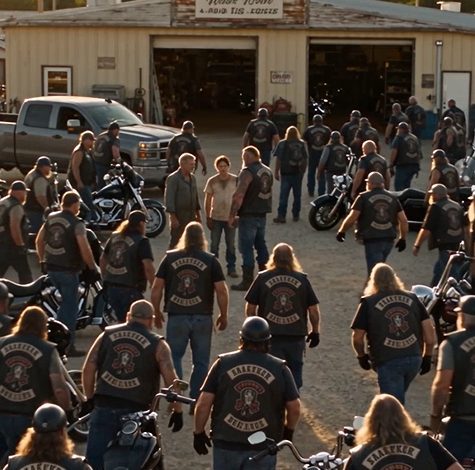
Nearly three hundred motorcycles surrounded the repair shop.
The gravel parking lot was crowded with bikes, and more were parked in orderly rows along the surrounding street.
Chrome mirrors and polished exhaust pipes caught the morning sunlight, while riders in leather vests stood together in clusters.
The garage seemed almost buried beneath the gathering.
Luke stared.
He could barely see the service bays through the rows of motorcycles.
For one frightening moment, he wondered whether something terrible had happened during the night.
Had there been an accident?
Was someone angry about a repair?
Had his father somehow become involved in a problem he hadn’t told Luke about?
Nothing made sense.
Luke drove forward slowly, aware that more and more people were looking toward his truck.
The riders weren’t behaving like an uncontrolled crowd.
They stood in loose but disciplined groups, leaving clear paths between the motorcycles and the garage entrance.
That organization unsettled him almost as much as their numbers.
It suggested they had arrived together.
On purpose.
He could hear low conversations and occasional mechanical sounds, but no one was yelling.
Still, hundreds of strangers gathered around his father’s struggling business were more than enough to make his pulse race.
Luke pulled into an available space near the edge of the property.
He shifted into park.
Then he sat motionless.
He considered calling his father, but Tom wasn’t there yet, and Luke had no idea what he would say.
There are three hundred bikers outside the garage?
The words sounded ridiculous even in his own head.
He left the keys in the ignition.
That detail mattered to him without his fully understanding why.
If something was wrong, he wanted to be able to leave quickly.
He looked through the windshield.
Several riders had turned toward him.
One man said something to another, and their attention moved toward a figure standing farther back among the motorcycles.
Luke noticed the movement but couldn’t hear the words.
Then a large man separated himself from the crowd.
The man began walking directly toward Luke’s truck.
Luke felt his mouth go dry.
The stranger was broad-shouldered, with a powerful build and a thick beard streaked with gray.
Tattoos covered both forearms, visible beneath the sleeves of his dark shirt, and a worn leather vest rested over his shoulders.
His boots moved steadily across the gravel.
He didn’t hurry.
He didn’t raise his voice.
There was something almost military about the way he carried himself: back straight, movements deliberate, eyes focused on where he intended to go.
That control made him more intimidating than shouting would have.
Luke watched him approach.
The man stopped several feet from the truck and waited.
Luke realized he was expected to get out.
He took a breath, opened the door, and stepped onto the gravel.
The stranger studied him.
Luke tried not to look nervous.
He failed.
The man stopped directly in front of him.
“Are you Luke Parker?”
Luke swallowed.
“Yeah.
That’s me.”
The stranger extended his hand.
“Clint Hummer.
I believe you helped my mother last night.”
For a moment, Luke didn’t understand.
His mother?
Then the pieces began fitting together.
The elderly woman.
The old blue sedan.
The shredded tire.
The faded denim jacket.
Luke stared at the man standing before him.
The woman who had needed a replacement tire was this enormous biker’s mother.
He hadn’t considered that possibility for even a second.
His first reaction wasn’t relief.
It was concern.
“Is she okay?”
Clint’s expression softened slightly.
“She made it home just fine.”
Luke released a breath he hadn’t realized he was holding.
Then Clint added, “Afterward, she called me and told me everything you did.”
Luke looked toward the motorcycles.
Almost three hundred riders.
All gathered outside his father’s garage.
He felt the uneasy weight of their attention.
Clint followed his gaze.
“Word travels fast among our riders.”
Luke tried to smile.
“I only changed a tire.”
Clint didn’t return the smile.
Instead, he studied Luke for another moment, as though weighing the words.
“You only changed a tire?”
Luke shifted his feet.
“Yeah.”
Clint stepped a little closer.
“You gave her water.”
Luke nodded cautiously.
“You made sure she had somewhere to sit.”
“That was my dad.”
“You used a tire from your own inventory.”
Luke lowered his gaze.
“And you refused to take even one dollar.”
Luke looked up again.
The way Clint listed those details made him uncomfortable.
He didn’t see anything remarkable about offering an elderly stranger a chair while helping with her car.
His father had done it naturally, just as Luke had naturally gone to find a replacement tire.
But Clint spoke as though every small action had mattered.
Luke wasn’t sure how to answer.
“Your mom needed help,” he said.
Clint held his gaze.
“That’s what she told me.”
Behind Clint, several riders continued watching quietly.
Luke glanced toward them, then back at the man.
He still didn’t understand why so many motorcycles had come.
One grateful son would have been enough to thank him.
Even a few friends might have made sense.
Nearly three hundred riders surrounding a garage that was already struggling to survive felt like something entirely different.
Luke rubbed his palms against his jeans.
“I’m glad she got home.”
Clint nodded.
“She is too.”
Luke waited.
He expected Clint to explain the gathering.
Instead, the biker glanced around the property.
His eyes moved over the faded sign, the aging service bays, and the narrow entrance where vehicles normally waited for repairs.
He looked toward the shelves visible through the garage windows.
Then he returned his attention to Luke.
“Your dad run this place?”
“Yeah.”
“Been here long?”
“Most of my life.”
Clint nodded slightly.
He looked toward the building again, taking in the details with the attention of someone who understood workshops.
His gaze lingered on the empty service bays, the worn concrete near the entrance, and the parts shelves that no longer looked particularly full.
Luke didn’t like the feeling of being inspected.
He knew the garage wasn’t impressive anymore.
He knew the building needed repairs they couldn’t afford, that their remaining inventory was smaller than it should have been, and that their work schedule had become painfully thin.
He suddenly felt embarrassed.
Not because his father had done anything wrong.
Because a stranger could look at the garage and recognize how much trouble they were in.
Luke straightened.
“Can I ask why everyone’s here?”
Clint looked at him.
Before he could answer, another engine approached.
Luke turned.
His father’s truck was entering the parking lot.
Tom slowed almost immediately.
Through the windshield, Luke saw his father staring at the motorcycles.
Then at the crowd.
Then toward Luke, standing in front of a large biker with tattooed arms.
The color seemed to drain from Tom’s face.
Luke understood exactly what his father was thinking.
A business barely surviving financially was now surrounded by hundreds of strangers, and his teenage son appeared to be standing in the middle of it.
Tom parked his truck.
He climbed out slowly.
Luke raised one hand.
“I’m okay, Dad.”
His father looked at him.
Then at Clint.
Then at the riders standing around the garage.
Tom shut his truck door.
“Luke, what’s going on?”
Luke opened his mouth.
Nothing sensible came out.
He looked toward Clint.
“That’s what I’m trying to figure out.”
Clint watched the exchange without interrupting.
Tom approached carefully, keeping his attention on the man beside Luke.
He wasn’t a small man, and years of physical work had given him a solid frame, but he looked exhausted compared with the confident biker standing before him.
His eyes moved across the leather vest and tattooed arms.
Then back to his son.
“Everything all right?”
Luke nodded, though he wasn’t entirely sure.
“This is Clint Hummer.”
Tom looked at the stranger.
Clint offered his hand.
Tom hesitated before taking it.
Clint spoke evenly.
“My mother stopped here last night with a flat tire.”
Recognition crossed Tom’s face.
“The lady in the blue sedan?”
“That’s right.”
Tom glanced at Luke.
Clint continued, “She made it home safely.”
Tom’s shoulders loosened slightly.
“Glad to hear it.”
Clint looked between father and son.
“She had quite a bit to say about the two of you.”
Tom gave a faint, uneasy smile.
“Well, we just helped her get back on the road.”
Clint’s gaze remained steady.
“That’s what you call it?”
Tom looked confused.
“What else would we call it?”
Clint didn’t answer immediately.

He looked toward the crowded lot again.
Luke watched the exchange, increasingly uncertain whether the stranger was pleased, angry, or testing them for reasons he couldn’t understand.
Tom stepped closer to his son.
Luke could tell his father wanted to pull him aside and ask questions.
But with hundreds of riders watching, neither knew what to say.
The old garage had never felt so exposed.
Every weakness seemed visible.
The faded paint.
The empty bays.
The equipment that had been carefully maintained because replacing it was impossible.
The shelves where supplies had steadily disappeared.
Luke wished they had at least had time to straighten the office before the crowd arrived.
Then he caught himself.
Why should he care how the garage looked to strangers who had appeared without warning?
Because the garage was his father’s life’s work.
And he couldn’t bear the thought of people looking at it as something already finished.
He turned back toward Clint.
“Look,” Luke began, “I appreciate everyone coming here, but we’re not trying to get into any trouble.”
Tom looked sharply at him.
Clint stared.
For one uncomfortable second, nobody moved.
Then Clint laughed.
The sound startled Luke so badly that he stepped back half a pace.
The biker folded his arms.
“Trouble?”
Luke didn’t answer.
Clint shook his head.
“Kid, we’re not here to cause trouble.”
Tom looked around the gathering again.
Luke glanced toward the motorcycles, searching for some clue he might have missed.
If the riders weren’t angry, what were they doing here?
Why had they come so early?
Why were they watching the garage?
And why had Clint arrived with nearly three hundred people to talk about a forty-dollar tire?
Clint’s amusement faded, though his expression remained calm.
He looked at Luke with something that seemed almost like admiration.
“You really don’t know, do you?”
Luke shook his head.
“No, sir.”
Clint nodded once.
Then he lifted his head toward the gathering.
He gave a sharp whistle.
The sound cut through the low conversations.
Immediately, riders across the parking lot began moving.
Luke felt his chest tighten.
A man near the road straightened and turned toward the garage.
Several women beside a row of touring motorcycles began walking toward the service bays.
Other riders followed, leaving their parked bikes and moving in organized groups.
From farther down the street, more men and women stepped away from their motorcycles.
Hundreds of people were suddenly in motion.
Luke looked around in alarm.
Tom moved closer to him.
Neither father nor son understood what was happening.
The riders weren’t running.
They weren’t shouting.
They weren’t approaching aggressively.
But they were moving toward the garage, and the movement seemed to spread across the entire property in seconds.
Luke stared at the nearest group.
A man with a gray beard and a black riding jacket walked toward one of the open bays.
Behind him came two other riders, both carrying helmets.
Across the lot, another group began guiding motorcycles toward the entrance.
The scene looked less like a confrontation and more like the beginning of some enormous organized operation.
But Luke couldn’t imagine what operation would involve their garage.
Tom turned to Clint.
“What exactly is going on here?”
Clint didn’t answer at once.
He looked toward the service bays, where the first riders were gathering.
Then he reached inside his leather vest.
Luke watched his hand disappear.
His pulse quickened again.
Clint pulled out a thick envelope.
The object seemed ordinary enough, but the way he held it immediately captured Luke’s attention.
It was heavy.
Not a thin letter.
Not a folded note.
A substantial envelope that looked as though it contained far more than a few sheets of paper.
Clint held it between them.
“We’re here to bring you business.”
Luke stared.
“Business?”
Clint nodded.
“A lot of business.”
Tom looked toward the motorcycles.
Luke followed his gaze.
Suddenly, some of the details began making sense.
The riders weren’t simply gathering outside the property.
They were preparing to bring motorcycles into the service bays.
But that raised an entirely different problem.
Parker’s Garage was almost out of money.
Their certified mechanic had quit.
Their supplier was threatening to suspend deliveries.
And even if a few riders needed routine maintenance, the shop had neither the staffing nor the inventory to handle the enormous crowd surrounding it.
Luke looked back at Clint.
“How much business?”
Clint glanced over his shoulder.
“Nearly eighty motorcycles need work.”
Luke’s mouth opened slightly.
Clint continued, “Maintenance.
Engine repairs.
Fabrication.
Custom upgrades.”
Tom stared at him.
Clint’s tone remained practical.
“Different jobs, different schedules.
Your shop handles what it can do properly, and the riders pay for the work.”
Luke looked from Clint to his father.
Eighty motorcycles.
He could hardly imagine that many repair orders passing through their little garage.
Clint continued explaining that every job would be paid in cash, up front.
Nobody would bargain over the prices, and nobody would expect installment arrangements that left the shop waiting for money.
The words seemed to move through Luke’s mind without settling.
Cash.
Up front.
No bargaining.
No delayed payments.
He had spent the previous evening wondering whether his family could afford to give away forty dollars.
Now a stranger was telling him that almost eighty motorcycle owners wanted to pay his father for legitimate repair work.
Tom shook his head slowly.
“That’s more work than we can take on at once.”
Clint nodded.
“Then don’t take it all at once.”
Luke watched his father’s expression.
Tom didn’t look relieved yet.
He looked overwhelmed.
That made sense.
A large number of customers could help a garage survive, but only if the work was organized, the necessary parts were available, and the people doing the repairs knew what they were doing.
Luke knew his father would never promise services he couldn’t safely deliver.
Clint seemed to understand that too.
“We’re not asking you to rush,” he said.
“We’re asking you to do the work right.”
Tom studied him.
“And you’re serious?”
Clint looked at the rows of waiting motorcycles.
“Does this look like a joke?”
For the first time that morning, a faint smile appeared on Tom’s face.
It vanished almost immediately.
He looked toward the service bays again.
The riders were waiting.
Not demanding.
Not arguing.
Simply waiting for instructions.
Luke could see several people studying the repair shop with the practical curiosity of riders who understood their machines.
One man gestured toward his motorcycle’s engine while another listened.
A woman beside a touring bike checked something in a saddlebag.
The entire crowd suddenly seemed less frightening.
They were customers.
Potential customers, at least.
People who needed actual work done.
Luke’s mind began racing through the possibilities.
Even a fraction of those jobs could make a difference.
A few weeks of steady repairs could provide money for parts.
A larger schedule might help with the rent.
If they could find a qualified replacement mechanic, perhaps they could accept more jobs without compromising their standards.
But those thoughts brought another fear.
What if the offer was too good to be true?
He looked at Clint.
“Why us?”
Clint’s expression grew serious.
“Because of what you did last night.”
Luke shook his head.
“But that was just—”
“A tire?”
Luke fell silent.
Clint looked toward Tom.
“Your son had no reason to expect anything from my mother.”
Tom’s eyes moved to Luke.
Clint continued, “He didn’t know who she was.
He didn’t know she had family who rode motorcycles.
And he certainly didn’t know she’d call me.”
Luke felt his face grow warm.
He didn’t like being praised in front of so many people.
Especially when the act being praised had been so ordinary to him.
The elderly woman needed help.
They had helped her.
That was all.
Yet Clint seemed determined to treat the decision as something much larger.
The biker extended the thick envelope.
Luke looked at it.
He hesitated.
Clint held it closer.
“Take it.”
Luke glanced toward his father.
Tom was staring at the envelope too.
Neither knew what to expect.
Finally, Luke reached out.
The envelope felt heavier than he’d imagined.
He looked at Clint, who gave a small nod.
“Open it.”
Luke carefully pulled back the flap.
Inside were tightly bundled bills.
Twenties.
Fifties.
Hundreds.
For a moment, he simply stared.
He had never held an envelope containing that much cash, and the sight of the bundled money sent a wave of disbelief through him.
His mind returned to the empty inventory shelf.
The forty-dollar tire.
The overdue rent.
The supplier’s warning.
The bank.
He looked at Tom.
His father’s face had gone still.
The money represented an opportunity they had barely dared to imagine, but it also raised questions neither of them could ignore.
Who was paying it?
What did Clint expect?
Could they accept it honestly?
Luke looked back at the biker.
He immediately held out the envelope.
“I can’t take this.”
Clint didn’t reach for it.
Instead, he watched Luke’s trembling hand and slowly shook his head.
The story isn’t over yet.
Select “Next Part” below to see what happens next.