Chapter 1: The Forty-Dollar Decision
Clint Hummer made no attempt to take the envelope back.
Luke continued holding it toward him, suddenly feeling as though the entire parking lot had gone quiet.
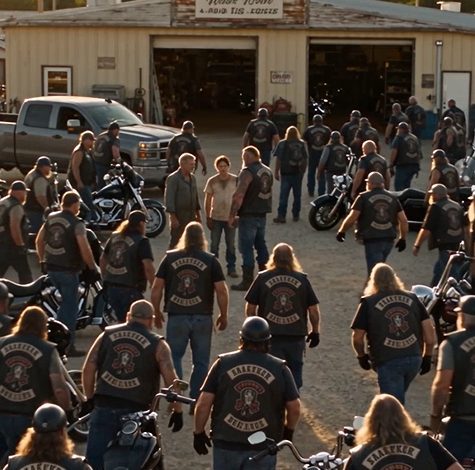
His father stood beside him, looking between the cash and the imposing biker who had brought almost three hundred motorcycle riders to their struggling garage.
Clint’s expression remained steady.
“My mother told me your garage has been struggling,” he said.
“She said you gave her something your own family could barely afford to part with.”
Luke swallowed.
He looked at his father.
Tom didn’t deny it.
The worn building, the nearly empty shelves, and the unpaid invoices in the office told enough of the story without either of them explaining the details.
Luke looked down at the envelope.
“I wasn’t expecting anything back.”
“I know,” Clint answered.
“That wasn’t why I helped her.”
“I know that too.”
Clint stepped closer and touched the envelope with one finger.
His voice grew quieter.
“I’m a Marine.
Did three tours.
You know what people like me respect?
A person who chooses to do what’s right when nobody’s watching.”
Luke looked into the biker’s face.
The tattoos, gray-streaked beard, and powerful build suddenly seemed less important than the sincerity in his eyes.
Clint wasn’t smiling now.
He wasn’t performing for the crowd.
He was speaking to a seventeen-year-old boy who had done something decent without expecting anyone to notice.
Luke looked toward his father.
Tom’s eyes had become unusually bright.
The man who had spent so many evenings calculating how much longer his business could survive was now standing beside a group of strangers offering him work he desperately needed.
Luke wanted to believe that everything was about to change.
But he was afraid to believe it too quickly.
He glanced at the envelope again.
“Is this supposed to be a gift?”
Clint shook his head.
“It’s money for work.
We intend to pay you fairly for what you do.”
Tom stepped forward.
“Then we need to be clear about something.”
Clint turned toward him.
Tom gestured toward the garage.
“We don’t have enough staff to handle eighty motorcycles.
Our certified mechanic left two days ago, and our supplier is getting ready to stop deliveries.”
Luke felt embarrassed hearing the problems spoken aloud.
Clint, however, simply listened.
Tom continued, “I won’t take people’s money for jobs I can’t guarantee we’ll finish properly.”
For several seconds, the biker studied him.
Then he nodded.
“Good.”
Tom frowned.
“Good?”
“Means my mother was right about both of you.”
Clint glanced at Luke.
“She said you were decent people.”
Tom shook his head slowly.
“Being decent doesn’t get an engine rebuilt.”
“No,” Clint agreed.
“It doesn’t.”
He looked toward the riders waiting near the service bays.
“But it does tell people something about who they’re trusting with their motorcycles.”
Luke followed his gaze.
Until that moment, he’d been focused entirely on the number of bikes and the money in his hands.
Now he began noticing individual riders watching from the background, people who had taken the trouble to come out early because someone in their community had told them about what happened the previous night.
They hadn’t arrived because Parker’s Garage was famous.
They hadn’t come because Tom offered the lowest prices.

They were there because an elderly woman had needed help, and a teenage boy had refused to send her away.
Clint looked back at Tom.
“Start with the jobs you can handle.
Make a proper schedule for the rest.
If something requires a qualified mechanic, wait until you’ve got one.”
Tom considered that.
It was the first proposal he’d heard all morning that didn’t sound impossible.
Luke carefully held the envelope with both hands.
“But why pay everything up front?”
Clint answered without hesitation.
“Because you need to order parts, and nobody here wants you paying for our repairs out of money you don’t have.”
Tom’s expression changed.
That was a practical answer.
A workable answer.
The kind of answer a struggling garage owner needed.
For months, Tom had been trapped in the same cycle: needing customers to earn money, but needing money to buy the parts that allowed him to serve customers.
The riders’ offer could break that cycle.
Not through charity disguised as a miracle.
Through actual business, paid for fairly.
Tom looked toward the garage office.
Then toward the waiting riders.
“Every job gets written up properly,” he said.
Clint nodded.
“Exactly.”
“Each customer gets an estimate.”
“Of course.”
“And we don’t promise a completion date until we know what parts we can get.”
“Fair enough.”
Tom studied the biker for another moment.
Then he slowly extended his hand.
Clint took it.
The handshake lasted only a few seconds, but Luke felt the importance of it.
His father hadn’t surrendered his pride.
He hadn’t accepted money simply because someone felt sorry for him.
He had agreed to work.
Real work.
The kind that had kept Parker’s Garage alive for years.
Clint released Tom’s hand and turned toward Luke.
“You still holding that envelope?”
Luke looked down.
“Yes, sir.”
Clint smiled faintly.
“Then let’s put it to work.”
He gestured toward the first motorcycles preparing to enter the service bays.
His voice dropped into a quieter, more personal tone.
“Now let’s find out what you can do with the opportunity you’ve just been handed.”
The first hour was almost overwhelming.
Luke had never seen so many motorcycles gathered around the garage, and suddenly the riders were no longer simply standing there.
They were approaching the service entrance, describing repair problems, asking about appointments, and discussing the work they needed.
Tom immediately understood that organization mattered more than enthusiasm.
He moved toward the office desk, cleared the unpaid invoices into a separate stack, and pulled out the paperwork he used for customer estimates.
Luke followed him inside.
For a moment, they stood together in the cramped office.
The same room where Tom had spent the previous evening staring helplessly at overdue bills was now filling with voices from people who wanted to become paying customers.
Luke looked at his father.
“Dad?”
Tom glanced up.
“Yeah?”
“Are we really doing this?”
His father looked toward the open service bays.
Then back at Luke.
“I think we’d better.”
Luke laughed nervously.
Tom gave him the first genuine smile he’d seen in days.
“Get the job sheets.”
Luke moved quickly.
He gathered the forms, found working pens, and cleared space on the counter.
Outside, the riders continued waiting patiently.
Clint stood near the entrance, helping maintain order without turning the process into a spectacle.
He spoke quietly with people approaching the bays and made it clear that everyone would have a chance to discuss their motorcycles.
The first rider described a maintenance job.
The next needed an engine problem diagnosed.
Another wanted custom work that Tom explained would require more planning and a longer appointment.
Nobody argued.
Nobody demanded immediate service.
When Tom explained that the shop was short-staffed, the riders listened.
Luke began recording names, contact information, motorcycle details, and the type of work requested.
His hands moved so quickly that he had to remind himself to write clearly.
By the time the first several appointments were arranged, the garage already looked different.
Not physically.
The aging walls and worn equipment hadn’t changed.
But the empty service bays no longer felt like evidence of defeat.
They had a purpose again.
Motorcycles were waiting to be inspected.
Customers were discussing prices.
And Tom was making the same practical decisions he had always made when business was healthy.
Luke watched his father explain a repair to one rider.
Tom didn’t exaggerate the problem.
He didn’t promise a complicated fix before examining the machine.
He simply described what he could check, what the likely costs might be, and what needed to happen before any repair began.
The rider listened carefully.
Then he nodded.
“Sounds fair.”
Luke felt an unexpected rush of pride.
That was his father.
Not the exhausted man staring at overdue bills.
Not the business owner who had begun losing sleep over every expense.
The mechanic who knew how to talk to customers honestly.
The man Luke had admired all his life.
As the morning continued, Tom asked Luke to organize the jobs by priority.
Routine maintenance could be scheduled around more involved repairs.
Parts would need to be ordered before certain motorcycles were brought inside.
Fabrication and custom upgrades would require longer conversations about cost, time, and the shop’s available capabilities.
Luke quickly realized that nearly eighty motorcycles didn’t mean eighty immediate repairs.
It meant a substantial amount of potential work that had to be handled responsibly.
And that distinction mattered.
By late morning, the office counter was covered with legitimate work orders.
Some customers had paid for parts that would be ordered specifically for their motorcycles.
Others had placed agreed-upon deposits toward scheduled work, with the amounts recorded properly against their jobs.
The money wasn’t simply free cash.
It came with responsibilities.
But those responsibilities represented something Parker’s Garage had been missing.
A future.
Tom sat down briefly after the rush slowed.
Luke noticed him studying the paperwork.
For a second, his father’s expression reminded him of the previous evening.
Then Tom turned one of the forms over and smiled.
Luke stepped closer.
“What?”
His father shook his head.
“Yesterday, I was trying to figure out how to pay bills with no customers.”
Luke looked at the crowded appointment sheets.
“And now?”
“Now I’m trying to figure out how to schedule customers without promising too much.”
Luke laughed.
It wasn’t a problem they could solve instantly, but it was a much better problem to have.
Tom leaned back.
“We’re going to need help.”
Luke nodded.
“I know.”
“Qualified help.”
“I know that too.”
They both looked toward the riders outside.
Several had been discussing engines and maintenance since arriving.
Some clearly had years of mechanical experience, and Luke could tell that a few knew the difference between casual enthusiasm and professional repair work.
Still, experience alone wasn’t enough for every job.
Tom would need someone capable of performing the repairs that required a certified technician.
Clint entered the office while they were discussing the problem.
“Everything going all right?”
Tom gestured toward the paperwork.
“Better than I expected.”
Clint looked at the work orders.
“Good start.”
Tom nodded.
“But we’ve still got the staffing problem.”
Clint considered that.
“Some of the riders work in mechanical trades.
You can talk with them if you want.
I’m not telling you to hire anybody who isn’t qualified.”
Tom gave a grateful nod.
“That’s reasonable.”
The offer didn’t solve everything, but it gave him another possible place to look.
Later that day, Tom spoke with riders who had relevant professional experience.
He asked practical questions about qualifications, scheduling, and the kinds of work they could perform safely.
He wasn’t looking for someone to rescue the business with unpaid labor.
He needed a reliable mechanic he could pay.
The difference mattered to him.
Luke understood why.
His father wanted Parker’s Garage to survive because it was worth operating, not because hundreds of people had agreed to support a business that couldn’t do the work.
Clint seemed to respect that.
He never suggested cutting corners.
He never pressured Tom to accept more jobs than the shop could manage.
He simply helped keep the waiting riders informed while Tom and Luke made decisions.
By the afternoon, the earliest repair appointments had been organized, and the father and son had enough confirmed work to begin addressing the most urgent practical problems.
Tom looked at the list.
Then at Luke.
“We’ve got a chance.”
Luke nodded.
For the first time in weeks, those words sounded real.
The following days demanded more work than Luke had ever experienced.
The first priority was making sure the parts required for scheduled repairs could actually be obtained.
Tom contacted their supplier, reviewed the overdue balance, and began arranging payment against the debt using money earned from confirmed work and the funds available for approved orders.
The conversation wasn’t effortless.
Their account had been overdue, and the supplier had good reasons to be cautious.
But the situation had changed.
Parker’s Garage now had a growing schedule of legitimate customers, payments recorded against real repair orders, and a clear plan for purchasing the parts needed to complete the jobs.
The supplier no longer had to rely on vague promises about future business.
There were actual orders to discuss.
Luke listened from the office while Tom handled the call.
He couldn’t hear every word.
But he heard enough.
His father wasn’t begging for unlimited patience.
He was explaining a realistic payment arrangement and asking for the chance to keep doing business.
When the conversation ended, Tom sat quietly for several seconds.
Luke looked up.
“Well?”
Tom released a long breath.
“We have a way forward.”
Luke smiled.
It wasn’t the same as every debt being paid.
It wasn’t a guarantee that nothing would go wrong.
But a way forward was more than they’d had before the motorcycles arrived.
The next problem was staffing.
Tom continued speaking with qualified applicants and carefully reviewing what the garage needed.
He wasn’t prepared to let the excitement of a sudden surge in customers push him into hiring someone simply because they rode with Clint’s group.
The person had to understand the work.
They had to take safety seriously.
And they had to be willing to become part of an ordinary repair business, not treat the situation like a one-time favor.
That process took effort.
So did the repairs.
Luke spent his days helping with the jobs he was qualified to assist with, organizing parts, handling basic service tasks under supervision, cleaning work areas, and recording progress so that customers knew what was happening with their motorcycles.
His father took responsibility for the work and made sure no repair left the garage without the necessary checks.
Some jobs turned out to be straightforward.
Others required more time.
A few had to be postponed until appropriate parts arrived.
The riders accepted those realities.
After all, they weren’t bringing their motorcycles to Parker’s Garage because they expected impossible promises.
They had come because they believed the people running it would treat them fairly.
Luke gradually understood something important about the motorcycle community gathered around Clint.
Their loyalty wasn’t expressed through speeches.
It appeared in the way they returned for appointments, paid the agreed prices, respected the garage’s schedule, and talked with one another about the work.
They had offered the Parkers an opportunity.
Now they were allowing them to earn it.
One afternoon, Luke found his father standing near the same parts shelf that had held the forty-dollar tire.
The space was no longer empty.
Replacement stock had begun arriving as the garage’s cash flow improved, and Tom had carefully arranged the supplies according to the jobs already scheduled.
Luke stopped beside him.
“Something wrong?”
Tom shook his head.
“No.”
He looked at the shelf.
“Just thinking.”
Luke followed his gaze.
The familiar tire inventory suddenly made him remember the elderly woman standing beside her blue sedan.
He smiled faintly.
“About the other night?”
Tom nodded.
“About how close I came to telling you we couldn’t afford to help her.”
Luke turned toward him.
“You wouldn’t have done that.”
Tom looked at his son.
“I don’t know, Luke.”

The admission surprised him.
His father continued, “I was scared.
I still am, a little.
We’ve got a lot of work to do before we’re completely out of trouble.”
Luke listened.
“But when I think about that evening, I keep coming back to what your mother would’ve done.”
Luke looked toward the service bays.
“I remember.”
Tom rested his hand on the shelf.
“I kept telling myself we couldn’t afford to lose another forty dollars.”
Luke said nothing.
His father looked at him.
“Turns out we couldn’t afford to forget why we started helping people in the first place.”
Luke felt the words settle somewhere deep inside him.
He didn’t answer immediately.
There was nothing he needed to argue.
The garage was still the same building.
Tom was still the same man.
Luke was still a teenager learning how to work responsibly and trying to help his father through a difficult time.
But the future no longer seemed to be closing in on them quite so quickly.
And it had started with a tire neither of them believed they could spare.
Clint continued checking on the garage as the repairs progressed.
He didn’t hover over the mechanics or demand special treatment for the riders who had arrived with him.
He asked practical questions, listened to the answers, and made sure anyone waiting for an appointment understood the shop’s limits.
Luke found himself becoming more comfortable around him.
The man who had frightened him that first morning now seemed easier to understand.
Clint’s appearance remained imposing, and he still carried himself with the same controlled precision Luke had noticed from the beginning.
But beneath that stern exterior was someone who valued responsibility more than appearances.
One afternoon, Clint found Luke wiping down a workbench after finishing an assigned task.
“How’s it going, kid?”
Luke looked up.
“Busy.”
Clint smiled.
“Good busy?”
Luke nodded.
“Definitely.”
Clint glanced around the garage.
Several motorcycles were being worked on, parts had been labeled for upcoming jobs, and the office no longer looked like a place where everyone was waiting for bad news.
“Looks different,” Clint observed.
Luke smiled.
“Feels different too.”
Clint nodded.
For a moment, they stood quietly.
Then Luke looked at him.
“Can I ask you something?”
“Sure.”
“Why did your mother tell you about us?”
Clint considered the question.
“Because she was grateful.”
Luke shook his head slightly.
“I mean, why did she make such a big deal out of it?”
Clint studied him.
Then he leaned one shoulder against the workbench.
“My mother was tired.
Her car was in bad shape, her phone didn’t work, and she didn’t know whether anybody would still be open.”
Luke remembered the evening clearly.
Clint continued, “She didn’t know what kind of response she’d get when she stopped here.”
Luke looked down.
“But you didn’t make her feel like a burden.”
The words struck him harder than he’d expected.
Clint wasn’t describing the tire itself.
He was describing how his mother had been treated.
“You helped her,” Clint said.
“Your dad gave her a chair and some water.
Neither of you acted like she was wasting your time.”
Luke swallowed.
“I didn’t think about it that way.”
“I know.”
Clint straightened.
“That’s part of why she remembered.”
Luke looked toward the garage entrance.
He thought of the woman’s tired face, the faded denim jacket, and the way she’d held the glass of water with both hands.
He hadn’t known who she was.
He hadn’t known she had a son who rode with hundreds of other motorcyclists.
And he hadn’t expected her to tell anyone.
Clint watched him for a moment.
“Kindness is easy to talk about,” the biker said.
“It’s harder when helping somebody costs you something.”
Luke looked back at him.
Clint gave a small nod.
“You proved you understood that.”
Then he returned to the waiting motorcycles.
Luke remained beside the workbench for several seconds, thinking about what he’d said.
As the weeks passed, the garage began finding its footing.
The improvement didn’t happen all at once.
There were still long days, difficult repairs, delayed parts, and customers whose motorcycles required more work than anyone initially expected.
Tom remained careful with every estimate because he knew that one careless promise could damage the trust the riders had placed in him.
But the schedule stayed active.
The shop secured the qualified mechanical help needed for its workload, paying for professional work rather than relying on favors.
With better staffing, Tom could accept more of the waiting appointments while Luke continued learning and assisting within his abilities.
The riders kept coming.
Some brought motorcycles that had been part of the original group.
Others returned for additional maintenance after their first repairs were completed.
The garage earned money through real service, and Tom began applying it toward the overdue obligations that had nearly forced the business to close.
Their supplier relationship stabilized.
The rent arrears began shrinking.
The pressure from the bank became something Tom could address with actual financial progress instead of desperate promises.
Luke noticed the change most clearly in his father’s evenings.
Tom still worked late sometimes.
He still checked the books carefully.
But he no longer sat staring helplessly at the same unpaid invoices until the garage lights were almost the only things still awake.
There were payments to record.
Parts to order.
Appointments to organize.
Work to complete.
For a man who had almost lost the business he’d built, those ordinary responsibilities felt like an extraordinary relief.
One evening, Luke entered the office and found Tom reviewing a new set of figures.
He hesitated near the doorway.
“Bad news?”
Tom looked up.
Then he smiled.
“No.”
Luke raised his eyebrows.
“Really?”
“Really.”
Tom turned the paper toward him.
Luke leaned closer.
The numbers weren’t spectacular.
They didn’t represent sudden wealth or a business transformed into something enormous.
But for the first time in a long while, they showed a clear improvement.
The garage was meeting its current obligations, reducing what it owed, and generating enough work to plan beyond the next few days.
Luke stared at the figures.
Then he looked at his father.
“We’re going to make it?”
Tom took a moment before answering.
He had learned not to promise what he couldn’t guarantee.
But this time, the uncertainty in his face was different.
“I believe we can.”
Luke smiled.
It was the answer he’d been hoping to hear for months.
Eventually, the most frightening deadline passed without Parker’s Garage closing its doors.
The bank no longer faced the same collapsing financial picture that had threatened the business before the riders arrived.
Tom had made progress on the overdue obligations and established a realistic plan for the remaining amounts.
The garage wasn’t suddenly wealthy.
It didn’t have unlimited money.
And its survival would still depend on careful management, dependable repairs, and customers willing to keep coming back.
But it was operating.
The service bays were busy.
The shelves held the parts needed for scheduled work.
And the sign above the entrance still read PARKER’S GARAGE.
Luke often thought about how close they had come to losing all of it.
Sometimes, while cleaning up after a long day, he remembered the evening his father had sat surrounded by unpaid invoices.
He remembered the empty bays, the strained silence, and the fear that six weeks might be all they had left.
Then he’d hear a motorcycle engine outside.
A rider arriving for an appointment.
A customer returning to collect a repaired bike.
And the memory would loosen its grip.
The garage had been given another chance.
More importantly, the Parkers had worked hard enough to make that chance meaningful.
One quiet evening, after the day’s final motorcycle had been collected, Luke stood beside the garage entrance.
The sun was sinking beyond the road, and the parking lot was nearly empty again.
It reminded him of the Sunday when the old blue sedan had arrived.
The same concrete floor stretched behind him.
The same fluorescent lights glowed overhead.
The same faded sign hung above the service bays.
But the atmosphere had changed.
He no longer looked at the empty spaces and imagined the end of everything.
He saw a garage that would open again the following morning.
His father came out of the office carrying the day’s paperwork.
“Ready to close?”
Luke nodded.
“Yeah.”
Tom set the forms aside and joined him near the entrance.
For a while, they watched the road without speaking.
Then Tom glanced toward the inventory shelves.
Luke knew exactly what he was thinking about.
“The tire?” he asked.
Tom nodded.
Luke smiled.
“Still think we could’ve used those forty dollars?”
His father laughed softly.
“We definitely could’ve used them.”
Luke looked at him.
Tom continued, “And I still think giving it away was the right thing.”
Luke lowered his eyes for a moment.
He remembered how frightened he’d been when his father first mentioned the cost.
He’d thought Tom was disappointed.
Instead, his father had told him that his mother would have done the same thing.
Now Luke understood that the conversation had been about much more than money.
Tom placed a hand on his shoulder, just as he had that Sunday night.
“You know something?”
“What?”
“I spent a lot of time worrying that I was going to lose this place.”
Luke nodded.
“I know.”
Tom looked toward the garage.
“And I was scared I wouldn’t have anything left to give you.”
Luke turned toward him.
“Dad, you already gave me something.”
Tom frowned slightly.
“What?”
Luke glanced at the tools hanging neatly inside the service bay.
“You taught me how to work.”
His father listened.
“You taught me to be honest with people.
To do a job right.
And not to turn somebody away just because helping them is inconvenient.”
Tom’s expression softened.
Luke continued, “That’s worth more than the garage.”
For several seconds, Tom didn’t speak.
Then he pulled his son into a brief, tight embrace.
Luke held on.
He could feel the exhaustion his father still carried, but it was no longer the same helpless exhaustion that had filled those final weeks before the motorcycles arrived.
It was the tiredness of someone who had spent a full day working.
Someone who had customers waiting.
Someone who had a reason to open the doors again tomorrow.
When they separated, Tom wiped one hand across his face.
“Your mother would’ve been proud of you.”
Luke swallowed.
“You think?”
Tom nodded.
“I know.”
The words brought back another evening, another conversation, and the same quiet certainty in his father’s voice.
Luke looked toward the road.
He imagined the elderly woman driving away in her repaired blue sedan, never knowing what her gratitude would eventually mean to their family.
Or perhaps she had known more than he realized.
Perhaps she understood that a small kindness could travel farther than the person offering it ever imagined.
Luke didn’t need an answer.
The garage was still standing.
His father was smiling.
And tomorrow, they had work to do.
He reached for the garage door.
Before lowering it, he took one final look at the shelves.
There were replacement tires waiting for the customers who would need them.
Real inventory.
Bought with money the shop had earned.
Luke smiled to himself.
He knew there might come another evening when someone arrived late, exhausted, frightened, or unable to pay.
If that happened, he couldn’t promise he’d always have a tire to spare.
He couldn’t promise every problem would have an easy solution.
But he knew what he would remember.
An elderly woman beside a broken-down sedan.
A glass of water.
A folding chair.
His father’s hand resting on his shoulder.
And nearly three hundred motorcycle riders arriving at sunrise because someone had chosen kindness when kindness wasn’t convenient.
Tom stepped beside him.
“Come on, son.”
Luke nodded and began lowering the door.
The last sunlight disappeared beneath the metal edge, leaving the familiar workshop lights glowing behind them.
For the first time in months, neither father nor son was afraid of what the next morning might bring.
Because Luke Parker had learned that a good deed didn’t guarantee a reward, but sometimes it reached people who understood its value.
And Tom Parker had learned that even when a business was running out of money, a family didn’t have to lose the values that made it worth saving.
Forty dollars had once seemed like more than they could afford to give away.
In the end, that small act of generosity helped give their garage a future.
THE END