A Neighbor Ruined Her Trash Can and Got an Unexpected Thanksgiving Surprise
Viral Stories
By Jessica Ray
·
November 26, 2026
My trash can melted on Thanksgiving.
I found it at noon, when I went out with the kitchen trash.
I had the bag in one hand and the door open with my hip. I had a pie in the oven, potatoes waiting in the sink, and eleven people coming at three. I wasn’t thinking about anything except whether I’d remembered to buy cranberry sauce in a can. Danny’s kids won’t touch the real kind.
Then I got to the end of the driveway, and I stopped.
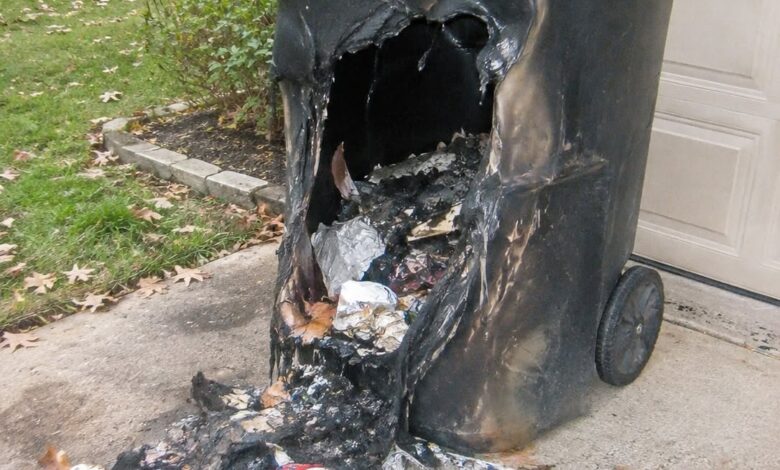
One side of the can had folded in on itself. It looked like a candle somebody had left on a windowsill in August. The green plastic had sagged and drooped and run, and then it had hardened again in a kind of frozen wave. The lid was warped so badly it was standing up on one corner.
There were ashes inside. Gray and white and powdery. And chunks of charcoal, some of them still black and some of them the pale gray that charcoal turns when it’s spent.
My potato peels from that morning were all over the driveway. My coffee grounds. The paper from the butter. The bag they’d been in had burned through at the bottom, and everything had spilled out when the side gave way.
I stood there holding my new bag of trash.
Next door, somebody was asking if there were any onions left.
I’d seen them that morning.
Denise and her guests. Around eight, while I was rolling out the pie crust at the kitchen window. They had a little portable charcoal grill set up on her side yard. The round black kind on three short legs. Four or five people were standing around it in their coats with coffee mugs, laughing. Someone was cooking sausages on it. Someone else was holding a pan of something over the coals with a pair of oven mitts.
I remember thinking it was a nice idea. A little breakfast cookout on Thanksgiving morning. I remember thinking, Good for her. Her first holiday in the new house.
That’s the kind of thing I think.
I knew where the charcoal came from.
I didn’t need anybody to tell me. There was only one little grill on our street that morning, and only one person who’d been putting things in my trash cans since the spring.
I also knew how the conversation at Denise’s door was likely to go.
I’d had enough conversations at Denise’s door by then.
I’m seventy-six.
My husband, Frank, and I have lived in this house for forty-one years. We bought it in 1983, when Danny was four and this whole street was half-built. There were still cornfields behind the back fence. You could hear the cows some nights.
Around here, I call people who moved in nine years ago “the new neighbors.” The Okafors across the street have been here twelve years, and I still think of them as the young couple. Their twins are in college now.
Denise had just moved in.
She bought the Hendersons’ place in April, after Marv Henderson passed and Ellen went to live with her daughter in Ohio. Ellen and I had been neighbors for thirty-three years. We’d traded zucchini and casseroles and keys. When Frank had his knee replaced, Ellen walked our dog twice a day for six weeks and never once let me pay her.
I cried when the moving truck took Ellen’s things away.
Then I baked a loaf of banana bread for whoever was coming next.
Denise was in her forties, I’d guess. Tall, quick, loud in a cheerful sort of way. She had two teenagers who came every other weekend, and a little white dog who barked at our mailman. She worked something in sales. She was always on the phone. She talked with her free hand.
I brought her the banana bread on her second day.
She took it at the door with one hand, still on the phone with the other, and mouthed “Thank you!” at me and smiled a big smile.
I thought we’d get along fine.
The first time I caught her in our garage, she had two of my flowerpots stacked in her arms.
It was a Tuesday in late April. I’d been in the backyard pulling weeds. I came around the side of the house to get my kneeling pad, and there she was. Standing in the middle of our garage, between Frank’s car and the workbench, holding my terra-cotta pots against her chest. The big ones. The ones I’d planted geraniums in every spring for twenty years.
Our rake was hooked over her elbow.
I asked what she was doing.
I didn’t say it sharply. I don’t think I’ve ever said anything sharply in my life. I just said, “Oh! Denise. What are you doing?”
She didn’t even look embarrassed.
“What’s the big deal? I just moved in, and I need so many things. I’ll return them later.”
And yes, I let her take them.
I stood in my own garage and watched her walk out of it with my flowerpots and my rake, and I didn’t say one single word.
I want to explain that, but I’m not sure I can. Not in a way that makes sense to anyone who isn’t me.
I suppose I figured I’d see her at the mailbox the next morning. I figured she’d bring them back, and we’d laugh about it, and that would be the beginning of being neighbors.
It seemed easier to let it go.
That’s the sentence. If you want to know about my whole life, that’s the sentence. It seemed easier to let it go.
A few days later, I needed the rake.
We’d had a windy night, and the last of the old oak leaves from the winter had blown out from under the hedges and all across the front lawn. I went to the garage and stood there looking at the empty hook where the rake used to hang.
So I went over to ask for it.
Denise was in her driveway, unpacking boxes from the back of her car. I walked up and said, “Good morning! I’m so sorry to bother you, but I need my rake back today, if that’s all right.”
She didn’t stop unpacking.
“Oh, sure. It’s around back. By the steps.”
And she went back to what she was doing.
I carried it home myself.
The rake was leaning against her back steps. Right where she’d said it would be. It had been out in the rain the night before. There was a little rust starting on the tines.
I picked it up.
And I almost thanked her.
I mean it. I picked up my own rake from her yard, and I turned toward her driveway, and the words “Thanks, Denise!” were right there in my mouth, ready to go.
I wish I were kidding.
I caught myself at the last second. I just walked home instead. I didn’t thank her. But I didn’t say anything else, either.
The flowerpots stayed where they were. I could see them from our kitchen window. She’d put them on either side of her front door with some yellow mums in them.
They looked nice there. I’ll say that.
Then it was the gardening tools.
A trowel. A hand rake. My long-handled cultivator, the one with the green tape wrapped around the handle where it had started to split. Frank had taped it for me ten years ago. He’s always taping things.
I didn’t catch her taking those. They were just gone, one by one, over a few weeks in May. I’d reach for them and find the nail empty.
I didn’t say anything.
I told myself I’d probably misplaced them.
Then it was the lawn mower.
Frank and I came home from the grocery store one Saturday in June, and the mower was gone.
Frank stood in the garage with a bag of groceries in each arm and stared at the empty spot by the wall.
“Ruth,” he said. “Where’s the mower?”
“I don’t know.”
“Did Danny borrow it?”
“Danny has his own mower.”
Frank put the groceries down on the hood of his car and got his phone out of his shirt pocket. We’d put in a little camera above the garage a couple of years before, after the Okafors had a package stolen. Frank checks it more than he needs to. He likes having something to check.
He scrolled back.
He found it.
Sure enough, there was Denise, pushing our mower across the grass.
We’d taken my car that day. His was still in the garage.
We watched the clip together, standing there with the groceries going warm. You could see her walk right in, look around, find the mower, and start wheeling it out backward. The garage isn’t wide. Frank’s car takes up most of it. She had to angle the handle very carefully to get around his side mirror. She took her time doing it.
She came awfully close.
Frank made a sound in his throat.
“Look at that,” he said. “Half an inch.”
“She didn’t hit it.”
“She came half an inch from it, Ruth.”
He saved the clip. Because of the mirror, he said.
I went over and asked for the mower back.
That afternoon. Frank wanted to go. I told him I would.
Denise was out back by her pool with a magazine. Our mower was sitting in the middle of her lawn. She’d cut about half the grass and stopped.
“Oh, hey, Ruth!” she said. “You need it already?”
“Frank likes to mow on Saturdays,” I said. Which was true.
“Sure, sure. It’s all yours. Hey, it’s kind of hard to start. You might want to get that looked at.”
I pushed it home across the grass myself.
The next time we saw Denise, at the mailboxes, we talked about the weather.
It was going to be hot that week. She thought it would rain on Thursday. I said I hoped so, for the gardens.
That was it.
Nobody said a word about the mower.
Frank stood next to me holding the mail. When we got back inside, he put it on the counter and looked at me for a long moment.
“The weather,” he said.
“What did you want me to say?”
“I don’t know, Ruth. Something.”
We used to leave the garage open during the day.
We’d always done that. Forty-one years. In the summer, especially. Frank would putter at the workbench, and I’d go in and out for my gardening things, and the neighbors would wave on their walks and sometimes stop to talk. Ellen used to come over and sit on the old kitchen chair Frank kept by the door, and we’d have iced tea in there out of the sun.
After the mower, I started closing it before we went out.
Then I started closing it when I was in the backyard, too.
Then I started closing it even when Frank was at the workbench, and he’d have to hit the button to open it again so he could get some air.
“It’s a garage, Ruth,” he said one day. “Not a bank vault.”
“I know.”
“So why are you closing it?”
I didn’t have a good answer. Or I had one, and I didn’t like it.
Of course, the rest of the yard was still right there.
One hot afternoon in July, I went out back to water my tomatoes, and the water wouldn’t come out of the hose.
I turned the faucet. Nothing. I turned it more. A little dribble.
Then I followed the faucet with my eyes.
There was a second hose screwed onto it. Not mine. A bright blue one. Brand new. It ran from our outdoor faucet, along the side of our house, across our lawn, across Denise’s lawn, under her fence, and straight into her pool.
I could hear it filling. That happy little gurgle.
The hose bothered Frank more than the mower.
He was in the den watching a ballgame. I came in and told him, and he got up out of his chair faster than I’d seen him move since his knee.
“Our water?” he said. “She’s filling her pool with our water?”
“It’s not the whole pool. She’s probably just topping it off.”
“Ruth. That’s our water bill.”
He was already heading for the back door.
He wanted to go over.
I told him I’d handle it.
I went outside.
I turned off the water. I unscrewed her blue hose from our faucet. My hands were a little shaky. I coiled it up neatly, all the way from our house to the property line, so it wouldn’t be a tangle for her. And then I left it, in a nice tidy circle, on her side of the grass.
That was my idea of handling it.
I want you to understand that I was proud of myself. For about ten minutes, I really was.
I’d done something. I’d stopped it.
I never said a word to her about it.
The next morning, the blue hose was gone. It never came back. Denise never mentioned it.
Neither did I.
Another time, I watched her cut three of my roses.
This was in August. My roses are along the front of the house, under the windows. Pink climbers. I planted them in 1991, the summer my mother died. They were her roses, cuttings from her yard. I rooted them in coffee cans on the windowsill, and when I planted them out, Frank built the trellis.
They’re the only thing in the yard I’d say I really love.
I was in the living room folding towels, and I looked out the window, and Denise was standing in my flower bed with a pair of kitchen shears.
Snip.
Snip.
Snip.
I went outside so fast I still had a towel in my hand.
I was going to tell her to put down the shears. I was going to say, Those are my mother’s roses. I really was. The words were right there.
“Denise—”
“Oh, Ruth, hi! These are gorgeous. I need a sample so I can plant the same ones. Do you know what kind they are?”
And you know what I said?
I asked what color she wanted.
I stood there in my flower bed with a bath towel over my arm, and I told her they also came in a deeper pink and a sort of peachy cream, and that if she wanted the climbing kind, she’d need a trellis, and that they liked morning sun better than afternoon.
I’d gone out to tell her to put down the shears.
Somehow, I was about to give her gardening advice.
She thanked me and walked home with three of my mother’s roses in her hand.
I went back inside and finished folding the towels. I folded every single one of them twice.
The trash was the first thing I ever asked her outright to stop.
Our pickup is Wednesday mornings. Frank and I are retired, and we’re tidy, and it’s just the two of us, so we don’t make much trash. One bag a week, sometimes two. Our two cans out front were always half empty by pickup day.
Then, starting sometime in September, they weren’t.
I’d go out on a Monday or Tuesday morning with our kitchen trash, and the cans would already be nearly full. Black bags I didn’t recognize. Big ones. Contractor bags.
I thought at first maybe the wind had blown something in. Then I thought maybe kids. I actually said that to Frank. “Maybe it’s kids.”
He just looked at me over his glasses.
Then I caught her.
A Tuesday evening in October. I’d gone out to get the mail late, and there was Denise, coming down her driveway with two enormous black bags. One in each hand. Heavy enough that she was leaning back to carry them.
She didn’t go to her cans.
She came to mine.
By the time I got down the driveway, the first one was already in.
“Denise,” I said. “Please use your own trash cans.”
I was polite. I’ve gone back over it a hundred times, and I’m sure I was polite.
She looked at me like I’d said something strange.
“Mine are always full, and yours are practically empty. You two are retired. How much trash could you possibly have? What’s the problem?”
“If you don’t have enough room in your trash cans,” I said, “please get some additional ones. The city will bring you another one. You just call.”
She rolled her eyes and dropped in the second bag.
“Pfft, and pay extra for them? No, thanks.”
She let the lid fall shut. It banged.
“Why are you being so stingy? I only threw a couple of bags of trash into your cans.”
And she walked away.
I stood there by my mailbox with a handful of mail. A seed catalog. The electric bill. A card from my sister in Tucson.
Stingy.
I’d never been called stingy in my life. I’m the woman who brings two casseroles when somebody dies. I’m the woman who still has a drawer full of birthday cards in case anybody on the street needs one. I gave Ellen Henderson my good winter coat the year her furnace broke and she had to wait three weeks for the part.
I walked back up the driveway feeling like I’d done something wrong.
That’s the part I can’t get over, even now.
She’d put her trash in my can. And I felt like I’d done something wrong.
I caught her doing it several more times.
Twice more in October. Three times in November. Always the big black bags. Always with that same breezy walk, like she was returning something to a shelf.
Once, she waved on her way back across the lawn.
She saw me in the window and waved. Big and friendly. Like we were the best of neighbors.
I waved back.
I’m telling you the truth. I waved back.
I kept thinking I’d said it politely enough.
Surely, I thought, I wouldn’t have to keep saying it. Surely she’d heard me. Surely one time was enough, for a grown woman, for something that simple.
Please use your own trash cans.
There’s nothing complicated in that sentence.
Frank asked me about it one evening, about a week before Thanksgiving.
He was at the kitchen table doing the crossword, and I was going out the back door with a bag of kitchen trash. Going the long way. Around the side of the house, past the hydrangeas, to the little can we keep by the back steps for yard waste and odds and ends.
“Ruth,” he said. “Where are you going with that?”
“Out back.”
“Why?”
I stopped with the door half open.
“Both cans out front are full again.”
He put his pencil down.
“Full of what?”
I didn’t answer.
“Full of hers,” he said. “Again.”
“I have room in the little can by the back door.”
“Ruth.”
“It’s fine, Frank. I’d rather make two trips than go next door and have the same conversation.”
He took off his glasses and rubbed his eyes.
Frank is not an angry man. In fifty-two years of marriage, I’ve seen him truly angry maybe five times. He doesn’t yell. He just gets very quiet and very tired-looking.
“You know what your mother used to say?” he said.
I did know. I didn’t want him to say it.
“Don’t make a fuss, Ruthie,” he said. “Don’t make a fuss, don’t make a scene, don’t make the neighbors talk.”
“She meant well.”
“I know she did. But she’s been gone thirty-three years, and you’re still carrying trash around the side of the house so you don’t upset somebody who calls you stingy.”
I stood in the doorway with the bag.
“I’ll handle it,” I said.
He put his glasses back on and picked up his pencil.
“That’s what worries me,” he said.
I took the trash out back.
Back to Thanksgiving.
I stood at the end of my driveway looking at that melted can for a long time. Long enough that the bag in my hand started to feel heavy.
Then I took the bag back inside and asked Frank to come look.
He was in the living room putting the extra leaf in the dining table. He came out in his slippers and his good sweater, the brown one Danny’s wife gave him. He stood over the can with his hands in his pockets.
He didn’t say anything at first.
He reached down and put the back of his hand near the side of it. Not touching. Just near.
“It’s still warm,” he said.
“Is it?”
“Ruth. If that had been up against the garage—”
He didn’t finish. He didn’t need to. The can sat at the end of the driveway, away from the house, on the concrete. But on another day, if Frank had rolled them up by the garage door the way he sometimes does when it’s windy—
Frank went and got the garden hose. He sprayed the inside of the can down until the ashes were a gray soup and the steam stopped coming off. It hissed. That hissing sound was the worst part, somehow.
We waited for it to cool all the way.
Once we could move it safely, I wheeled it next door.
Frank asked if I wanted him to come.
“No,” I said. “I’ll do it.”
He looked at me like he wanted to argue. Then he just nodded and went back inside. I saw him in the front window, though. Watching. Not even pretending he wasn’t.
Only one wheel turned properly. The other one had melted at the axle and just dragged.
I had to tip the thing almost sideways to get it up the little step to her front walk. I’m seventy-six, and I have a bad shoulder from the year I fell on the ice. It took me three tries. The can scraped and thumped and left a black streak on her walk.
I could hear them inside the whole time. Talking, laughing. A football game on loud. Someone shouting “Go, go, go!” at the TV.
I rang the bell.
Denise opened the door with a dish towel over her shoulder and a glass of wine in her hand.
Behind her, the house was full. Coats piled on the stairs. A folding table set up in the front room because the dining table wasn’t big enough. A tall man in a football jersey. Two women about Denise’s age. Her teenagers on the couch on their phones. A little boy running in circles.
The smell of turkey came out the door. And onions.
“Ruth!” she said. “Happy Thanksgiving!”
“Did you dump hot coals into my trash can?” I said. “Look what you’ve done!”
I’d barely gotten the can upright. It was leaning against my hip.
She took one look and waved it off. With the hand holding the wine.
“I cleaned out the grill,” she said. “I thought the coals had already cooled down.”
She shrugged.
“It’s no big deal. Just buy a new trash can.”
I gripped the handle with both hands.
I was shaking. Not just my hands. All of me. The way you shake when you’ve been cold for a long time and finally come inside.
Behind her, someone reached across the folding table for a roll.
I watched that hand. A man’s hand, with a watch on it. Reaching for a dinner roll in a basket. Like nothing was happening. Like an old woman wasn’t standing on the step with a melted trash can full of wet ashes.
Did I really need to explain, in front of an audience, why I shouldn’t have to buy myself another trash can?
Apparently I did.
“Denise,” I said. “You had no right to use my trash cans in the first place. You need to replace this one at your own expense.”
It was the most direct thing I had said to anyone, outside my own family, in years. Maybe decades.
She laughed.
“Oh, come on!”
She put the wine glass down on the little table by her door, hard enough that it sloshed.
“God, you’re such a cheapskate. I’m not buying you anything. You and your husband can use some of your retirement money to buy a new one.”
Her voice went up.
“Now stop ruining our holiday!”
Someone behind her laughed.
I don’t know who. One of the women, I think. Not a mean laugh, exactly. More the laugh people do when something uncomfortable is happening and they want it to stop being uncomfortable. But it was a laugh. And it was at me.
Denise shut the door while my mouth was still open.
I stood there.
The football game was still going on inside. Somebody said, “Who was that?” and Denise said something I couldn’t hear, and there was more laughing.
I looked down at the can.
You know what bothered me most afterward?
It wasn’t the cheapskate. It wasn’t the laugh. It wasn’t even the door.
It was that I’d been about to offer to split the cost.
That was what I’d planned. Walking over there with that can, tipping it up the step, I’d had the whole thing worked out. She’d apologize, and I’d say, Well, these things happen. And then I’d say, Why don’t we split it? Fifty-fifty. And she’d say, Oh, Ruth, you’re so sweet, and we’d go back to waving.
She’d just told me to use my retirement money.
And there I was, halfway to doing exactly that. Halfway to paying for my own melted trash can, so we could go back to waving at each other.
I wheeled the can home without making the offer.
It took me even longer going down the step than it had going up.
Frank came out to meet me at the end of our driveway. He didn’t ask how it went. He’d seen it through the window. He’d seen the door shut.
He just got a broom and the dustpan and a fresh trash bag. I got the rubber gloves from under the sink.
Frank and I picked up the mess together. On our hands and knees, both of us, on Thanksgiving Day. Potato peels and coffee grounds and the soggy, half-burned bag. A piece of charcoal had rolled all the way down to the gutter, and Frank went and got it, and held it up, and looked at it.
“Well,” he said. “That’s that.”
We didn’t talk much.
Then I went inside and washed my hands for a long time.
And I put the potatoes on.
While they boiled, I pulled up the camera app.
Frank had put it on my phone too, a year ago. I’d only ever used it to check whether the mail had come.
I sat at the kitchen table with the potatoes rattling in the pot behind me, and I scrolled.
I started the clip too late, the first time.
Denise was already walking home with the grill. Carrying it by the handle, the lid off, swinging a little.
So I backed it up.
Both cans were in view. Hers, at the end of her driveway. Mine, at the end of ours. About twenty feet apart.
Denise came down her driveway with the little black grill held out in front of her.
She went to hers first.
She opened the lid. She looked at the bags piled inside. Full, all the way to the top.
Then she shut it.
And she crossed the grass to mine.
She opened my lid.
She tipped the grill into it. Shook it a little, to get all the coals out. A puff of gray ash rose up.
She even closed my lid afterward.
Neatly. Gently. Like a good neighbor.
I watched it twice.
The potatoes boiled over. I heard them hiss on the burner. I got up and turned down the heat and came back and watched it again.
Maybe she really did think the coals were cold. I’ll give her that. I’ve cleaned out a grill. Sometimes they look cold. Sometimes they look like nothing but ash, and they’re still burning underneath.
But she’d still checked her own can first.
She’d opened it. She’d looked inside. She’d decided it was too full.
Then she’d gone straight to the one I’d asked her to leave alone.
I’d been in the kitchen the whole time.
Right there at the window. Rolling pie crust. If she’d knocked, I’d have heard her. If she’d knocked and said, Ruth, my can’s full, could I put a little something in yours? — I’d have said yes.
That’s the truth. I’d have said, Of course, dear.
She didn’t knock.
She never once knocked. Not for the flowerpots, not for the rake, not for the mower or the hose or the roses. Not for one single thing.
I saved the recording.
Then I went looking for Frank’s old mower clip. It took me a while. He’d saved it in a folder called MIRROR.
I found it.
Then I looked up what a can the same size would cost. The same brand. Ninety-six gallons, with wheels.
The price was right there on the screen. Sixty-eight dollars and forty-nine cents, plus delivery.
I could’ve ordered it and been done by the time the potatoes were ready.
For a minute, I had the order page open. My thumb was right over the button.
I sat there and looked at it.
Sixty-eight dollars. That’s nothing. Frank and I can afford sixty-eight dollars. We could afford a hundred cans. And if I just pressed the button, it would be over. No more talking about it. No more going next door. We’d have a new can on Tuesday and I’d never have to think about it again.
That was what scared me.
That it would be over, and nothing would be different. She’d do something else in January. And I’d handle it.
I closed the order page.
I opened a new search instead. I don’t really know what I typed. Something like “neighbor problem what to do.” Something an old woman types.
The first thing that came up was the Valley Community Mediation Center. A free service, run by the county. For “neighbor disputes, landlord-tenant issues, and family conflicts.” They had a little online calendar. You could pick a time for an intake call.
I picked Monday at ten.
I typed in my name and phone number. There was a box that said “Briefly describe the issue.” I sat there for a long time. Then I typed: “My neighbor uses my things without asking.”
That was all. It looked so small, written down.
I pressed the button.
The confirmation came to my email a minute later.
Then I wrote a letter.
On the computer in the den, with the door closed. Frank was setting out chairs and didn’t ask. I wrote it the way I used to write notes to Danny’s teachers when he was little. Short. Plain.
Dear Denise,
This morning, you emptied your charcoal grill into my trash can. The can melted and is ruined. A replacement of the same size costs $68.49. I am asking you to pay for it.
I have also asked you before to please use your own trash cans. I’m asking again.
I’ve booked a call with the Valley Community Mediation Center for Monday morning, because I don’t think you and I have been understanding each other, and I’d like help with that.
Ruth
I signed it in pen.
Then I printed two pictures from the camera clips. Frank’s printer is old and slow and it groaned the whole time.
One showed Denise tipping the grill into my can. You could see the puff of ash.
The other showed her coming out of our garage with the mower. Angling the handle past Frank’s mirror. There was a date and time stamp across the top. June 14. 10:52 a.m.
I put the letter and the pictures and the printed confirmation in a folder, and I put the folder in the kitchen drawer with the dish towels.
And then our family came over.
Danny and Kim got there at quarter to three with the kids. Lily is fourteen now. Ben is ten. Kim brought a green bean casserole and the canned cranberry sauce, God bless her, because she knew I’d forget.
My sister’s boy, Marcus, came with his new wife, and Frank’s brother Lou, and Lou’s wife Patty, and a friend of Danny’s from work who didn’t have anywhere to go.
Eleven people. My good tablecloth. My mother’s turkey platter in the middle, with the domed silver lid Frank polished every November.
I’d love to tell you I enjoyed it.
I did, mostly. I did the things you do. I carved, and I passed, and I said, “Ben, honey, take some vegetables,” and Lou told the same story about the time he got lost in Canada.
But I kept looking out the dining room window. At the end of our driveway, where the melted can was sitting, waiting.
Lily noticed. She notices everything.
She came into the kitchen while I was getting the pies out and stood next to me at the counter.
“Grandma, what happened to your trash can?”
“The neighbor put hot coals in it.”
“On purpose?”
“No,” I said. “Not on purpose.”
“Did she say sorry?”
I set the pumpkin pie down very carefully on the trivet………….CONTINUED ON NEXT PAGE