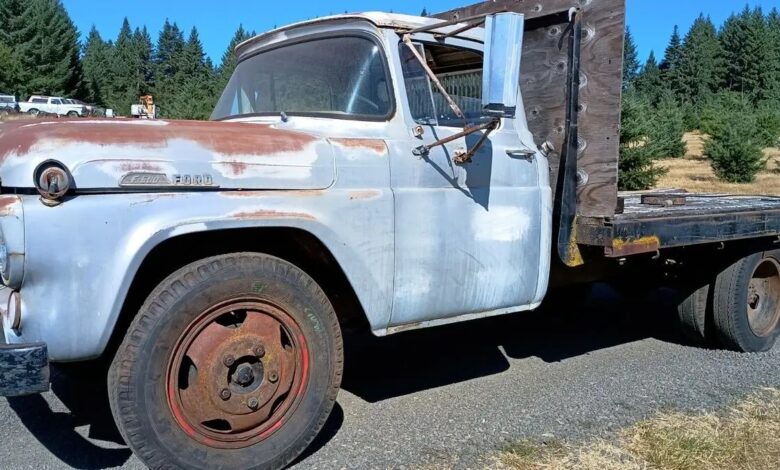
After 31 Years of Marriage My Husband Left Me With His Fathers Rusty 1957 Pickup Then a Stranger Offered Me 85 000 and Told Me to Look Under the Seat
My name is Alva Hartley. I’m fifty-eight years old, and I live in Pueblo, Colorado, in a little rented duplex on the east side of town, with a chain-link fence, a crabapple tree, and a neighbor who plays Marty Robbins records too loud on Saturday nights. Until last spring, I lived in a four-bedroom house on six acres out on the Boone Road, with a barn, a horse pasture, and a kitchen I’d picked out every cabinet in.
I was married to Devlin Hartley for thirty-one years.
He came home on a Tuesday in April. I remember because Tuesday was meatloaf night, and I had it in the oven, and the whole house smelled like ketchup and onions. He walked in the back door at six-fifteen, later than usual, and he didn’t take his boots off on the mat the way I’d asked him to for three decades. He stood in the middle of my kitchen floor with mud on his boots and his truck keys in his hand.
“Alva,” he said. “Sit down.”
I didn’t sit down. I was holding a pot holder. I just stood there by the stove.
“I’m in love with Kendra,” he said.
Kendra was his assistant. She’d worked for Hartley Roofing for two years, answering phones and doing the scheduling. She was thirty-four, with long blond extensions and fingernails so long I’d wondered more than once how she typed. I’d met her at the company Christmas party. She’d hugged me and told me my green bean casserole was “so retro.”
“I want a divorce,” Devlin said. “I’ve thought about it a long time. I deserve to be happy, Alva. I’m sixty. I don’t have that many years left. I deserve to be happy for the ones I’ve got.”
I stood there with the pot holder in my hand. Behind me, the oven timer went off. The meatloaf was done. I didn’t move to get it.
“How long?” I said.
“Does it matter?”
“It matters to me.”
He looked at the floor. “About a year.”
The timer kept beeping. Finally, Devlin reached past me and turned off the oven himself. Then he walked back out the kitchen door and got in his truck and drove away, and I stood in the kitchen until the meatloaf was cold, and then I threw the whole thing in the trash, pan and all.
I’d given that man thirty-one years. I raised our two children, Josie and Cody. Josie’s twenty-nine now, a dental hygienist in Colorado Springs. Cody’s twenty-six and works for his father. When Devlin started Hartley Roofing in 1998 with one truck and two ladders and a loan from his father, I kept the books at our kitchen table at night after the kids went to bed. I did the payroll and the invoices and the quarterly taxes on an adding machine, and later on a computer I taught myself to use from a library book. I cooked lunch for his crews every summer. I drove out to job sites with coolers full of ham sandwiches and iced tea in hundred-degree heat. When the company got big enough, twelve trucks and thirty men, Devlin hired a bookkeeper and an office manager, and then he hired Kendra, and he told me I could finally relax.
I didn’t know I’d be relaxing all the way out the door.
His lawyer was very good. His name was Garrett Pruitt, and he had an office in a glass building downtown on Main Street, with a framed photograph of himself shaking hands with a governor. He wore cufflinks. He billed four hundred and fifty dollars an hour, I found out later, and Devlin paid every penny of it out of the business.
My lawyer was a nice young woman from Colorado Legal Services named Rosa Delgado. She was twenty-nine, a year older than my daughter, and she had an office the size of a closet in a building on Abriendo Avenue, with a water stain on the ceiling shaped like Texas. She was smart and she worked hard and she believed me. But she had a hundred and forty other cases and no secretary, and Garrett Pruitt ran over her like a cattle truck.
Devlin kept the house on the Boone Road. He kept the boat, a twenty-two-foot Bayliner he kept at Lake Pueblo and took out about four times a summer. He kept Hartley Roofing, all of it, the trucks and the equipment and the contracts and the name. Garrett Pruitt argued that the company was Devlin’s “separate enterprise” and that my bookkeeping had been “informal household assistance.” Rosa fought that. She fought it hard. She got a forensic accountant to look at the books. But we couldn’t afford to keep him on very long, and in the end the judge split the difference in a way that came out a lot closer to Devlin’s side than mine.
Devlin kept most of our savings, too. About two hundred and forty thousand dollars in retirement accounts and a money market account at Legacy Bank. He said he’d earned it. He said it at the mediation, sitting across the long table from me in a sport coat I’d bought him for our twenty-fifth anniversary.
“I’m the one who was out on those roofs in August, Alva,” he said. “Not you. I earned that money with my own two hands.”
I didn’t say anything. I just looked at his two hands, folded on the table. They had calluses on them, sure. They also had a brand-new watch on one wrist, a heavy gold one, that I’d never seen before.
When it was all done, I got a check for sixty-two thousand dollars. That was my half of thirty-one years, after Garrett Pruitt got done with his arithmetic. I got my car, a 2014 Honda Accord with a hundred and sixty thousand miles on it. I got my mother’s china and my sewing machine and the furniture from the guest room.
And I got one more thing.
His father’s old pickup truck.
I should tell you about Elmer.
Elmer Hartley was Devlin’s father. He died six years ago, at eighty-seven. He was a rancher. He ran cattle on four hundred acres south of Pueblo, out past Rye, toward the Wet Mountains, on land his own father homesteaded in 1911. He was a tall, thin, quiet man with a face like a dry creek bed and hands like old saddle leather. He didn’t like many people. He thought most people talked too much and said too little. He didn’t go to church, and he didn’t go to town unless he had to, and he didn’t own a television until 1994.
But he liked me.
I don’t know why, exactly. Maybe it was because I didn’t talk too much either. The first time Devlin took me out to the ranch to meet him, in 1992, when we were engaged, Elmer barely said three words to me all afternoon. Then, when we were leaving, he walked me out to Devlin’s car and said, “You know how to make biscuits?”
“Yes, sir,” I said. “My grandmother’s recipe.”
“Huh,” Elmer said. And that was all.
The next Sunday, I drove out to the ranch by myself with a pan of biscuits and a pot of chicken and dumplings wrapped in towels on the passenger seat. I knocked on his door, and he opened it and looked at the food in my hands and looked at me.
“Devlin’s not with you,” he said.
“No, sir. He had a job.”
Elmer stood in the doorway for a long time. Then he stepped back and let me in.
I went every Sunday after that. Every single Sunday for twenty-five years. I’d go to early service at First Methodist, and then I’d drive the forty-five minutes out to the ranch with a hot dinner on the seat beside me. Pot roast. Fried chicken. Green chile stew in the winter. Pie in the summer, peach or cherry or rhubarb from the plant by his back steps. We’d eat at his kitchen table, and then we’d sit out on his front porch in two old wooden chairs and look at the mountains. Some Sundays we talked for hours. Some Sundays we didn’t talk at all. Either way was fine with both of us.
Devlin came maybe four or five times a year. Christmas. Elmer’s birthday. Sometimes when he needed money for the business.
When Elmer got sick at the end, it was his heart, and then his kidneys, and then everything at once. I was the one who took care of him. I drove him to his appointments at Parkview Medical Center in Pueblo. I sat in the waiting rooms. I picked up his prescriptions at the Walgreens on Northern Avenue. The last two months, when he couldn’t be alone anymore, I drove out to the ranch every day and stayed until the night nurse came. I gave him his pills and changed his sheets and read him Louis L’Amour novels out loud, the ones he’d read a hundred times already.
Devlin was always too busy. “Roofing season, Alva,” he’d say. “You know how it is. Somebody’s got to make the money around here.”
Elmer’s truck was a 1957 Chevrolet pickup. Faded green, the color of an old dollar bill, with white trim that had gone yellow. It had rusty fenders and a cracked windshield and a dent in the tailgate where a cow had kicked it in 1974. The seat was cracked leather patched with duct tape. Elmer bought it new, he told me once, in the spring of 1957, at the Chevrolet dealer on Union Avenue, with money he’d saved for eleven years. He drove it for forty-five years, every single day, until his eyes got too bad to drive.
After that, it sat in his barn. When Elmer died and Devlin sold the ranch, he had the truck towed to our barn on the Boone Road. Devlin was going to “fix it up someday.” He never touched it. It sat in the back corner of the barn for six years behind his old lawn tractor and a stack of shingles, gathering dust and mouse nests. It didn’t run. The tires were flat. Barn swallows had built a nest on top of the cab.
During the divorce, at the mediation, in that conference room with the long table, Rosa asked for it.
Devlin laughed out loud.
“The truck? Dad’s old truck?” He looked at Garrett Pruitt and laughed again. “Take it. It’s worth maybe five hundred bucks for scrap. If that. Enjoy.”
Garrett Pruitt made a note on his legal pad and didn’t argue.
But I’d been thinking about that truck for months. Ever since the night Devlin left. So I leaned over and whispered something to Rosa. And Rosa wrote one more line into the settlement agreement, in her neat handwriting, right there in the margin, before it got typed up.
“The 1957 Chevrolet pickup truck, VIN on file, and all of its contents.”
Devlin didn’t even read it. He was in a hurry. Kendra was waiting for him in the parking lot in his new black Ram, with the engine running and the music going. He’d checked his phone four times during the mediation. When Garrett Pruitt slid the settlement across the table to him to sign, Devlin signed it on every page where the little yellow sticky arrows were, without reading a word, and pushed it back.
I read every single page. Twice. Then I signed it.
On the day I moved out of the house on the Boone Road, in July, I hired a tow truck to come get Elmer’s pickup. A man named Hector from a towing company in Pueblo came with a flatbed and a winch. It took him almost an hour to drag it out of the back of the barn on its four flat tires, with the barn swallows screaming at him.
Devlin and Kendra stood on the front porch and watched. Kendra had a glass of white wine in her hand, at two o’clock in the afternoon. She was wearing my old gardening hat. I’d left it on the hook by the back door.
When Hector finally got the truck up on the flatbed and chained down, it sat there in the sun, green and rusty and sad, with its cracked windshield and its flat tires and a bird’s nest on top of the cab.
“Good luck with your junk!” Kendra called after me from the porch, and raised her wine glass.
Devlin laughed.
I looked at them both standing there on the porch I’d swept every morning for twenty-two years.
“Okay,” I said.
Then I got in my Honda and followed the tow truck down the long gravel driveway, and I didn’t look back.
What Devlin didn’t know was what his father had told me, two days before he died.
It was a Thursday evening in October, six years ago. Elmer was in a hospital bed at Parkview by then. They’d moved him there the week before, when his breathing got bad. I was sitting in the chair beside his bed, the way I did every evening. Devlin had come by that afternoon for fifteen minutes and left.
Elmer had been sleeping most of the day. Around seven o’clock, he woke up, and he reached over and took my hand in his. His hand was thin and cold, all bones under that old leather skin.
“Alva,” he said. His voice was very weak, just a scrape.
“I’m right here, Elmer.”
He held onto my hand harder than I thought he could.
“Don’t ever let my son sell that truck,” he said. “You hear me? Don’t you let him sell it. When the time is right, somebody will come. You’ll know.”
I thought he was confused. They had him on a lot of medicine by then, for the pain, and it made him say strange things sometimes. The day before, he’d asked me if I’d fed the horses, and he hadn’t owned a horse since 1988.
“Okay, Elmer,” I said. “I won’t let him sell it.”
“Promise me.”
“I promise.”
He nodded, very slowly, and closed his eyes. He didn’t say much of anything else after that. He died two days later, on a Saturday morning, with me holding his hand. Devlin was at a job site in Cañon City.
I never told Devlin what his father said. At the time, it seemed like nothing. An old man’s fever talk. And then the truck sat in our barn for six years, and Devlin never once tried to sell it, because he never once thought about it. So I never had to keep my promise.
Until the mediation. Until Devlin laughed and said five hundred dollars for scrap. That’s when I remembered the hospital room, and Elmer’s cold hand around mine.
When I got to my little duplex on the east side, I had Hector drop the truck behind the building, in the gravel strip between my back door and the alley, under the crabapple tree. I paid him two hundred and twenty dollars. He looked at the truck sitting there on its four flat tires, and he looked at me.
“Ma’am,” he said. “You want me to haul it to the scrapyard instead? I could get you a couple hundred for it.”
“No,” I said. “It stays.”
He shrugged and drove off.
I didn’t touch it. I didn’t even open the doors. I’m not sure why. I think part of me was afraid that if I opened the doors and found nothing in there but mouse nests and old receipts, I’d have to admit I’d fought over a five-hundred-dollar piece of scrap because a dying man said something strange in a hospital bed. And part of me thought it was still Elmer’s truck, somehow, and I didn’t have any business going through it.
So it sat there under the crabapple tree. My landlord, a retired postman named Mr. Archuleta, asked me about it once in August, very politely, and I told him it was my late father-in-law’s and I wasn’t ready to move it. He nodded and never asked again.
Eight months passed. I got a job at the front desk of a physical therapy clinic on Pueblo Boulevard, twenty-eight hours a week, at sixteen dollars an hour. I put most of my sixty-two thousand dollars in a CD at the credit union, because I didn’t know what else to do with it, and lived on the rest.
I didn’t see much of Devlin. I heard things. I heard Kendra had moved into the house on the Boone Road in August. I heard they’d redone my kitchen. They took out the oak cabinets I’d picked out and put in white ones, with gold hardware. I heard Devlin had bought a new boat, a bigger one. I heard it from Cody, mostly. My son works for his father, and he’s twenty-six, and he’s in a hard spot, and I try not to put him in a harder one. When he tells me things, I just say, “Okay, honey,” and change the subject.
Thanksgiving was quiet.
My daughter Josie drove down from Colorado Springs the night before, and the two of us cooked in my tiny duplex kitchen, bumping elbows. A small turkey breast. Mashed potatoes. My grandmother’s biscuits. A pumpkin pie. We ate at my little card table in the living room with the TV on, the Lions game.
My son spent Thanksgiving with his father and Kendra, at the house on the Boone Road. He called me that morning to say happy Thanksgiving. His voice sounded small.
“I’m sorry, Mom,” he said.
“Don’t be sorry, honey,” I said. “You go be with your dad. I’m fine. Josie’s here.”
“Kendra’s making a tofu turkey,” he said.
“Well,” I said. “Good luck with that.”
Josie laughed so hard in the kitchen that she had to put down the potato masher.
Josie drove back to Colorado Springs that evening. She had to work on Friday. I washed the dishes by myself, and I went to bed early, and I didn’t think about the truck at all.
The next morning, the day after Thanksgiving, at nine o’clock exactly, somebody knocked on my front door.
I was still in my bathrobe, drinking coffee at the card table and doing the crossword in the Pueblo Chieftain. I almost didn’t answer. Nobody knocks on my door at nine in the morning. I figured it was a man selling something.
I opened the door with the chain still on.
A man in his sixties was standing on my little concrete porch. He was tall and thin, with a gray mustache and a weathered face. He was wearing a gray suit, a good one, the kind of suit you don’t see much in Pueblo, with a white shirt and a bolo tie with a turquoise stone in it. And on his feet, he was wearing cowboy boots, old ones, brown, worn soft as gloves. He had a leather folder tucked under his arm.
He took off his hat, a gray Stetson, and held it against his chest.
“Good morning, ma’am. I’m sorry to come so early on a holiday weekend. Are you Alva? Elmer Hartley’s daughter-in-law?”
I looked at him through the gap in the door.
“I was,” I said.
He nodded slowly. “I heard about that, ma’am. I’m sorry.”
“Who are you?”
“My name’s Bertrand Ashby,” he said. “I’m a collector. Out of Santa Fe. Old cars and trucks, mostly. Elmer and I knew each other for forty years. We met at a cattle auction in La Junta in 1981 and argued about Herefords versus Angus for three hours. He was wrong, but I liked him anyway.” He smiled a little under his mustache. “Before he passed, he made me promise him something. I’ve been waiting six years to keep that promise.”
He turned and pointed past the side of my duplex, toward the gravel strip out back, toward the crabapple tree.
Toward the old green truck.
“I’d like to buy that truck,” he said. “I’m prepared to pay you eighty-five thousand dollars for it. Cash. Today. I’ve got a cashier’s check in this folder from First Bank of Santa Fe, if you’d rather. Either way.”
I almost fell over. I had to grab the doorframe…………CONTINUED ON NEXT PAGE 2