My Mother Forgot to Invite My Two Children to Christmas Dinner, Then Called a Week Later Demanding $5,200. When I Finally Refused, She Appeared at My Door at 6 A.M. With Two Strangers and a Mysterious Folder.
The first time my mother tried to take me home, she appeared at six in the morning with two men in dark coats and a folder bearing my signature.
The second time, she tried to erase my children from our family history.
But the most surprising part wasn’t what my mother did.
It was what my father had arranged thirteen years earlier, knowing he might never get the chance to explain.
By the time I uncovered his secret, my mother had already made a mistake that would change everything.
My name is Claire Whitmore.
I’m thirty-nine, divorced, and raising two children who have taught me more about love than anyone else.
Until last Christmas, I believed my greatest failure was never making my mother proud.
I was wrong.
My real mistake was believing I had to earn my place in my own family.
It began with a casserole, two Christmas sweaters, and one unforgettable phone call.
On Christmas afternoon, nearly every driveway in our Marshfield, Wisconsin, neighborhood was filled with visiting relatives.
Except ours.
I stood in the kitchen holding a warm casserole wrapped in a towel, checking my phone again.
My eleven-year-old son, Noah, waited near the door in his green reindeer sweater.
His eight-year-old sister, Sophie, wore a red Christmas sweater with a tiny silver bell near her shoulder.
It jingled whenever she moved.
Normally, I loved that sound.
That afternoon, it only made me more anxious.
“Mommy, when are we going to Grandma’s?”
I checked the clock.
2:07 p.m.
“Soon, sweetheart. Grandma probably has more cooking to finish.”
I’d already given that explanation twice.
Six days earlier, my mother, Evelyn Whitmore, had invited us to Christmas dinner at the farmhouse.
She’d specifically mentioned my children.
“Bring those babies,” she’d said. “And don’t forget your casserole.”
She promised to text the time after confirming Aunt Carol’s arrival.
I should have followed up sooner.
But even at thirty-nine, part of me still hoped this Christmas would be different.
Noah entered carrying a pie box.
“Should I put this in the van?”
“Not yet, buddy. The roads are icy. Let’s wait for Grandma’s call.”
He nodded, left the pie on the counter, and returned to the door.
He didn’t complain or ask why nobody had called.
He simply waited.
Later, that quiet moment would stay with me more than almost anything else.
My son wasn’t merely excited about visiting his grandmother.
He seemed like a child who had already learned that family affection wasn’t always dependable.
At 2:15, I called.
Mom answered on the fourth ring.
“Hello, Claire!”
She sounded cheerful.
Behind her, I heard silverware, moving chairs, conversations, and laughter.
I smiled automatically.
“Hey, Mom. What time should we come over?”
She paused.
Then came the words I’ll never forget.
“Oh, honey, we already ate.”
For a moment, I couldn’t process them.
“What?”
“We had dinner at noon this year. It worked better.”
I glanced toward the hallway.
Noah was watching.
Sophie held her little Christmas purse, filled with handmade cards for her grandparents.
“You already ate?”
“Well, Aunt Carol arrived early, and everyone was hungry. We couldn’t let the food get cold.”
Then I heard my younger sister, Jenna, laughing.
It wasn’t an awkward or apologetic laugh.
It sounded amused, almost as though she’d anticipated my reaction.
“Claire?” Mom interrupted. “Don’t make a big thing out of it.”
I couldn’t answer.
Six days earlier, she’d invited my children.
They’d chosen their outfits, wrapped presents, and counted down the days.
Sophie had spent two evenings making a paper angel for Grandma’s tree.
Yet everyone had eaten without us.
No call. No message.
Not even a question about where we were.
“Okay, Mom,” I whispered.
“Well, Merry Christmas, sweetheart.”
I ended the call.
Noah studied my expression.
“Is Grandma ready?”
I swallowed.
“Change of plans.”
Sophie looked confused.
“What plans?”
“We’re having Christmas dinner right here.”
I tried sounding excited, as though it were a wonderful surprise.
Our home was half of a modest duplex, with no dining room, just a kitchen counter and three stools.
Still, I brought out our nicest plates.
I lit a vanilla candle from a school fundraiser, served the casserole, and cut generous slices of pie.
Sophie arranged paper napkins beneath every plate.
Noah quietly removed the shoes he’d worn since lunchtime and placed them beside the door.
Then he returned.
“Mom?”
“Yes?”
He glanced at Sophie.
“Was it us?”
My heart sank.
“What do you mean?”
“Did Sophie and I do something wrong? Is that why Grandma didn’t want us there?”
“No.”
My answer came too quickly, startling him.
I softened my voice.
“No, sweetheart. Absolutely not.”
“Are you sure?”
I hugged him.
“More sure than anything.”
But other questions troubled me.
How had my children reached an age where they felt responsible for an adult’s choices?
And why had I spent years trying to please relatives who couldn’t even save two places at Christmas dinner?
That evening, we watched Christmas movies.
Sophie fell asleep against my shoulder, still wearing her sweater.
Noah stayed until the final credits.
Before heading upstairs, he turned around.
“Mom?”
“Yeah?”
“I’m glad we stayed home.”
I smiled.
“Me too.”
He hesitated.
“It was better here anyway.”
Only after he went upstairs did I finally let myself cry.
I washed our three plates in the quiet kitchen.
Then I opened the drawer beside the stove.
Inside lay a thick bank envelope.
Four words were written across it in my handwriting.
MOM — TAXES, JANUARY.
Inside was $5,200.
I’d saved it throughout the previous year.
Twenty dollars some weeks.
Fifty whenever possible.
Occasionally a hundred, provided nobody needed shoes, school supplies, or medicine.
Every Friday after payday, I added something.
Not for a vacation. Not for a better vehicle. Not even for the emergency savings we badly needed.
It was for my mother’s property taxes.
Taxes on a farmhouse where my children hadn’t been included in Christmas dinner.
Holding that envelope, I remembered everything I’d told Noah and Sophie we couldn’t afford.
A weekend at Wisconsin Dells.
Sophie’s swimming lessons.
New winter boots for Noah, whose classmates had begun noticing the duct tape holding his old pair together.
Yet I’d saved $5,200 for relatives who hadn’t thought to contact us on Christmas.
I sat down slowly.
For the first time, I confronted a question I’d avoided for decades.
If I stopped supporting my mother financially, would she still want me around?
The possibility frightened me.
Because deep down, I suspected I already knew the answer.
To understand why I kept paying, you need to know about the farmhouse.
It stood twenty-five minutes outside Marshfield, beyond a gravel driveway bordered by sugar maples.
White siding. Green shutters.
A wide porch with a swing Dad built when I was thirteen.
The property included twelve acres of pasture, an aging machine shed, and a maple dining table that could accommodate nearly every visiting relative.
My father, Paul Whitmore, repaired industrial machinery at a cheese plant.
He was quiet and practical.
He smelled of motor oil, coffee, and the peppermint candies he carried in his shirt pocket.
When something broke, Dad repaired it.
When someone needed support, he didn’t deliver speeches.
He showed up.
My mother, Evelyn, was different.
She could command any room.
She determined seating arrangements, dessert assignments, and which family issues could be discussed.
I was the oldest daughter.
The dependable one.
Jenna, six years younger, was everyone’s baby.
Beautiful, charming, and constantly “finding herself.”
When Jenna missed a payment, someone covered it. When she damaged a car, Dad helped replace it. When she left beauty school, Mom praised her bravery. When I earned a scholarship and worked two college jobs, Mom simply said, “Well, of course. Claire’s always been independent.”
She presented my independence as a compliment.
Eventually, I understood what it meant.
Because I could manage alone, nobody felt obligated to help me.
At seventeen, I balanced my parents’ checkbook. At twenty-two, I organized Dad’s health insurance paperwork. At twenty-eight, I lent Jenna money for a salon lease. Then, at thirty, I made a financial decision that changed my future.
Dad d!ed unexpectedly in the fall of 2013.
One moment, he was repairing an old tractor in the machine shed.
Soon afterward, an ambulance was heading down our driveway.
He passed away before I reached the hospital.
I still remember standing beneath those fluorescent lights, struggling to accept that the person who’d always made me feel secure would never answer another call.
Five months later, Mom asked me to visit the farmhouse.
I was seven months pregnant with Noah.
My husband, Eric, drove me after work.
Mom sat at the maple dining table, surrounded by paperwork.
She’d been crying.
“Your father left me in a terrible situation,” she whispered.
There was a second mortgage.
Forty-six thousand dollars.
Some debt came from medical expenses.
The rest involved money Dad had borrowed after Jenna walked away from her beauty salon lease.
The farmhouse secured the loan.
The bank was requesting payment.
Mom slid the notice toward me.
“I don’t know what I’m going to do.”
Eric and I had exactly $46,000 saved.
Six years of careful budgeting.
Six years of inexpensive apartments, delayed vacations, and secondhand furniture.
We’d planned to buy our first home before Noah arrived.
I studied the notice.
Then I looked at my mother’s trembling hands.
“I can’t lose this house,” she said. “It’s all I have left of your father.”
She never explicitly asked for the money.
She didn’t need to.
Three days later, Eric and I transferred our entire savings to settle the debt.
Our dream of owning a home vanished.
Mom cried and hugged me.
“You’re my angel.”
Jenna sent a heart emoji.
That was all.
No repayment agreement. No acknowledgment of our sacrifice. No discussion about our future.
Just another family emergency Claire had solved.
Over the years, the requests continued.
A broken furnace. A replacement roof.
Insurance payments. Property taxes.
I’d become the emergency fund my family never bothered to establish.
Then Eric and I divorced.
There was no dramatic confrontation or affair.
Just years of quiet resentment that eventually overwhelmed us.
One evening, sitting across the kitchen table, Eric said something I never forgot.
“Claire, I love you. But I can’t spend my life being the last person on your list.”
I accused him of being unfair.
He shook his head.
“No. What’s unfair is that your mother gets our savings, Jenna gets endless excuses, and our family gets whatever remains.”
I hated hearing it.
Mostly because he was right.
After our divorce, Eric moved into an apartment across town.
We shared custody, and he remained a devoted father.
But I finally had to confront the consequences of decisions I’d always called love.
The house we’d planned to buy was gone.
So was our marriage.
Yet somehow, I was still saving money for Mom.
Until that Christmas.
The week after Christmas, I did something completely new.
I opened the envelope.
I deposited $3,500 into savings accounts for Noah and Sophie.
I settled an overdue dental bill.
Then I booked three nights at an indoor waterpark resort in Wisconsin Dells.
Our trip wouldn’t happen until spring break.
But when I showed the children our reservation, Sophie squealed so loudly that our neighbor knocked to make sure everything was okay.
Noah studied the pictures of the waterslides.
“Really, Mom?”
“Really.”
He wrapped his arms around me.
A genuine, full-body hug from my eleven-year-old boy.
The kind he’d started giving less frequently.
Suddenly, I understood how much happiness I’d postponed while waiting for my relatives’ approval.
Seven days after Christmas, Mom called.
I answered out of habit.
“Claire, the property taxes are due. We need the fifty-two hundred.”
No greeting. No apology.
Not even a question about the children.
Only money.
I glanced at our resort confirmation beside my coffee.
“Oh, Mom,” I said calmly. “I already spent it.”
Silence.
“What?”
“The money’s gone.”
“Claire, that’s not funny.”
“I’m serious.”
“You know those taxes must be paid.”
“Then you’ll have to arrange something else.”
Her voice sharpened.
“That money was meant for the farmhouse.”
I inhaled slowly.
“No, Mom. That money belonged to me.”
She sounded genuinely shocked.
“After everything I’ve done for you?”
There it was.
The familiar sentence that once sent me reaching for my checkbook.
This time, I remained calm.
“What have you actually done for me lately, Mom?”
“How dare you?”
“Did you even notice my children weren’t at Christmas dinner?”
“Claire, we’re not discussing that again.”
“We haven’t discussed it once.”
“You’re being selfish.”
I studied the photographs covering my refrigerator.
Noah smiling with missing front teeth.
Sophie wearing butterfly wings.
All three of us were together at the county fair.
My family.
“I’m finished paying for the privilege of being treated like an inconvenience.”
Then I ended the call.
For the first time, I didn’t call back to apologize.
I thought the matter was settled.
I was mistaken.
The knocking began at exactly 6:03 the following morning.
Three firm knocks.
A pause.
Then three more.
I hurried downstairs in my bathrobe.
Outside, darkness still covered the neighborhood.
Snow lined the porch railing, while streetlights illuminated the icy road.
When I opened the door, Mom stood there wearing her burgundy winter coat.
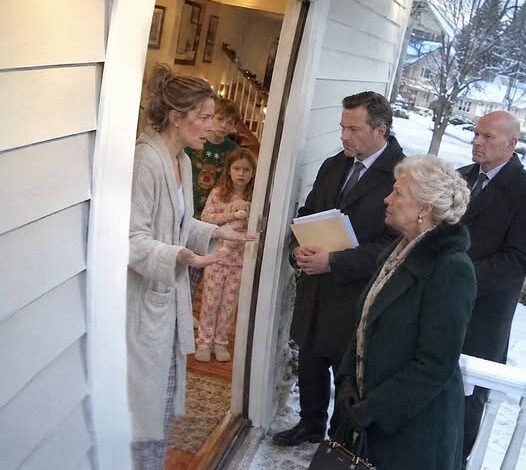
Two unfamiliar men waited behind her.
One carried a leather folder.
The other held a clipboard.
“Mom? What’s happening?”
She moved forward.
“Claire, we need to settle this nonsense.”
I remained in the doorway.
“At six in the morning?”
The taller stranger cleared his throat.
“Mrs. Claire Whitmore?”
“Yes?”
“I’m Robert Hayes, an attorney. This is Henry Pike, a title examiner.”
I looked between them.
“Why are you here?”
Robert glanced toward Mom.
“We’ve been asked to clarify the legal status of the Whitmore farmhouse.”
My stomach tightened.
Mom crossed her arms.
“Since you’re refusing to cooperate, certain matters need to be made official.”
“What matters?”
Robert opened his folder.
“The property records include a document bearing your signature.”
“What document?”
“A trustee acceptance filed after your father’s passing.”
I blinked.
“I’m sorry. A what?”
He produced an old document.
The date read November 2013.
At the bottom was a familiar signature.
Mine.
Claire Whitmore.
My heart raced.
“I don’t understand.”
Robert turned the page.
“Your father transferred the farmhouse and surrounding acreage into a trust before his death. This document identifies you as successor trustee.”
Mom’s expression shifted.
“Robert, there’s no need to explain all that now.”
He continued.
“The issue is that your mother recently attempted to use the property as collateral for another financial arrangement. The records suggest she may lack the authority.”
I turned toward her.
“Another financial arrangement?”
She avoided my eyes.
“It’s a misunderstanding.”
Henry stepped closer.
“Mrs. Whitmore, you should understand that your mother may not personally own this property.”
I tightened my grip on the doorframe.
“What?”
Robert showed me the paperwork.
“According to the recorded documents, your father placed the farmhouse in a family trust.”
I examined my signature.
Behind that page was another document bearing a notary seal.
Mom reached toward the folder.
“That’s enough.”
Robert kept it in his hands.
“Mrs. Whitmore, these records must be properly addressed.”
Mom faced me.
“Claire, just sign what they need, and everything can return to normal.”
Those familiar words echoed in my mind.
Just help. Just pay.
Just one more favor.
I looked at the two men.
“What exactly am I supposed to sign?”
Robert paused.
“A document confirming your mother’s authority to proceed with a proposed property transaction.”
“What transaction?”
Nobody answered.
For the first time, genuine fear appeared in Mom’s eyes.
Then Robert spoke.
“Mrs. Whitmore, I strongly recommend having your own attorney examine everything before you sign.”
Mom turned sharply.
“That isn’t what we discussed!”
Robert closed his folder.
“I’m explaining what she needs to understand.”
Cold morning air brushed against my bathrobe.
Behind me, the staircase creaked.
Noah stood halfway downstairs, rubbing his eyes.
“Mom?”
I turned around.
“Everything’s okay, honey. Go back upstairs.”
He looked toward the porch.
“Grandma?”
Mom immediately smiled.
“Merry Christmas, sweetheart.”
Noah remained still.
Then he asked with a child’s remarkable directness.
“Are you here because Mom wouldn’t give you money?”
Nobody spoke.
Mom’s smile disappeared.
I stepped onto the porch, pulling the door nearly shut behind me.
“Whatever this involves,” I said, “you can discuss it with my attorney.”
Mom gave a disbelieving laugh.
“Your attorney? Claire, don’t be ridiculous.”
“Then we’re finished talking.”
I closed the door.
My hands trembled as I turned the lock.
Through the window, I watched Mom arguing with Robert.
He repeatedly shook his head.
Henry stood nearby, looking uncomfortable.
Eventually, all three left.
I remained by the window until their vehicles disappeared.
Then I examined the business card Robert had quietly handed me.
On the back was a handwritten warning.
DO NOT SIGN WITHOUT COUNSEL.
By nine o’clock, I’d called Eric.
He answered immediately.
“Are the kids okay?”
“They’re fine. I need to ask something.”
“What is it?”
“Do you remember me signing documents at the farmhouse after Dad passed away?”
He paused.
“What documents?”
I explained the morning’s events.
When I mentioned the family trust, he interrupted.
“Wait. Say that again.”
“Apparently, Dad placed the property in a trust.”
“Claire, your father mentioned doing that years ago.”
I sat down.
“He did?”
“Yes. Remember when he wanted us to meet him at the bank?”
A memory suddenly returned.
A cold November morning.
Dad had been gone only a few weeks.
Mom had given me a folder at the farmhouse, explaining that the bank needed updated paperwork.
I was exhausted from grief.
She assured me everything was routine.
“I signed something,” I whispered.
Eric sighed.
“I remember. I told you to request a copy.”
“But I didn’t.”
“No.”
I shut my eyes.
“Why didn’t you say more?”
“I did, Claire. Several times. Your mother said I was being suspicious, and you believed her.”
His voice carried no accusation.
Somehow, that made his words harder to hear.
After a moment, he added, “Whatever this is, I’ll help you locate the old records.”
I thanked him.
Then I searched for a local attorney.
By noon, I’d arranged a meeting with Grace Mercer.
Grace was in her early fifties, with silver-streaked hair, dark-framed glasses, and the unmistakable expression of someone who had little patience for unnecessary drama.
Her office was on the second floor of an old brick building near downtown Marshfield.
I brought every document I could gather.
Bank statements. Tax receipts.
The old mortgage payoff confirmation.
Photographs of the paperwork Robert had shown me.
Grace listened carefully.
When I finished, she leaned back.
“Claire, I need to ask you something.”
“Okay.”
“Has your mother ever claimed she owns the farmhouse outright?”
“Constantly.”
“Has she shown you the deed?”
“No.”
Grace removed her glasses.
“Then that’s where we’ll begin.”
She turned her monitor toward me.
A scanned county record filled the screen.
My father’s name appeared at the top.
Below it were the words:
WHITMORE FAMILY LAND TRUST.
The recording date was June 2012.
More than a year before Dad passed away.
Grace pointed toward another paragraph.
“Your father transferred his ownership interest into this trust. Your mother retained certain rights to live there, but those rights had limitations.”
“What does that mean?”
“She could occupy the home under specific conditions. That doesn’t automatically authorize her to sell or mortgage it.”
I stared at the screen.
“Then who owns the property?”
“The trust.”
“And who controls it?”
Grace met my eyes.
“Based on what we’ve discovered, Claire, that person may be you.”
I felt dizzy.
For thirteen years, I’d sent money to maintain what Mom called her house.
For thirteen years, she’d insisted I owed her.
Now I was learning that she might have been asking me to protect property she didn’t personally own.
“Did she know?” I whispered.
Grace paused.
“We need more evidence before reaching that conclusion.”
I nodded.
But I was beginning to understand Mom’s reaction on my porch.
Two days later, the first substantial evidence emerged.
Grace obtained additional property records and contacted the attorney who’d prepared Dad’s estate plan.
His name was Joseph Keene.
He’d retired years earlier and now lived near Wausau.
When Grace called, he remembered Dad immediately.
“Paul Whitmore,” he said. “Worked at the cheese plant. Always carried peppermint candy.”
My eyes filled with tears.
That was Dad.
Exactly as I remembered him.
Joseph explained that my father had inherited the farmhouse property from his parents.
He’d established the trust because he was concerned about growing family debts.
“He wanted to protect the land,” Joseph explained. “Especially against future borrowing.”
I closed my eyes.
Dad had understood the financial problems.
He’d recognized where things were heading.
Joseph continued.
“He made it clear that his wife could remain in the farmhouse, but the property itself should be preserved for the next generation.”
“Which generation?”
Joseph hesitated.
“I’d prefer Grace to examine the complete trust before we discuss its beneficiaries.”
My heartbeat quickened.
“Why?”
“Because several provisions are unusual.”
I glanced at Grace.
She wrote something on her legal pad.
Joseph added, “A complete trust binder should have been delivered to the successor trustee after Paul’s death.”
“I never received one.”
Silence.
“Are you certain?”
“Absolutely.”
He sighed.
“Then that’s our first issue.”
After the call, Grace looked at me.
“We need to locate that binder.”
“Mom probably has it.”
“That’s possible.”
I shook my head.
“She’ll never hand it over.”
Grace folded her hands.
“Then we’ll request it formally.”
Outside, snow drifted past the windows overlooking Main Street.
Suddenly, this was no longer about $5,200.
It concerned my father.
And something important he’d wanted me to understand.
Mom called that evening.
I watched her name appear before answering.
“Claire, Jenna says you’ve hired some aggressive attorney who’s threatening our family.”
“Grace isn’t threatening anyone.”
“She’s demanding private paperwork.”
“Documents containing my name.”
Mom sighed.
“Honestly, what’s gotten into you?”
“What is the Whitmore Family Land Trust?”
She fell silent.
Then she asked, “Where did you hear about that?”
“County records.”
“That’s ancient paperwork.”
“It’s legally recorded paperwork.”
“Your father loved complicated arrangements. Half of them never meant anything.”
“Then why didn’t you tell me?”
“Because you already had enough responsibilities.”
I gave a humorless laugh.
“Mom, I gave you $46,000 while I was pregnant.”
“And I’ve thanked you countless times!”
“Did you know I was the successor trustee?”
“Claire—”
“Did you know?”
Her voice lowered.
“Your father wasn’t thinking clearly toward the end.”
I tightened my grip on the phone.
Dad had been exhausted.
He’d mourned his older brother. He’d struggled with high bl00d pressure. But he’d remained perfectly capable of making decisions.
“Don’t do that,” I said.
“Do what?”
“Don’t question Dad’s judgment just because you’re upset with me.”
Her voice turned cold.
“You have no idea what it took to keep this family together.”
“Then explain it.”
Instead, she said something I’ll never forget.
“That house belongs to me because I stayed. You can’t claim it just because your father signed some documents.”
I stood motionless.
She hadn’t denied knowing about the trust.
Not once.
Then she continued.
“And after your stunt with the taxes, Jenna and I have every right to protect ourselves.”
“Protect yourselves from what?”
She ended the call.
Three days later, Aunt Carol called.
Carol was Dad’s older sister.
At family gatherings, she was usually the quiet observer, bringing homemade bread and listening from the far end of the table.
“Claire,” she began softly, “I owe you an apology.”
“For what?”
“Christmas.”
I sat down.
She explained that Mom had told everyone we weren’t attending.
“She said the children had a stomach bug.”
I stared at the wall.
“What?”
“Your mother claimed you’d called that morning and asked everyone not to bother you.”
I was speechless.
Carol continued.
“I thought it was strange. Sophie had mentioned making me a Christmas ornament. But Evelyn sounded certain.”
“Did Jenna know?”
Carol hesitated.
“Jenna suggested you were being dramatic because you and Eric had been arguing.”
My face grew warm.
Eric and I hadn’t argued in months.
We’d even exchanged Christmas gifts with the children on Christmas Eve.
“Carol, Mom invited us. She promised to send the dinner time. We spent Christmas afternoon dressed and waiting.”
“Oh, Claire.”
The sadness in her voice nearly brought me to tears.
Then she added, “There’s something else.”
“What?”
“I saw two men at the farmhouse that afternoon. One wore a suit. Jenna introduced him as someone assisting with property planning.”
I straightened.
“Property planning?”
“They had maps spread across the kitchen table. When I asked about them, Evelyn told me everything was fine.”
My heart raced.
“What kind of maps?”
“Survey maps, I believe. Colored lines marked different parts of the pasture.”
I remembered Robert’s warning.
The documents Mom wanted signed.
Her sudden urgency about the property taxes.
Carol lowered her voice.
“Claire, I don’t believe your mother forgot to invite you.”
I closed my eyes.
“I know.”
“No, sweetheart. I mean I don’t think she wanted you anywhere near that farmhouse.”
The next morning, Grace discovered why.
A development company from Eau Claire had offered to purchase part of the Whitmore property.
The company wanted approximately ten acres for a distribution and storage facility.
The proposed purchase price was astonishing.
$1.35 million.
I stared at the figure.
“That can’t be right.”
Grace shook her head.
“The property borders an expanding commercial corridor. Apparently, the company has been purchasing nearby parcels.”
I studied the map.
The pasture where Dad taught me to drive his old pickup.
The maple trees.
The machine shed.
The pond where Noah caught his first fish.
All marked inside a red boundary.
“Mom agreed to sell?”
“She signed a preliminary agreement. Jenna was named as an authorized representative.”
My mouth went dry.
“Authorized by whom?”
“That’s part of the problem.”
Grace handed me another document.
My name appeared near the bottom.
CLAIRE WHITMORE — SUCCESSOR TRUSTEE.
Below it was a signature.
My signature.
Or something remarkably similar.
The date was December 25.
Christmas Day.
At 1:11 p.m.
I stared at those details.
At that exact time, I’d been standing in my kitchen checking my phone while my children waited to visit Grandma.
I hadn’t been at the farmhouse. I hadn’t signed anything.
“That’s not my signature.”
Grace nodded thoughtfully.
“I suspected you’d say that.”
I examined it more carefully.
The curve of the C.
The extended tail on the final e.
The small downward hook I once made when signing quickly.
Everything looked familiar.
Too familiar.
Then I remembered the November 2013 document.
I retrieved my copy.
Placed both pages beside each other.
And felt a chill.
The signatures matched exactly.
Not merely similar.
Identical.
Even a tiny break in the ink appeared in the same place.
Someone appeared to have reproduced my old signature on a new document.
Grace examined both pages.
“That’s significant evidence that the newer signature may have been copied from the earlier record.”
I struggled to process it.
“So they didn’t simply exclude us from Christmas.”
“No.”
“They were using that afternoon to arrange the farm’s sale.”
Grace looked serious.
“That’s what we need to establish.”
I leaned back.
Suddenly, the pieces began fitting together.
The early dinner.
Jenna’s laughter.
Mom’s refusal to confirm a time.
The strangers examining survey maps.
My children and I hadn’t simply been forgotten.
It appeared we’d been deliberately kept away while they arranged a property transaction without my knowledge or authorization.
That evening, I drove to Eric’s apartment.
The children were staying with him, and I wanted to discuss the documents in person.
He opened the door wearing an old Packers sweatshirt.
“Hey. What’s wrong?”
I showed him the copied agreement.
“Someone used my signature to sell Dad’s land.”
His expression changed.
He invited me inside.
I explained everything.
By the time I finished, he sat motionless.
“Claire, this is more than a family disagreement.”
“I know.”
“Have you contacted the authorities?”
“Grace wants us to preserve all the evidence first.”
He nodded.
Then he looked at me with genuine concern, something I hadn’t seen in years.
“Are you okay?”
I tried answering.
Instead, I burst into tears.
Not quietly or carefully.
I cried harder than I had since Dad’s funeral.
Eric sat beside me.
He waited before offering a tissue.
“I should’ve pushed harder back then,” he said.
I shook my head.
“No. You tried.”
“Not hard enough.”
“You warned me. I just couldn’t accept what was happening.”
He looked down.
“Your mother convinced you that refusing her meant abandoning her.”
I wiped my cheeks.
“She still believes that.”
Eric met my eyes.
“Then perhaps it’s time she understood the difference.”
I stayed another hour.
We discussed our children, our marriage, and how two people can care deeply for each other yet lose sight of what matters.
Before I left, Eric retrieved a worn cardboard box from his bedroom.
“These are old tax records from our marriage. I kept them after the divorce because I never got around to shredding anything.”
He handed me the box.
“Maybe something will help.”
That night, I sorted through financial statements.
Near midnight, I discovered the original $46,000 transfer confirmation.
The payment had gone directly to the bank.
Dad’s mortgage really had been settled.
Somehow, that discovery hurt almost as much as the questionable signature.
Part of me had hoped the debt hadn’t been real.
That perhaps we hadn’t truly sacrificed our first home.
But we had.
I’d helped save the farmhouse.
And for eleven years afterward, the people living there continued treating my financial support as an obligation.
The following week, everything intensified.
Grace contacted the development company’s attorney, presenting evidence that the proposed sellers lacked clear authority to transfer the property.
The transaction was suspended.
An independent title examination began.
Mom called eleven times that day.
I ignored every call.
Then Jenna texted.
“You’re ru!ning Mom’s life over one stupid Christmas dinner.”
I stared at the message.
Then replied:
“Christmas dinner didn’t create the questionable signature.”
Three typing dots appeared.
Disappeared.
Then returned.
Finally, Jenna answered.
“You’re going to regret this.”
I saved our conversation.
Then blocked her number.
Two days later, a letter arrived from a private financing company.
Mom and Jenna had received a substantial advance connected to the anticipated land sale.
$105,000.
The payment had been issued based on their representations that they possessed authority to complete the transaction.
Now the company wanted explanations.
I read the letter repeatedly.
Mom hadn’t actually needed $5,200 for property taxes.
Grace confirmed those taxes were already covered through agricultural lease income and available reserves.
Instead, the $5,200 was intended for expenses and fees associated with the financing arrangement.
Mom had misrepresented that, too.
I remembered her words.
“The property taxes are due. We need fifty-two hundred.”
Not a request.
An expectation.
Another expense Claire was supposed to cover.
Except this time, my payment might have helped advance a transaction involving a signature I hadn’t authorized.
I felt nauseated.
Grace noticed.
“Claire?”
“What if I’d given her the money?”
She considered my question.
“Then you might never have discovered what it was really for.”
I looked outside.
Snow drifted between nearby buildings.
For years, I’d interpreted Mom’s financial demands as evidence that she needed me.
Now I understood something far more troubling.
She hadn’t simply needed me to save the farmhouse.
She’d needed me to keep helping without asking questions.
The following Friday, Mom appeared at my workplace.
I worked in accounting for a regional medical supply company.
The job wasn’t glamorous, but it covered our expenses and let me collect the children most afternoons.
At 3:20 p.m., the receptionist called.
“Claire, your mother’s here. She says it’s urgent.”
My stomach tightened.
I entered the lobby.
Mom sat beneath a framed landscape photograph, holding her purse.
She stood when she saw me.
“Thank goodness.”
“Mom, you can’t show up here.”
“I’ve tried reaching you for days.”
“Then contact Grace.”
She glanced around.
“Can we talk privately?”
I took her into an empty conference room.
Once the door closed, her expression hardened.
“Do you understand what you’ve done?”
I crossed my arms.
“What exactly?”
“The buyers are threatening legal action. Jenna is overwhelmed. I haven’t slept.”
I looked straight at her.
“Did you copy my signature?”
Her lips parted.
Then closed.
“That’s a serious accusation.”
“Did you?”
“Your father wanted this family protected.”
“That wasn’t my question.”
She gripped the table.
“Everything I’ve done was for our future.”
“Whose future?”
She appeared offended.
“Our family’s!”
I gave a bitter laugh.
“Then why weren’t my children invited to Christmas?”
Her eyes narrowed.
“You’re still bringing that up?”
“Yes.”
“Claire, it was one dinner.”
“No, Mom.”
I moved closer.
“It was eleven years of Noah learning not to expect birthday cards.”
“Eight years of Sophie wondering why Jenna’s friends were welcome at your gatherings while she wasn’t.”
“It was every emergency I helped pay for and every family celebration where we barely mattered.”
Mom shook her head.
“You’re exaggerating.”
I reached into my bag and removed a photograph.
Sophie wearing her red Christmas sweater.
Noah standing beside her.
Both waiting near our front door.
I placed it on the table.
“This is what happened.”
Mom glanced at the picture.
Then turned away.
“They look fine.”
Suddenly, I felt completely still.
Not angry.
Not even sad.
Just certain.
I picked up the photograph.
“Please leave my workplace, Mom.”
Her eyes widened.
“Claire—”
“Please.”
She stood.
At the doorway, she turned back.
“Your father would’ve been ashamed of how you’re treating me.”
I met her gaze.
“Then I’m glad we’re finally discovering what he actually wanted.”
Her face went pale.
For a moment, I thought she might finally explain everything.
Instead, she walked away.
The farmhouse carried a familiar scent I’d nearly forgotten.
Aged wood.
Coffee.
Cinnamon.
And a faint trace of the machine oil that once clung to Dad’s work clothes.
Grace had arranged an inspection of the trust property, and Mom had reluctantly granted access.
Neither Mom nor Jenna was home.
Aunt Carol waited near the driveway.
“I thought you might appreciate a familiar face,” she said.
I hugged her.
Inside, almost nothing had changed.
The yellow curtains.
The ceramic rooster on the counter.
The long maple dining table beneath its chandelier.
I stopped beside it.
Seven chairs.
Not nine.
Seven.
I remembered Mom saying she’d expanded the table for Christmas.
I pictured my children entering with their carefully wrapped presents.
Then I remembered Noah asking whether they’d done something wrong.
Carol noticed my expression.
“Claire?”
I shook my head.
“Let’s check Dad’s shed.”
The machine shed stood behind the farmhouse, snow covering its metal roof.
Inside, everything seemed frozen in time.
Dad’s workbench remained beneath the narrow window.
A steel vise was attached to one corner.
Rusty coffee cans held screws, old tools lay scattered, and a calendar still displayed September 2013.
I touched the vise.
Dad had taught me to use it when I was ten.
“Measure twice, Peanut,” he’d always say.
“You only get one chance to cut it right.”
I smiled through tears.
Grace searched several filing cabinets.
Most drawers were empty.
But in the bottom drawer of a narrow metal cabinet, behind an old service manual, Carol discovered a sealed plastic pouch.
Inside were photocopied documents.
A handwritten inventory.
And a letter.
My name appeared across the envelope.
CLAIRE.
I sat on Dad’s stool.
My hands trembled as I opened it.
The paper smelled slightly musty.
His familiar handwriting covered three pages.
“My dearest Peanut,” it began.
I stopped reading.
Nobody had called me Peanut since Dad passed away.
After several moments, I continued.
Dad wrote about the farmhouse.
About his parents’ sacrifices to preserve it.
About the years he’d spent repairing machinery to support his daughters and maintain the property.
Then came something unexpected.
“I’ve made decisions I regret.”
“I helped Jenna when that help sometimes prevented her from learning responsibility.”
“And I asked you to carry too much because you always made difficult things look easy.”
My vision blurred.
“I know your mother sees things differently.”
“She believes the person who complains the least must need the least.”
“I allowed her to think that for far too long.”
I covered my mouth.
Grace and Carol remained respectfully silent.
Then I read the next paragraph.
“One day, after I’m gone, someone may tell you that protecting this family requires sacrificing your own.”
“Don’t believe it.”
“A family that survives only because one person sacrifices everything isn’t being protected.
It’s being allowed to remain broken.”
I lowered the letter.
For thirteen years, I’d wondered whether Dad would have expected me to keep paying.
Now I had my answer.
He’d noticed.
He’d understood.
And he’d tried to warn me.
The final paragraph made me pause.
“I couldn’t give you the life you deserved, Peanut. But I made certain there was something nobody could take from the family you create.”
Below those words was a reference to another trust document.
Schedule B.
It wasn’t inside the pouch.
Only a handwritten note remained.
“Original deposited with Keene office, duplicate in sealed estate packet.”
Grace examined it.
Then looked at me.
“We need Schedule B.”
“Why?”
“Because it identifies the final beneficiaries.”
I studied Dad’s handwriting again.
Something nobody could take from the family you create.
My heart raced.
Finding Schedule B took almost two weeks.
Joseph Keene had retired, and his older files were stored off-site.
The first copy we obtained was incomplete.
Water had damaged several pages.
Grace contacted the bank holding the original trust records.
Meanwhile, matters with Mom deteriorated.
The development company officially withdrew its offer.
The financing company demanded repayment.
Jenna hired her own attorney.
And Mom began telling relatives I intended to remove her from the farmhouse.
Messages flooded my phone.
“She’s your mother.”
“How could you treat her this way?”
“Your father would’ve never wanted this.”
I stopped reading after the fifth message.
Then an email arrived from an unfamiliar address.
It contained a photograph.
Mom seated at the Christmas table.
Jenna beside her.
Aunt Carol at the far end.
Several cousins.
Full plates.
Smiling faces.
The timestamp showed 12:47 p.m.
Beneath the photograph was a message.
“Maybe you should remember what family really means.”
I stared at the picture.
Then something caught my attention.
Near the table’s edge sat a brown leather folder.
The same folder Robert Hayes had brought to my doorstep.
Behind Jenna, partly obscured by flowers, was a man in a gray suit.
He wasn’t a relative.
I enlarged the photograph.
He was holding documents.
Across the top was a familiar logo.
The development company’s.
Mom hadn’t simply celebrated Christmas without us.
She’d used Christmas dinner to conduct a business meeting.
At the very table where Dad once said grace.
I forwarded the photograph to Grace.
She called almost immediately.
“Claire, where did you find this?”
“Someone emailed it anonymously.”
“Do you recognize that man?”
“No.”
“Preserve the original email. Don’t modify anything.”
“Why?”
Her voice grew serious.
“This could help establish who attended the meeting when those documents were signed.”
I examined the photograph again.
For years, I’d wondered why Mom favored Jenna.
Now I had another question.
How long had they been planning to disregard Dad’s wishes?
Jenna provided the next answer herself.
Three days later, she appeared outside my duplex.
She wore an expensive designer coat.
Her hair was perfectly arranged.
But her eyes were red.
“Can we talk?” she asked.
I considered shutting the door.
Instead, I stepped onto the porch.
“What do you need?”
She glanced toward the neighboring houses.
“Not out here.”
“Then contact Grace.”
“Claire, please.”
Something about her voice stopped me.
For once, she didn’t sound demanding.
She sounded frightened.
I allowed her into the kitchen.
She looked around.
The children’s drawings.
Our inexpensive furniture.
The mismatched mugs drying beside the sink.
Then she spoke.
“I didn’t realize money was so tight for you.”
I stared.
“What?”
“You never told me.”
I almost laughed.
“When would you have listened?”
She lowered her eyes.
“That’s unfair.”
“No, Jenna. What’s unfair is that I helped settle your salon debt while pregnant, and you laughed when Mom told me Christmas dinner was finished.”
Her cheeks reddened.
“I wasn’t laughing at the children.”
“Then what was funny?”
She looked away.
“Mom said you’d probably call at the worst possible time.”
My chest tightened.
“The worst possible time?”
She rubbed her forehead.
“The developer was there. Mom was trying to finalize everything.”
“So she knew we were waiting.”
Jenna stayed silent.
“She knew.”
“Claire—”
“And you knew, too.”
She looked up.
“Mom said if you came, you’d start asking questions about the property. She said you were always suspicious about money.”
I stared at her.
“You knew I was bringing Noah and Sophie.”
“Yes.”
“And you didn’t tell me.”
Her eyes filled with tears.
“I thought Mom would call afterward.”
I gave a disbelieving laugh.
“After someone copied my signature?”
Her expression changed.
“I didn’t do that.”
“Then who did?”
She shook her head.
“I don’t know.”
I watched her carefully.
For the first time, Jenna seemed to realize how serious everything had become.
“Tell me about the advance,” I said.
She froze.
“How much did you know?”
Her silence was revealing.
Finally, she whispered, “Mom said we’d split the money from the sale.”
My heart sank.
“Split it?”
“She said Dad never intended you to control everything. That the trust was a mistake.”
“And you believed her.”
Jenna wiped her cheeks.
“She promised me half.”
I glanced around my kitchen.
The refrigerator’s dented handle.
The worn flooring.
The bills beside the microwave.
Then I looked at my sister.
While I carefully managed grocery expenses, Mom and Jenna were planning to divide more than a million dollars from property they didn’t personally own.
“Where’s the $105,000?” I asked.
Jenna’s face crumpled.
“Some paid Mom’s debts. Some paid mine.”
“How much remains?”
She shook her head.
Very little.
Possibly nothing.
Then she said something unforgettable.
“Mom said if you loved us, you’d sign whatever she needed.”
I stared at her.
Suddenly, our family dynamic became painfully clear.
They didn’t seem to recognize my rights.
They only recognized my responsibilities.
Jenna stood to leave.
At the doorway, she paused.
“Claire?”
“What?”
“Mom doesn’t know I came.”
“Okay.”
She swallowed.
“I’ve never seen her this frightened.”
I looked at my sister.
“She has reason to be concerned.”
The next discovery was more upsetting than I’d imagined.
Grace called Tuesday afternoon.
“Can you come to my office?”
“What happened?”
“I’d rather explain in person.”
My stomach tightened.
I drove downtown.
Henry Pike was waiting in Grace’s conference room.
He looked exhausted.
Several certified property documents lay across the table.
Grace offered me a chair.
“Claire, Henry located another filing connected to the proposed sale.”
He handed me a document.
Its heading read:
AFFIDAVIT OF HEIRSHIP AND FAMILY STATUS.
I frowned.
“What is this?”
“A sworn statement signed by your mother.”
I began reading.
It described Dad’s passing.
His property.
His surviving relatives.
Then I reached a paragraph that stopped me.
“To the best of my knowledge, Paul Whitmore left no surviving descendants with a present claim to the property other than Jenna Whitmore.”
I read it twice.
Then a third time.
My name was missing.
So were Noah’s and Sophie’s.
Only Jenna appeared.
I looked up.
“She claimed Dad had only one daughter?”
Grace nodded.
“And no grandchildren with a relevant property interest.”
I stared at the document.
“That’s false.”
“Yes.”
“She knows it’s false.”
“Yes.”
I turned the page.
Mom had signed before a notary.
The date was December 25.
Christmas Day.
At 12:52 p.m.
Five minutes after the photograph was taken.
I felt overwhelmed.
While my children waited in their Christmas sweaters, Mom had signed a sworn statement that omitted us as potential beneficiaries.
She hadn’t merely left us out of Christmas dinner.
She’d attempted to exclude us from the inheritance Dad intended for his family……………………….READ MORE NEXT PAGE