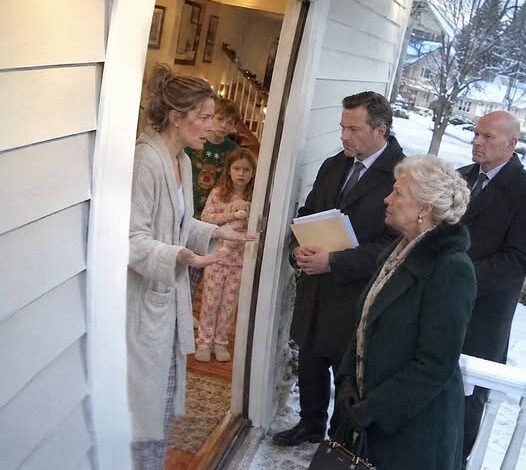
My Mother Forgot to Invite My Two Children to Christmas Dinner, Then Called a Week Later Demanding $5,200. When I Finally Refused, She Appeared at My Door at 6 A.M. With Two Strangers and a Mysterious Folder.
I covered my face.
For several moments, I couldn’t speak.
Then a quiet question escaped.
“Why would she do this to us?”
Grace moved closer.
“Claire, I can’t explain why your mother made these decisions.”
I shook my head.
“I spent my entire life trying to make her happy.”
My voice trembled.
“I gave her our savings. I spent years helping her. My children love her.”
I looked at the document again.
“And she signed something pretending we had no place in this family.”
Henry lowered his gaze.
Grace gently rested a hand on my shoulder.
“She doesn’t get to make that true.”
I started crying.
Not because of the property.
Not because of money.
But because the document confirmed something I’d refused to accept.
My mother hadn’t simply overlooked my children’s feelings. She was willing to leave them out of our family’s history whenever acknowledging them became inconvenient.
When I finally calmed down, Grace offered me a tissue.
“We’ll handle this carefully,” she said. “And we’ll follow the proper legal process.”
I nodded.
“Good.”
For once, I wasn’t looking for an apology.
I wanted the truth officially established.
The legal dispute continued for months.
Meetings.
Written statements.
Document requests.
Questions about the copied signature and inaccurate affidavit.
The development company cooperated with the title investigation.
The financing company pursued separate claims against Mom and Jenna.
Robert Hayes withdrew from representing Mom once the conflicts surrounding the transaction became apparent.
He provided relevant records through appropriate legal channels.
Grace began proceedings to confirm the trust’s authority and prevent unauthorized property transfers.
I learned more about property law than I ever expected.
I also discovered that being right didn’t make the experience easy.
Mom’s friends stopped contacting me.
Some relatives accused me of trying to take an elderly widow’s home.
Jenna alternated between apologizing and blaming me for their financial troubles.
Every unexpected phone call made me anxious.
But something remarkable happened.
The less responsibility I accepted for everyone else’s emotions, the more peaceful our home became.
I stopped checking messages during dinner.
I stopped explaining why I couldn’t lend money I didn’t have.
I learned to say no without repeatedly apologizing.
Sophie started swimming lessons.
Noah got new winter boots.
And when spring break arrived, we finally visited Wisconsin Dells.
For three wonderful days, I watched my children race between waterslides, splash in the pool, and eat enormous stacks of pancakes.
One evening, we sat beside our hotel window, watching lights shimmer across the water.
Sophie leaned against me.
“Mommy?”
“Yes?”
“Are we rich now?”
I laughed.
“No, sweetheart. Not even close.”
She considered my answer.
“Then how come we get to do fun things?”
I looked at her.
Because I’d finally stopped giving away everything we had.
Because I’d realized that enjoying life wasn’t irresponsible.
Because my children deserved happy memories that didn’t depend on Grandma’s approval.
Instead, I kissed her forehead.
“Because sometimes we need to remember what matters most.”
Noah looked up from his hot chocolate.
“I like this version of our family.”
My throat tightened.
“Me too, buddy.”
Then he added, “But I liked the old version, too. When we stayed home for Christmas.”
I smiled.
“We were the same family.”
He shook his head.
“Not exactly.”
“What do you mean?”
He studied me with an expression unusually thoughtful for an eleven-year-old.
“At Christmas, you still looked sad all the time.”
I couldn’t answer.
He reached across the table and squeezed my hand.
“You don’t anymore.”
In that moment, I knew our trip had been worth more than anything I’d ever given Mom.
The original trust schedule arrived in April.
Grace called while I was preparing spaghetti.
“Claire, the bank found the sealed estate packet.”
My heart skipped.
“Schedule B?”
“Yes.”
“Does it explain what Dad wanted?”
She paused.
“It does. I’d like you to come tomorrow.”
I stared at the boiling pot.
“Is something wrong?”
“No. But there’s more than we anticipated.”
I barely slept.
The following morning, I dropped the children at school and drove downtown.
Grace had the original packet waiting.
Its envelope was yellowed but undamaged.
Dad’s signature crossed the back flap.
Inside were several pages identifying the Whitmore Family Land Trust’s beneficiaries.
I’d expected my name.
Perhaps Jenna’s.
Maybe both.
Instead, the wording surprised me.
The trust designated me successor trustee.
But its long-term beneficiaries were the children born to or legally adopted by me, along with their descendants.
My hands trembled.
“Grace…”
She nodded.
“Your father didn’t leave the property directly to you.”
I stared.
“He left it to my children?”
“Ultimately, yes. The trust protects your children and future generations.”
I looked down.
When Dad prepared these documents, Noah hadn’t been born.
Neither had Sophie.
Dad had never seen their faces.
Never heard them laugh.
Never held them.
Yet he’d planned for their future.
Tears filled my eyes.
Grace waited.
Then she turned another page.
“There’s more.”
The trust included detailed restrictions on selling, borrowing against, or transferring the property.
Mom had received a conditional lifetime right to live in the farmhouse.
She could occupy the home.
Maintain it.
Use the surrounding land within the trust’s rules.
But she couldn’t mortgage it, sell it, or redirect its value for personal benefit.
An unauthorized attempt to sell or use the property as collateral could also result in termination of her occupancy rights, subject to the trust’s required notice and enforcement procedures.
I stared at the page.
“Did Mom know?”
Grace met my eyes.
“Your father required her written acknowledgment of these restrictions.”
She showed me another page.
There was Mom’s signature.
Dated June 2012.
More than a year before Dad passed away.
My breath caught.
She hadn’t simply misunderstood.
She’d known about the restrictions all along.
“Why would Dad arrange this?” I whispered.
Grace hesitated.
Then handed me another letter.
It was separate from the one we’d discovered in the shed.
Dad had written it when establishing the trust.
The envelope was addressed:
MY FUTURE GRANDCHILDREN.
I held it against my chest before opening it.
Inside, Dad had written:
“I don’t know your names yet.
I don’t know whether you’ll resemble your mother or inherit her stubborn personality.
But if you’re reading this, I hope you understand that someone loved you long before meeting you.”
I covered my mouth.
He continued.
“I’ve spent most of my life repairing machines.
When machinery fails, you can usually identify the damaged part.
Families are more complicated.
Sometimes the person carrying the greatest responsibility is expected to continue until there’s nothing left to give.”
Tears dropped onto the paper.
“Your mother is the strongest person I know.
That’s why I worry about her.
People sometimes mistake strength for permission to demand more.”
Then came the words that overwhelmed me.
“If I can’t restore everything she’s sacrificed, perhaps I can give her children something that reminds them they never have to buy their place at the family table.”
My vision blurred.
Dad had passed away before Noah’s birth.
He’d never met Sophie.
Yet thirteen years earlier, he’d somehow understood what my children might need.
Not simply property.
Not merely money.
Belonging.
A place that couldn’t be taken away because someone considered them inconvenient.
Grace offered another tissue.
“Claire, there’s one final provision.”
I looked up.
“What is it?”
She pointed toward the last page.
Dad had directed that, once the conditions for distributing the property were satisfied, part of the income generated by the land could support the beneficiaries’ education and essential needs.
The trust wasn’t merely designed to preserve a farmhouse.
It was meant to protect a future.
The very future Mom had attempted to sell.
The hearing took place several weeks later.
I wore a navy dress and the simple silver necklace Dad had given me for my twenty-first birthday.
Mom sat across the courtroom with Jenna.
She looked older.
Her hair seemed thinner.
Dark shadows surrounded her eyes.
For a brief moment, I wanted to approach her.
Ask whether she’d eaten.
Whether she was sleeping.
Whether she needed groceries.
Then I remembered the affidavit.
The copied signature.
The Christmas sweaters.
And I remained seated.
The court reviewed the recorded trust documents and disputed property transaction.
Grace presented the evidence methodically.
The 2012 deed.
The 2013 trustee acceptance.
The signature appearing on the Christmas Day paperwork.
The affidavit that incorrectly omitted Dad’s surviving descendants.
The financial records connected to the attempted sale.
Mom’s attorney argued that she’d believed she possessed broader authority over the property.
Grace produced Mom’s signed acknowledgment of the trust restrictions.
I watched her shoulders sink.
Jenna stared at her hands.
When the judge questioned Mom about the affidavit, her voice was barely audible.
“I was trying to protect my home.”
The judge asked whether she knew I was alive.
“Of course.”
Whether she knew I had children.
“Yes.”
Whether she’d signed the affidavit.
Mom hesitated.
Then answered.
“Yes.”
The courtroom fell silent.
The judge examined the document.
“Then why did the statement fail to identify them?”
Mom’s eyes filled with tears.
For a moment, she looked directly at me.
I waited.
Part of me still hoped she’d admit making a terrible mistake.
That she regretted her decisions.
That she’d never intended to hurt my children.
Instead, she whispered:
“Claire has always had more than Jenna.”
I stared at her.
The judge requested clarification.
Mom lowered her gaze.
“Claire had a husband. Children. A career. She was always capable. Jenna needed something of her own.”
An awful emptiness settled over me.
That was her explanation.
Mom had looked at the life I’d worked to build and decided my independence meant I deserved less.
My children had been overlooked because they already had me.
Meanwhile, Jenna, who’d received help through every difficulty, deserved the property because she hadn’t learned to manage without support.
Grace requested permission to ask a question.
The judge agreed.
She turned toward Mom.
“Mrs. Whitmore, did Claire contribute approximately $46,000 toward paying off the mortgage on this property in 2014?”
Mom nodded.
“Yes.”
“Did she continue helping financially afterward?”
“Sometimes.”
Grace placed a summary of bank records before the court.
“More than sometimes, wouldn’t you agree?”
Mom looked away.
Grace continued.
“During those years, did Claire ever ask you to transfer ownership of the farmhouse?”
“No.”
“Did she demand repayment?”
“No.”
“Then why did you believe she’d interfere with the sale?”
Mom stared at the table.
Finally, she whispered:
“Because she would’ve said no.”
There it was.
The truth.
No complicated explanation.
No misunderstanding.
She’d deliberately kept me away because she knew I’d protect Dad’s wishes.
The court ultimately confirmed the trust’s authority over the property and ordered protections against unauthorized transfers.
Questions surrounding the disputed documents and financing were referred for further investigation and separate proceedings.
Mom’s attempt to treat the land as her personal property had failed.
But her right to remain in the farmhouse was still unresolved.
The trust allowed enforcement of the restrictions she’d violated.
Grace explained that I had grounds to begin terminating Mom’s occupancy rights.
I could pursue legal steps to remove her.
After everything, few people would’ve questioned that decision.
But it wasn’t so simple.
The woman who’d tried to exclude my children was still my mother.
And the farmhouse she’d attempted to sell was where Dad had taught me to ride a bicycle.
That evening, after the children fell asleep, I sat at our kitchen counter.
Dad’s letter lay open beside me.
I repeatedly read its final paragraph.
“Never let anyone convince you that love is measured by how much you’re willing to sacrifice.”
I wanted to hate Mom.
That would’ve been easier.
Instead, I felt grief.
For the mother I had.
And for the mother I’d spent thirty-nine years hoping she’d become.
I remembered being seven, waiting outside school after a concert.
Mom had promised to attend.
But she’d forgotten.
Jenna had been sick, and Mom had taken her shopping afterward to cheer her up.
Dad arrived late, still wearing his work uniform.
He found me sitting alone with my paper certificate.
“Hey, Peanut.”
I struggled not to cry.
“Mom forgot.”
Dad sat beside me.
He studied the certificate.
Then looked at me.
“Well, I didn’t.”
He took me for ice cream.
I hadn’t remembered that afternoon in years.
Now I understood something.
Dad had spent his life quietly repairing the disappointment Mom left behind.
And when he realized he couldn’t always do that, he’d arranged one final protection.
Not for himself.
For me.
For the children he hoped I’d someday have.
I folded his letter.
Then made my decision.
I wouldn’t deliberately ruin Mom’s life.
But I wouldn’t sacrifice my children’s future to shield her from the consequences of her choices.
Grace prepared a formal proposal.
Mom could temporarily remain in the farmhouse under a supervised occupancy arrangement while a lawful, permanent solution was established.
She couldn’t borrow against, sell, lease, or otherwise dispose of trust assets.
Her financial responsibilities would be documented.
The trust would no longer depend on my informal payments.
Jenna would have no authority over the property.
Further interference would trigger enforcement proceedings.
Most importantly, Mom couldn’t access funds intended for Noah and Sophie.
It wasn’t forgiveness.
It was a boundary.
A genuine one.
The first I’d ever established with her.
After receiving the proposal, Mom requested a meeting.
We chose a small diner outside Marshfield.
Neutral ground.
No maple dining table.
No childhood memories in every corner.
She arrived fifteen minutes early.
When I entered, she was staring into her coffee.
She looked up.
“Claire.”
“Mom.”
I sat opposite her.
For several moments, neither spoke.
Finally, she said, “I never imagined you’d do this to me.”
I felt the familiar temptation.
To defend myself.
To soften my response.
Instead, I asked, “Do what?”
“Take away my control of the farmhouse.”
I folded my hands.
“Mom, you attempted to sell property Dad placed in trust.”
“I lived there forty years.”
“I know.”
“I raised you there.”
“I know.”
“I said goodbye to your father in that house.”
My throat tightened.
“So did I.”
She looked away.
Then whispered, “I thought I was going to lose everything.”
I watched her.
“Did you consider what Noah and Sophie might lose?”
She frowned.
“What?”
“When you signed that affidavit and omitted them as potential beneficiaries, did you think about my children?”
Her lips trembled.
“I never wanted to hurt them.”
“But you understood what you were signing.”
She stared at the table.
I waited.
Finally, she whispered, “I didn’t think it would matter.”
Those words hurt more than shouting.
I stared at her.
“That’s exactly the problem, Mom.”
She looked up.
“You never considered whether it mattered to us.”
Tears filled her eyes.
“Claire, I’m sorry.”
I wanted to believe her.
I truly did.
But I’d heard apologies before.
Usually followed by another request.
So I asked one question.
“What are you sorry for?”
She hesitated.
Then answered, “For creating such a mess.”
My remaining hope faded.
Not for hurting my children.
Not for the unauthorized signature.
Not for misleading us.
For creating a mess.
For facing consequences.
I stood.
Mom reached across the table.
“Claire, please.”
I looked at her outstretched hand.
Then her face.
“I hope someday you understand what happened.”
She began crying.
“You’re my daughter.”
I nodded.
“Yes.”
My voice trembled.
“But Noah and Sophie are my children.”
I picked up my purse.
“And I will never make them pay for being loved.”
Then I left.
Summer arrived slowly in Wisconsin.
The snow disappeared.
The maples turned green.
School ended.
And our lives settled into a peaceful routine I hadn’t realized was possible.
Legal matters remained unresolved.
The attempted sale had created serious financial consequences for Mom and Jenna.
The financing company pursued repayment.
The disputed documents remained under investigation.
The trust’s restrictions were formally enforced.
Mom eventually accepted the supervised occupancy arrangement while the remaining issues were addressed.
Jenna left the farmhouse and found work at a small salon in Stevens Point.
In August, she sent a brief message.
“I’m sorry about Christmas. I was selfish, and I should’ve told you what was happening.”
I read it twice.
Then replied:
“Thank you for acknowledging that.”
I didn’t offer financial help.
I didn’t invite her over.
And I didn’t pretend everything was repaired.
Perhaps we’d rebuild our relationship someday.
Perhaps not.
I was learning that forgiveness didn’t automatically mean giving someone access to my life.
Meanwhile, Eric and I developed a new friendship.
Not romantic.
Not a reconciliation.
Just two parents who’d stopped allowing old resentment to shape every conversation.
One afternoon, while helping Noah repair his bicycle, Eric said, “You seem different.”
I smiled.
“Good different or bad different?”
He considered.
“Free different.”
I laughed.
Then, unexpectedly, he hugged me.
“I’m glad you finally reached this point.”
For the first time in years, I believed his kindness without wondering whether he expected something in return.
In September, Aunt Carol called with unexpected news.
A large envelope had arrived from Joseph Keene.
While sorting his remaining personal archives, he’d discovered something among Dad’s old papers.
Another letter.
This one wasn’t addressed to me.
It was addressed to Evelyn.
Carol hesitated.
“Joseph says your father asked him to keep a copy in case anyone disputed the trust.”
I fell silent.
“Have you read it?”
“No.”
“Can you bring it over?”
She arrived that afternoon.
We sat together at my kitchen counter.
The envelope had worn edges.
Across the front, in Dad’s handwriting, were the words:
EVELYN — PLEASE READ THIS BEFORE MAKING ANY DECISIONS ABOUT THE LAND.
I studied it for several moments.
Then opened it.
Dad had dated the letter June 2012.
The day he established the trust.
“My dear Evelyn,” it began.
“I know you’re unhappy with the arrangements I’ve made.
I understand you believe the farm should belong to you, with complete freedom to decide what happens to it.”
I stopped.
Mom had known.
Not vaguely.
Not by accident.
She’d disagreed with the arrangement from the beginning.
I continued.
“I’ve protected your right to remain in the farmhouse because it’s your home in every meaningful, everyday sense.
But I cannot allow the land to become another source of money for problems that continue returning.”
Dad wrote about Jenna.
Her salon debts.
The repeated borrowing.
How each rescue seemed to make the next emergency bigger.
Then he wrote about me.
“Claire gives because she believes that’s what holds our family together.
I’ve watched her surrender opportunities she deserved.
I’ve watched you praise her strength while asking her to carry even more.”
My eyes filled with tears.
The next paragraph stopped me.
**”One day, Evelyn, Claire may finally learn to say no.
When that happens, I hope you won’t punish her.
I hope you’ll recognize that her refusal may be the healthiest decision anyone in this family has ever made.”**
I covered my mouth.
Carol began crying beside me.
Dad had written those words more than a decade before that Christmas.
Before Noah.
Before Sophie.
Before my divorce.
Before the $5,200 envelope.
Dad had understood what might happen in the simplest way possible.
He knew the people he loved.
His letter ended with one final request.
“Please don’t force our daughter to choose between loving you and protecting her own family.
If that day comes, I hope she’ll choose her family.
That’s what I would want.”
I lowered the letter.
Carol took my hand.
For a long time, we sat silently.
Then she asked, “Will you show Evelyn?”
I looked at Dad’s handwriting.
“No.”
Carol seemed surprised.
“Why?”
“Because she’s had thirteen years to make that choice.”
I carefully folded the pages.
“And I don’t need to convince her anymore.”
By October, the trust’s finances had been reviewed and stabilized.
Grace helped establish proper accounting procedures and a long-term maintenance plan.
The farmhouse remained secure.
The development agreement was over.
The pasture wouldn’t become a warehouse.
Dad’s maple trees still bordered the driveway.
And the property would remain protected for its rightful beneficiaries.
But Grace had one final matter to discuss.
She invited me to her office on a rainy Friday.
When I arrived, she wore an unusual expression.
Not worried.
Almost amused.
“Claire, remember your father’s letter about leaving something for the family you’d build?”
“Of course.”
“And the provisions concerning income from the property?”
“Yes.”
She opened a folder.
“During the final accounting, we discovered an older agreement nobody had thoroughly examined.”
My stomach tightened.
“Another debt?”
She smiled.
“No.”
She turned the document toward me.
It was a contract between Dad and a regional dairy equipment manufacturer.
I recognized the company.
Dad had worked with them years earlier.
“He helped develop a replacement component,” Grace explained.
“A coupling used in dairy-processing cleaning systems.”
I frowned.
“I remember that. He always complained the original parts wore out too quickly.”
“Exactly.”
She pointed to the agreement.
“In exchange for helping improve the design, he received a small royalty interest.”
I stared at the page.
“Dad never mentioned that.”
“Apparently, he didn’t expect it to become particularly valuable.”
I examined the contract.
The royalty rights had been assigned to the family trust.
Initially, payments were small.
A few hundred dollars.
Later, a few thousand.
But the manufacturer had grown considerably.
The improved component was now used across several product lines.
Grace handed me a financial statement.
“Claire, the royalty agreement remains active.”
I blinked.
“What does that mean?”
“The trust has been entitled to payments for years.”
I studied the figures.
At first, they didn’t register.
Then I looked again.
The accumulated balance was far greater than anything I’d imagined Dad could leave behind.
More than $286,000 in royalties and investment growth.
I stared at Grace.
“That can’t be possible.”
She shook her head.
“We’ve verified the figures against the company’s records and the trust account. Some historical distributions still need reconciling, and the ongoing rights require confirmation, but the balance is real.”
I couldn’t find words.
My father had spent his working life repairing machinery.
Yet he’d quietly helped create something valuable.
He’d assigned those rights to the trust.
And the payments had continued after his death.
“Did Mom know?” I whispered.
Grace shook her head.
“We haven’t found evidence she understood the account’s value. Statements went to the former trust administrator and were stored separately from the farmhouse records.”
I stared at the balance.
For eleven years, I’d struggled to cover my children’s expenses.
Saving fifty dollars whenever possible.
Feeling guilty about buying myself a winter coat.
All while a fund Dad had established for future generations quietly accumulated value.
I felt overwhelmed.
Then Grace explained something important.
“Claire, these funds aren’t yours to spend however you wish. They must be managed according to the trust’s terms for its beneficiaries.”
I nodded immediately.
“I understand.”
She smiled.
“I thought you would.”
I looked at the statement again.
Noah.
Sophie.
Their education.
Their future needs.
A little financial security in a life that had rarely offered much.
Tears filled my eyes.
Grace handed me a tissue.
“Your father was a thoughtful man.”
I laughed through tears.
“He really was.”
Then a memory returned.
Dad often came home from the plant with tiny metal components in his pockets.
He’d place them on the kitchen counter and explain how one worn connector could stop an entire production line.
I’d usually been bored.
I’d wanted him to finish so we could watch television.
And now, years later, those little components had helped secure my children’s future.
I pressed Dad’s letter against my chest.
For the first time since his passing, I almost felt him beside me.
Not solving every problem.
Just reminding me I didn’t have to carry everything alone.
The following Christmas approached quietly.
Noah was twelve.
Sophie was nine.
Mom hadn’t invited us.
I hadn’t expected her to.
Instead, I bought a larger dining table.
Nothing expensive.
Just a sturdy secondhand oak table from a family moving away.
It seated ten people.
Noah helped carry the chairs inside.
Sophie insisted on selecting the centerpiece.
We placed the table beside the living-room window, near our Christmas tree covered in mismatched ornaments.
Then we prepared our guest list.
Eric.
Aunt Carol.
Our neighbor Mrs. Henderson, whose husband had passed away the previous spring.
Sophie’s best friend and her mother.
A coworker who couldn’t afford to travel home.
Nobody needed to bring presents.
Nobody had to contribute money.
Nobody had to prove they belonged.
They only needed to arrive hungry.
On Christmas Eve, Sophie stood beside the table, counting chairs.
“Mommy?”
“Yes?”
“What if someone forgets to come?”
I smiled.
“Then we’ll call them.”
“What if they’re late?”
“We’ll save them a plate.”
She nodded thoughtfully.
Then asked, “What if they don’t bring a present?”
I crouched beside her.
“Sweetheart, they don’t need to.”
She looked relieved.
“Good.”
Then she hurried away to help Noah hang the stockings.
I watched her go.
And I realized how uncomplicated love could feel when nobody treated it like a transaction.
Christmas morning arrived beneath a gentle layer of snow.
By noon, our house smelled of roasted turkey, cinnamon rolls, and fresh coffee.
Carol brought homemade bread.
Eric arrived with far too many mashed potatoes.
Mrs. Henderson brought cookies and became emotional when Sophie handed her a homemade ornament.
The house filled with laughter.
Genuine laughter.
The kind that never comes at someone else’s expense.
At two o’clock, my phone rang.
I checked the screen.
Mom.
For a moment, my chest tightened.
Then I answered.
“Hello?”
Her voice sounded quieter than I remembered.
“Claire?”
“Hi, Mom.”
A long silence followed.
Then she asked, “Are you having Christmas dinner?”
I looked around.
At my children.
At the guests filling our modest home.
At the ten chairs surrounding our table.
“Yes.”
Another pause.
“Oh.”
I waited.
Finally, she whispered, “I thought maybe…”
Her voice trembled.
“Maybe there would be room for me.”
I closed my eyes.
For an instant, I remembered the previous Christmas.
Standing in my kitchen with a casserole.
Hearing Jenna laugh.
Waiting for an invitation that never came.
But this time was different.
I wasn’t waiting.
I wasn’t pleading.
I wasn’t trying to earn my place.
I looked at Noah.
He was helping Sophie arrange the napkins.
Then I asked Mom something.
“Before we discuss dinner, do you understand why the children were hurt?”
Silence.
“Mom?”
She began crying.
“I know I did something terrible.”
I remained quiet.
“I lied to everyone. I excluded you because I knew you’d stop the sale. And I let Jenna laugh because I was angry you wouldn’t keep giving us money.”
My throat tightened.
For the first time, she acknowledged her choices without blaming me.
“I’m sorry,” she whispered.
“Not because everything came out. Because I hurt you. And because I hurt those children.”
My eyes filled with tears.
I wanted to believe her.
But one apology couldn’t undo years of disappointment.
“Thank you for saying that,” I replied.
She sniffled.
“Could I come?”
I looked at the table.
Then at my children.
I thought about Dad.
His letters.
The farmhouse.
And what protecting a family truly meant.
Then I understood.
Protecting Noah and Sophie didn’t require teaching them to resent their grandmother.
But it didn’t require pretending nothing had happened, either.
“Mom,” I said gently, “we’re not ready for that today.”
She fell silent.
I continued.
“We can talk after Christmas. Maybe meet somewhere and begin discussing what a healthier relationship might look like.”
Another long pause.
Then she whispered, “All right.”
I expected an argument.
An attempt to make me feel guilty.
Another demand.
But none came.
“Tell Noah and Sophie Merry Christmas,” she said.
“I will.”
We ended the call.
I stood by the window, watching snow drift across the yard.
Then Noah appeared beside me.
“Grandma?”
I nodded.
“Is she coming?”
“Not today.”
He considered my answer.
Then shrugged.
“Okay.”
I hugged him.
He hugged me back.
“Mom?”
“Yeah?”
“Can we eat now?”
I laughed.
“Absolutely.”
We gathered around the table.
Ten chairs.
Nine guests.
One empty seat.
Carol noticed me looking at it.
“Waiting for someone else?” she asked.
I shook my head.
“No.”
I studied that empty chair.
And suddenly, I understood why I’d wanted such a large table.
Not because every chair needed someone sitting in it.
Not because I wanted to prove anything to Mom.
But because I never wanted another child waiting beside a front door, wondering whether their family had forgotten them.
I reached for Noah’s hand.
He took Sophie’s.
Soon, everyone around the table was holding hands.
I thought about Dad.
His old machine shed.
The peppermint candies he always carried.
And the letter he’d written to grandchildren he’d never meet.
Then I spoke.
“Before we eat, there’s something I want everyone to understand.”
The room fell quiet.
“You never have to earn your place at this table.”
Sophie smiled.
Noah squeezed my hand.
I continued.
“You don’t need to bring expensive presents.
You don’t have to be successful.
You don’t have to prove you’re useful.
And if life has been difficult lately, you’re just as welcome.”
Carol wiped her eyes.
“All you have to do is come as you are.”
For a moment, nobody spoke.
Then Mrs. Henderson whispered, “Your father would’ve loved this.”
I smiled through tears.
“I think so, too.”
We ate until everyone was satisfied.
The children laughed.
The candles slowly burned down.
And for the first time I could remember, Christmas felt exactly as I’d always imagined it should.
But three days later, one final surprise arrived.
A package came from Joseph Keene.
Inside was a small wooden box.
Old.
Scratched.
Immediately familiar.
Dad’s initials were carved into its lid.
P.W.
I recognized it instantly.
He’d kept it in a drawer beneath his workbench.
I hadn’t seen it since before his funeral.
Joseph included a note explaining that Dad had entrusted him with the box.
His instructions were to deliver it once the trust was properly established and the family dispute resolved.
I carried it to our kitchen table.
Noah and Sophie gathered around me.
“What’s that?” Sophie asked.
“Something from Grandpa Paul.”
Noah leaned closer.
“But Grandpa died before I was born.”
“I know, sweetheart.”
The box had a small brass latch.
Inside were three objects.
An old photograph.
A folded letter.
And a tiny silver bell.
I picked up the photograph.
Dad stood smiling on the farmhouse porch beside a little girl with untidy brown hair.
Me.
About eight years old.
In my hands was a homemade Christmas ornament.
A silver bell.
My breath caught.
Sophie leaned forward.
“Mommy, that looks like the bell on my sweater!”
I nodded.
It did.
Almost exactly.
I unfolded the letter.
Dad’s handwriting covered both sides.
“My dearest Claire,” it began.
“I’ve spent many years wondering what I could leave you that would truly matter.”
I swallowed.
“I could leave money.
I could leave property.
But possessions can be lost, sold, or taken away.
I hope the lessons I’ve shared with you will last longer.”
He described the Christmas shown in the photograph.
A winter storm had knocked out our electricity.
Mom had been upset because dinner was ruined.
Jenna had cried because her presents weren’t beneath the tree.
And I’d helped Dad build a small fire in the old stove.
We’d eaten sandwiches by candlelight.
I remembered that evening.
I’d considered it the best Christmas ever.
Dad continued.
“You told me that night you didn’t need presents because everyone was together.
You said Christmas meant knowing somebody wanted you there.”
Tears rolled down my cheeks.
“I hope you always remember that, Peanut.
And if someone ever makes you feel unwelcome, remember this.”
I paused.
My children moved closer.
Then I read the final lines aloud.
**”You don’t need anyone’s permission to create a family of your own.
You don’t need anyone’s approval to open your door.
And people who truly love you won’t leave you standing outside, wondering whether you belong.”**
Beneath those words, Dad had written one final sentence.
**”The farmhouse was never the greatest inheritance I wanted to leave you.
The real inheritance was the courage to stop giving up everything for people who would never make the same sacrifices for you.”**
I held the letter against my chest.
For years, I’d believed the most valuable thing Dad left behind was the farmhouse.
Then I thought it was the land.
Later, the money.
But sitting beside my children at our kitchen table, I finally understood.
His greatest gift was a truth.
One I’d spent most of my life refusing to accept.
Love shouldn’t require you to lose yourself.
I looked at Noah.
Then Sophie.
Then the little silver bell inside its wooden box.
I handed it to my daughter.
“Grandpa wanted you to have this.”
Her eyes widened.
“Really?”
“Really.”
She held it gently.
Then gave it a small shake.
A cheerful jingle filled our kitchen.
It reminded me of the sound I’d heard the previous Christmas, when my children waited for a dinner that never happened.
But this time, the sound didn’t bring sadness.
It brought hope.
Noah wrapped an arm around my shoulders.
Sophie hugged me from the other side.
And at last, I allowed myself to believe something I’d struggled to accept.
I had always been enough.
Not because I could save a farmhouse.
Not because I could pay $5,200 toward property expenses.
Not because I could solve another financial emergency for Mom.
But simply because I was Claire.
A daughter.
A mother.
A woman who’d finally learned that saying no was allowed.
And somewhere, I hoped Dad knew his little girl had stopped waiting for permission to feel loved.
Because that Christmas, when my children asked what time we’d have dinner, I didn’t need to check my phone.
I didn’t need an invitation.
I didn’t have to wonder whether anyone remembered us.
I simply looked at them and smiled.
“Whenever you’re ready, sweetheart.
There will always be a place for you here.”