My Father Called Me Birdie Until Vietnam Took Him Away
For eleven mornings, a limping German shepherd with dried blood on her collar walked into my diner at 6:40, took one biscuit from my hand, and left.
She never ate it.
On the twelfth morning, she grabbed my apron in her teeth and pulled.
“Don’t you dare follow that mutt,” one of my customers snapped.
I followed her.
My name is Dorothy Kincaid. Everybody calls me Dot.
I’m seventy-one, and I’ve run Dot’s Diner in Ely, Minnesota, for thirty-two years. It sits on Highway 169 on the east edge of town, where the road bends toward the Boundary Waters. We have nine stools, six booths, a pie case, and a coffee machine older than some of my customers.
My husband, Ed, built the counter with his own hands. It’s knotty pine, sanded smooth and varnished so many times it glows like honey. He used to say a counter is just a long table where strangers learn to talk to each other.
He’s been gone six years now. It was a heart attack, in the walk-in cooler, on a Wednesday. Some mornings I still pour two coffees by mistake. I set the second one down on the counter by the register where he used to stand, and then I just look at it for a while.
Rudy, my cook, never says anything. He just picks it up after a minute and drinks it himself.
Business isn’t what it used to be.
There’s a chain place out by the new hotel now, with a drive-through and a breakfast sandwich that costs three dollars. The young families go there. The tourists go there. My regulars are getting old, and some of them are getting dead.
In September, my landlord raised the rent.
I’ve never owned the building. Ed and I always meant to buy it, but there was always something. A new furnace, a new grill, Ed’s knee surgery. The building belongs to a property company down in Duluth. A young man in a nice suit came up in September and sat in my best booth and explained it to me with a lot of words I didn’t need.
It came down to eight hundred more a month.
After he left, I sat at the counter with a cup of coffee and a pencil and the back of an order pad. I added it up three times. Then I went back into the kitchen where Rudy was scraping the grill.
“We might make it to Christmas,” I told him.
Rudy put down his scraper. He’s fifty-eight, built like a mailbox, and he’s cooked for me for nineteen years. He doesn’t say much. He didn’t say anything then either. He just nodded slowly and went back to scraping.
“Might,” I said.
The first morning the dog came, it was snowing sideways.
It was early December. The wind was coming hard off Shagawa Lake. The front windows were frosted at the corners. I had four customers. Glen Hobart at the end of the counter. The Lindahl brothers in the second booth, two retired miners who argue about fishing every morning of their lives. And Marlene from the post office, who comes in for one poached egg and the crossword.
At 6:40, the front door opened.
Not all the way. Just a crack, enough to let in a blast of cold air and a swirl of snow. Then a long black nose pushed through the gap and shoved it open the rest of the way.
It was a German shepherd. A big one, black and tan, with a thick winter coat full of snow. She was thin, though. You could see her ribs under the fur when she moved. She was favoring her back left leg, holding it up off the floor every other step.
There was a dark crust on her collar. It was brown and stiff, like old paint. It took me a second to understand it was blood.
There was no tag.
The bell over the door jingled. The Lindahl brothers stopped arguing. Marlene looked up from her crossword.
The dog walked in three steps and stopped by the register.
Then she just stood there and looked at me.
She wasn’t begging. I’ve seen plenty of begging dogs over thirty-two years. They whine. They wag. They put their heads down and roll their eyes up at you.
She didn’t do any of that.
She just stood there with her ears up and her tail still and looked at me with these steady brown eyes.
She was waiting.
I don’t know why I did it. I’d just pulled a tray of buttermilk biscuits out of the oven. They were sitting on the counter cooling. I picked one up and walked around the register and held it out to her.
She stepped forward. She took it from my hand so gently I barely felt her teeth. Then she turned around and trotted back out the door into the snow.
The door swung shut behind her. The bell jingled.
“Huh,” said one of the Lindahl brothers.
“Probably a stray,” Rudy said from the kitchen pass-through.
“She had a collar,” I said.
“Lot of strays have collars.”
I looked out the window. The dog was already across the parking lot, limping along the shoulder of the highway, the biscuit in her mouth. Then the snow swallowed her up.
The next morning, at 6:40 on the dot, she was back.
The same nose in the door. The same three steps. The same spot by the register. The same steady brown eyes.
I’d already set a biscuit aside for her. I don’t know why. I’d just done it without thinking, while I was pulling the tray out of the oven.
She took it gently and went back out the door.
The third morning, the same.
By the fourth morning, I noticed something.
After she took the biscuit, I walked to the front window to watch her go. She trotted across the parking lot. She waited on the shoulder for a logging truck to pass. Then she crossed the highway and went straight into the pines on the other side, toward the old logging trail that runs up to the fire tower.
The biscuit was still in her mouth.
She was holding it the way a mother dog carries a pup, high and careful, her head up so it wouldn’t drag in the snow.
She never ate it.
Glen Hobart noticed too.
Glen comes in every morning for coffee and complaints. He’s sixty-six. He owns the hardware store downtown, two duplexes, and a self-storage place out by the airport. He wears the same tan Carhartt jacket every day from October to May. He drinks his coffee black and his opinions blacker.
He’s been trying to buy my building for years.
Not from me. From the property company in Duluth. Everybody in town knows it. He wants to tear down the diner and put in a gas station with a car wash. He’s told me so to my face.
“Nothing personal, Dot,” he said once. “It’s just the best corner in town.”
When the rent went up in September, I wondered more than once if Glen had something to do with it. I never asked. I didn’t want to know.
“You’re feeding strays in a food establishment now?”
He said it loud, on the fifth morning, so the whole diner could hear. He swiveled around on his stool to face the room.
“No wonder this dump is closing,” he said.
“She doesn’t come past the register, Glen.”
“It’s a health code violation.” He looked around at my few customers. Marlene, the Lindahl brothers, a trucker from Virginia, Minnesota, I’d never seen before. “Old woman’s finally lost it.”
The trucker looked down at his eggs. Marlene filled in a crossword square very hard with her pen.
I didn’t say anything. I just topped off Glen’s coffee and went back into the kitchen.
But my hands were shaking a little when I set the pot back on the burner.
On the eighth morning, Glen stood up when the dog walked in.
He stood up off his stool and pointed at her with his coffee cup.
“I called the county,” he said. “Yesterday. Inspector’s coming Friday.” He smirked at me. “Enjoy your last week, Dot.”
The dog didn’t even look at him. She was looking at me.
I didn’t argue.
I just smiled and walked around the register and handed the dog her biscuit.
She took it and left.
Glen sat back down. He shook his head and muttered something to himself. The Lindahl brothers looked at each other.
I went back behind the counter and poured myself a coffee. I didn’t drink it. I just held it in both hands.
That night, I couldn’t sleep.
I live above the diner, in a little apartment Ed and I fixed up after the kids moved out. Two bedrooms, a kitchen, and a window that looks out over the highway toward the pines.
I sat at that window in my bathrobe until almost midnight, looking at the dark line of the trees.
I kept thinking about it.
Eleven days. Eleven biscuits. Not one eaten.
A dog that thin should have wolfed that biscuit down before she was out the door. I’ve had dogs my whole life. A hungry dog eats. Always. It doesn’t matter if it’s a biscuit or a shoe. A hungry dog eats whatever’s in front of it.
Unless it’s not for her.
That was when I thought of the old man from the corner booth.
He’d started coming in back in October. Every Tuesday, at seven in the morning. He always sat in the far corner booth by the window, with his back to the wall. He was tall and stooped, with a long gray beard and a knit cap pulled down low. He wore an old green Army field jacket with the name tape torn off.
He always ordered the same thing. Black coffee and one biscuit.
He paid in quarters and dimes, counted out carefully on the table.
He never talked. When I brought his coffee, he’d nod and say “Thank you, ma’am” so quietly I could barely hear it. He’d stay about an hour, looking out the window, nursing that one cup of coffee. Every so often, I’d catch him watching me. When I looked back, he’d look away.
I figured he was one of the men who live rough out in the woods. There are a few of them around Ely. Vets, mostly. Men who came back from somewhere and never quite came back.
I always gave him a second biscuit for free. I always pretended it was a mistake. He always ate it anyway.
And he hadn’t come in for two Tuesdays.
I hadn’t thought anything of it. People come and go. People move on.
Until then.
I sat at my window and looked at the pine trees and felt cold all the way down to my bones.
On the twelfth morning, she came in at 6:40.
I was ready for her. I’d been ready since five. I’d barely touched my own breakfast.
I held out the biscuit.
She didn’t take it.
She looked at it. Then she looked at me. Then she walked right past it, past the register, around the end of the counter, and into the space behind it where customers never go.
“Hey!” Glen said. “Hey, Dot, she’s…”
The dog walked straight up to me. She took the hem of my apron in her teeth.
And she pulled. Hard.
She nearly pulled me off my feet. I grabbed the counter to keep from falling.
Then she let go. She ran to the front door and looked back at me.
She didn’t bark. She didn’t whine. She just stood there with her nose against the door, looking back over her shoulder at me with those steady brown eyes.
The diner went completely quiet.
“Don’t you dare follow that mutt,” Glen snapped.
He’d stood up off his stool.
“It’s ten degrees out, Dot,” he said. “And it’s snowing. You break a hip out there, nobody’s coming for you.”
I looked at him.
Then I reached behind my back and untied my apron. I folded it and laid it on the counter, right where Ed’s second coffee usually went.
I took my coat off the hook by the kitchen door. It was my old red wool coat, the warm one. I wound my scarf around my neck twice. I pulled on my boots, the good ones with the felt liners.
“Rudy,” I called back into the kitchen. “You’ve got the grill.”
Rudy’s face appeared in the pass-through. He looked at me. He looked at the dog. He looked at Glen.
“Dot,” he said quietly. “You sure?”
“No,” I said. “But I’m going.”
I opened the front door. The dog was out of it before I could blink.
She led me across the highway.
She waited on the shoulder for me, the way she’d waited for the logging trucks. When I’d crossed, she trotted ahead into the pines.
There was an opening in the trees where the old logging trail starts. It’s barely a trail anymore. The loggers haven’t used it in thirty years. The snow was almost up to my knees in places.
The dog went up the trail ahead of me, limping on her back leg. She’d go twenty feet, then stop and look back. Then go another twenty.
I followed her.
My knees screamed. My lungs burned.
I’m seventy-one years old. I have arthritis in both knees and a hip that clicks when it rains. I walk to the post office and back. That’s my exercise.
This was a mile and a half uphill through snow.
The cold got into my chest like a hand squeezing. My breath came out in big white clouds. The wind was whistling through the tops of the pines, and every so often a clump of snow would fall off a branch and land on my head.
Twice I had to stop.
The first time, I leaned against a birch tree with both hands on my knees. I thought I might be sick. I thought about turning back. I thought about Glen saying Old woman’s finally lost it, and about him being right.
The dog came back for me.
She came all the way back down the trail. She stood in front of me and looked up at my face. Then she whined, the first sound I’d ever heard her make. It was a thin, high, worried sound.
“I’m coming,” I said. “Give me a minute, girl. I’m coming.”
She waited. When I straightened up, she turned and went on.
The second time, I sat down. I just sat right down in the snow on the side of the trail because my legs wouldn’t hold me anymore. I sat there gasping, with snow soaking through the seat of my pants, and I thought, This is how it ends. Dot Kincaid, frozen on a logging trail, chasing a dog.
The dog came back again.
This time she lay down beside me in the snow and pressed her side against my leg. She was warm. I could feel her ribs. I could feel her heart beating fast.
She stayed until I got up.
A mile and a half in, near the creek, I saw it.
The trail dips down there, into a little hollow where Burntside Creek runs under the snow. There’s a stand of big old white pines that the loggers never got to.
Under the biggest pine was a lean-to.
It was made of pine branches stacked against a fallen log. A torn blue tarp was stretched over the top and tied down with bits of rope and wire. A little ring of stones held the ashes of a fire, long gone cold. There was a dented coffee can and a plastic jug of water frozen solid.
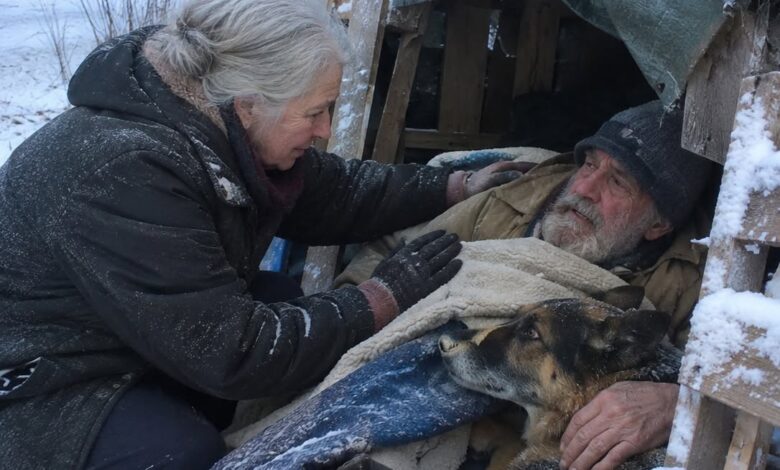
And under the tarp, an old man was wrapped in a stained Army field jacket.
He was lying on his side on a bed of pine boughs, curled up, with a filthy sleeping bag half over him. His knit cap had slipped off. His long gray hair was spread out on the branches. His beard was full of frost.
He was gray. All of him. His face, his lips, his hands. He was shivering so hard I could hear his teeth.
One of his legs was bent wrong. The left one, below the knee. It was bent at an angle a leg isn’t supposed to go.
All around him in the snow were biscuit crumbs.
There were crumbs on the sleeping bag. Crumbs on his jacket. Crumbs in his beard. Little pieces of my buttermilk biscuits, scattered in the snow all around that lean-to like birdseed.
Eleven days of them.
The dog walked past me and crawled under the tarp.
She lay down against the old man’s chest, curling her whole body around him. She put her head on his shoulder.
She did it so easily, like she’d done it a hundred times before. I knew right then that she had. Every night. For eleven nights. She’d brought him a biscuit every morning and then lain against him every night to keep him from freezing to death.
The old man’s hand moved. It crept up out of the sleeping bag, slowly, and found the fur on her neck.
I knelt down in the snow beside him.
My knees didn’t scream anymore. I didn’t feel them at all.
I reached out and touched his face. His cheek was ice cold under my fingers. For a terrible second, I thought he was dead.
But he was breathing. Shallow, ragged breaths. I could see them, tiny puffs of white in the cold air.
“Sir?” I said. “Sir, can you hear me? My name’s Dot. I run the diner on the highway. Your dog brought me. I’m going to get you help.”
His eyes opened.
They were pale blue and cloudy. It took them a long time to find me. When they did, he looked at me for a long moment without blinking.
Then something changed in his face. It was something I couldn’t name. It looked like a door opening.
His lips moved. He whispered one word.
“Birdie?”
I stopped breathing.
Nobody had called me that in fifty-eight years.
Only one person ever had.
I was born Dorothy Anne Lindqvist, in a little white farmhouse outside Tower, Minnesota, twenty miles west of here. My father worked in the iron mine. My mother kept chickens and canned everything that didn’t move.
I had one brother. His name was Henry. Everybody called him Hank.
He was six years older than me. He was tall and skinny and funny, and he could whistle louder than anyone in Saint Louis County. When I was little, he used to carry me on his shoulders out to the chicken coop every morning so I could help gather eggs.
I was a small, skinny, loud little girl who never stopped talking. I chirped, he said. Like a bird.
“Morning, Birdie,” he’d say, every single morning, swinging me up onto his shoulders. “What are we singing about today?”
Nobody else ever called me that. Not my mother, not my father, not my friends. It was just his. Hank’s word for me.
Hank was drafted in 1966. He was nineteen. I was thirteen.
I remember standing in the driveway in my nightgown the morning he left, crying so hard I couldn’t breathe. He knelt down in the gravel in his new uniform and put his hands on my shoulders.
“Hey, Birdie,” he said. “Hey. Look at me. I’m coming back. I promise. And when I do, you’re going to be so tall I won’t be able to carry you anymore.”
“You’ll still carry me,” I said.
“I’ll try,” he said, and grinned. “I’ll probably throw my back out.”
He wrote me letters from Vietnam. Every week at first. Funny letters about the food, the heat, and a sergeant from Alabama who snored like a chainsaw. Then every other week. Then once a month. The letters got shorter. They stopped being funny.
He came home in the spring of 1968.
He didn’t carry me on his shoulders.
He didn’t whistle. He didn’t laugh. He sat at the kitchen table and stared at the wall. He jumped every time a truck went by on the road. He slept in the hayloft instead of his bedroom because he said the walls were too close. My father yelled at him to snap out of it. My mother cried in the pantry where she thought nobody could hear.
I used to sit with him in the hayloft at night. I didn’t know what to say, so I just sat there.
“Sorry, Birdie,” he said one night. “I’m sorry I’m not much fun anymore.”
“That’s okay,” I said. “You don’t have to be fun.”
He put his arm around me. He didn’t say anything else.
That summer, he had a terrible fight with my father. I don’t know what it was about. I was in my bedroom with a pillow over my head. I heard things breaking. I heard my father shout, Then get out! Get out of my house!
The next morning, Hank was gone.
He left a note on my pillow. It was just three lines on a torn piece of notebook paper.
Birdie, I’m sorry. I can’t stay. Don’t wait up for me. Love, Hank.
I was thirteen years old.
I never saw my brother again.
I looked for him for years.
I wrote letters to the VA. To the Army. To missing persons offices in four states. When I was twenty, I drove all the way to Minneapolis because someone said they’d seen a man who looked like him at a shelter downtown. It wasn’t him. When I was thirty-one, I hired a private investigator with money Ed and I didn’t have. He found a Henry Lindqvist in Montana who’d died in 1979. It wasn’t him either. Wrong birthday.
My parents died without ever hearing from him. My father, in 1986, still too proud to say he was sorry. My mother, in 1994, still keeping Hank’s room exactly the way he’d left it.
Somewhere around my fiftieth birthday, I stopped looking.
I didn’t stop thinking about him. I never stopped that. Every Veterans Day, I’d look at the faces in the newspaper. Every time I saw an old man in an Army jacket on the side of the road, I’d slow down the car.
But I stopped believing I’d ever find him.
And now he was lying in the snow in front of me, in a lean-to made of pine branches, a mile and a half from my diner.
He’d been coming into my diner every Tuesday since October.
He’d been sitting in my corner booth, with his back to the wall, watching me.
And I hadn’t known him.
“Hank?” I whispered.
His eyes filled with tears. They spilled over and ran down into his frozen beard.
“Hi, Birdie,” he said.
I don’t remember all of what happened next.
I remember taking off my red wool coat and wrapping it around him, over the sleeping bag. I remember wrapping my scarf around his head. I remember lying down beside him under the tarp, pressing myself against his back while the dog pressed against his chest, the two of us trying to put every bit of warmth we had into him.
I remember pulling out my phone with numb fingers. There was one bar of signal. Then none. Then one again.
I remember calling 911 and shouting into the phone. The fire tower trail. Burntside Creek. A man with a broken leg. Hypothermia. Hurry, please hurry. And the woman on the other end telling me to stay calm, that it might take a while to get a crew up there in the snow, and the call dropping before she finished.
I remember thinking, Glen was right. Nobody’s coming.
And I remember Hank’s hand finding mine under the coat. His fingers were so cold they burned.
“I’m sorry,” he whispered. “I’m so sorry, Birdie.”
“Don’t,” I said. “Don’t you dare. Not now. Save your breath.”
Then I heard the engine.
It was faint at first, way down the trail, a high whining buzz echoing through the pines. Then louder. Then louder still.
The dog lifted her head and barked once, sharp.
A snowmobile came over the rise above the creek. It was a big black Arctic Cat with a towing sled hitched behind it. Two men were on it. The one in front was wearing a tan Carhartt jacket.
Glen Hobart.
Rudy was sitting behind him, holding on with one hand, clutching a stack of blankets from the diner with the other. The towing sled behind them was piled with more blankets, a thermos, and a first aid kit.
Glen pulled up beside the lean-to and cut the engine. He climbed off. He looked at the lean-to, at the old man, at the dog, at me lying in the snow without my coat.
His face went white.
“Jesus, Dot,” he said.
“How did you…” I started.
“You were gone forty minutes,” Rudy said. He was already kneeling down, pulling blankets out of the pile. “Glen kept looking at the clock. Then he got up and went out to his truck.”
“I’ve got the sled in the back of the truck,” Glen said gruffly. He wouldn’t look at me. “I use it for ice fishing. Wasn’t going to have you dying on my conscience.”
He looked down at Hank.
Then he crouched beside the lean-to. He looked at the bent leg. He looked at the crumbs in the snow. He looked at the Army jacket.
“I know this fella,” Glen said slowly. “He’s the one from your corner booth. Tuesdays.”
“He’s my brother,” I said.
Glen stared at me.
“Your brother?”
“I haven’t seen him since 1968.”
Glen didn’t say anything for a long moment.
Then he stood up and started unhitching the sled.
“Okay,” he said. “Okay. Rudy, get those blankets around him. All of them. Dot, put your coat back on before you freeze. We’re getting him down.”
It took all three of us to get Hank onto the sled.
Rudy splinted his leg with two straight pine branches and a roll of gauze from the first aid kit. He’d been a medic in the National Guard, years ago. I didn’t know that. Nineteen years, and I didn’t know that.
Hank screamed when they moved him. It was a terrible, raw sound that echoed off the trees. The dog barked and barked and danced around the sled………………………READ MORE NEXT PAGE 2