Vanishing Husband Returns After 9 Years With A Secret That Changes Everything
The silence of that Tuesday morning remains etched in my memory like a scar that never quite faded. There was no slamming door, no heated exchange over the breakfast table, and no dramatic exit. When I opened my eyes at 7:00 AM, the sunlight was filtering through the curtains just as it always did, but the weight of the air in the room had shifted. My hand reached out to the other side of the bed, finding only cold, smoothed-over sheets. Mark was gone. At first, I assumed he had simply left early for a high-stakes meeting, but as I walked through the house, the reality began to unravel in small, terrifying increments. His laptop was gone. His favorite leather jacket, which always hung by the door, was missing. Even his toothbrush had been vanished from the porcelain holder.
By noon, the panic had graduated from a dull thrum to a deafening roar. I called his office, only to be told he had resigned via email the night before. I called his friends, who met my frantic questions with genuine confusion. My eight-year-old son, Leo, stood in the hallway clutching a plastic dinosaur, his wide eyes tracking my pacing feet. He didn’t ask where his father was because, in the primal way children sense disaster, he already knew something was fundamentally broken. I had no answers to give him. For weeks, I lived in a state of suspended animation, convinced that a phone call would eventually resolve the nightmare. I imagined a temporary breakdown or a sudden, urgent trip he had forgotten to mention. But the phone stayed silent, and the mailbox remained empty of explanations.
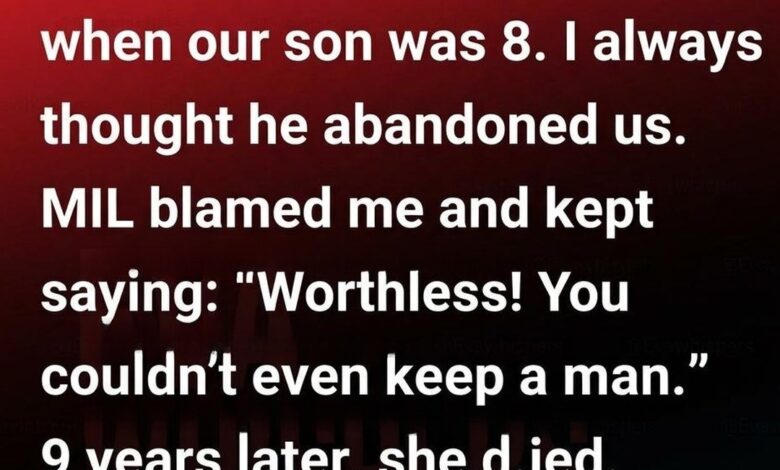
The years that followed were a masterclass in survival. The transition from a dual-income household to a single-parent struggle was immediate and brutal. I learned to balance a spreadsheet with the precision of an accountant, cutting every luxury until our lives were stripped down to the bare essentials. I took on a second job in the evenings, working until my eyes blurred, all to ensure that Leo’s life felt as stable as possible. Yet, the emotional toll was far heavier than the financial one. My former mother-in-law, Eleanor, became a haunting presence during that era. Instead of offering a grandmother’s comfort, she wielded blame like a weapon. Every time we spoke, she whispered the same poisonous narrative: that I was too demanding, too focused on my career, and that I had surely driven her son into the shadows with my coldness. She made sure I felt the weight of his departure as if I had packed his bags myself.
Under the crushing pressure of her judgment and the mystery of Mark’s absence, I hardened. I buried my grief beneath layers of routine and necessity. Leo grew from a confused boy into a resilient teenager, a young man who looked more like his father every passing day. We built a life that was quiet but whole. We had our own traditions, our own inside jokes, and a shared understanding that we did not speak of the man who had walked out on us. I thought I had achieved a fragile kind of peace, a closure built on the assumption that Mark simply didn’t want us.
The news of Eleanor’s passing nine years later felt like the final period at the end of a very long, painful sentence. I attended the funeral not out of affection for the woman who had spent a decade vilifying me, but out of a sense of duty to Leo. I wanted him to see that we could face the past with dignity. The cemetery was draped in a gray mist, the air thick with the scent of damp earth and lilies. I stood at the back of the crowd, my arm linked through Leo’s, watching the casket descend. It was only as the mourners began to disperse that I saw him.
He was standing under a willow tree, several yards away from the main path. He was older, his hair peppered with gray at the temples, and his shoulders seemed to sag under an invisible weight. My heart didn’t race; it felt as though it stopped entirely. Nine years of suppressed anger, unanswered questions, and lonely nights crystallized into a single moment of recognition. Mark was alive. He was right there.
When we finally stood face-to-face in the quiet corner of the cemetery, the world seemed to shrink until it only contained the two of us. I expected a confession of cowardice or a tale of a secret life. Instead, what spilled out of him was a story of a devastating deception. Mark explained that the night he left, he had received a series of frantic messages and documents—purportedly from a legal representative I had hired—stating that I was filing for a restraining order and moving to strip him of all parental rights. He had been told that if he didn’t disappear immediately, I would use his recent struggle with clinical depression to ensure he never saw Leo again.
My jaw dropped as the pieces began to click into place. On my end, Eleanor had told me she had seen Mark packing a getaway bag with another woman. She had intercepted his letters, blocked his attempts to call the house, and told me he had moved across the country to start a new family. She had played both sides of the fence, feeding his insecurities and my heartbreak until the bridge between us was completely incinerated. She had wanted her son back to herself, away from the woman she deemed unworthy of him. She had spent nine years watching me struggle, knowing exactly where he was and exactly how much we were hurting, all to maintain a control she had never truly earned.
The revelation was a physical blow. The anger I felt toward Mark shifted, morphing into a cold, sharp fury toward the woman we had just buried. We had been victims of a meticulous, cruel campaign of misinformation. All those years of Leo growing up without a father, all those nights I spent wondering what I had done wrong, were based on a lie fabricated by a woman who claimed to love her family.
The meeting between Mark and Leo was the part I feared most. Leo was seventeen now, a man in his own right, and he had every reason to be bitter. But as they stood in the driveway of our home a few days later, something miraculous happened. There were no shouts, no accusations. Leo looked at the man who shared his eyes and saw the brokenness there. He saw a father who had been robbed of a decade, just as he had been robbed of a childhood. They sat on the back porch for hours, the silence of the past finally being filled with the messy, complicated truth.
We can never get back the nine years that were stolen from us. We can’t erase the struggle or the loneliness that defined our lives for so long. However, learning the truth provided a different kind of healing than I had ever imagined. It didn’t fix the past, but it cleared the path for the future. We began to rebuild, not as the family we were, but as the people we had become—scarred, perhaps, but finally free from the shadows of someone else’s malice. Sometimes the most profound endings aren’t about finding what you lost, but about discovering that the strength you found while searching was the very thing that would allow you to start over.