Two Years After My Father Rejected My Wife, He Needed My Signature to Sell Grandpa’s Cabin
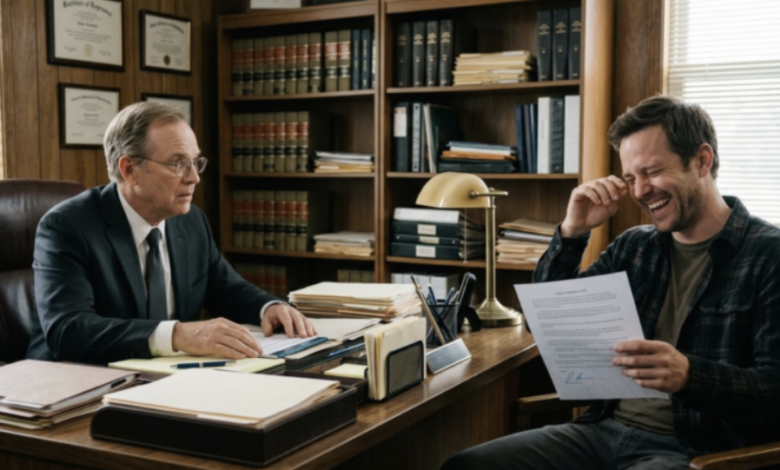
The attorney stopped turning pages and looked at my father.
“Mr. Harlon, did you know about this?”
My father frowned. “Know about what?”
The attorney turned toward me. “Where did you obtain this document?”
“From my grandfather’s personal belongings,” I answered.
My father gave a dismissive laugh. “Cyrus collected all kinds of paperwork. Whatever you have there doesn’t change the fact that the cabin belongs to this family.”
I leaned back in my chair. “That’s what I used to believe.”
Three days earlier, I had discovered something unusual inside my grandfather’s old cedar tackle box. While cleaning his belongings, I noticed a small wooden panel at the bottom. After carefully removing the screws, I found a sealed envelope with my name written across it.
Inside were a handwritten letter, a trust agreement, and instructions to contact an attorney named Eleanor Whitmore.
The documents revealed that Grandpa Cyrus had transferred his hunting cabin and the surrounding forty-seven acres into an irrevocable trust several years before his death. I was the sole beneficiary. My father had only been appointed caretaker, meaning he could maintain the property but could not sell it without following the trust’s legal requirements.
My grandfather had anticipated that someone might eventually try to take control of the property.
I looked at my father.
“Grandpa didn’t leave the cabin to you. He placed it in a trust, and I’m the beneficiary.”
He immediately reached for the documents.
“This is impossible! Your grandfather never told me about this.”
“Maybe he had his reasons.”
My father insisted that he had managed the property for years, but the attorney carefully explained that managing something did not automatically make someone its legal owner.
After reviewing the paperwork, he admitted there was a serious issue with the proposed sale.
“If these documents are authentic and the trust remains valid, Mr. Harlon does not have the authority to transfer ownership.”
My father became noticeably uncomfortable.
I then opened the final envelope and began reading Grandpa’s letter.
He wrote that he had watched me grow up believing I needed to earn my place in the family. He remembered how I worked hard, asked for very little, and frequently apologized even when I had done nothing wrong.
He also remembered how my father constantly compared me with my brother Dexter.
The final lines were particularly meaningful.
“Love is not a debt. Family is not a business arrangement. Being a good son does not mean allowing people to make every decision for you.”
I folded the letter.
For years, I had tried to earn my father’s approval. I had worked hard, supported myself, and avoided asking my family for help. Meanwhile, Dexter had received financial assistance whenever he needed it.
My father looked at me.
“You’re going to destroy this family over a hunting cabin?”
I answered quietly.
“The family was already struggling long before I found these documents. I’m simply protecting something Grandpa wanted me to have.”
The meeting ended without my signature.
Before leaving, I asked the attorney to preserve every document related to the proposed sale. I also explained that my independent attorney would contact his office.
My father remained behind, clearly unhappy with the outcome.
When I arrived home, my wife Camille was waiting with two cups of coffee.
“How did it go?”
“He didn’t get my signature.”
She smiled with relief.
But I had another piece of news. Grandpa’s attorney, Eleanor Whitmore, had contacted me and wanted to arrange a meeting. She had additional documents that my grandfather had instructed her to keep until someone attempted to interfere with the cabin.
The following morning, Camille and I visited her office.
Eleanor greeted us warmly and placed a sealed brown envelope on her desk. It carried my grandfather’s initials.
“Cyrus delivered this to me four years before he passed away,” she explained. “He gave specific instructions about when I could release it.”
I opened the envelope.
Inside were several documents, a photograph, and another handwritten letter.
The photograph showed Grandpa standing beside me outside the cabin when I was twelve. I was holding a fishing rod, and he had his hand resting on my shoulder.
On the back, he had written:
“The boy who never asked for much deserved more than he ever received.”
I smiled before examining the remaining documents.
Eleanor explained that my grandfather had been a careful investor. Although he lived modestly, he had accumulated several properties, investment accounts, and shares in a manufacturing company.
His remaining estate was valued at approximately $4.8 million.
I was surprised. Grandpa had always driven an old pickup truck, repaired his belongings, and avoided unnecessary expenses. I had never imagined he possessed such substantial assets.
Eleanor explained that my father and Dexter had each received smaller inheritances, while I had been named the primary beneficiary of the remaining estate, subject to the legal arrangements and administration.
“Your grandfather made these decisions after consulting independent advisers,” she said. “He wanted his wishes documented clearly.”
I asked why Grandpa had never mentioned the inheritance.
“He didn’t want money to change your relationship with him. He also wanted to protect you from pressure while he was alive.”
I opened his final letter.
He explained that he had watched me spend countless afternoons repairing fences and helping around the cabin. He understood that I often visited because it was one of the few places where I felt peaceful.
He ended with a message I would remember for the rest of my life:
“Do not use what I leave you to punish anyone. Do not allow anyone to use it to control you. Build something good, protect the people who love you, and remember that you were always enough.”
I placed the letter beside the photograph.
For the first time, I understood how carefully Grandpa had planned everything.
However, there was another problem.
Dexter had contacted Eleanor claiming that Grandpa had promised him the cabin. He had even submitted a letter that supposedly proved his claim.
When Eleanor showed me a copy, I immediately noticed something unusual.
The handwriting looked similar, but it wasn’t quite right.
I had spent years reading Grandpa’s notes, shopping lists, and handwritten instructions. I knew how he formed certain letters.
“This isn’t his handwriting,” I said.
Eleanor agreed that there were inconsistencies. She had arranged for an independent handwriting examination before making any conclusions.
A few weeks later, the examiner identified significant differences between the disputed letter and authenticated samples from Grandpa.
The document could not be relied upon as genuine evidence.
Dexter eventually withdrew his challenge to the trust.
Meanwhile, my father’s proposed sale had also become complicated. A potential buyer had already paid a deposit before discovering that the cabin was held in a trust.
The transaction was suspended, and the buyer requested the return of the deposit.
My father had assumed he could sell the property without consulting me. Now he had to address the legal and financial consequences of that decision.
Soon afterward, my mother called.
She wanted to know why I was refusing to help the family.
I explained that Grandpa had made his own inheritance decisions and that nobody had been left without support.
She insisted that Dexter was struggling with his business and needed assistance.
I reminded her that I had spent years supporting myself while Dexter received financial help whenever he encountered difficulties.
Then I asked a question I had wanted to ask for a long time.
“Mom, where were you when Dad asked Camille and me to leave the house on Christmas Eve?”
She became quiet.
I continued, explaining that I had never forgotten how my wife had been treated. I wasn’t interested in arguing, but I also wasn’t willing to pretend that nothing had happened.
Eventually, I ended the conversation.
Several weeks later, my father requested another meeting.
This time, he arrived with my mother and his attorney. He explained that Dexter’s business had accumulated substantial debts and that the family wanted me to provide financial assistance.
He suggested that I give Dexter $300,000 to help him start again.
I looked at the proposal and then at my father.
“Are you asking me to give him another opportunity using money Grandpa left me?”
“He’s your brother,” my father replied.
“I understand that. But I’m not responsible for his business decisions.”
My mother tried to explain that everyone was under pressure.
I told them I hoped Dexter would find a way forward, but I would not provide the requested money.
My grandfather had left me an inheritance to manage responsibly, not an obligation to solve every financial problem in the family.
Eleanor then presented the preliminary examination report concerning Dexter’s disputed letter. The findings raised serious questions about its authenticity, and the estate’s attorneys were reviewing the matter.
The meeting ended without an agreement.
A few days later, Dexter emailed me.
He admitted that things had become difficult and asked whether I would lend him money. He also reminded me that we had grown up together.
I read the message several times.
Despite everything, I didn’t hate my brother. I remembered fishing with him as children and the good moments we had shared.
But those memories didn’t change the decisions we had made as adults.
I replied that I genuinely hoped he would rebuild his life, but I wouldn’t lend him money. I also told him I would be willing to have a conversation someday if he was prepared to take responsibility for his actions.
Then I closed my laptop…………CONTINUED ON NEXT PAGE