They Tried to Hide the Truth About My Baby — Then I Discovered a Family Secret That Changed Everything
The room became completely silent. My mother stared at me, unable to speak. I was still looking at my aunt, Patricia, trying to understand how everything had become so complicated so quickly.
The principal had just explained that the school had received messages suggesting someone had tried to conceal the identity of my baby’s father. There was also a warning indicating that my situation might be connected to something much older.
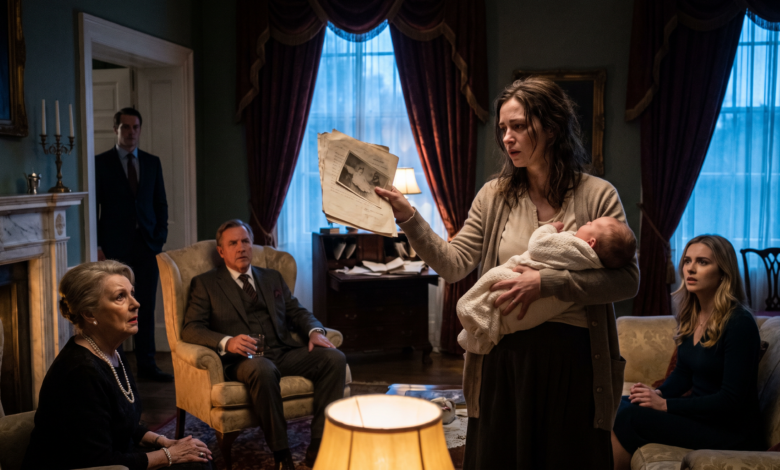
I held up my phone.
“Did you know about this message?”
Patricia frowned. “What message?”
I showed her the screen.
She didn’t come closer.
“You shouldn’t believe everything strangers send you,” she said.
My stomach tightened.
“How did you know it was from a stranger?”
Patricia froze.
My father immediately noticed.
“Patricia,” he said firmly. “Explain yourself.”
She insisted she had done nothing wrong, but the principal remained concerned. She recommended that I leave school with my parents rather than return home with my aunt.
Then Matthew finally spoke.
He admitted that he had lied about me because his mother had pressured him. She had warned him that if he admitted the baby was his, he could lose important opportunities and his family’s financial support.
I looked at him with disbelief.
“So you chose your family’s approval over telling the truth?”
He lowered his eyes.
“I was scared.”
“So was I,” I replied. “But I didn’t make everyone else pay for my fear.”
The principal asked everyone except my parents and me to leave the room.
Then she asked me an unexpected question.
“Has Patricia ever given you anything to drink when your parents weren’t around?”
I thought about it.
Tea.
Patricia had started making tea for me regularly. She always said it would help me relax.
I remembered several occasions when she had become unusually upset if I didn’t finish it.
The memory made me uncomfortable.
I told my parents about it.
My father immediately became concerned, and the principal contacted the appropriate authorities. I was not sent home with Patricia.
That evening, my father returned with an old photograph.
It showed a teenage girl standing outside a school.
Her name was Elena.
My mother immediately recognized her.
“She was your cousin,” she said.
I was confused.
“I don’t remember having a cousin named Elena.”
“You were very young when she died,” my mother explained.
My father told me that Elena had been sixteen when she became pregnant. Her pregnancy had caused serious conflict within the family. At the time, relatives had treated the situation as a source of embarrassment rather than supporting her.
I stared at the photograph.
“She looks like me.”
My father nodded.
“She does.”
On the back of the photograph was a handwritten sentence:
I won’t let them take my baby.
My hands began to shake.
“What happened to her child?”
My parents exchanged a worried look.
They told me that the family had always claimed Elena had lost the baby.
But the more we investigated, the less convincing that explanation became.
Then an anonymous message arrived.
It said that Elena’s baby had not been lost.
According to the message, the child had been taken from the hospital and raised by another family.
The family name mentioned in the message shocked me.
Rivas.
The same family Matthew belonged to.
I couldn’t understand how my pregnancy and Elena’s story could possibly be connected.
Then another woman contacted me.
Her name was Sofia.
She explained that she had known Elena when they were teenagers. She had witnessed the difficult circumstances surrounding Elena’s pregnancy and had spent years carrying the guilt of not being able to protect her friend.
According to Sofia, Elena had never willingly given up her baby.
She had been told that the child was gone.
The truth was much more complicated.
The baby had been adopted by the Rivas family.
Rebecca Rivas, the woman I knew as Matthew’s mother, had been raised without knowing the complete story of her birth.
When I heard that, everything suddenly made sense.
This wasn’t simply a story about my pregnancy.
It was a family secret that had been hidden for years.
My mother finally admitted that she had known pieces of the story.
She had been a teenager herself when Elena’s child was taken away.
She had tried to object but had been too young and frightened to challenge the adults around her.
She had kept an old letter from Elena for many years.
The letter was addressed to my mother.
I opened it carefully.
Elena had written that she believed her baby was still alive. She begged my mother to find her someday and tell her that she had never abandoned her.
At the bottom of the letter was one name.
Rebecca.
I cried when I read it.
For years, Rebecca had lived without knowing where she came from.
Elena had lived without knowing where her daughter went.
And my family had carried the secret in silence.
But there was another revelation.
My mother told me that her own history was also connected to the family’s decision to hide pregnancies and adoptions.
Before I was born, she had experienced a difficult situation as a teenager. Another child had been placed for adoption, and she had spent years wondering what happened to that child.
That discovery eventually led investigators to another woman named Daniela.
Daniela had been searching for information about her biological family.
When she met my mother, the resemblance was immediate.
My mother cried.
Daniela cried.
And for the first time, two people separated by an old family decision were able to meet and begin rebuilding their relationship.
Meanwhile, the investigation into Patricia continued.
Authorities discovered records showing that she had been involved in discussions about Elena’s adoption many years earlier.
There were also documents connected to the Rivas family.
The evidence showed that several relatives had known more about Elena’s story than they had admitted.
Patricia eventually had to answer difficult questions about her actions.
The truth was finally coming into the open.
Matthew also admitted that he had known his family was hiding something.
He hadn’t understood the full story, but he knew there were subjects he wasn’t supposed to discuss.
He apologized for the way he had treated me at school.
I didn’t forgive him immediately.
But eventually I realized something important.
Forgiving someone doesn’t mean pretending nothing happened.
It means deciding that their choices will not control your future.
Months passed.
My daughter was born healthy.
I gave her the name Elena Sofia.
Elena, to honor the young woman whose story had been hidden for so long.
Sofia, to honor the person who eventually found the courage to help bring the truth into the open.
When I brought my daughter home, my mother held her carefully.
Tears filled her eyes.
“You will never be hidden,” she whispered.
I looked at my daughter and thought about everything that had happened.
For a long time, people had told me that becoming a mother so young meant my future was over.
They were wrong.
My life had changed, but it wasn’t over.
I returned to school.
I continued my education.
Eventually, I began helping other young mothers who felt frightened and uncertain about their futures.
I wanted them to understand something I had learned through experience.
A difficult beginning does not determine the rest of your life.
Other people’s mistakes do not define your identity.
And family secrets may remain hidden for years, but truth has a way of finding its way into the light.
Years later, our family gathered together around one table.
Elena’s photograph was placed beside my daughter’s birthday cake.
Rebecca came.
Daniela came.
My mother sat beside me.
For the first time, the women connected by years of silence were able to sit together openly.
My mother reached for my hand.
“I wish I could change what happened,” she said.
I squeezed her fingers.
“So do I.”
Then I looked at my daughter.
“But we changed what happened next.”
That was enough.
The secret that had once divided our family no longer had the power to control us.
The past could not be changed.
But the future could be different.
And this time, we chose honesty, compassion, and family.