The Battered Suitcase in My Trunk Contained a Secret That Changed My Life Forever
It was supposed to be just another ordinary Sunday, the kind of quiet morning where the neighborhood sits softly under a blanket of silence and cool coffee steam. I had spent twelve years performing the exact same acts of quiet kindness for the old man next door, expecting nothing in return except his warm smile and steady presence. But when the black hearse finally drove away and his stern-faced lawyer pressed a dusty, worn leather suitcase into my trembling hands with a cryptic warning, my chest tightened. Nothing could have prepared me for what was waiting inside.
For over a decade, my life moved to the gentle cadence of suburban predictability. When I first bought the modest home two houses down from Ezra Harrison, I was twenty-eight, ambitious, and convinced I would only stay for a couple of years before moving on to bigger things. Ezra was already an fixture of the street—an eighty-four-year-old widower who moved with the slow, deliberate caution of a man who had lived alone for far too long. We exchanged polite waves from our driveways and exchanged brief pleasantries over lawn mowers, but our lives existed in completely separate orbits.
That all changed on an unassuming autumn afternoon. I was standing in my driveway with a recycling bin when I saw Ezra struggling by the open trunk of his sedan. A heavy paper grocery bag was slipping from his frail grip, its edges tearing against his forearm. Instinct took over before thought did; I hurried across the grass and caught the load just before it hit the asphalt. When I carried the bundles inside his kitchen—a room that smelled faintly of old timber, dried herbs, and instant coffee—he insisted on pouring me a cup to express his gratitude.
I almost declined. I was never the type to linger over hot drinks with strangers, but something in his quiet, expectant posture made me pull out a vinyl-backed chair. That single hour of conversation stretched effortlessly into twelve years of an unspoken, sacred ritual. Ezra shared stories of the valley back when cornfields still stood where the local elementary school now sat. He mentioned his late wife, Margaret, with a tenderness that time had never dulled, and occasionally brought up a distant nephew named Marcus—speaking the name with the hollow, hesitant pause of a man who knew he was only remembered when a loan was needed.
Before leaving that day, I casually mentioned that he should just call me whenever he needed provisions. What started as a casual offer quickly became an unyielding commitment. As Ezra’s strength gradually faded, driving became impossible for him, and every single Sunday morning without fail, I picked up his groceries, stocked his shelves, and sat with him at his small wooden kitchen table.
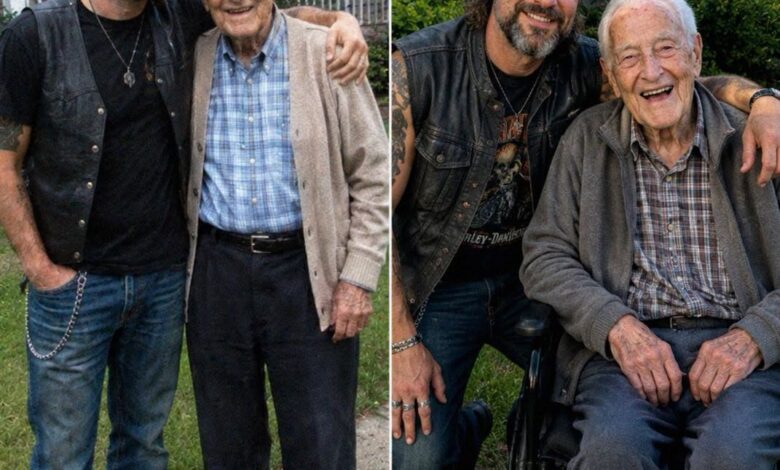
We talked about everything and nothing. On some mornings, we discussed my career, my eventual marriage to my wife, Claire, and our hopes for the future. On other mornings, we simply sat in comfortable silence, watching sparrows dart around the wooden feeder outside his window. Ezra tried to pay me in the early days, pressing crisp bills into my palm, but I firmly refused every time. Our friendship was never a transaction; it was simply a anchor in both of our lives.
When I turned forty, the rhythm of those twelve years came to a sudden, painful halt. It was a crisp October morning when I noticed his front porch light still burning brightly at nine in the afternoon. Ezra was meticulously thrifty and would never leave a lamp on past sunrise. A cold knot of dread formed in my stomach, and by noon, my worst fears were confirmed when an ambulance arrived at his driveway. Ezra had passed away peacefully in his sleep.
The funeral was a small, subdued affair. A handful of distant acquaintances filled the back pews, while across the aisle sat Marcus, impeccably dressed in a tailored suit, constantly checking his phone with an air of mild annoyance. When the service concluded, Marcus approached me not with grief, but with cold suspicion. He made patronizing comments about my years of service, implying that my devotion to an elderly man must have been driven by hidden financial motives. I kept my composure, refusing to let his bitterness taint Ezra’s memory, and reaffirmed that I had never accepted a single dime.
As I walked toward my car, a tall man in a dark overcoat intercepted me. It was Mr. Whitman, Ezra’s longtime attorney. In his hands, he held a heavy, battered suitcase with dull brass latches and corners worn pale by time. He explained that Ezra had left strict, notarized instructions for this specific object to be handed directly to me, entirely separate from the formal estate. Despite Marcus’s angry protests and threats of legal action on the church steps, Mr. Whitman stood firm and placed the trunk in my arms.
When I arrived home, Claire met me in the kitchen. Together, with hands trembling from a mix of grief and anticipation, we unbuckled the brass latches and lifted the heavy leather lid.
There was no hidden fortune of gold or stack of banknotes inside. Instead, the suitcase was filled to the brim with hundreds of neatly organized envelopes, two leather-bound photo albums, and a thick personal journal. I picked up the top letter; it was addressed to me, written in Ezra’s familiar, steady script, and dated the exact Sunday we first shared a cup of coffee twelve years ago.
Ezra had written a letter for every single Sunday we spent together. Inside the journal, he revealed a deeply buried heartbreak: he and Margaret had lost their only son, Daniel, decades earlier. Over the years of our weekly routine, Ezra had come to regard me with the same pride and silent affection he had once held for his boy. Tucked into the back of the journal was a legal document showing that, years prior, he had established a modest, untouchable savings account dedicated solely to me—a quiet gesture of protection from a man who considered me family.
Reading those pages alongside Claire, tears streamed down our faces as the true depth of Ezra’s quiet gratitude washed over us. The fight left Marcus completely when I later showed him one of his uncle’s letters, which plainly detailed how deeply his neglect had hurt the old man.
Using the gift Ezra left behind, Claire and I founded a local initiative dedicated to providing Sunday groceries, maintenance, and companionship to isolated seniors living on their own. Today, before I step out the door every Sunday morning to visit those in need, I open that battered suitcase and read one of Ezra’s letters. It remains an enduring reminder that the smallest acts of consistent human kindness can build a legacy that outlasts us all.