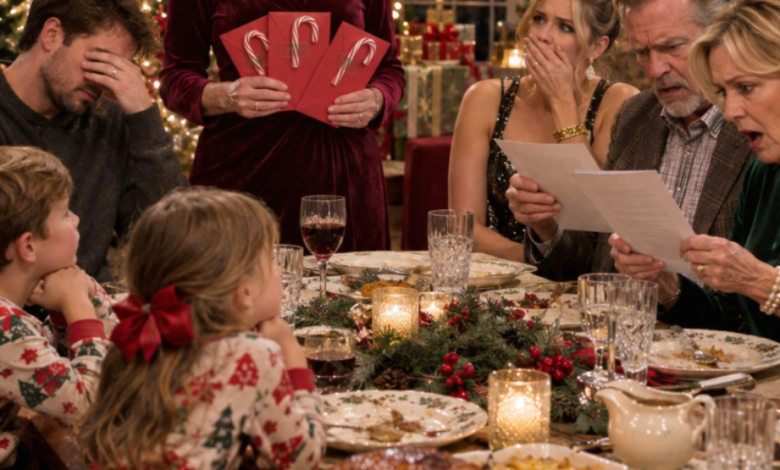
She Asked Me to Pay for My Thanksgiving Meal, and the Family Dinner Took an Unexpected Turn
“I am not putting the adult phone lines back on my account, and I’m not paying for your truck insurance anymore.”
He nodded.
“I understand.”
Before he left, he told me that Brittany wanted to apologize. I wasn’t sure what to expect, but I agreed to speak with her when she was ready.
Three days later, she arrived at my house carrying a small bakery box.
“Hi, Georgia. I brought you some cookies.”
I invited her into the kitchen and prepared two cups of coffee.
After a few moments, she began talking about Thanksgiving.
“I shouldn’t have charged you for dinner,” she said quietly. “And I shouldn’t have treated my parents differently.”
I appreciated that she was finally acknowledging what had happened.
She explained that she and Kyle had been arguing about household expenses. She had felt overwhelmed by their financial responsibilities and had made decisions without considering how they affected other people.
“I thought you could afford it,” she admitted.
I looked at her.
“Brittany, being able to buy groceries doesn’t mean I have unlimited money. I worked for decades, saved carefully, and planned my finances. I have my own expenses and my own future to consider.”
She nodded.
“I understand that now.”
I explained that I had spent many years working at a deli counter. My late husband, Hal, and I had saved money through careful planning. After he passed away, I wanted to help Kyle and his children whenever possible.
But I had also learned that being a mother did not mean taking responsibility for every financial difficulty in the family.
Brittany apologized again.
“I hope you can forgive me.”
“I forgive you,” I said. “But I also want things to change.”
I explained that I would continue paying for my grandchildren’s phone lines as a gift to them, but the adults would remain responsible for their own expenses.
She agreed.
It wasn’t a perfect conversation, and everything wasn’t suddenly resolved. However, it was an honest beginning.
The following December, Kyle visited me again. He watched me prepare homemade noodles before reaching into his jacket pocket and taking out an envelope.
Inside was a check for five hundred dollars.
“Mom, I want to pay you back for some of the phone bills.”
I looked at him and gently pushed the check toward him.
“You don’t need to do that.”
“But I should have helped you more.”
“If you want to do something for me, I would rather you visit because you want to spend time with me. Call me to ask how my day went. That’s worth more than a check.”
He smiled and hugged me.
That Christmas, we gathered at Kyle’s house again. This time, Brittany called ahead of the celebration to ask what I would like to bring.
“Nothing special,” I told her. “I’ll bring myself.”
She laughed and asked whether I could make my homemade noodles.
I happily agreed.
When I arrived, Ron was helping prepare the potatoes, Debbie was arranging the dining table, and the children were excited to see me. There were no price lists, no uncomfortable conversations, and no special arrangements for one side of the family.
We simply enjoyed dinner together.
Afterward, Kyle stood up and thanked everyone for coming. Then he turned toward me.
“Mom has helped us more than we sometimes realized. I also want to apologize for not standing up for her when I should have.”
Brittany reached for his hand.
“I owe you an apology too, Georgia,” she added.
I smiled.
“I appreciate that. But I want everyone to remember something. Family should never become a list of payments and obligations. We should help one another when we can, but we should also respect each other’s time, effort, and responsibilities.”
Kyle raised his glass.
“To Mom.”
Everyone joined him.
That evening, I went home feeling grateful that our relationship had improved. It wasn’t because anyone had paid me back. It was because we had finally started communicating honestly.
A few weeks later, I found the original Thanksgiving card in a kitchen drawer. The forty-five-dollar request was still written across it.
I considered throwing it away, but instead I placed it in a small frame.
It reminded me of an important lesson: generosity and being taken for granted are not the same thing.
I still love making pies, preparing family meals, and remembering everyone’s birthdays. I still enjoy helping my grandchildren, and I continue spending time with my family.
But I no longer pay the regular expenses of other adults.
My son and daughter-in-law manage their own phone accounts. Ron and Debbie manage theirs, and Kyle takes care of his vehicle insurance.
Meanwhile, I have started saving more money for myself.
Last summer, Dot and I took a short trip to Lake Erie. We enjoyed the scenery, ate at little restaurants, and spent hours talking and laughing.
When I returned home, I realized how many simple experiences I had postponed.
At sixty-nine, I finally understood that taking care of myself was not something I needed to feel guilty about.
I still love my family with my whole heart. I simply understand that love and personal boundaries can exist together.
A few days ago, Lily brought me a school project. It was a drawing of our family sitting around a large dining table. Everyone was smiling, and there was a beautiful pie in the middle.
Underneath the picture, she had written four simple words:
FAMILY DOESN’T CHARGE FAMILY.
I smiled and placed it on my refrigerator beside an old photograph of Hal.
The picture reminded me that family relationships are built through kindness, understanding, and respect.
I thought again about that first Thanksgiving, the little forty-five-dollar card, and the Christmas envelopes.
Some people might say I should have handled things differently. Perhaps they are right. But I know that making a reasonable change to my finances was necessary.
I didn’t stop loving my son. I simply stopped confusing love with paying his bills.
I didn’t turn my back on my daughter-in-law. I gave our relationship an opportunity to become healthier.
And I didn’t abandon my family. I learned that supporting people does not mean neglecting myself.
My late husband used to remind me that kindness should come with wisdom.
I wish I had understood that lesson sooner.
But I’ve learned it now.
You can love your children without taking responsibility for every adult expense. You can be generous without forgetting your own needs. You can forgive someone while maintaining reasonable boundaries.
And you should never have to purchase your place at your family’s table.
Because the most meaningful part of being together has never been the money spent on dinner.
It has always been the love, appreciation, and respect shared around the table.