A Grandmother Raised Her Grandson After a Tragic Accident—Twenty Years Later, He Uncovered the Truth
“Grandma, there’s something I need to tell you about the night my parents died.”
My grandson Mateo stood in the doorway of my house, wearing his winter coat. Snow covered his shoulders, and he held a folded piece of paper in both hands. His expression was serious, and his eyes looked unusually troubled.
“What is it, sweetheart?” I asked.
He took a deep breath.
“It wasn’t the accident everyone told us about.”
For a moment, I couldn’t understand what he meant.
For twenty years, I had believed that a terrible winter storm had taken my daughter, her husband, and their oldest son. Mateo, their youngest child, was the only one who survived.
I had raised him from the age of five, doing everything I could to give him a peaceful childhood after such a difficult beginning. I never imagined that the story we had accepted for two decades was incomplete.
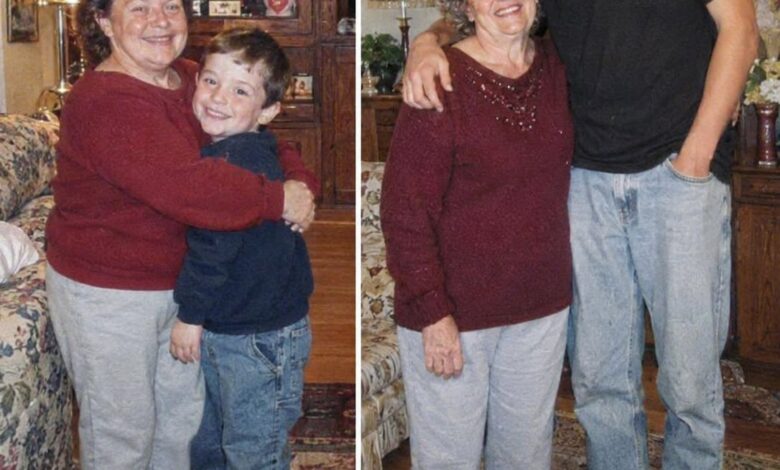
My name is Elvira Montoya. I was seventy years old, and I had spent most of my life in Alamosa, Colorado. I had worked as an elementary schoolteacher for thirty-four years. My husband had passed away when our daughter Lucía was still young, so she and I had always been especially close.
Lucía eventually married Andrés, a hardworking mechanic. They had two wonderful boys, Tomás and Mateo. Tomás was eight, while Mateo was only five.
Every Christmas, they visited my home. Those visits were among the happiest moments of my life. The house filled with laughter, children’s toys, homemade food, and conversations that continued long after dinner.
I especially loved preparing traditional cookies using my mother’s recipe. Tomás always asked for more, while Mateo preferred sitting beside me and telling stories about his school adventures.
During one Christmas visit, I knitted two pairs of red mittens for the boys. Mateo loved his so much that he wore them everywhere.
A few days later, the family prepared to return home.
The weather was changing quickly. Snow was falling, and the forecast warned that conditions could become difficult along the mountain roads.
I asked Lucía to stay another night.
“Please, mija. You can leave tomorrow morning,” I told her.
She smiled and hugged me.
“Don’t worry, Mamá. Andrés will drive carefully. We’ll be home before it gets too late.”
I watched their silver minivan disappear down the snowy road. Mateo waved his little red mittens through the window, while Tomás pressed his face against the glass.
I waved until I could no longer see them.
That was the last ordinary goodbye I ever received from my daughter.
Hours passed, but Lucía never called to tell me they had arrived. I tried reaching her several times, but there was no answer.
Late that evening, my telephone rang.
A deputy from the local sheriff’s office explained that the family had been involved in a serious road accident near La Veta Pass.
The vehicle had reportedly lost control on an icy curve and gone down an embankment.
Lucía, Andrés, and Tomás had not survived.
Mateo was alive and receiving treatment at a hospital in Walsenburg.
I remember very little about the journey to the hospital. A neighbor drove me through the snow while I sat silently in the passenger seat, praying that the news about Mateo would be better than everything else I had heard.
When I finally reached his room, I saw a little boy surrounded by medical equipment.
He had suffered several injuries, including broken ribs and a serious lung injury. The doctors explained that he had also experienced a significant concussion.
They were doing everything possible to help him recover.
I sat beside his bed and held his hand.
He was all I had left of my daughter.
The following weeks were difficult. I arranged the funeral, brought Mateo home, and began the enormous task of raising a young child while still trying to understand my own grief.
The doctors explained that his memories of the accident might remain incomplete. They advised me not to pressure him with questions.
I followed their advice.
However, one night, shortly after the funeral, Mateo woke up frightened.
“Grandma,” he whispered, “the man walked away.”
I sat beside him.
“What man, sweetheart?”
“The man with the light. He came down the hill. He looked inside the car, and then he walked away.”
I held him close and told him that he had experienced a frightening dream. I believed his injured mind was trying to make sense of the accident.
He eventually fell asleep.
I never questioned him about it again.
Years passed. I raised Mateo, helped him through school, attended his sporting events, and celebrated every birthday.
He grew into a thoughtful young man. He studied criminal justice at university and eventually found employment with a private investigation company.
He enjoyed examining documents, understanding complicated situations, and discovering details that others sometimes overlooked.
I was proud of him.
Yet every winter, when snow covered the mountains, I remembered the terrible night that had changed our family forever.
As the twentieth anniversary approached, Mateo began asking unusual questions.
One evening, while we were eating dinner, he asked when his parents had left my house.
Another night, he wanted to know whether the sheriff’s office had ever contacted me again after the accident.
I answered as honestly as I could.
I assumed he was simply trying to understand more about his childhood.
Then one snowy afternoon, everything changed.
Mateo came home holding a folded letter.
“Grandma, please read this,” he said.
The letter was written by a retired deputy named Thomas Hargis, who had been among the first officers at the accident scene.
According to the letter, he had noticed something unusual that night.
There were two sets of tire tracks near the accident location. One belonged to my family’s minivan. The other appeared to belong to a pickup truck.
He also described damage to the minivan’s side mirror, including traces of red paint.
Most importantly, he had discovered footprints leading down the embankment toward the overturned vehicle and then returning to the road.
The deputy believed another vehicle had been involved.
He claimed that he had documented these findings in his original report. However, his supervisor later instructed him to change the report and describe the incident as a weather-related accident.
The letter explained that the original report and several photographs had been preserved in a bank’s safe deposit box.
Mateo looked at me.
“I think someone was involved, Grandma.”
I could barely speak.
For twenty years, I had believed the snow was responsible. Now, my grandson was telling me that another person might have played a role.
Mateo explained that he had recently contacted the retired deputy. After several conversations, the elderly man had decided to share the documents he had kept for years.
The next morning, we traveled to Walsenburg.
Inside the safe deposit box, we found an old folder and a collection of photographs.
The original report was much longer than the official version I had been given. It described the second vehicle, the damaged mirror, and the footprints leading toward the wreck.
The photographs supported several details recorded by the deputy.
Mateo studied every page carefully.
Then he discovered the name connected to the second vehicle.
Kyle Brandt.
At the time of the accident, Kyle was a young man whose father worked in local law enforcement. According to the retired deputy’s letter, Kyle had been driving a red pickup truck in the area that evening.
Mateo and I decided to consult an experienced attorney before taking any further steps.
The attorney examined the documents and explained that the passage of time could create serious legal obstacles. Some potential charges and civil claims might no longer be available, depending on the applicable laws and circumstances.
However, he also explained that preserving the evidence and seeking an official review could still be meaningful.
Mateo was determined to find out what had happened.
Eventually, he arranged a meeting with Kyle Brandt.
We visited the dealership where Kyle worked. Mateo introduced himself and explained that he was the child who had survived the accident on the mountain road.
When Kyle heard his name, his expression changed.
He agreed to meet us privately.
Mateo placed the original report and photographs on the desk.
For several minutes, Kyle studied them without speaking.
Finally, he admitted that he had been driving his father’s red pickup that evening.
He explained that he had attended a gathering and had been drinking. While driving through the snowy mountain road, he had lost control of his vehicle and entered the opposite lane.
He remembered seeing the minivan approaching.
He remembered hearing an impact.
He also remembered stopping his truck and walking down the embankment with a flashlight.
His account matched several details in the old photographs.
He said he had seen the damaged minivan and realized that the situation was extremely serious.
He also remembered seeing Mateo inside the vehicle.
Instead of immediately calling emergency services, he panicked and returned to his truck.
He drove away and contacted his father…………………..CONTINUED ON NEXT PAGE