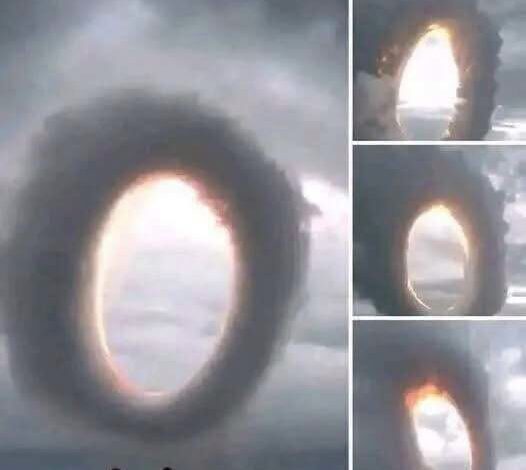
Scientists Stunned as Glowing Portal Rips Through the Sky: Is It an Atmospheric Anomaly or Something Else?
The world stopped spinning for a brief, breathless moment when a jagged, luminous hole suddenly tore through the clouds, bathing the landscape in an eerie, otherworldly glow. Witnessed by thousands and captured in hundreds of frantic, shaky cell phone videos, the sight left onlookers paralyzed with fear. Social media erupted within seconds, with conspiracy theorists screaming about government experiments, dimensional rifts, and signs of the end times. For a few terrifying minutes, the boundary between reality and science fiction seemed to evaporate, leaving humanity to gaze upward at a celestial mystery that defied all conventional explanation and logic.
The sheer scale of the phenomenon was breathtaking. As the light hit the edges of the circular void, it created a prismatic shimmer that looked less like weather and more like a gateway into the unknown. It was as if the sky itself had been punctured by an invisible spear, revealing a hidden, radiant depth that no cloud formation should possess. The internet buzzed with frantic speculation—was it a localized gravitational distortion? An extraterrestrial signature? Or perhaps the byproduct of an experimental weapon test kept hidden from the public eye? Every witness described a feeling of profound insignificance, a sense that we were staring directly into a process that was never intended for human eyes.
However, behind the veil of sensationalism and widespread alarm, meteorologists and atmospheric scientists were working overtime to calm the public frenzy. While the average person looked up and saw a “portal,” the scientific community looked up and saw a classic, albeit rare, atmospheric masterpiece known as a fallstreak hole, or more colloquially, a “hole-punch cloud.” The reality of the phenomenon is perhaps even more fascinating than the myths, as it highlights the volatile, delicate balance of the environment we live in—a world where the laws of physics can produce visuals that look like pure magic to the untrained eye.
To understand the spectacle, one must look at what happens in the mid-level layers of our atmosphere. These regions are often populated by clouds consisting of supercooled water droplets—pockets of moisture that remain liquid even at temperatures far below the freezing point. Under normal circumstances, these droplets are in a state of suspended instability. They are waiting for a catalyst, a tiny, singular disturbance to push them past their threshold of liquid resistance. When that catalyst arrives, the transformation is nothing short of explosive. The droplets don’t just freeze; they undergo a rapid, chain-reaction phase change into ice crystals.
This is where the “hole” begins to take shape. As these droplets crystallize and gain mass, they become heavier than the surrounding liquid. Consequently, they begin to fall out of the cloud deck, creating a distinct, circular or elliptical void that expands with surprising speed. As the ice crystals descend through the drier air beneath the cloud layer, they often evaporate before they even hit the ground, leaving behind a pristine, clear ring in the sky. The brilliant, glowing effect that caught the world’s attention is merely the result of sunlight refracting through the ice crystals and the high-altitude moisture lingering around the edges of the gap.
Interestingly, human activity often plays a direct, unintentional role in these dramatic displays. High-altitude aircraft passing through these supercooled layers can inadvertently act as the “disturber” required to trigger the chain reaction. As a plane cuts through the cloud, the changes in air pressure and the vibrations around its wings or propellers can initiate the freezing process, effectively carving a giant hole through the overcast sky like a celestial razor. This explains why these formations often appear perfectly symmetrical, a level of geometric precision that usually fuels the most intense, illogical debates among those who believe in supernatural origins.
What makes these events so captivating is not just the science, but the way they force us to stop and look at the sky with genuine wonder. We spend so much of our lives tethered to screens, focused on our immediate surroundings, that we often forget the complex, fluid machinery of the planet above our heads. A fallstreak hole is a reminder that Earth is a dynamic, living system governed by forces that can produce art on a global scale. It is a moment where the mundane reality of meteorology collides with the human need for mystery.
Despite the initial terror and the waves of wild theories that accompany such a sight, there is a profound comfort in the scientific explanation. It suggests that our world is still capable of surprising us, of producing moments of absolute, inexplicable beauty that are entirely natural. When we see a “portal” open in the clouds, we aren’t seeing an omen or a threat; we are seeing the raw, unscripted power of a planet that is constantly in motion, constantly changing, and consistently capable of turning the atmosphere into a stage.
The next time a bizarre, circular void appears overhead, there is no need to fear the end of the world or hidden government agendas. Instead, we can appreciate the rarity of the event for what it is: a fleeting, fragile masterpiece of thermodynamics. It is nature’s way of breaking the monotony, a quiet, spectacular reminder that even in a world governed by science and data, there is always room for the miraculous. The sky remains the ultimate theater, and once in a while, it decides to put on a performance that keeps the entire world looking up in awe, waiting to see what might happen next in the ever-shifting canvas of our atmosphere.